
Interview
Square Interview Questions and Process: The Complete Guide (2026)
Prepare for Square software engineering interviews with a practical round guide, five mapped DSA questions, an honest process overview, and a 30-day plan.
Square interview questions are best approached as a modern software engineering loop: expect an initial screen, a technical coding conversation, further technical or design discussion, and a behavioural conversation about how you work. Public candidate accounts for Square are thin and vary by team, so confirm the exact format with your recruiter. The most reliable preparation is to build strong pattern recognition, explain your decisions clearly, and rehearse under realistic conditions. Square's interview kit holds five mapped DSA questions to help focus that preparation.
This guide separates what is generally transferable from what cannot be responsibly claimed without a clearer company-specific report. You will find a practical round guide, an honest view of difficulty and timing uncertainty, a 30-day plan, and a way to prepare without depending on rumours about a particular team.
The process at a glance
Because current public reporting does not establish a dependable fixed sequence for Square, treat this table as a preparation map rather than a promised interview itinerary. A recruiter can tell you which stages apply to your role and level.
| Stage | Common format | What it may screen for | Best preparation |
|---|---|---|---|
| Initial screen | Recruiter or hiring conversation | Role fit, motivation, experience | Clear project narrative and role questions |
| Technical screen | Live coding or shared-editor discussion | Problem solving, communication, complexity | Pattern recognition and thinking aloud |
| Technical loop | Coding, design, or project discussion | Engineering judgement and depth | Structured reasoning and trade-offs |
| Behavioural discussion | Hiring manager or team conversation | Ownership, collaboration, judgement | Specific stories from your own work |
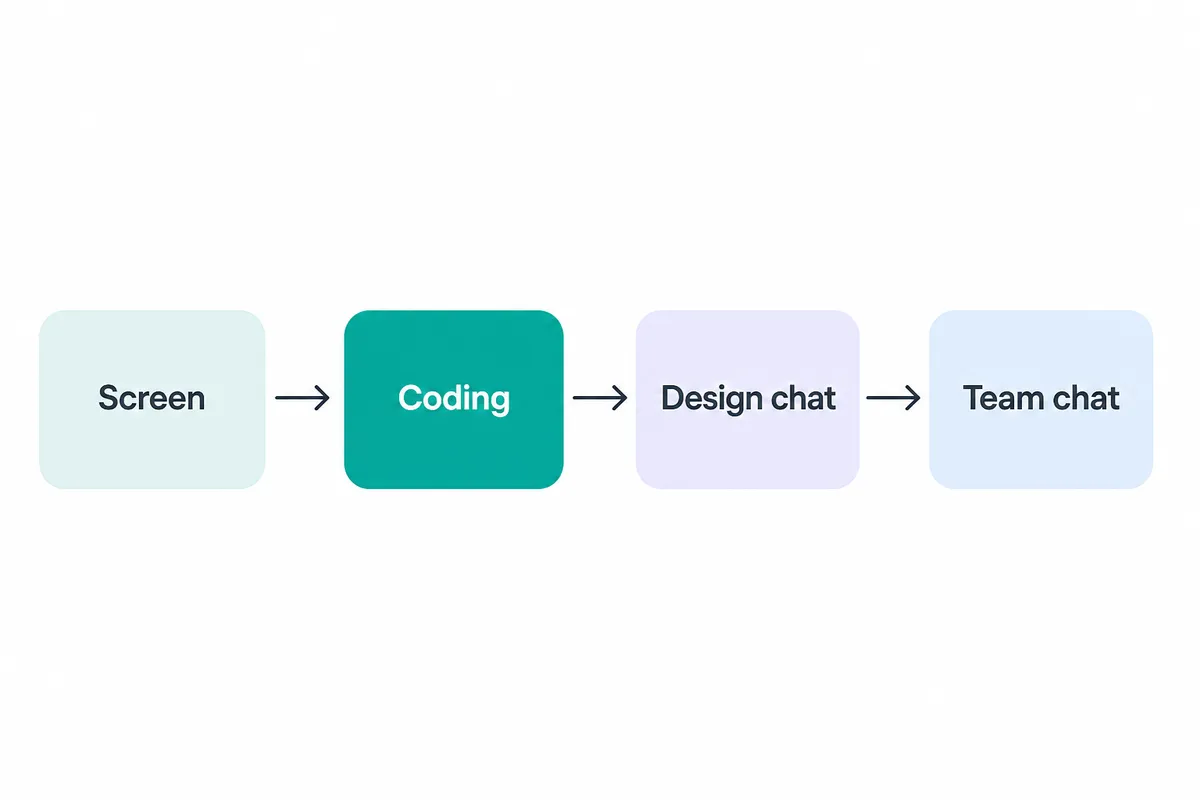
The useful point is not to memorise an assumed sequence. It is to prepare for the evidence an interviewer can actually assess: how you break down an unfamiliar problem, whether your code is correct and maintainable, how you discuss trade-offs, and whether your examples show personal ownership.
The initial screen — clarity before technical depth
An early conversation often decides whether the rest of the process makes sense for both sides. It is not usually a deep algorithms test, but it is still an evaluation. You may be asked to summarise your current work, explain why you are considering a move, describe the kind of engineering problems you want to own, and talk through a project on your CV.
The strongest answers are specific without becoming overlong. Instead of saying, “I improved performance,” explain the constraint, your role, the decision you made, and the outcome. Instead of claiming that your team delivered a feature, identify what you personally owned: an API contract, a data migration, an operational decision, a technical proposal, or a difficult trade-off.
Prepare a concise version of your story before the call:
- What kind of engineer are you today?
- Which recent project best demonstrates that?
- What did you personally decide or deliver?
- What would you improve if you revisited it?
- What are you looking for in your next role?
This is also the right moment to ask your recruiter about the interview format. Ask whether there will be live coding, whether a design conversation is expected, what language choices are supported, and whether the process differs for your level. Those answers are more useful than trying to infer a universal Square loop from old posts.
The technical coding round — show your reasoning
A live coding round normally screens more than whether you eventually reach a working answer. Interviewers can observe how you react when the first approach is too slow, when a requirement is ambiguous, or when an edge case undermines an otherwise neat solution.
A reliable structure is:
- Restate the problem in your own words.
- Ask about inputs, constraints and expected behaviour.
- Describe a straightforward approach before jumping to the best one.
- State the time and space complexity of your intended solution.
- Write in small pieces and test as you go.
- Walk through edge cases before declaring the work complete.
This makes your judgement visible. It also protects you from the most avoidable failure: silently writing a solution based on an assumption the interviewer did not share.
The DSA Patterns Sheet is free to browse and is useful for rebuilding recognition speed across common coding shapes. Do not study it as a list to memorise. Study the signals that identify a pattern: a sorted input may suggest binary search; a contiguous range may suggest a sliding window; repeated lookup may suggest hashing; a dependency structure may suggest graph traversal.
For a deeper method, read how to identify the right DSA pattern in a coding interview. Once you know the likely pattern, practise explaining why it fits before you code. That explanation is often the difference between a correct answer and a convincing interview performance.
💡 Pro Tip: Narrate your uncertainty as well as your certainty. “I am considering a hash map because we need fast lookup, but I want to check whether order matters” is much stronger than going silent while you decide.
The technical depth or design discussion — make trade-offs explicit
Public reporting does not provide a reliable Square-specific design-round format. Still, many engineering processes include some form of deeper technical conversation, particularly where the role calls for system ownership, architecture decisions, or substantial work on existing services.
In this kind of discussion, interviewers are less interested in a perfect diagram than in the quality of your reasoning. They may look for whether you can:
- establish requirements before proposing a solution;
- identify the most important constraints;
- separate core functionality from later improvements;
- discuss data flow, failure cases and operational concerns;
- choose trade-offs deliberately rather than by habit; and
- communicate clearly when the problem is underspecified.
For a lower-level design conversation, start with the smallest viable model. Name the key entities, define their responsibilities, then introduce interfaces only where behaviour truly varies. Avoid adding patterns merely because you recognise them. A simpler design with well-placed responsibilities is easier to defend than a complicated hierarchy with no clear reason to exist.
For broader system design, begin by clarifying scale and reliability expectations. Then work from the main request path outward: clients, services, storage, asynchronous processing, observability, and failure handling. You do not need to mention every component at once. Prioritise the decisions that change the design.
The Low Level Design Sheet and System Design Sheet are free to browse if you want structured practice across both styles. If you are unsure where one stops and the other begins, low-level design vs high-level design explains the distinction clearly.
The behavioural or hiring conversation — prove ownership
A behavioural conversation is not an informal finish line. It gives a hiring manager or prospective team an opportunity to test how you make decisions with other people involved.
Prepare examples that show more than a positive outcome. Strong stories include tension: a disagreement, an incident, a missed expectation, a difficult prioritisation call, an ambiguous requirement, or a technical decision you later changed your mind about.
Use a simple structure:
- Situation: What was happening and why did it matter?
- Task: What responsibility did you personally have?
- Action: What did you decide, communicate or build?
- Result: What changed, and what did you learn?
Be careful with “we”. Team success matters, but vague collective language makes it difficult for an interviewer to identify your contribution. Say what the team did, then specify your role within it.
You can rehearse project depth, disagreement and ownership stories with an AI mock interview. Practising aloud is important: a story that feels coherent in your head often needs editing once you have to explain it under pressure.
Named Square rituals: what is actually known
No current, usable source in the available research establishes a named Square interview ritual, a standard platform, a fixed round count, or a company-wide time limit. That means it would be misleading to present one as fact.
This uncertainty is itself useful preparation information. Different teams can assess similar engineering skills through different formats. One team may lean harder on coding fluency, another on project depth, and another on design reasoning. Rather than preparing for a rumoured ritual, prepare a repeatable process for each core skill and ask your recruiter what the relevant team uses.
That approach is more robust than overfitting to a candidate report from a different level, location, or hiring cycle.
Is the Square interview hard?
It can be hard, but not because a fixed public process is known to be unusually long or unusually specialised. The challenge is the normal one for software engineering interviews: you need to demonstrate technical competence while communicating your judgement in real time.
How many rounds are there? There is no dependable sourced company-wide count available for Square. Reported accounts are too thin to give a precise number responsibly, and the shape may vary by role and team. Ask your recruiter for the current sequence.
How long does the process take? A reliable Square-specific end-to-end timeline is not established in the available research. Scheduling, team needs and role seniority can all change the pace, so treat any unsourced timeline as speculation.
The practical difficulty is usually uneven:
- Coding rewards pattern recognition, complexity reasoning and careful testing.
- Design rewards prioritisation and explicit trade-offs.
- Behavioural discussion rewards specific ownership rather than polished generalities.
- Every stage rewards clear communication.
Candidates often spend all their preparation time collecting problems. That helps only up to a point. The more durable advantage is being able to explain a solution, revise it after a prompt, and identify the limitation in your own first answer.
A 30-day preparation plan
Days 1–7 — rebuild coding fundamentals
Start with the patterns that appear across technical interviews: arrays, strings, hash maps, two pointers, sliding window, trees, graphs and binary search. Work in short focused sessions. For each problem, say the brute-force approach aloud first, then explain why the improved approach works.
Use Square's interview kit for the five mapped DSA questions and compare your solution against the editorial only after you have committed to an approach. The aim is not answer recall; it is recognition and explanation.
If graph problems feel slow, the guide to graph traversal patterns with DFS and BFS is a useful focused review.
Days 8–14 — practise live-round communication
Move from solving privately to explaining every decision. Use a timer, write code in an editor without autocomplete dependence, and test inputs manually.
After each session, review three things:
- Did you clarify the problem before coding?
- Did you state complexity before implementation?
- Did you test the cases most likely to break the solution?
The Code Practice workspace can help you practise in-browser with feedback. Combine that with the advice in what interviewers actually look for in live coding rounds.
Days 15–21 — add design and project depth
Spend part of each session on a design prompt. Choose a modest problem, establish requirements, and explain the first version before adding scale or flexibility. The goal is disciplined scope control.
In parallel, choose two work projects and outline them using situation, task, action and result. Include one success story and one story where something went wrong. Prepare to explain the technical details without turning either story into a monologue.
Days 22–30 — simulate the real experience
Run full practice sessions: one coding round, one design discussion, and one behavioural mock. Keep notes on recurring weaknesses rather than restarting your entire study plan after a poor session.
Use AI mock interviews to practise responding aloud, especially if you do not have a partner who can challenge your assumptions. In the final days, prioritise sleep, concise revision and confidence in your process over cramming unfamiliar topics.
What is specific about preparing for Square?
The Square-specific reality is not a documented signature round. It is the need to avoid pretending that an uncertain format is certain.
That changes how you should prepare. Do not build your entire plan around a claimed platform, a supposed time limit, or an invented ritual. Build a portable interview method: clarify, structure, implement, test, explain, and reflect. That method transfers whether your loop emphasises coding, design, project discussion, or a mix of all three.
The company-focused resource that is available is Square's interview kit, which brings together five mapped DSA questions. Use it as a focused starting point, then broaden your practice through the free sheets and realistic mock conversations.
Frequently asked questions
What are the most common Square interview questions?
Current public research does not establish a dependable company-wide question list. Prepare for transferable coding, design and project-depth questions, then confirm the format with your recruiter.
Does Square ask DSA questions?
Technical coding interviews commonly assess data structures, algorithms, complexity and edge-case handling. Square's interview kit contains five mapped DSA questions for focused practice.
How many interview rounds does Square have?
A reliable fixed count is not available in current sourced reporting. The process can vary by team and role, so ask your recruiter for the active interview plan.
How long does the Square interview process take?
There is no dependable Square-specific timeline in the available research. Ask about expected scheduling when you speak with the recruiter.
Is the Square coding interview difficult?
Expect the usual challenge of solving and explaining a problem under observation. Clear reasoning, testing and complexity awareness matter alongside the final code.
Should I prepare system design for Square?
Prepare design fundamentals if your role involves experienced-level engineering, ownership or architecture. Your recruiter can confirm whether a design discussion is part of your loop.
What should I say during a live coding interview?
Clarify requirements, describe your approach, state complexity, narrate key implementation choices, and test edge cases aloud.
How should I prepare for the behavioural interview?
Prepare specific stories about ownership, conflict, setbacks, technical judgement and collaboration. Focus on what you personally did and learned.
What language should I use in a coding interview?
Use the language in which you can write clear, correct code quickly. Confirm supported languages with your recruiter before the interview.
Where to start
Start with the technical habits that transfer across teams: recognise common problem patterns, explain your reasoning before you code, and practise discussing trade-offs without overcomplicating the design.
Open Square's interview kit to work through the five mapped DSA questions, then use the free DSA Patterns Sheet and an AI mock interview to rehearse the skills a static question list cannot measure.
Finally, confirm the exact Square process with your recruiter. When public reports are thin, direct information about your team and role is the best preparation advantage available.
Topics
Related on Thita
Your next step
Practise with AI mock interviews
A spoken interview that asks follow-up questions, runs your code and ends with a written report.