
Interview
Swiggy Interview Questions and Process: The Complete Guide (2026)
A full breakdown of Swiggy's SDE interview process — every round, what each one screens for, difficulty, timelines, and a 30-day preparation plan that works.
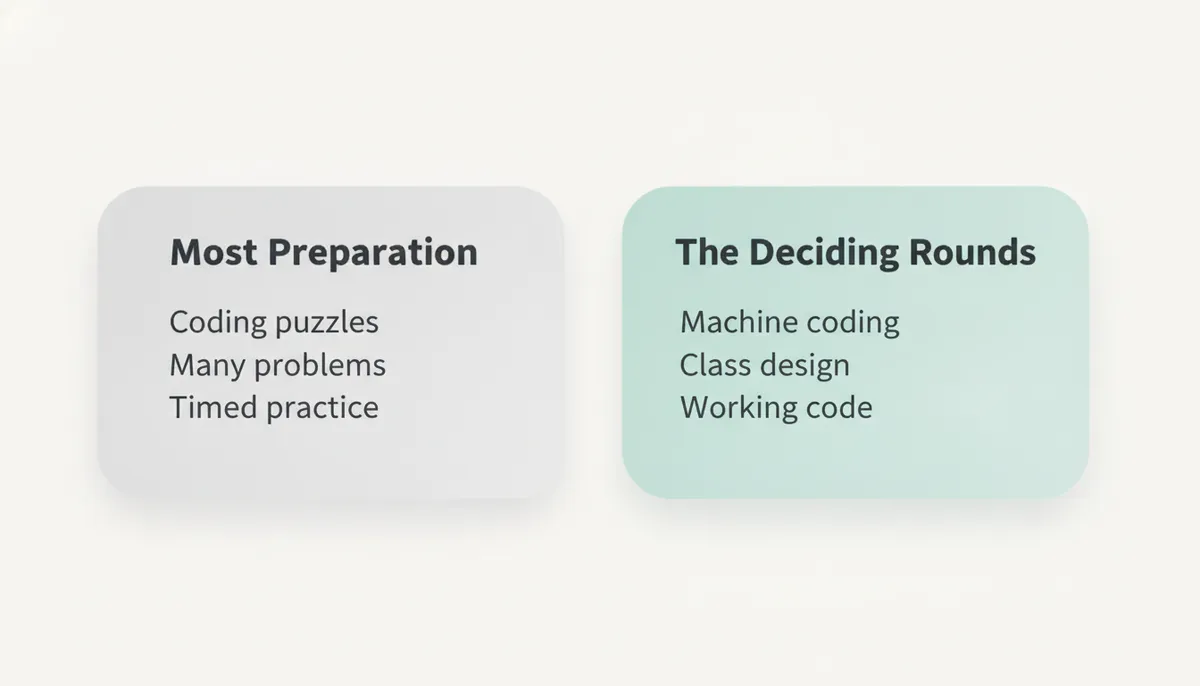
Swiggy's software engineering loop runs five stages, and the two that decide it are not the ones most candidates prepare hardest for. The algorithmic rounds filter volume; the design rounds pick the hire. Candidates who solve the coding problems cleanly are still turned down at the machine coding and low-level design stages, which is the single most consistent pattern in reported Swiggy experiences.
This guide walks the whole process — every round, what each screens for, how hard it actually is, and how to prepare in the time you have. To practise against the design problems evidenced at Swiggy, Swiggy's interview kit holds nine low-level design problems attributed to the company, each with a worked editorial and an AI-evaluated practice mode.
The process at a glance
| # | Round | Format | What it screens |
|---|---|---|---|
| 1 | Online assessment | ~3 medium algorithmic problems, timed | Baseline coding ability |
| 2 | Data structures & algorithms | Live coding with an engineer | Problem solving, complexity reasoning |
| 3 | Machine coding | 60–120 min, build a working system | Design under time pressure, code quality |
| 4 | Low-level design | Discussion-led class and interaction design | Abstraction, extensibility, trade-offs |
| 5 | Engineering manager | Behavioural and project depth | Ownership, collaboration, level fit |
Exact round counts vary by level, team and whether you came through a referral or a campus channel. Treat the sequence as the shape rather than a fixed script, and confirm specifics with your recruiter.
Round 1 — the online assessment
A timed set of roughly three algorithmic problems at medium difficulty. This round exists to reduce volume, not to find your ceiling, so the bar is competence rather than brilliance: solve the problems correctly, within the time, with reasonable complexity.
The material is standard interview algorithms — arrays and strings, hash maps, two pointers, sliding windows, sorting, basic trees and graphs. What separates people who clear it is not exotic knowledge but recognition speed: seeing within thirty seconds which shape of problem you are looking at.
That recognition is trainable, and it is what pattern-based preparation is for. The DSA Patterns Sheet is free to browse and organises problems by the pattern each one actually tests, rather than by topic label. If you want the reasoning behind that approach, how to identify the right DSA pattern in a coding interview is a good starting point.
💡 Pro Tip: Practise with a timer from the beginning. The failure mode in this round is almost never "could not solve it" — it is "solved it with four minutes left and no time to check edge cases".
Round 2 — data structures and algorithms
A live round with an engineer, usually one or two problems with discussion. The difficulty steps up from the assessment, but the real change is that how you work is now being marked as much as what you produce.
Interviewers are watching for whether you clarify the problem before coding, whether you state your approach and its complexity before writing, whether you notice your own edge cases, and whether you can be nudged without being carried. Silence is the most common self-inflicted wound: reasoning the interviewer cannot hear cannot be credited. Our guide to what interviewers actually look for in live coding rounds covers the mechanics.
✅ Do: State your approach and its complexity out loud before you type. ❌ Don't: Start coding the first idea that arrives, then rewrite it silently.
Rounds 3 and 4 — where the loop is decided
These two rounds are the substance of a Swiggy loop, and they examine the same underlying skill in two different formats.
Machine coding gives you a short, deliberately under-specified problem and 60 to 120 minutes to produce running code. No database, no framework, in-memory state, your choice of language, and a driver or test harness demonstrating the flows. The incompleteness of the spec is part of the test — it checks whether you ask or whether you quietly build the wrong thing.
Low-level design covers similar ground through discussion: entities and their relationships, where behaviour varies and therefore where an interface belongs, how the design absorbs the next requirement. There is usually less code and more argument.
What gets marked, roughly in order of weight: it works; responsibilities sit in sensible places; the design extends cleanly against the obvious next requirement; abstractions are used where behaviour genuinely varies; the code reads well; and something demonstrates it running.
We have a dedicated walkthrough of the format, the rubric and the failure modes in Swiggy's machine coding round: format, timing and what gets marked.
⚠️ Important: The most common way to fail this round is to arrive at the end with nothing running. Build the smallest working version of the core flow first, then improve its structure.
Round 5 — the engineering manager round
A genuine evaluation, not a formality, and it does two jobs: checking that you work well with people, and confirming the level you are being hired at.
Expect depth on your own projects. Not the summary you put on a résumé — the specifics. What did you own rather than contribute to? What broke, and what did you do about it? What would you build differently now? Vague ownership is the thing that reads badly here; a candidate who says "we migrated the service" and cannot say what they personally decided tends to get levelled down.
Prepare two or three projects you can discuss for ten minutes each without notes. Practising this out loud matters more than people expect — behavioural mock interviews are a reasonable way to rehearse if you have nobody to practise with.
Is the Swiggy interview hard?
Moderately, and unevenly.
The algorithmic rounds are a fair notch below the hardest FAANG loops — medium difficulty, standard patterns, no trick questions in most reports. If you have prepared systematically you will likely clear them.
The design rounds are where the difficulty concentrates, and their difficulty is of a kind most candidates have not trained for. Producing clean, working, extensible code from an empty file in ninety minutes is a distinct skill from solving algorithmic puzzles, and months of the latter build very little of the former. That asymmetry, rather than raw difficulty, is what makes Swiggy's loop catch people.
How many rounds? Typically four to five technical and managerial stages after the assessment, though this varies by level.
How long does it take? Reported timelines commonly run two to four weeks end to end, with variation by team and hiring urgency.
A 30-day preparation plan
Week 1 — algorithmic foundations. Work through the core patterns rather than a problem list: two pointers, sliding window, hashing, binary search, trees, graphs. Aim for recognition speed, not volume. Short daily sessions of in-browser code practice with AI feedback work better here than long weekend marathons.
Week 2 — design vocabulary. Object-oriented design patterns and the class-design idioms these rounds assume. Implement two design problems end to end with no time limit, focusing entirely on structure. Read the editorials afterwards and compare them against your own decisions — that comparison is where most of the learning is. Design patterns for interviews covers the ground you need, and the Low Level Design Sheet is free to browse.
Week 3 — design under the clock. Switch to a 90-minute timer. One problem per session, running code by the end, no exceptions. Alternate familiar and unfamiliar problems. The nine low-level design problems evidenced at Swiggy are the most directly relevant set to work through.
Week 4 — integration and rehearsal. Keep algorithmic practice ticking over so it stays sharp. Do two or three full mock rounds — one algorithmic, one machine coding, one behavioural. Write out your project stories and say them aloud.
💡 Pro Tip: Practise design rounds without an AI assistant. The round is timed and unassisted, and practice that ignores either constraint builds confidence that will not survive the real thing.
What gets candidates rejected
Reported rejections cluster around a small number of causes, and only one of them is "could not solve the problem".
Nothing running at the end of the machine coding round. The most common single cause. Candidates spend the first half hour designing an elegant hierarchy, then run out of time before any of it executes. A working system with an average design passes; a beautiful design that does not run does not.
Designing without asking. The problem statement is deliberately incomplete. Candidates who fill the gaps silently, with their own assumptions, frequently build something adjacent to what was wanted — and there is no credit for solving a different problem well.
Abstraction without judgement. Interfaces and factories everywhere, applied because they are patterns rather than because anything varies. This reads worse than a plain design, because it suggests you cannot tell when a pattern earns its place.
Working in silence. In both the algorithmic and design rounds, the interviewer is marking your reasoning. If they cannot hear it, they cannot credit it — and a candidate who arrives at a good answer wordlessly scores below one who thinks aloud toward a slightly worse one.
Ownership that dissolves under questioning. In the manager round, "we decided" invites "what did you decide?". Candidates who cannot answer that tend to be levelled down rather than rejected outright, which is its own kind of bad outcome.
Notice that four of the five are about process rather than knowledge. That is the useful thing to take from it: the marginal hour is usually better spent rehearsing how you work than learning one more pattern.
Frequently asked questions
How many rounds does Swiggy have for SDE roles? Typically an online assessment followed by four stages: a data structures round, machine coding, low-level design, and an engineering manager round. Counts vary by level and team.
Which round matters most? The design rounds. Reported experiences consistently describe machine coding and low-level design as the decisive stage, with strong algorithmic performers still being turned down there.
Does Swiggy ask data structures and algorithms questions? Yes — both in the online assessment and in a dedicated live round. Pattern-based preparation is the efficient route through them.
What is the difficulty level of the coding rounds? Medium, in the main. Standard interview patterns rather than competitive-programming difficulty.
How long is the machine coding round? Reported durations run 60 to 120 minutes, with 90 minutes common. Confirm with your recruiter.
Do I need system design for an SDE-1 role? Class-level design, yes — that is what machine coding and LLD examine. Architecture-level design becomes more prominent at senior levels. Low-level design vs high-level design explains the distinction.
What language should I use? Whichever you are most fluent in. Java, Python, C++, Go and JavaScript are all commonly used; fluency beats the choice.
How long does the process take end to end? Commonly two to four weeks, varying by team and hiring urgency.
Where to start
If you have a Swiggy loop coming up, the highest-leverage thing you can do is practise the design rounds under real constraints — timed, unassisted, running code by the end. That is the stage that decides the outcome and the one almost nobody rehearses.
Open Swiggy's interview kit for the nine low-level design problems evidenced at Swiggy, each with an editorial and AI-evaluated practice. Read the machine coding round deep dive for the format and rubric in detail, and use an AI mock interview to rehearse the discussion rounds.
Interview processes change. Confirm round structure and timings with your recruiter, and check Swiggy's careers site for current openings.
Topics
Related on Thita
Your next step
Practise with AI mock interviews
A spoken interview that asks follow-up questions, runs your code and ends with a written report.