
Interview
Two Sigma Interview Questions and Process: The Complete Guide (2026)
A practical guide to Two Sigma interview questions, the hard DSA-focused assessment, phone screen, onsite preparation, and a focused 30-day plan.
Two Sigma interview questions are commonly reported to have a high algorithmic bar from the first stage: a HackerRank online test with hard problems, followed by a live coding phone screen and an onsite loop. The most useful preparation is not broad problem collecting. It is practising graphs, dynamic programming, sliding window and complexity reasoning until you can explain a correct solution under pressure. Two Sigma's interview kit holds six mapped DSA questions for focused company-tagged practice.
Reported accounts are thin compared with the documentation available for larger consumer technology companies, and details can vary by team and level. Treat the process below as a practical shape rather than a fixed hiring policy, then confirm your own format with the recruiter.
The process at a glance
| Stage | Reported format | What it screens for | How to prepare |
|---|---|---|---|
| Online assessment | HackerRank test with hard coding problems | Speed, algorithm selection, correctness | Timed graph, DP and array practice |
| Phone screen | Live CoderPad coding plus rapid CS fundamentals | Communication, implementation and foundations | Narrate decisions and revise core concepts |
| Onsite | Technical interviews after earlier screens | Depth, judgement and team fit | Rehearse coding, technical discussion and project stories |
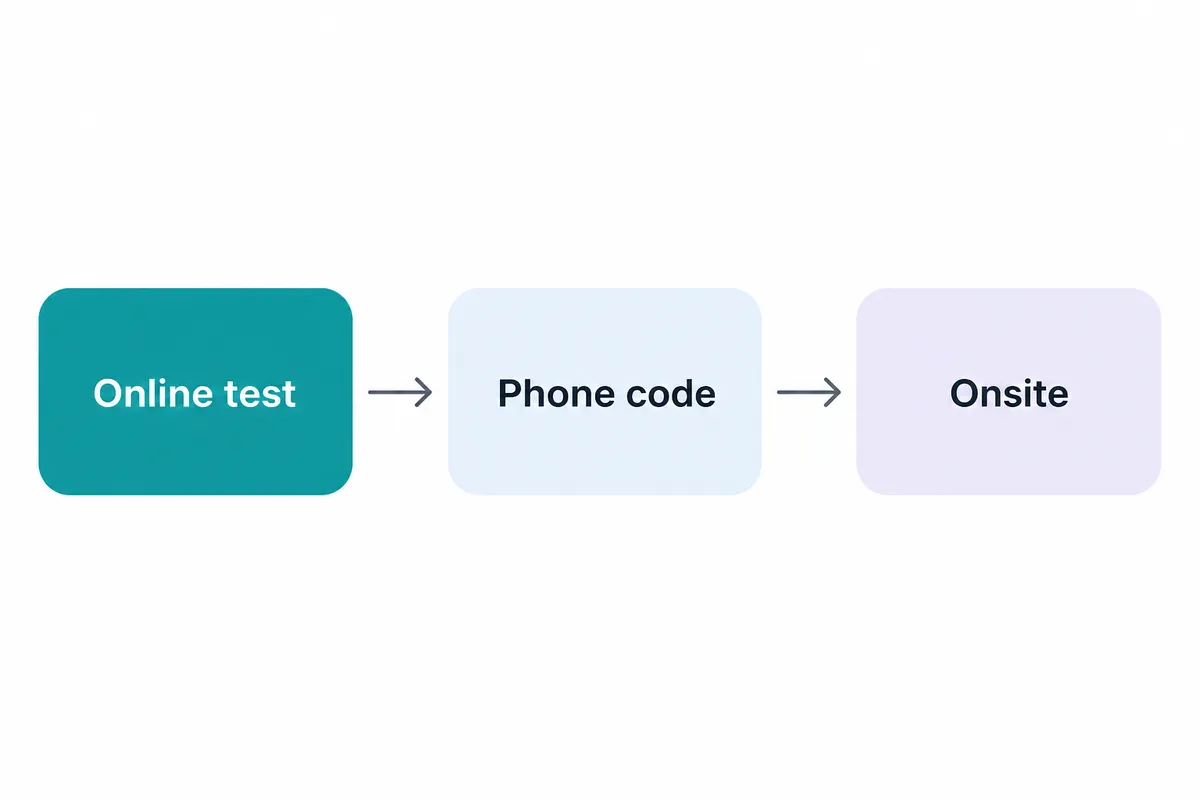
The reported sequence is an online test, a phone screen and an onsite. The research does not establish a reliable fixed number of onsite interviews, a universal time limit for the full loop, or a single format across teams. That uncertainty matters: prepare for the skills that recur, but ask for the actual agenda once your process is scheduled.
Stage 1 — online assessment
Candidate reports describe a HackerRank assessment lasting roughly an hour to an hour and a half, with two or three hard problems. That is a notably demanding opening screen. It is not simply checking whether you know basic arrays and hash maps; it is designed to distinguish candidates who can identify an efficient approach quickly and implement it without repeated resets.
The commonly reported emphasis is on graphs, including BFS, DFS and Dijkstra-style shortest-path thinking; dynamic programming; and sliding-window reasoning. These categories matter less as labels than as cues. When a problem describes state transitions, constrained choices or best outcomes over subproblems, you need to recognise DP early. When it describes relationships, routes, dependencies or reachability, you need to test whether a graph model is the right abstraction.
The assessment screens for four things:
- Pattern recognition: can you identify the problem family before spending too long on an unsuitable approach?
- Complexity judgement: can you reject a brute-force solution when input constraints make it unworkable?
- Implementation discipline: can you turn the right idea into correct code with limited debugging time?
- Edge-case coverage: can you test boundaries, empty inputs, repeated values and unusual graph shapes before submission?
The DSA Patterns Sheet is free to browse and is useful here because it groups practice by the reasoning pattern behind the problem. For graph work, review graph traversal patterns with DFS and BFS. For state-based problems, use this guide to dynamic programming patterns.
💡 Pro Tip: Do not spend the first several minutes trying to prove that a hard problem has a clever trick. Write down the constraints, identify what makes brute force fail, and choose the simplest efficient structure that meets those constraints.
Stage 2 — phone screen
Reported accounts describe a live phone screen using CoderPad, combining coding with rapid-fire computer science fundamentals. The coding component still matters, but this stage also reveals whether your fundamentals are robust enough to support your solution choices.
Rapid questions can expose gaps that a polished coding answer hides. If you choose a hash map, can you explain average lookup behaviour and collisions? If you use recursion, can you discuss stack depth? If you choose a heap, can you justify insertion and removal costs? If you store a graph, can you explain why an adjacency list fits the expected density?
The screen is likely to assess whether you can:
- clarify an ambiguous prompt before coding;
- compare a straightforward solution with a more efficient one;
- state time and space complexity accurately;
- write code that compiles conceptually and handles edge cases;
- explain core data structures and language choices without prompting.
This is a communication round as much as a coding round. A strong candidate does not narrate every keystroke. They narrate the decisions an interviewer needs to evaluate: the model, the invariant, the trade-off, the complexity and the test cases.
Read how to explain your thought process clearly in coding interviews before beginning mock practice. Then use AI mock interviews to rehearse saying your reasoning aloud while solving unfamiliar problems.
✅ Do: pause before coding to state your chosen approach, why it fits, and what complexity you expect.
❌ Don't: silently write a solution, reveal it only at the end, and hope the interviewer infers the reasoning behind it.
Stage 3 — onsite interviews
Reported accounts confirm an onsite stage after the assessment and phone screen, but they do not provide a dependable universal breakdown of its individual sessions. Two Sigma teams, roles and seniority levels can change the technical depth and discussion format, so avoid assuming that another candidate’s schedule will exactly match yours.
What you can prepare confidently is the likely continuation of the earlier signal: rigorous problem solving, clear technical communication, sound computer science judgement and depth on work you claim as your own.
For a software engineering onsite, prepare in three lanes.
Coding depth. Continue practising problems at the upper end of your current level. You should be able to move from examples to an efficient model, then from model to readable code. Do not neglect review: many candidates solve a problem but fail to inspect overflow risks, visited-state handling, duplicate treatment or off-by-one boundaries.
Technical foundations. Refresh the concepts that make your coding answers credible. The free Operating Systems Sheet, DBMS Sheet and Computer Networks Sheet are useful for structured revision. Focus on explanation rather than memorising isolated definitions.
Project discussion. Prepare concise stories about systems you built, trade-offs you made, incidents you handled and decisions you would now change. Be specific about your contribution. “We improved reliability” is weak; “I changed the retry path after identifying duplicate processing under timeout conditions” gives an interviewer something concrete to explore.
Because the onsite format is not reliably standardised in available reports, your recruiter is the best source for whether a particular loop includes further coding, design discussion, project depth or behavioural evaluation.
Named rituals and what to do instead
The available research identifies no named company-wide ritual for Two Sigma comparable to a formal values round or cross-team evaluator. That does not mean culture and communication are unimportant. It means candidates should not overfit preparation to a branded interview label that is not well substantiated.
Instead, build a repeatable operating routine for every technical round:
- clarify the problem and constraints;
- offer a baseline approach before optimising;
- explain why the chosen data structures fit;
- write a small, testable version first;
- test normal and adversarial cases aloud;
- summarise complexity and any remaining trade-offs.
This routine is portable across interviewers and prevents the most expensive mistake in hard coding rounds: finding an answer but giving no evidence that you reached it deliberately.
Is the Two Sigma interview hard?
Yes. The reported difficulty is concentrated early, especially in the online assessment. A test containing two or three hard problems creates a different preparation requirement from a standard medium-level screen: you need recognition speed, careful implementation and the ability to recover when the first idea is not viable.
How many rounds are there? Reported accounts describe an online assessment, a phone screen and an onsite stage. They do not establish a dependable fixed total for every Two Sigma software engineering process, because onsite composition varies by team and level.
How long does it take? The assessment is commonly reported at 60–90 minutes, and the phone screen at 60 minutes. A reliable end-to-end process timeline is not established in the available reports. Ask your recruiter about scheduling, onsite duration and the role-specific interview agenda.
The hard part is not necessarily knowing an obscure algorithm. It is executing familiar advanced ideas under a clock: recognising a graph when the prompt does not say “graph”, reducing a search space correctly, choosing state for DP, and testing code without a long debugging cycle.
A 30-day preparation plan
Week 1 — rebuild recognition speed
Start with the patterns most often associated with reported Two Sigma preparation: graphs, sliding windows and dynamic programming. Solve one category at a time rather than jumping across random questions.
For each solution, write down the trigger: “I used a sliding window because the problem asked for a contiguous range under a constraint.” This creates the recognition habit you need when a prompt is unfamiliar.
Use in-browser code practice for short timed sessions. Spend as much time reviewing failed approaches as completing new problems.
Week 2 — strengthen hard-problem mechanics
Move to longer sessions. Practise converting a brute-force idea into a viable solution by identifying repeated work, unnecessary searches or states that can be cached.
For graphs, practise selecting between traversal, topological ordering, union-find and shortest-path methods. For DP, practise defining state clearly before writing transitions. The goal is not to memorise templates; it is to know what each template assumes.
Use Two Sigma's interview kit as a focused set of six mapped DSA questions, then branch into related patterns when an editorial reveals a weak area.
Week 3 — simulate the assessment
Run timed sessions that resemble the reported assessment pressure. Begin with a quick scan, rank prompts by confidence, and decide when to move on. After each session, review three questions:
- Did I choose the right problem to start?
- Did I spend too long pursuing an unpromising approach?
- Did I leave enough time to test and simplify code?
Practise explaining complexity in a sentence, not after-the-fact hand waving. If you cannot state why an approach is efficient, you probably do not yet control it well enough for a live screen.
Week 4 — phone-screen and onsite rehearsal
Alternate live-coding simulations with computer science revision and project stories. In each coding mock, force yourself to speak from the first minute: clarify, propose, compare, code, test and summarise.
Use an AI interview for realistic speaking practice. Then rehearse your project stories without notes until you can explain scope, ownership, trade-offs and outcomes naturally.
💡 Pro Tip: Keep the final few days lighter. Review patterns, revisit mistakes and practise clear explanations. Trying to cram entirely new hard topics immediately before a technical screen often harms recall more than it helps.
What is specific to Two Sigma’s process?
Two Sigma’s reported differentiator is a hard-first DSA bar. The online test is not described as a gentle volume filter before easier conversations; it is commonly reported as a demanding HackerRank stage with hard problems, followed by a live coding screen that also tests rapid computer science fundamentals.
That combination changes how you should allocate preparation time. At many companies, candidates can postpone advanced algorithm work until after a recruiter conversation or an initial medium-level screen. For Two Sigma, the early assessment itself may demand advanced comfort with graphs, DP and efficient search.
Practise being decisive without being reckless. When faced with a hard prompt, use this sequence:
- restate the objective and constraints;
- build a small example by hand;
- identify the slow operation in the obvious solution;
- choose the data structure or state representation that removes it;
- validate the approach before committing to implementation.
This is the company-specific skill to build: not merely solving hard questions eventually, but making disciplined progress on them while time is visible.
Frequently asked questions
What types of Two Sigma interview questions should I expect?
Reported accounts emphasise difficult DSA questions, especially graphs, dynamic programming and sliding-window problems. Expect to discuss complexity and implementation choices, not merely provide a final answer.
Is the Two Sigma online assessment difficult?
Yes. Candidate reports describe a HackerRank assessment with two or three hard problems, making speed and advanced pattern recognition important from the first stage.
How long is the Two Sigma online assessment?
Reported duration is 60–90 minutes. Confirm the exact format and timing with your recruiter because assessments can vary by role.
What happens in the Two Sigma phone screen?
Reported accounts describe a 60-minute live CoderPad screen that combines coding with rapid-fire computer science fundamentals.
Does Two Sigma focus on graphs and dynamic programming?
These are commonly reported areas of emphasis, alongside sliding-window reasoning. Prepare them as transferable patterns rather than isolated question types.
How many interview rounds does Two Sigma have?
The reported process includes an online assessment, phone screen and onsite stage. Available accounts do not establish one fixed total across all teams and levels.
How long does the full Two Sigma interview process take?
A reliable end-to-end timeline is not established in the available reports. Ask your recruiter about scheduling and the expected onsite agenda.
How should I prepare for the onsite?
Continue advanced coding practice, revise CS fundamentals, and prepare detailed project stories. The onsite structure can vary, so request the agenda when it is available.
Should I practise explaining my solution aloud?
Absolutely. Live coding evaluates reasoning as well as code. Explain your approach, complexity, assumptions and tests in a concise, structured way.
Where to start
Two Sigma preparation should begin with the hard DSA bar, not a random list of easy questions. Prioritise graph modelling, DP state design, sliding-window recognition, complexity analysis and spoken reasoning under a timer.
Open Two Sigma's interview kit to practise the six mapped DSA questions connected to the company. Use the free DSA Patterns Sheet to fill pattern gaps, then rehearse your delivery with an AI mock interview.
Interview processes change by team and level. Confirm your exact format with the recruiter, but prepare early for the demanding coding screen that reported Two Sigma accounts consistently highlight.
Topics
Related on Thita
Your next step
Practise with AI mock interviews
A spoken interview that asks follow-up questions, runs your code and ends with a written report.