
Interview
Uber Machine Coding Round: Preparation Guide (2026)
Prepare for Uber's machine coding round with a practical rubric, timed build plan, common failure modes, a two-week schedule, and focused practice guidance.

The Uber machine coding round is worth preparing for even though reported Uber interview accounts more commonly describe coding, system design and behavioural conversations than a separately named machine-coding stage. For candidates, that distinction matters: do not assume a fixed format, prescribed prompt, or standard time limit. Confirm the exact format with your recruiter.
What does remain highly relevant is the underlying skill: taking an ambiguous product workflow, turning it into sensible objects and interactions, and producing code that can survive questions about change. That skill transfers directly into practical coding tasks, low-level design discussions, and the implementation detail that can surface inside broader technical rounds.
For focused practice, Uber's interview kit includes 72 mapped DSA questions, 10 low-level design problems, and 4 system design problems. This guide stays focused on the machine-coding and low-level-design side of that preparation. For the wider process, read the Uber interview pillar page rather than treating this article as a full-loop breakdown.
Where machine coding fits in an Uber interview
Reported accounts describe Uber’s process as beginning with recruiter contact and a coding phone screen, followed by an onsite loop that commonly includes data structures and algorithms, system design, and behavioural evaluation. Mid-level and senior candidates commonly face system-design work geared towards real operational concerns: dispatch-style flows, changing locations, matching, demand spikes, latency, and scale.
A standalone machine-coding round is not consistently reported as a fixed Uber ritual. That means you should not prepare around a made-up script such as “build a particular app in a particular duration”. Instead, prepare for the practical overlap between three kinds of evaluation:
- Implementation fluency: Can you move from requirements to working, readable code?
- Low-level design judgement: Can you divide responsibilities between classes and modules without building an unnecessary framework?
- Design communication: Can you explain assumptions, trade-offs and likely extensions while staying grounded in the immediate requirement?
This is especially useful when a design conversation moves from architecture into implementation. A candidate who can name services and databases but cannot explain the domain model, state transitions, or failure handling underneath them has left an important part of the answer unproven.
The distinction between class-level and architecture-level thinking is worth making explicit. Low-level design versus high-level design explains where the boundary usually sits. In short: high-level design concerns system components and their interactions; machine coding concerns the code and object decisions that make a smaller workflow work.
Format and time limit: what to expect instead of assuming
There is no consistently reported, standalone Uber machine-coding format or fixed time limit to rely on. Treat recruiter guidance as the source of truth for your role, location and team.
That uncertainty should change your preparation strategy, not weaken it. Practise in two modes.
First, practise an untimed design build. Start with a modest workflow and work until the code is coherent. This teaches you how to identify entities, boundaries, invariants and the smallest useful interfaces.
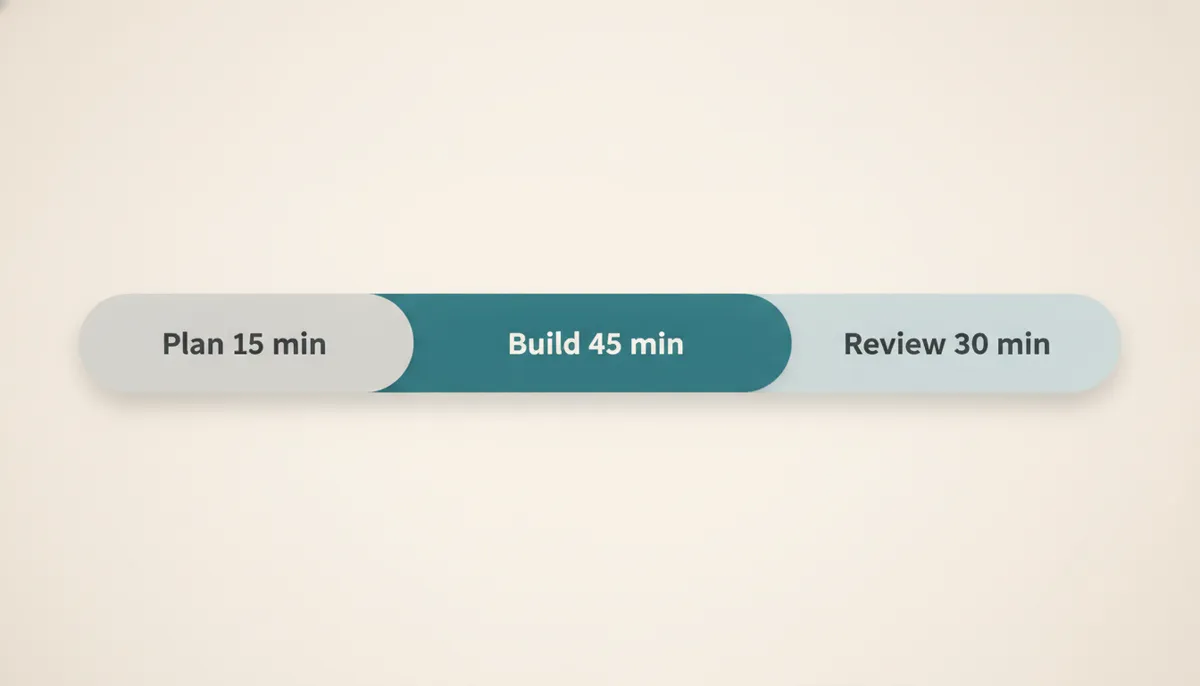
Then, practise timed builds. Pick a time box that forces decisions. The goal is not to reproduce Uber’s timing; it is to rehearse prioritisation. You should be able to produce a minimal working path, demonstrate it, and explain the next changes you would make.
For code-first repetitions, in-browser code practice helps you build the habit of compiling, testing and correcting your work rather than stopping at a diagram. The Low Level Design Sheet is free to browse and is a useful source of problem shapes to implement repeatedly.
💡 Pro Tip: Ask your recruiter whether the relevant round is discussion-led, code-led, collaborative, or a mixture. One precise question can prevent weeks of practising the wrong delivery format.
What assessors reward, in practical order
Uber does not publish a machine-coding scoring rubric, so no external guide can provide an official weighting. Still, for practical coding and low-level design work, this is the order you should optimise for.
| Priority | What strong work demonstrates | What weak work looks like |
|---|---|---|
| Working core flow | The main user journey runs correctly | Many classes, but no usable outcome |
| Sound responsibilities | Each object has a clear reason to exist | One large class controlling everything |
| Sensible assumptions | Ambiguity is surfaced and resolved aloud | Silent guesses drive the whole solution |
| Change readiness | Obvious new rules can be added locally | Every change requires rewriting core code |
| Tests and edge cases | Important boundaries are checked | Happy-path-only code |
| Clear explanation | Decisions and trade-offs are easy to follow | Correct code with no visible reasoning |
The first row is deliberately first. In a constrained exercise, working code establishes credibility. A perfectly abstract design that has not been integrated, executed or tested does not demonstrate that the system works.
The second and third rows are where interview quality often separates. Do not reach for patterns because you remember their names. Use an interface when behaviour genuinely varies. Introduce a strategy when rules need to be swapped. Keep a plain class when the behaviour is stable and local.
For a useful refresher on patterns without turning every solution into a pattern catalogue, read design patterns for interviews. The aim is judgement: recognising when an abstraction earns its complexity.
How to structure the available time
Because the exact duration can vary, use percentages rather than memorising a rigid schedule. The table below works for a short practical exercise as well as a longer implementation task.
| Portion of time | What to do | Output before moving on |
|---|---|---|
| Opening tenth | Read carefully and clarify the main flow | A short list of assumptions |
| Next fifth | Sketch entities, state and responsibilities | A minimal design plan |
| Largest middle section | Build the happy path first | Running core behaviour |
| Next sixth | Add validation, edge cases and one extension | Better resilience |
| Final tenth | Test, tidy and prepare the walkthrough | A demonstrable solution |
Start by narrowing the problem
Restate the core workflow in your own words. Identify the actor, the action, the state that changes, and the result. If the prompt is about matching, booking, pricing, tracking or allocation, do not model every real-world complication immediately.
Ask questions that change the design:
- Is this in-memory or persistent?
- Which actions must be supported now?
- What happens when an operation cannot be completed?
- Which rules are likely to vary?
- What needs to be returned to the caller?
Avoid questions that merely delay work. If the interviewer leaves a detail open, state a reasonable assumption and continue.
Build the smallest complete slice
Your first version should do one meaningful thing end to end. It might create an entity, register it, apply a request, update its state, and return an outcome. That slice gives you a backbone for later changes.
Do not begin with factories, repositories, notification systems, elaborate logging, authentication, or persistence unless the prompt makes them central. Those additions may be reasonable in production. They are expensive before the core path works.
Explain while you work
Narrate in compact checkpoints:
“I am keeping this rule inside this class because it owns the state it changes.”
“I am starting with one matching rule, then I can extract it if we need multiple policies.”
“I will test the unavailable case before adding the optional feature.”
This is not performance for its own sake. It gives the interviewer access to your judgement and makes it easier for them to redirect you early.
Midway through your preparation, return to Uber's interview kit and choose a low-level design problem to implement from an empty file. Read the editorial only after you have committed to your own design. The comparison will reveal whether your abstractions were purposeful or premature.
The failure modes that cost otherwise strong candidates
Building architecture before behaviour
Candidates sometimes spend too long drawing a general-purpose design and too little time making a workflow run. They finish with impressive nouns—service, manager, factory, repository—but no proof that the pieces work together.
Fix: Build one vertical slice first. Add layers only when they solve a demonstrated problem.
Treating requirements as complete
Practical prompts are often intentionally incomplete. A candidate who silently chooses rules may build a clean solution to the wrong task.
Fix: State assumptions out loud. If the interviewer corrects one, adapt without defending the original interpretation.
Over-engineering for hypothetical scale
Uber is associated with large-scale systems, but that does not mean every low-level design answer should begin with distributed caches, queues, sharding or geospatial indexing. Those may belong in a high-level design conversation; they can obscure a small coding task.
Fix: Separate “what I am implementing now” from “what I would consider at larger scale”. This shows awareness without losing focus.
Ignoring state transitions
Many practical systems fail at the boundaries: an item is already assigned, a request is cancelled, capacity is exhausted, or a price rule changes. Candidates often model objects but not their valid transitions.
Fix: Write down the states and the actions allowed from each one before coding the tricky methods.
Coding silently
A quiet candidate may still write good code, but the evaluator cannot easily see how they approached ambiguity, chose trade-offs, or recovered from mistakes.
Fix: Use brief narration before each meaningful decision. For more help with this skill, read how to explain your thought process clearly in coding interviews.
Leaving no time to test
A solution that compiles is not necessarily a solution that works. The final minutes often reveal null inputs, duplicate actions, invalid transitions and forgotten updates.
Fix: Reserve the end for a small driver, targeted test cases and a clear walkthrough. Test the unhappy path, not only the polished demo.
A two-week Uber machine-coding practice plan
This plan is designed for candidates who need a focused design sprint while keeping their other technical preparation active.
Week one — design fundamentals and clean implementation
Days one and two: domain modelling. Pick simple workflows and identify entities, ownership, state and operations. Write a short design before coding. The aim is to stop making every object a “manager”.
Days three and four: working vertical slices. Implement two small systems from scratch. Prioritise a runnable happy path, then add validation and one variation. Use the free-to-browse Low Level Design Sheet for structured prompts.
Day five: design patterns in context. Revisit a previous solution. Ask where a strategy, interface or factory would genuinely reduce coupling—and where it would be needless ceremony. Refactor only the parts that improve clarity.
Day six: tests and transitions. Take one implementation and write edge cases first: unavailable state, duplicate request, cancellation, invalid input and repeated action.
Day seven: review day. Read your own code as if you were the interviewer. Can you explain every class in one sentence? Can you remove anything without breaking the core flow?
Week two — delivery under pressure
Days eight and nine: timed implementation. Complete one practical build each day under a self-imposed time box. Keep the scope small enough to finish. Record where time disappears.
Days ten and eleven: extension drills. Start from a completed solution and add a new policy or rule. Examples include multiple allocation strategies, changing price rules, prioritisation, or cancellation. The goal is to test whether your design can change locally.
Day twelve: communicate the design. Practise explaining a solution aloud from requirement to test plan. Focus on assumptions, class responsibilities and trade-offs. An AI mock interview can help you rehearse speaking clearly under interruption.
Day thirteen: blend coding and system thinking. Take a familiar low-level design and discuss how it would connect to larger services, storage and reliability mechanisms. Keep the implementation and architecture layers distinct. The System Design Sheet is free to browse for broader design practice.
Day fourteen: full rehearsal. Simulate the complete experience: read the prompt, clarify, plan, build, test and explain. Afterwards, list three concrete improvements. Do not restart immediately; learn from the completed attempt.
Keep a short DSA session in the background throughout the fortnight. Uber’s reported process includes coding evaluation, and pattern recognition should not decay while you focus on design. The DSA Patterns Sheet is free to browse, while Uber's interview kit gives you a company-focused starting set.
Frequently asked questions
Does Uber have a dedicated machine coding round?
Reported accounts do not consistently describe a separately named machine-coding round. They more commonly describe coding, system design and behavioural stages. Confirm the format for your specific process with your recruiter.
What should I practise for the Uber machine coding round?
Practise turning ambiguous workflows into working code: clarify requirements, model state, implement the core flow, test edge cases and explain your trade-offs.
How long is Uber’s machine coding round?
A fixed standalone time limit is not consistently reported. Avoid relying on generic online claims and ask your recruiter about the format and duration.
Is low-level design important for Uber interviews?
It is useful preparation for practical coding and design conversations, especially when you need to explain implementation choices beneath a broader system design.
Should I use design patterns in every solution?
No. Use patterns when they handle real variation or reduce coupling. Unnecessary abstractions make a small solution harder to understand and finish.
Should I optimise for scale immediately?
No. Start with correct local behaviour. Mention larger-scale concerns separately if they are relevant, but do not let distributed architecture replace the requested implementation.
What language should I use?
Use the language in which you can write, test and explain object-oriented code most fluently. Familiarity, speed and clarity matter more than novelty.
How should I handle missing requirements?
Ask concise questions where the answer affects behaviour. For remaining uncertainty, state your assumption, implement it consistently and show how it could change.
Do I need to prepare DSA as well?
Yes. Reported Uber processes include coding evaluation alongside design and behavioural assessment. Keep practising core patterns while you prepare practical implementation skills.
Where to start
The most productive preparation is not memorising class diagrams. It is repeatedly building small, complete systems: clarify the task, make the core path work, test its boundaries, and explain how you would extend it.
Open Uber's interview kit to work through 72 mapped DSA questions, 10 low-level design problems, and 4 system design problems in a company-focused set. Use the free-to-browse design sheets to widen your repetition, then practise delivering your thinking aloud in an AI mock interview.
Finally, confirm the exact round format with your recruiter. The strongest preparation plan is always the one matched to the interview you are actually scheduled to take.
Topics
Related on Thita
Your next step
Practise with AI mock interviews
A spoken interview that asks follow-up questions, runs your code and ends with a written report.