
Interview
Uber System Design Interview: Complete Guide (2026)
Prepare for the Uber system design interview with a practical guide to levels, dispatch and geospatial design, trade-offs, mock practice, and common questions.
The Uber system design interview is where an otherwise strong coding candidate has to show they can reason beyond an isolated function. Reported accounts describe a loop with coding, system design and behavioural evaluation, followed by a Hiring Committee debrief. For mid-level and senior engineering roles, system design is commonly reported as a major differentiator: the discussion is expected to connect architecture decisions to the realities of dispatch, moving locations, rider demand and operational scale.
The useful preparation mindset is not “memorise a ride-sharing diagram”. It is learning to turn an ambiguous product prompt into a bounded system, explain the decisions that matter, and revise your design when constraints change. Uber's interview kit holds 72 mapped DSA questions, 10 low-level design problems, and 4 system design problems evidenced at Uber, giving you a focused place to practise both coding patterns and design reasoning.
When does system design appear in Uber interviews?
System design is most relevant for candidates interviewing at mid-level and senior levels. Reported accounts commonly describe one or two design discussions for these roles, alongside algorithmic coding and behavioural rounds. The exact loop, interviewer mix and prompt scope can vary by team, location and level, so treat recruiter guidance as the final source for your own process.
For an early-career candidate, the emphasis is generally on demonstrating sound fundamentals: clear code, core data structures, complexity reasoning, basic object-oriented design and the ability to communicate. You may still be asked to discuss design choices, but you are less likely to be evaluated on a fully fledged distributed architecture.
For a mid-level engineer, the expectation changes. You should be able to lead a structured design conversation: clarify the product, estimate the shape of traffic, identify the critical data, define services and interfaces, and defend trade-offs. You do not need perfect production detail in every component. You do need to know which details become important first.
For senior candidates, the interviewer is more likely to test judgement under competing goals. A good answer distinguishes the first viable version from the architecture needed at much greater scale. It makes explicit decisions about consistency, availability, failure recovery, cost, observability and operational ownership. Seniority is visible in prioritisation: not in adding more boxes to a diagram.
For a useful framing of how the bar shifts by level, read how much system design is enough for SDE-1 versus SDE-2 interviews.
Uber’s natural system design territory
A company’s products do not dictate the exact prompt you will receive. They do, however, make certain system properties especially natural to discuss. Reported Uber interview accounts repeatedly point towards infrastructure shaped by ride matching, driver location and surge pricing. That means your preparation should be comfortable with real-time state, geospatial lookup, marketplaces and systems that must respond quickly despite incomplete information.
Dispatch and ride matching
A dispatch-style system begins with two moving populations: riders requesting trips and drivers becoming available. The central design question is not merely how to store a request. It is how to find suitable supply quickly, make an offer, avoid assigning the same driver twice and cope with drivers or riders changing their minds.
A strong answer identifies the core workflow before introducing technologies:
- A rider submits a request with pickup and destination information.
- The system identifies nearby eligible drivers.
- A matching service ranks candidates and makes an offer.
- A driver accepts or declines.
- The trip state changes only when the assignment is safely confirmed.
The difficult parts are the transitions. What happens if a driver accepts just after being assigned elsewhere? What happens if the rider retries because their connection failed? What happens when no drivers are available? These are the points where idempotency, state machines, leases, retries and event ordering become more useful than a generic list of databases.
Driver location and geospatial search
Location systems invite vague answers: “put locations in a database and query by distance.” A better answer asks what freshness the product actually requires. A rider viewing a nearby car needs a recent enough location to make the map useful. A matching system needs a fast candidate set. Historical analytics needs durable records, but that is a different workload from the live dispatch path.
Talk through the split:
- a write path for frequent location updates;
- an in-memory or rapidly queryable representation of active drivers;
- a geospatial partitioning strategy to locate nearby candidates;
- an event stream or durable store for downstream consumers and history.
You do not need to force a named technology into every answer. Explain the access pattern first. If the interviewer asks how you divide geography, discuss cells or regions, boundary cases and how dense areas differ from sparse ones. If they ask about stale updates, state how timestamps, expiration and reconciliation protect the matching decision.
Pricing and marketplace balance
Surge pricing is a useful design territory because it joins computation with product constraints. It is not enough to say that price rises when demand rises. You should define the signals, the aggregation window, the geographic granularity, the update cadence and the safeguards against abrupt or confusing changes.
The important judgement is recognising that pricing is not simply a calculation service. It can affect rider conversion, driver supply, fairness, communication and the overall marketplace. A thoughtful candidate can say which part of the pricing decision needs to be immediate, which part can be asynchronous, and how they would monitor unexpected outcomes.
Reliability in a live marketplace
Uber-like systems are time-sensitive. A delayed notification, duplicated assignment or stale driver status can be more harmful than an eventually consistent analytics record. In an interview, identify the critical path and give it stronger guarantees than secondary workflows.
For example, the immediate match outcome may require careful coordination and idempotent state changes. Trip history, reporting, recommendations and long-term data processing can often be handled asynchronously. This distinction shows that you understand consistency as a product decision, not as a slogan.
What strong Uber system design answers do differently
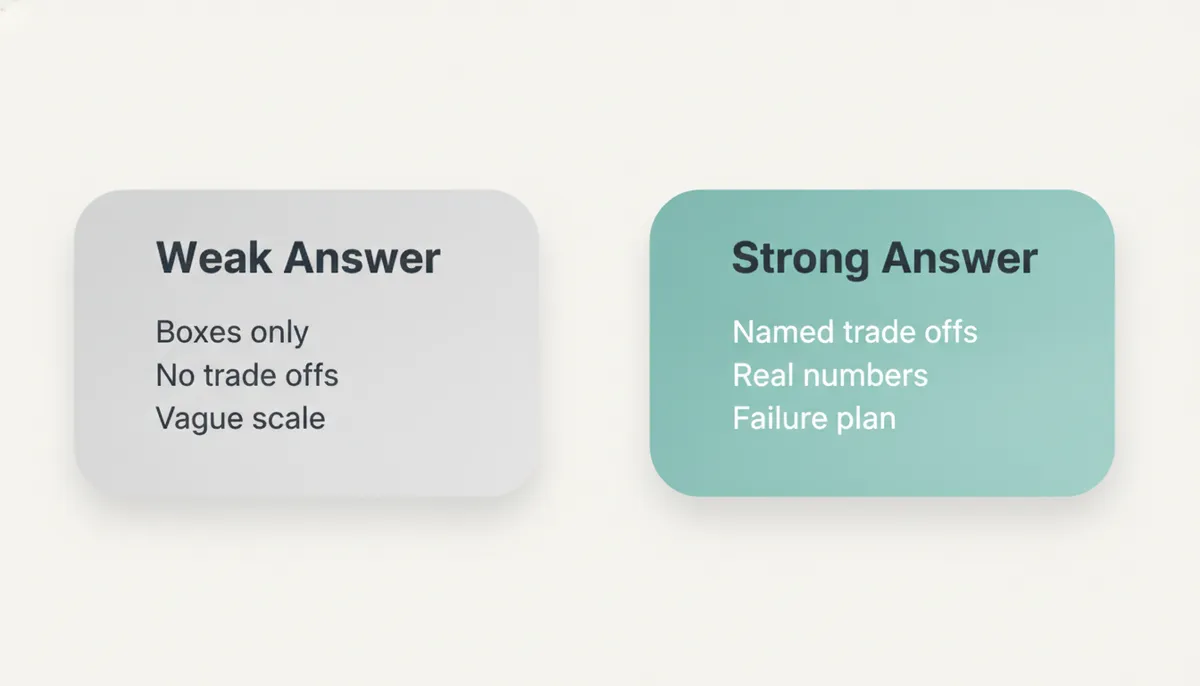
The best candidates make the conversation easy to evaluate. They provide enough structure that the interviewer can see their reasoning, then spend depth where the system is genuinely difficult.
They clarify before drawing
Start by narrowing the prompt. Ask about users, geography, request volume, latency expectations, core actions and features that are explicitly out of scope. For a ride-matching system, establish whether you are designing the full trip lifecycle or only the matching service. For a location service, ask whether the requirement is live discovery, route tracking, historical storage or all three.
This is not stalling. It prevents a polished answer to the wrong problem.
They state assumptions and use them
Reasonable estimates are valuable because they guide choices. You can state an assumed scale, identify the highest-frequency operation and use that to justify an architecture. The interviewer is usually more interested in whether your assumptions connect to your design than whether you recall a specific industry metric.
Avoid false precision. A simple estimate that leads to a clear partitioning, caching or asynchronous-processing decision is more persuasive than a long sequence of arithmetic with no consequence.
They separate the core path from supporting systems
A common weak answer describes every service at equal depth. Strong answers prioritise. Define the critical user journey, then identify the components needed to make that journey work: APIs, core data model, storage, matching logic, notifications and state transitions.
Only then add supporting concerns such as fraud checks, analytics, observability, experimentation or customer support. These matter, but they should not obscure the first version of the system.
They name trade-offs, not just components
“Use a cache”, “use a queue” and “use sharding” are not decisions until you explain why. Good answers pair each mechanism with a problem and a cost.
For example:
- Caching can reduce read latency, but introduces stale-data handling.
- Asynchronous processing can absorb bursts, but may delay non-critical updates.
- Geographic partitioning can improve locality, but creates border and rebalancing cases.
- Replication can improve availability, but complicates conflicting writes.
The goal is not to sound cautious about everything. It is to show that you can make a choice deliberately.
They revisit the design under failure
Near the end, ask yourself what breaks first. A dispatch service may receive repeated requests. A location stream may arrive out of order. A notification service may be delayed. A regional dependency may be unavailable.
You do not need an exhaustive disaster-recovery document. Pick the failure modes most connected to the product’s critical path and explain the mitigation. That is where a design answer starts to sound operational rather than theoretical.
A preparation plan for the Uber system design interview
Build the foundation first
Start by learning a repeatable system design structure: requirements, estimates, APIs, data model, high-level components, bottlenecks, trade-offs and failure modes. The System Design Sheet is free to browse and is useful for building that structure across different problem shapes.
Then practise explaining familiar systems aloud. A written diagram can hide gaps in thinking; speaking forces you to make sequencing and assumptions explicit. An AI mock interview can help you rehearse requirements gathering, design communication and follow-up questions in a more realistic format.
Practise Uber-shaped domains
Work through systems involving a real-time feed, a matching decision, a location update stream, dynamic pricing or a notification workflow. Do not aim to memorise one canonical architecture. Instead, repeat the same reasoning moves:
- What is the user-visible action?
- Which data must be fresh?
- Which action must be correct exactly once, or close to it?
- What can happen asynchronously?
- Where will traffic concentrate?
- Which failure would most damage the user experience?
Use Uber's interview kit to practise the problems evidenced at Uber, then deliberately alter the constraints. Add a second region, an unreliable network, a burst of demand or a stronger consistency requirement. This is how you learn to adapt rather than recite.
Keep coding sharp
System design does not replace the coding round. Reported accounts still describe a coding phone screen and algorithmic evaluation in the onsite loop. Build pattern recognition through the free-to-browse DSA Patterns Sheet, then practise implementation fluency with in-browser code practice.
Graph traversal is especially worth revisiting for marketplace and location-adjacent reasoning. The concepts are not a substitute for architecture, but they help when you need to discuss reachability, proximity models or network-like relationships. See graph traversal patterns: DFS and BFS for a focused refresher.
Add systems fundamentals where needed
Design interviews often expose uncertainty around storage, concurrency, networking and caching. You do not need to become a distributed-systems specialist overnight, but you should be able to explain why a system uses a particular persistence model, what happens when requests retry, and how services communicate.
The DBMS Sheet and Computer Networks Sheet are free to browse for targeted revision. Use them to close specific gaps revealed during mock interviews rather than trying to consume every topic at once.
Rehearse the discussion, not just the diagram
Set a timer and simulate the full conversation. Spend the opening portion clarifying requirements. Outline the architecture. Deep dive into one hard component. Finish with bottlenecks, trade-offs and failure handling.
After each practice session, review three questions:
- Did I state the problem boundary clearly?
- Did I explain why each major component exists?
- Did I spend time on the most consequential risk?
If the answer to any is no, improve your structure before learning another architecture.
Common mistakes to avoid
Jumping straight to named technologies. Begin with requirements and access patterns. A tool without a stated purpose sounds memorised.
Treating every data flow as equally important. Identify the critical path first: matching, assignment confirmation and live state are more urgent than reporting.
Ignoring duplicate and out-of-order events. Real-time systems receive retries, delayed messages and stale updates. Mention how you detect, tolerate or reconcile them.
Over-designing too early. A vast microservice diagram can prevent you from explaining the simple path. Start with a minimal viable architecture, then evolve it when scale or reliability requires it.
Staying silent during trade-offs. The interviewer cannot award credit for reasoning they cannot hear. State the benefit, the cost and the condition under which you would choose differently.
For more on the difference between object-level design and architecture-level design, read low-level design versus high-level design: what interviews actually expect.
Frequently asked questions
Is system design required in an Uber interview?
Reported accounts commonly describe system design as required for mid-level and senior candidates. It is a central part of evaluating architecture and engineering judgement at those levels.
What does Uber focus on in system design?
Reported accounts describe system design discussions connected to Uber’s infrastructure, including dispatch, geospatial location, ride matching and surge pricing. Prepare the underlying system properties rather than memorising one prompt.
How many system design rounds does Uber have?
Reported accounts commonly describe one or two system design rounds for mid-level and senior roles. Confirm the format with your recruiter because loops vary.
Is the Uber interview more about system design than coding?
Coding remains part of the process, including a reported coding phone screen and algorithmic evaluation. For mid-level and senior candidates, system design is commonly the differentiator because it tests a different level of judgement.
Should I practise ride-sharing system design only?
No. Ride matching is useful territory, but the transferable skills are requirements clarification, real-time state management, partitioning, reliability and trade-off analysis.
Do I need to calculate exact traffic estimates?
No. Use sensible assumptions and explain how they affect your design. The quality of the reasoning matters more than artificial precision.
How should I handle a vague design prompt?
Ask clarifying questions first, define the core user flow, state your assumptions and agree on scope before proposing components.
What is the best way to practise system design communication?
Practise aloud under time pressure. A mock interview exposes whether you can explain assumptions, guide the discussion and respond to follow-up constraints.
Should I prepare behavioural stories for Uber as well?
Yes. Reported accounts include a behavioural component. Prepare clear examples of ownership, collaboration, setbacks and decisions from your own work, and rehearse them aloud.
Where to start
The Uber system design interview rewards structured thinking under ambiguity. Start with the core architecture, make the dispatch or location path concrete, explain your trade-offs and show how the system behaves when reality is messy.
Open Uber's interview kit to work through the 72 mapped DSA questions, 10 low-level design problems, and 4 system design problems evidenced at Uber. Pair that practice with the free-to-browse System Design Sheet and an AI mock interview to rehearse the discussion that turns a diagram into a convincing answer.
Topics
Related on Thita
Your next step
Practise with AI mock interviews
A spoken interview that asks follow-up questions, runs your code and ends with a written report.