
Interview
Udaan Machine Coding Round: Preparation Guide (2026)
Prepare for Udaan's machine coding round with a practical guide to the reported format, grading priorities, time plan, common mistakes and practice plan.

The Udaan machine coding round is the part of the reported engineering loop where application design becomes concrete. Rather than rewarding recall of a familiar puzzle, it asks you to turn an incomplete product requirement into working code, explain the choices you made, and leave enough structure for the next feature to fit.
Reported accounts describe machine coding as an early technical stage, before a later design stage that may cover both low-level and high-level design. This guide stays deliberately focused on the machine coding and low-level design work. For a broader view of Udaan’s reported interview shape, confirm the current process with your recruiter.
To practise the kind of design problem evidenced at Udaan, Udaan’s interview kit includes six low-level design problems. Use them as timed builds rather than reading exercises: start from a blank file, make the main flow work, and then compare your choices with the editorial.
Where the machine coding round sits
Candidate reports commonly describe Udaan as application-design-led rather than a conventional LeetCode-style loop. The machine coding round is therefore not a warm-up before the “real” interview. It is an evaluation of whether you can make sensible engineering decisions when there is no complete specification and no existing codebase to guide you.
The reported sequence places machine coding before a broader system-design stage. That placement matters. In the machine coding round, graders can inspect whether your claimed design judgement survives implementation:
- Can you identify the core user flow quickly?
- Can you choose a small set of objects with clear responsibilities?
- Can you handle essential state and rules without creating a tangled implementation?
- Can you demonstrate that the code actually works?
- Can you discuss what you would change if the product grew?
Think of it as a compressed version of normal feature work. You are not expected to build a production service with deployment, storage and monitoring. You are expected to make good local decisions, communicate assumptions, and deliver a useful working slice.
💡 Pro Tip: Treat every unclear requirement as an opportunity to show judgement. Ask one concise question, state the assumption you will use, and keep moving. Waiting for a perfect specification is usually worse than making a visible, reasonable decision.
Reported format and time limit
Reported accounts describe a ninety-minute machine coding exercise. The prompt is likely to be intentionally incomplete: there may be a small domain, a few user actions, rules that govern those actions, and room for you to choose how the pieces fit together.
A strong submission is not the most elaborate one. It is the one that makes the core workflow easy to follow and easy to run.
Expect to work through a shape like this:
- Clarify the primary use case and state assumptions.
- Identify the main entities, their responsibilities and the state they own.
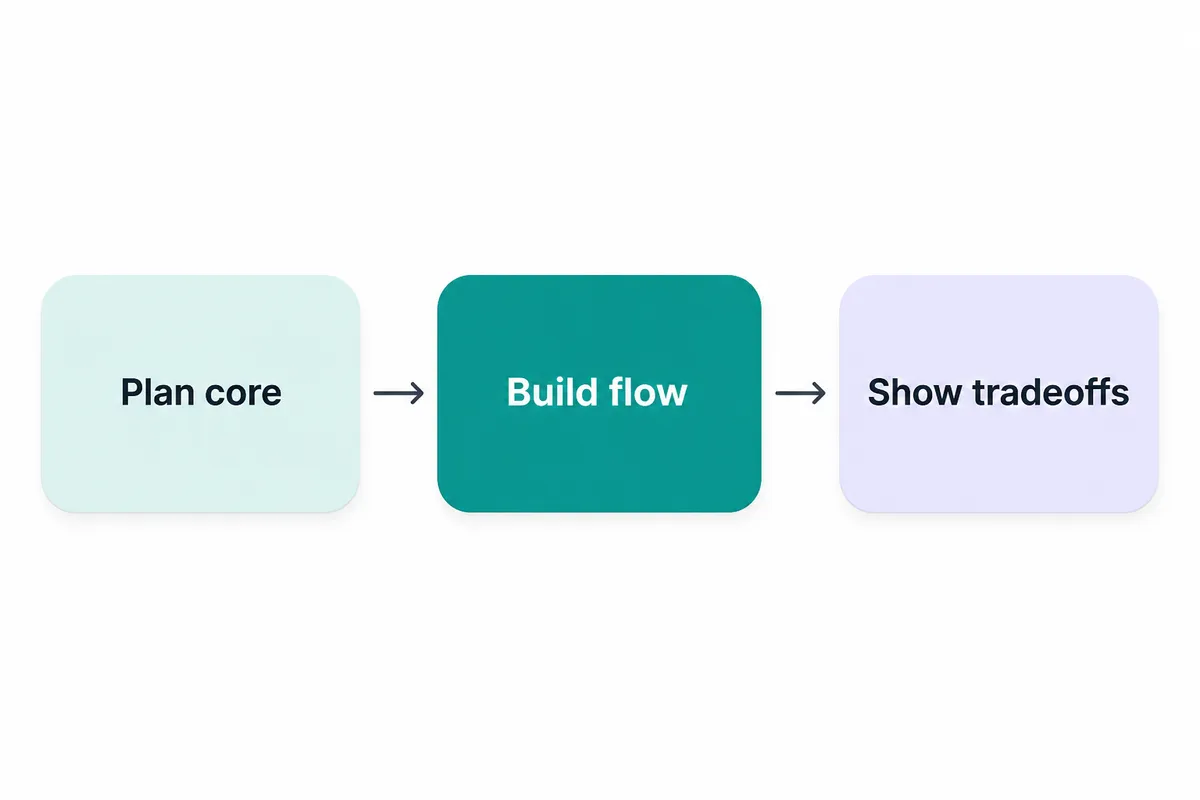
- Implement the smallest end-to-end path first.
- Add validation, meaningful edge cases and one or two sensible extensions.
- Demonstrate the result and explain trade-offs.
The format rewards a different muscle from solving an isolated coding question. You need implementation fluency, but you also need sequencing. A candidate who knows many design patterns can still struggle if they spend too long drawing abstractions before anything runs.
What graders reward, in rough order
No public rubric should be treated as official policy. Still, reported machine-coding experiences and the nature of the round point to a practical hierarchy of what tends to earn credit.
A working core flow
This is the foundation. A clean class diagram does not compensate for code that cannot demonstrate the requested behaviour. Get one happy path running early: create the relevant objects, perform the main action, and produce an observable result.
Your demo can be a small driver programme, focused test cases, or straightforward console output. It does not need a polished interface. It does need to establish that the system behaves as you say it does.
Sound responsibility boundaries
Graders want to see whether behaviour lives in sensible places. A class should have a reason to exist and a focused job to perform. Avoid a single service object that stores all state, validates every input, coordinates every action and formats every result.
Equally, do not create a separate abstraction for every noun in the prompt. Good design is not maximal separation. It is separation where it makes ownership clearer.
Clear handling of rules and change
The next question after the happy path is usually: what happens when a rule changes? Your code should make common variation visible. If pricing, allocation, status transitions or selection rules could change, avoid burying all of that logic inside one long conditional block.
That does not mean every design needs factories, strategies and layers of interfaces. Use an abstraction only when you can explain the variation it isolates. For a refresher on making that distinction, read design patterns for interviews.
Communication and assumptions
Machine coding is not silent programming. Narrate the important decisions: the scope you are taking, what you will defer, why a class owns a particular responsibility, and which trade-off you made to protect the time limit.
The best explanation is brief and attached to the code in front of you. If you have to give a long speech to justify the design, the design may be harder than it needs to be. How to explain your thought process clearly in coding interviews has a useful structure for keeping that narration crisp.
Readability and finishing discipline
Names, method size, error handling and a clean demonstration all matter. They rarely rescue a missing core flow, but they distinguish a candidate who can finish a feature from one who can only start one.
The closest transferable practice is live implementation under observation. Code practice can help you rehearse writing and explaining code in one sitting, while the Low Level Design Sheet is free to browse for design exercises and reference material.
How to use the available time
Ninety minutes feels generous until the first design decision opens three more. Give the clock a job before you begin.
| Time block | Focus | What “done” looks like |
|---|---|---|
| Opening minutes | Clarify scope | Main flow, assumptions and constraints stated aloud |
| First third | Model the core | Small set of entities and responsibilities chosen |
| Middle block | Build the path | Main scenario runs end to end |
| Later block | Add safeguards | Key rules, validation and edge cases covered |
| Closing minutes | Demonstrate and review | Code runs, trade-offs explained, rough edges named |
The table is a guide, not a rule to follow mechanically. If the core flow is not working by the middle of the session, stop extending the design. Simplify. Remove a non-essential feature. Replace an elegant but unfinished mechanism with the smallest version that can run.
A useful phrase to practise is: “I am going to implement the basic version first, then I will use the remaining time to make this rule easier to extend.” It signals prioritisation and protects you from the temptation to overbuild.
Failure modes that cost otherwise good candidates
Building a framework instead of a feature
The most frequent machine-coding mistake is treating the prompt as permission to demonstrate every pattern you know. This produces a project with many files, generic base classes and little usable behaviour.
Start with the feature. If a pattern becomes necessary, introduce it when the code creates evidence for it.
Coding before establishing the contract
A vague prompt can conceal crucial decisions: who owns an action, whether an item can be repeated, what happens when capacity is reached, or how conflicting requests resolve. Candidates who code immediately can spend much of the session repairing a model built on an unstated assumption.
Ask targeted questions. Do not interrogate the interviewer for every minor detail. State sensible defaults where the answer does not alter the central design.
Leaving execution until the end
Code that “should work” is not the same as code that has been run. Compilation errors, mismatched method signatures and overlooked state transitions tend to appear during the final demonstration, when there is no time left to fix them.
Run a small path after each meaningful addition. The habit is especially important if you are using a language with more ceremony around setup and types.
Making every class depend on every other class
Tight coupling makes an initial version fast to write and painful to change. If one class reaches into another class’s internal state, or a central coordinator knows every implementation detail, simple changes become risky.
Prefer methods that express intent: reserve, assign, cancel, calculate, publish. Keep internal collections and mechanics behind the object that owns them.
Treating tests as optional polish
You do not need a large suite, but a few targeted checks demonstrate that you considered failure cases. Test the boundaries of the rules, not only the successful example you built first.
Going quiet when the design changes
Interviewers do not penalise you for revising a decision. They may penalise you for revising it invisibly. Say what changed and why: “This requirement means the earlier ownership model is too broad, so I am moving this rule into the relevant entity.”
For more on the signals behind a live implementation round, see what interviewers actually look for in live coding interviews.
A two-week Udaan machine coding practice plan
The goal of two weeks is not to memorise designs. It is to develop a repeatable delivery process: clarify, model, build, run, explain.
Week one: build design instincts
Day one — baseline build. Choose a low-level design prompt and attempt it without preparation. Record where time goes: understanding the prompt, choosing classes, writing code, debugging or explaining.
Day two — responsibility review. Redo the same problem more slowly. For each class, write one sentence explaining its responsibility. Remove anything that lacks a clear reason to exist.
Day three — core flow first. Take a new prompt and impose a strict goal: a running happy path before adding any extension. Review whether the result is understandable without a verbal explanation.
Day four — rules and variation. Practise isolating one changing rule, such as selection, pricing or state transition logic. Add only the abstraction justified by that variation.
Day five — error paths. Revisit a previous solution and add invalid inputs, unavailable resources, duplicate actions or illegal state changes. Keep the handling local and readable.
Day six — explain aloud. Build a smaller prompt while narrating each major decision. Listen back if possible. Remove vague phrases such as “this is scalable” when you mean “this is easier to change”.
Day seven — review day. Read editorials for the problems you attempted. Udaan’s interview kit is the right place to compare your approach with the six low-level design problems evidenced at Udaan. Note principles, not copied class diagrams.
Week two: rehearse the round
Day eight — timed simulation. Do a full ninety-minute build. Use only your normal editor, basic language tools and a simple driver programme.
Day nine — refactor after delivery. Repeat yesterday’s problem without a timer, but do not rewrite it from scratch. Improve names, responsibility boundaries and duplication in the existing code.
Day ten — unfamiliar domain. Choose a problem outside your usual comfort zone. The point is practising clarification and decomposition when recognition does not help.
Day eleven — design discussion. Take one completed solution and practise explaining how it would evolve for more users, persistent storage or additional rules. Keep this clearly separate from the code you were asked to produce.
Day twelve — mock session. Use an AI mock interview to rehearse explaining assumptions, defending trade-offs and responding to follow-up questions.
Day thirteen — second full simulation. Repeat the timed format with a fresh prompt. Compare the result with day eight: did the core flow run sooner, and did you spend less time deciding what to build?
Day fourteen — light review. Review your notes, your most common failure mode and two project stories for any later discussion round. Browse the free System Design Sheet to keep the distinction between class-level design and architecture-level thinking clear.
Frequently asked questions
How long is the Udaan machine coding round?
Reported accounts describe a ninety-minute format. Processes can vary by role and team, so confirm the current timing with your recruiter.
Is the Udaan machine coding round the same as low-level design?
They overlap, but machine coding requires you to implement and demonstrate the design. A low-level design discussion may spend more time on objects, interactions and future changes.
Where does machine coding sit in the Udaan interview process?
Reported accounts place it before a later design stage. This page focuses on the implementation-led round rather than restating the wider loop.
What should I build first?
Build the smallest end-to-end version of the central user flow. A running core is more valuable than several unfinished extensions.
Should I use design patterns?
Use them when a real variation or responsibility boundary calls for them. Patterns added only to look sophisticated usually make the solution harder to explain and finish.
Do I need a database or web framework?
For a typical machine coding exercise, an in-memory implementation and simple demonstration are usually the practical choice unless the interviewer specifies otherwise.
How should I handle unclear requirements?
Ask about decisions that materially change the model. For smaller gaps, state a reasonable assumption aloud and proceed.
What language should I use?
Use the language in which you can write, run and debug quickly. Familiarity matters more than choosing a language that appears more enterprise-oriented.
How do I practise machine coding effectively?
Practise from a blank file under a timer, run the code during the session, and explain your decisions aloud. Reading solutions alone does not build finishing discipline.
Start with a working core
The Udaan machine coding round rewards practical judgement: reduce ambiguity, build the important path, keep responsibilities clear and make the result run before time expires. The strongest preparation is repeated timed delivery, followed by honest review of where your time disappeared.
Open Udaan’s interview kit to practise the six low-level design problems evidenced at Udaan. Pair that work with the free Low Level Design Sheet, and use an AI mock interview when you are ready to rehearse your explanation as well as your code.
Topics
Related on Thita
Your next step
Practise with AI mock interviews
A spoken interview that asks follow-up questions, runs your code and ends with a written report.