
Interview
Why You Are Not Getting Interview Calls Despite Practicing LeetCode
You’ve solved 300+ LeetCode problems, your streak is intact, and you can implement `LRUCache` from memory—yet your inbox is quiet. No recruiter emails, no on...
You’ve solved 300+ LeetCode problems, your streak is intact, and you can implement LRUCache from memory—yet your inbox is quiet. No recruiter emails, no onsite invites, sometimes not even an automated rejection.
If you’re wondering why you’re not getting interview calls despite practicing LeetCode, you’re not alone. The problem usually isn’t your algorithm skills. It’s that the hiring funnel is much larger and more multidimensional than “can solve medium LeetCode in 25 minutes.”
This post breaks down, in a systematic and technical way, why “LeetCode but no interviews” happens, where your preparation is misaligned with reality, and what to do about it.
The False Model: “LeetCode → Interview → Offer”
A lot of candidates implicitly adopt this mental model:
- Solve a lot of LeetCode.
- Apply to jobs.
- Get interviews.
- Pass interviews.
- Get offers.
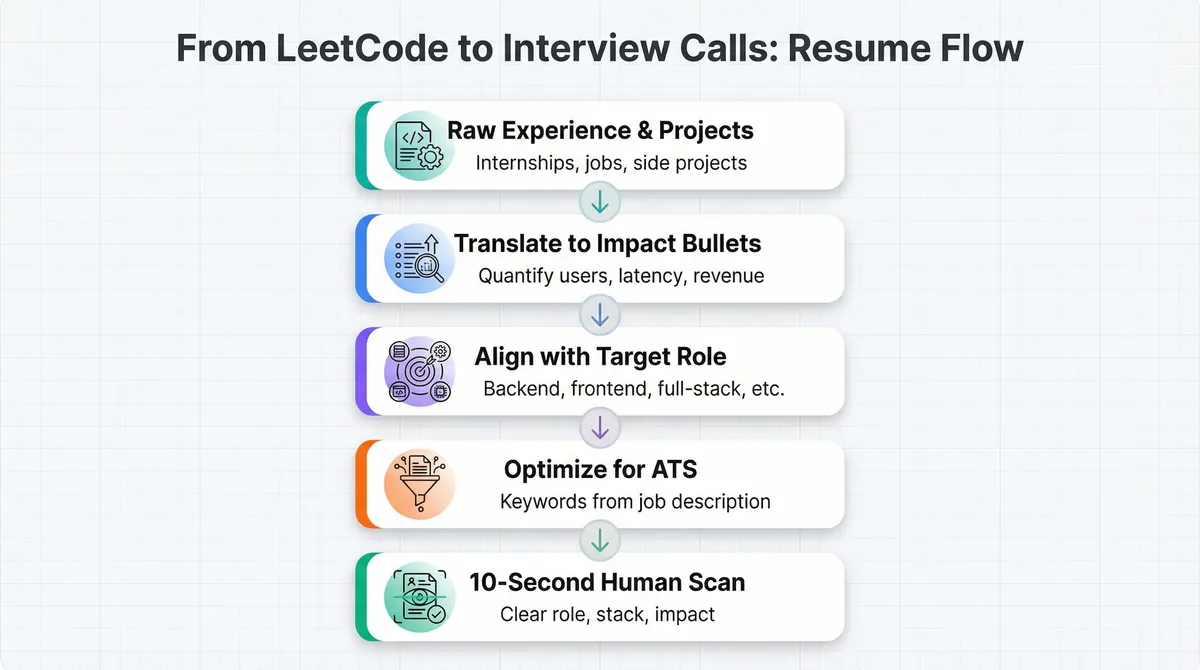
The real funnel looks more like this:
- Market & role fit: Are there roles that match your profile?
- Resume & profile screen: Does your resume survive 10 seconds of scanning?
- ATS & keyword filters: Does your resume match the job description textually?
- Signal strength: Any referrals, portfolio, open-source, or credible experience?
- Recruiter interest: Does your profile look like a safe bet worth scheduling?
- Interview performance: Can you actually solve problems, communicate, and design?
LeetCode only meaningfully affects step 6, and sometimes step 5 if you’ve signaled your competitive programming strength (e.g., contests, profiles). If you’re not getting interview calls, the failure is almost always happening before your coding skills are even evaluated.
1. You’re Optimizing for the Wrong Metric: Problem Count vs Signal
LeetCode Volume Is a Weak External Signal
From a recruiter’s perspective:
- “Solved 500 LeetCode problems” is not a verified, standardized, or easily comparable metric.
- They can’t quickly check your LeetCode stats in their ATS.
- They have no guarantee you didn’t brute-force every problem with hints and editorial.
In contrast, they do have:
- Your resume, LinkedIn, and maybe a GitHub profile.
- A job description with required skills, years of experience, and tech stack.
- A limited amount of time to screen a huge number of applicants.
LeetCode volume is internal signal (you know you improved). Recruiters operate on external signal (they see your impact, experience, and alignment).
What Recruiters Actually Look For in 10 Seconds
In the initial pass, a recruiter or hiring manager will scan for:
- Role alignment: Previous titles (e.g., “Software Engineer”, “Backend Engineer”).
- Tech stack match: Languages, frameworks, databases, cloud, etc.
- Company / project scale: Startups, big tech, internships, open-source.
- Impact: Numbers, ownership, shipped features, performance improvements.
LeetCode doesn’t show up in any of these. If your resume doesn’t surface strong, relevant signals quickly, your problem-solving ability may never be tested.
2. Your Resume Is Failing the 10-Second Scan
If you’re not getting interview calls, treat your resume as the primary suspect.
Common Resume Failure Modes
-
Too generic
“Worked on various web applications using JavaScript and Python.”
→ Says nothing about scale, complexity, or impact. -
Projects with no real users
“To-do app”, “Blog app”, “Weather app” with no unique challenge, no metrics. -
No alignment with target roles
Applying for backend roles, but resume screams “data science hobbyist” or “mobile dev”. -
No measurable impact
Bullet points like “Implemented features”, “Fixed bugs”, “Worked on APIs” without metrics. -
Skill dump without context
Listing 15+ technologies with no evidence you used them meaningfully.
What a Strong Technical Resume Bullet Looks Like
Weak:
Built REST APIs in Node.js and Express.
Stronger:
Designed and implemented 8+ RESTful APIs in Node.js/Express used by ~40k monthly active users; reduced average response time from 280ms to 120ms by adding Redis caching and optimizing SQL queries.
Key elements:
- Action verb: Designed, implemented, optimized, led, migrated.
- Scope: Number of users, endpoints, services.
- Impact: Latency reduction, error rate, revenue, engagement, cost savings.
- Tech: Explicit stack that matches job descriptions.
Checklist: Does Your Resume Survive the Scan?
Ask a friend or mentor to spend 10 seconds on your resume and answer:
- What role does this person seem best suited for? (Backend? Frontend? Full-stack?)
- What are the top 3 technologies they clearly know?
- What’s the most impressive impact or project?
- Would you forward this resume to a hiring manager for a relevant role?
If these answers aren’t obvious, that’s a major reason you’re not getting interview calls.
3. ATS and Keyword Mismatch: Your Resume Never Reaches a Human
Many companies use Applicant Tracking Systems (ATS) to filter resumes before a human sees them. If you’re making these mistakes, your application may be auto-rejected.
Common ATS Mistakes
-
Missing critical keywords from the job description
If the JD says:- “Java or Kotlin”
- “Spring Boot”
- “REST APIs”
- “SQL or PostgreSQL”
And your resume only says “Worked with backend technologies”, the ATS might not match you.
-
Fancy formatting that breaks parsing
- Two-column layouts with text in sidebars.
- Overly graphical resumes with icons instead of text.
- Text embedded in images or PDFs with weird encoding.
-
Using non-standard section titles
ATS parsers look for “Experience”, “Education”, “Skills”. Using “My Journey” or “What I’ve Done” may reduce parsing accuracy.
How to Make Your Resume ATS-Friendly
- Use a simple, single-column layout with clear section headings.
- Use standard fonts and avoid text inside shapes or images.
- Mirror exact keywords from the job description when they are truthful.
- JD: “Experience with AWS (EC2, S3, RDS)”
Resume: “Deployed services on AWS (EC2, S3, RDS) for production workloads.”
- JD: “Experience with AWS (EC2, S3, RDS)”
- Put core skills in both:
- A Skills section (e.g., “Languages: Java, Python; Frameworks: Spring Boot”).
- Your Experience/Projects bullets (so they’re in real context).
4. You’re Applying Like a Bot: Low-Quality, High-Volume Applications
Another frequent pattern: candidates apply to 300+ jobs with the same resume and wonder why they are not getting interview calls.
Volume Without Targeting Is Noise
If your strategy is:
- Apply to “Software Engineer” roles regardless of:
- Tech stack
- Seniority level
- Domain (backend, frontend, ML, embedded)
- Use the same generic resume and cover letter for all
…then you’re optimizing for application count, not conversion rate.
Targeted Application Strategy
Instead of 300 random applications, try:
-
Pick 1–2 primary role types
Example: “Backend Engineer (Java/Spring)” and “Distributed Systems Engineer (Go/Java).” -
Create a versioned resume for each role type
- Emphasize relevant projects and experiences.
- Reorder bullet points to highlight role-aligned work.
-
Align your profile
- LinkedIn headline: “Backend Engineer | Java, Spring Boot, PostgreSQL”
- About summary: 3–5 lines that mirror the roles you’re targeting.
-
Apply where your profile is competitive
- If you’re a new grad, focus on:
- New grad programs
- Internships
- Smaller companies/startups
- If you’re a career switcher, emphasize:
- Transferable skills
- Projects that mimic real-world systems
- If you’re a new grad, focus on:
This doesn’t mean you apply to fewer jobs necessarily—but each application is higher-quality and more aligned.
5. No Credible Experience or Portfolio: You Look Unproven
If you have “LeetCode but no interviews” and:
- No internships
- No substantial side projects
- No open-source contributions
- No visible track record of building real things
…then from a hiring manager’s perspective, you are a high-risk hire.
LeetCode vs Real-World Engineering
LeetCode tests:
- Data structures
- Algorithms
- Problem-solving under constraints
Real-world engineering also requires:
- Designing maintainable systems
- Understanding trade-offs (latency vs cost, consistency vs availability)
- Working with databases, queues, caches, logging, monitoring
- Debugging complex live issues
- Communicating and collaborating with others
Your application needs to show evidence that you can build and ship software, not just solve array problems.
What a Strong Project Looks Like
Compare these two versions of a “project”:
Weak project:
Personal blog app using React and Node.js. Users can create, edit, and delete posts.
Stronger project:
Built a multi-tenant blogging platform with React, Node.js, and PostgreSQL:
- Implemented JWT-based authentication and role-based access control (admin, editor, reader).
- Added full-text search on posts using PostgreSQL
tsvector, returning results in <100ms for 50k+ posts.- Deployed to AWS (EC2 + RDS), set up Nginx reverse proxy and HTTPS via Let’s Encrypt.
- Wrote integration tests (Jest + Supertest), achieving ~85% coverage on core services.
The second version:
- Shows understanding of auth, search, deployment, and testing.
- Uses concrete numbers.
- Demonstrates end-to-end engineering capability.
6. Poor Online Presence: Recruiters Can’t Validate You
Recruiters often cross-check your resume against your online presence. If you’re not getting interview calls, your external profiles may be hurting you.
LinkedIn Issues That Block Interviews
- No profile picture or a very casual one.
- Empty About section.
- Vague or missing experience descriptions.
- No skills or endorsements.
- Location mismatch (e.g., targeting US roles but location shows a different region with no relocation note).
What a Recruiter-Friendly LinkedIn Looks Like
- Headline: “Software Engineer | Backend | Java, Spring Boot, PostgreSQL”
- About: 3–5 sentences summarizing:
- Experience level (e.g., “2 years building backend services” or “Recent CS graduate”)
- Core skills (languages/frameworks)
- Types of systems you’ve built
- Experience: Mirrors resume with concise, impact-focused bullets.
- Projects: Highlight 2–4 serious projects with links to GitHub or live demos.
- Location & open to work: Set to regions where you can legally work or are willing to relocate.
7. Over-Reliance on Online Applications: No Referrals, No Network
Online applications are the noisiest and most competitive channel. If you’re only applying via job portals and company careers pages, you’re in the largest, least-filtered pool.
Why Referrals Matter
- Referred candidates often skip some initial filters.
- A referral doesn’t guarantee an offer, but it increases the chance of getting an interview call.
- Even a “soft referral” (someone internally forwarding your resume) can help.
How to Systematically Build Signals and Network
-
Contribute to relevant open-source projects
- Pick projects in your target stack (e.g., a Spring Boot library, React framework plugin).
- Start with documentation or small bug fixes.
- Over time, this becomes strong external signal.
-
Share your work publicly
- Write short technical posts: “How I built X with Y”, “Debugging Z in production-like setup”.
- Even a small blog or GitHub README can demonstrate clarity of thought.
-
Reach out thoughtfully
- Avoid “Can you refer me?” as the first message.
- Instead: “I’m building X using Y; saw you work in similar domain at Company Z. Would love 10 minutes of your time to get feedback on my approach or understand how your team solves this problem.”
-
Engage with engineers at target companies
- Comment meaningfully on their posts.
- Ask specific questions about their tech stack, challenges, or architecture.
Over time, this builds the kind of credibility that makes referrals natural rather than forced.
8. You’re Practicing LeetCode the Wrong Way
Even if you start getting interviews, you may face repeated coding interview rejection because your practice doesn’t translate to interview performance.
Common LeetCode Practice Mistakes
-
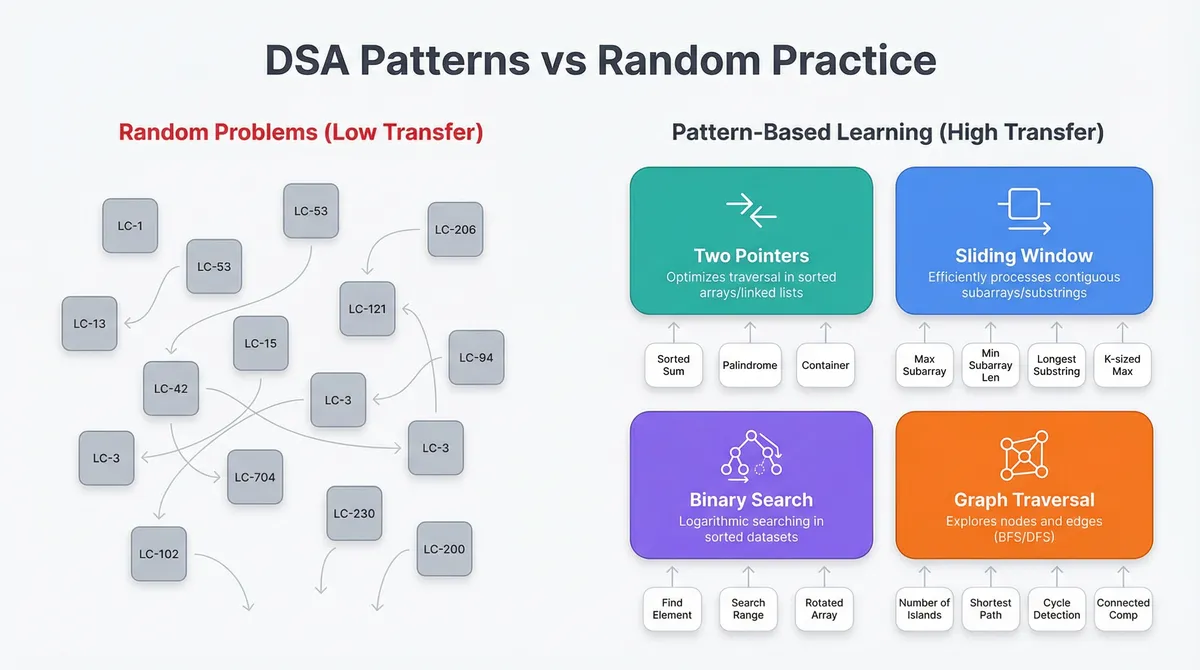
Grinding random problems with no structure
- 200+ problems, but no pattern recognition.
- Struggle to generalize from one problem to another.
-
Overfitting to editorial solutions
- Read solution immediately.
- Memorize code instead of learning the underlying pattern.
-
Ignoring communication and explanation
- Solve problems silently.
- No practice articulating thought process, trade-offs, or complexity.
-
No timed practice
- Take 90 minutes for a “medium” problem.
- In interviews, you get 25–35 minutes per problem.
Pattern-Based Learning vs Problem-Based Grinding
A more effective approach is to organize your prep around patterns rather than isolated problems:
- Sliding window
- Two pointers
- Fast & slow pointers
- Binary search on answer
- Top-K elements (heaps)
- Graph traversal (BFS/DFS)
- Dynamic programming patterns (knapsack, subsequence, interval, etc.)
For example, instead of solving 20 random array problems, you:
- Learn the two-pointer pattern: when and why it applies.
- Solve 5–8 problems that use two pointers in slightly different ways.
- Reflect: what changed, what stayed the same, what cues told you to use this pattern?
Platforms that organize questions by these patterns (like Thita’s LeetCode Patterns vs Topic-Wise Preparation: Which One Works Better?) help you build transferable intuition instead of shallow memorization.
9. You’re Not Practicing the Interview, Only the Code
Interviews are not just about writing correct code. They test:
- How you clarify problem statements
- How you reason about constraints and edge cases
- How you design solutions iteratively
- How you communicate under time pressure
If you’re only practicing in a text editor, you’re ignoring half the skill set.
What a Strong Coding Interview Flow Looks Like
- Restate the problem in your own words.
- Ask clarifying questions:
- Input size constraints?
- Are inputs sorted?
- Can we modify input in place?
- Discuss a brute-force approach:
- Time and space complexity.
- Why it might be too slow.
- Propose an optimized approach:
- High-level idea first.
- Then details, trade-offs, and complexity.
- Write clean, modular code:
- Good naming, small functions, handle edge cases.
- Walk through an example:
- Dry-run with a non-trivial test case.
- Analyze complexity:
- Time, space, and possible optimizations.
You can simulate this with a friend, or with structured tools that mimic real interview dynamics, such as an AI Mock Interviews vs Real Interviews: Do They Actually Help? platform that forces you to explain your reasoning out loud and gives feedback on both correctness and communication.
10. Misalignment Between Your Profile and Target Roles
Another subtle but important reason for not getting interview calls: you’re applying to roles that don’t match your current level or track.
Examples of Misalignment
-
New grad → Senior roles
Applying to “Senior Software Engineer” when you have academic projects only. -
Career switcher → Highly specialized roles
Coming from non-tech background, applying to “Distributed Systems Engineer” at FAANG with no systems experience. -
Frontend-heavy background → Pure backend roles
Resume shows React, CSS, UI work; applying to roles that require deep database and concurrency knowledge.
Fixing Role Alignment
- Be honest about your level
- New grad / junior / mid-level based on years and depth of experience.
- Target roles that match your strongest narrative
- If your best work is in frontend, target frontend roles first.
- Bridge the gap with focused projects
- Want backend roles? Build 2–3 serious backend-heavy projects:
- Services with databases, caching, authentication, testing, deployment.
- Want backend roles? Build 2–3 serious backend-heavy projects:
- Use your resume to tell a coherent story
- Don’t list every tech you’ve ever touched.
- Prioritize the stack that aligns with your target roles.
11. Common Pitfalls: Why “LeetCode but No Interviews” Persists
Here’s a concise list of recurring tech interview preparation mistakes that keep candidates stuck:
- Treating LeetCode as the entire job search strategy.
- Ignoring resume and LinkedIn optimization.
- Not tailoring applications to specific roles or companies.
- Lack of real-world projects or experience to show practical skills.
- Relying only on online applications, no networking or referrals.
- Practicing problems without patterns, reflection, or time constraints.
- Not simulating real interviews (no communication practice).
- Applying to roles far above current experience level.
- Underestimating how much presentation (resume, profile, communication) matters.
If you recognize yourself in several of these, that’s likely why you’re not getting interview calls.
12. A Concrete Step-by-Step Plan to Fix This
To move from “LeetCode but no interviews” to consistent interview calls, here’s a practical roadmap.
Step 1: Fix Your Resume and LinkedIn (1–2 weeks)
- Rewrite your resume:
- Impact-focused bullet points.
- Clear role alignment.
- ATS-friendly format and keywords.
- Mirror key elements on LinkedIn:
- Strong headline and About section.
- Detailed experience and projects.
Step 2: Build or Upgrade 2–3 Serious Projects (3–6 weeks)
- Pick projects that:
- Use the stack you want to work in.
- Have non-trivial requirements (auth, search, background jobs, etc.).
- Are deployed somewhere (Render, Railway, AWS, etc.).
- Document them well on GitHub:
- Clear README.
- Architecture overview.
- How to run locally.
Step 3: Switch to Pattern-Based LeetCode Practice (Ongoing)
- Organize your prep by patterns:
- Arrays & two pointers
- Hashing & maps
- Trees & graphs
- DP patterns
- For each pattern:
- Learn the core idea.
- Solve 5–10 representative problems.
- Write a short summary of the pattern in your own words.
Step 4: Simulate Real Interviews (2–4 weeks)
- Do mock interviews:
- With peers.
- With mentors.
- With tools that emulate interviewers and give feedback on both code and communication (e.g., an Best AI Interview Prep Tools of 2026: Compare Top Platforms & Features).
- Focus on:
- Explaining your thought process.
- Handling hints gracefully.
- Writing clean code under time constraints.
Step 5: Apply Strategically and Network (Ongoing)
- For each application:
- Tailor your resume slightly to the JD.
- Highlight the most relevant projects and skills.
- Each week:
- Reach out to 5–10 engineers or alumni in your target companies.
- Ask for advice, not referrals; referrals often follow naturally from good conversations.
- Track:
- Applications sent.
- Responses.
- Interviews scheduled.
- Rejections and reasons (if given).
Key Takeaways
- If you’re not getting interview calls, the issue is rarely just your LeetCode performance.
- The hiring funnel includes market fit, resume, ATS filters, portfolio, and networking—all before anyone sees your algorithm skills.
- Grinding more problems without fixing your resume, profile, and project story will not move the needle.
- Move from problem-count mindset to signal-strength mindset:
- Strong, focused resume.
- Real projects with measurable impact.
- Pattern-based DSA learning.
- Realistic interview simulations.
- Targeted applications and networking.
LeetCode is necessary for many tech interviews, but it’s not sufficient. Once you treat it as one component of a broader, deliberate strategy, you’ll start seeing more interview calls—and you’ll be prepared to convert them.