
Interview
Yahoo Interview Questions and Process: The Complete Guide (2026)
Prepare for Yahoo software engineering interviews with a practical guide to the reported loop, technical screens, design discussions, and a focused 30-day plan.
Yahoo interview questions are best prepared for as a modern software engineering loop: expect an initial screen, technical coding discussion, possible design conversation, and behavioural evaluation. Reported company-specific accounts are thin and vary by team, so confirm the exact format with your recruiter. Start with transferable technical fundamentals: Yahoo’s interview kit contains 15 mapped DSA questions, while the free DSA Patterns Sheet and timed practice help you build the recognition, explanation and debugging habits that travel across teams.
Yahoo’s interview kit is a useful place to focus your preparation on questions mapped to the company.
The process at a glance
There is no reliable, current company-specific round map that supports claiming a fixed Yahoo sequence, round count, platform or time limit. The table below is therefore a preparation map for the general stages commonly found in software engineering hiring, rather than a promised Yahoo script.
| Stage | Likely format | What to prepare | What it screens for |
|---|---|---|---|
| Initial screen | Recruiter or hiring conversation | Role fit, experience summary, motivation | Communication and basic fit |
| Technical screen | Live coding or technical discussion | DSA patterns, complexity, clear narration | Structured problem solving |
| Deeper technical loop | Coding and project discussion | Clean implementation, debugging, trade-offs | Engineering judgement |
| Design discussion | System or component design, role-dependent | Requirements, interfaces, scale, trade-offs | Technical reasoning |
| Behavioural conversation | Experience and collaboration questions | Ownership stories and reflection | Teamwork and maturity |
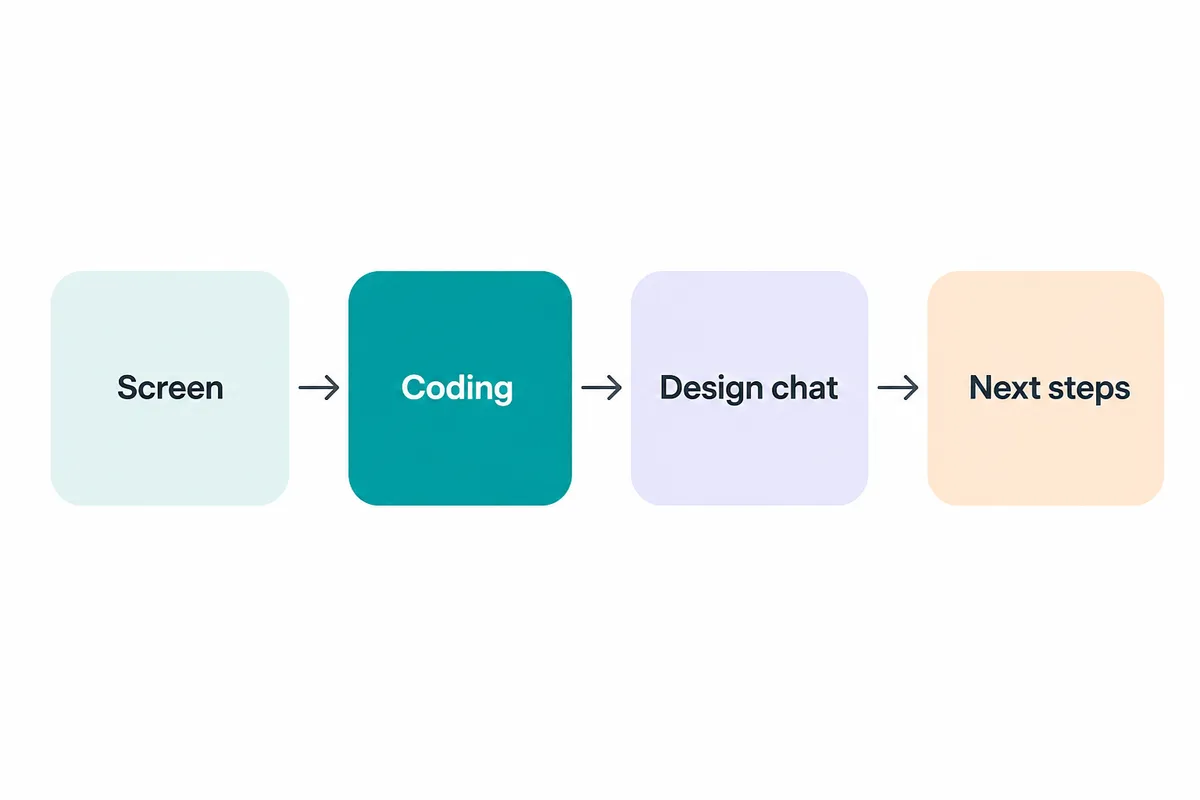
Ask your recruiter what the upcoming stage will assess. Ask whether it is coding, design, project discussion or behavioural; whether you will use a shared editor; and whether there is anything role-specific to revise. That is how you avoid treating a conversation about your experience as though it were a coding test, or arriving at a design discussion without a framework.
Initial screen — establish fit and context
An initial screen usually checks the practical conditions around the role as well as your ability to explain your background. Be ready to describe the kind of systems you have worked on, the languages you use most confidently, the type of role you want, and why the opportunity makes sense for you.
Do not treat this as a casual chat. A concise, coherent account of your work makes every later conversation easier. Prepare a short version of your background, then a deeper version for follow-up questions. The short version should cover your current scope, a meaningful technical contribution, and the direction you want to grow in.
Because Yahoo-specific candidate accounts are limited, do not assume a particular specialism will dominate. Read the job description closely. If it mentions backend services, prepare service ownership and API decisions. If it mentions infrastructure, revisit reliability, observability and performance. If it mentions product engineering, be ready to connect technical choices to user outcomes.
Preparation goal: explain your experience without reciting your CV. Interviewers need to understand what you owned, what constraints existed, and how you made decisions.
Technical coding screen — demonstrate the fundamentals
A coding screen generally tests whether you can turn an ambiguous problem into correct, readable code while communicating your reasoning. The underlying topics are familiar: arrays, strings, hash maps, trees, graphs, recursion, sorting, searching and dynamic programming. The hard part is often not memorising an advanced technique. It is identifying the right pattern quickly and then implementing it reliably.
Use Yahoo’s interview kit to work through the 15 mapped DSA questions with a deliberate process:
- Restate the task in your own words.
- Ask about inputs, constraints and edge cases.
- Describe a direct solution before jumping to an optimised one.
- State time and space complexity.
- Write code in small, testable steps.
- Dry-run the result aloud.
This approach is more robust than attempting to recognise a question from memory. A prompt may be phrased differently from anything you have practised, while the underlying pattern remains the same.
For a sharper way to build that recognition, read how to identify the right DSA pattern in a coding interview. The DSA Patterns Sheet is free to browse and lets you practise by recurring solution shape rather than by a long, unstructured list.
💡 Pro Tip: Narrate decisions before you make them. “I am using a hash map because I need constant-time lookups for previously seen values” is stronger than silently writing one and hoping the interviewer infers your reasoning.
Deeper technical discussion — show how you engineer
Later technical stages often distinguish candidates who can solve a puzzle from candidates who can build and maintain software. The discussion may still include coding, but the bar expands: code quality, test cases, error handling, trade-offs, debugging and your ability to adjust when requirements change.
This is where a technically correct solution can still underperform. A solution that works only for the happy path, has unclear naming, or cannot be explained is difficult for an interviewer to credit as production-minded engineering. Make your code easy to inspect:
- use names that reveal intent;
- separate parsing, core logic and output where useful;
- test empty, minimal and unusual inputs;
- identify assumptions explicitly;
- improve only after the core solution works.
Practise in a realistic editor with in-browser code practice. The aim is not to produce the most elaborate answer. It is to produce a correct answer that another engineer can understand, question and extend.
A useful rehearsal exercise is to take a completed problem and explain it aloud as though you were handing it over in a code review. If you struggle to explain why a loop invariant holds, why a data structure is appropriate, or where an edge case is handled, revisit the solution until you can.
Design discussion — reason from requirements to trade-offs
A design conversation may appear in a software engineering loop, especially for experienced candidates or roles with platform, backend or architecture responsibilities. With thin Yahoo-specific reporting, it would be inaccurate to present a fixed design round as universal. Prepare for it as a role-dependent possibility.
The screen is usually less about naming fashionable technologies and more about making sound decisions from incomplete requirements. Start by clarifying the system’s users, core actions, expected scale, correctness needs and failure tolerance. Then establish a simple baseline before adding components.
A dependable structure is:
Clarify the problem. Who uses the system? What are the critical flows? Which requirements are functional, and which are quality constraints?
Define the data and interfaces. What entities exist? What does each service own? What requests and responses matter?
Draw the simplest viable design. Begin with the core path. Avoid introducing queues, caches, partitions or replicas before explaining why they solve a real need.
Discuss pressure points. Where might latency, traffic, storage, consistency or failures become difficult? Explain the trade-off you would make.
Close with evolution. Describe what you would measure and what you would change if usage grew or requirements shifted.
The System Design Sheet is free to browse if you need a structured way to revisit these foundations. For component-level thinking, the Low Level Design Sheet is also free to browse. The distinction matters: low-level design versus high-level design explains what interviewers tend to expect at each level.
Behavioural conversation — make your contribution legible
Behavioural questions are not filler between technical rounds. They help an interviewer understand how you work when the specification is unclear, a launch goes wrong, a colleague disagrees, or a project needs someone to take ownership.
Prepare several stories from your experience, each with a clear situation, your specific responsibility, the actions you took, the result, and what you learned. Good topics include:
- resolving a difficult technical disagreement;
- improving a flawed process;
- recovering from an incident or missed expectation;
- making a trade-off under pressure;
- learning an unfamiliar area quickly;
- helping another engineer succeed.
Avoid turning every answer into a success story. A thoughtful account of a mistake can be compelling when you explain what changed in your approach afterwards. The key is specificity. “We improved performance” is vague; “I profiled the slow path, changed the query strategy, measured the result and documented the rollback plan” gives an interviewer something concrete to evaluate.
Use an AI mock interview to practise speaking under light pressure. It is particularly useful for identifying answers that are technically accurate but too long, too abstract or unclear about your own role.
Named Yahoo rituals: what is actually known
No sourced company-specific named ritual, platform, fixed timing or distinctive interview format was available for Yahoo in the current research. That is worth stating plainly because candidates are often harmed by false precision: a confident-looking preparation guide can make an unsourced claim feel like policy.
Prepare for transferable parts of engineering interviews and use the recruiter conversation to narrow the scope. Ask what type of discussion is next, whether the role is more product, platform or infrastructure-oriented, and whether you should expect coding, design or project depth.
This uncertainty is why your preparation should be modular. Keep DSA practice active, maintain a design framework, and rehearse project stories. You can then shift emphasis quickly when the actual loop becomes clear.
Is the Yahoo interview hard?
The honest answer is that difficulty depends heavily on the team, level and role because reliable Yahoo-specific interview reports are limited. There is not enough current evidence to responsibly state a fixed number of rounds or a typical end-to-end timeline.
That does not mean preparation is impossible. Most software engineering loops remain demanding for the same reasons: you need to solve unfamiliar problems, explain your thinking clearly, write dependable code, discuss trade-offs, and demonstrate that you work well with others.
The difficulty becomes manageable when you stop treating preparation as a question bank exercise. Focus on repeatable behaviours:
- recognise common problem patterns;
- communicate before coding;
- test your work deliberately;
- make trade-offs explicit;
- tell credible stories about your own engineering decisions.
Confirm the actual process with your recruiter, especially if you are interviewing for a specialised team. Then bias your final preparation towards the next known stage rather than spending equal time on every possible format.
A 30-day Yahoo interview preparation plan
Days 1–7 — build pattern recognition
Work through arrays, strings, hash maps, two pointers, sliding windows, binary search, trees and graphs. Do not merely read solutions. Solve first, then compare your approach with an editorial and identify the missed signal.
Use Yahoo’s interview kit as your company-mapped practice set, and supplement it with the free DSA Patterns Sheet. Keep a small error log: missed edge cases, complexity mistakes, syntax slips and moments where you started coding too soon.
Days 8–14 — practise live-round communication
Continue coding, but make every session verbal. State your assumptions, propose an approach, discuss complexity, then dry-run examples. Record yourself if possible. The goal is to make your reasoning easy to follow without becoming overly talkative.
Read what interviewers actually look for in live coding rounds and practise its central lesson: interviewers can evaluate only the thinking they can observe.
Days 15–21 — add design and project depth
Choose a small system or component and practise designing it from requirements. Focus on clean interfaces, failure cases and trade-offs rather than trying to cover every technology. Review the free design sheets, then explain your design aloud.
At the same time, write notes for your strongest project stories. Be precise about your own contribution, constraints, decisions and outcomes.
Days 22–30 — rehearse the full experience
Alternate coding, design and behavioural practice. Use AI mock interviews to rehearse switching between technical explanation and experience-based questions. In the final days, revisit your error log rather than cramming unfamiliar topics.
Your aim is calm execution: clarify, reason, build, test and reflect.
The Yahoo-specific preparation advantage: prepare for uncertainty well
Most company interview guides offer a precise-looking sequence. For Yahoo, current sourcing does not justify that certainty. The company-specific advantage is therefore not a secret ritual or guessed platform; it is preparation that remains useful despite incomplete information.
That means building a compact, adaptable system:
- a set of DSA patterns you can recognise quickly;
- a dependable framework for design conversations;
- project stories with evidence of ownership;
- recruiter questions that clarify the next stage.
Candidates often waste effort trying to predict an exact prompt. A better strategy is to make your process visible and reliable across prompts. If the technical screen is coding-heavy, you can communicate and test. If it becomes a design discussion, you can clarify and trade off. If it shifts to project depth, you can show ownership without exaggeration.
That adaptability is a genuine interview skill, not a fallback plan.
Frequently asked questions
What are common Yahoo interview questions for software engineers?
Current company-specific reporting is limited, so prepare for common software engineering topics: data structures, algorithms, complexity analysis, code quality, design trade-offs and project experience. Yahoo’s kit has 15 mapped DSA questions to start with.
How many interview rounds does Yahoo have?
There is no reliable current source supporting a fixed Yahoo round count. Reported accounts are thin and may vary by team and role. Confirm the sequence with your recruiter.
Does Yahoo have a coding interview?
Technical coding is a common part of modern software engineering hiring, and it is sensible to prepare for it. Focus on pattern recognition, clear explanation and correct implementation.
Does Yahoo ask system design questions?
A design discussion may be role- and level-dependent, but there is not enough current Yahoo-specific sourcing to describe it as universal. Prepare a basic design framework if the role involves backend, platform or senior engineering work.
How difficult are Yahoo interview questions?
Difficulty depends on the role, level and team. The most reliable preparation is to master transferable coding patterns, complexity reasoning, testing and communication.
What should I ask the recruiter before a Yahoo interview?
Ask what the next stage evaluates, whether it involves coding or design, what tools will be used, and whether the role has a particular technical focus. This helps you prioritise your preparation.
How should I prepare for a live coding round?
Practise solving problems aloud. Clarify requirements, discuss your approach before coding, state complexity, test edge cases and explain any trade-offs. Avoid working silently.
How should I prepare for behavioural questions?
Prepare specific stories about ownership, collaboration, disagreements, mistakes, delivery and learning. Make your individual contribution clear rather than describing only what the team did.
How long should I prepare for a Yahoo interview?
A structured 30-day plan is enough to improve substantially if you practise consistently. If your interview is sooner, focus first on the format your recruiter confirms.
Where to start
Begin with the technical fundamentals that remain valuable whatever your Yahoo loop looks like: solve problems methodically, explain your choices, test carefully and practise discussing real engineering work.
Open Yahoo’s interview kit to practise the 15 mapped DSA questions. Then use the free sheets to strengthen your foundations and an AI mock interview to rehearse the coding, design and behavioural conversations that a modern engineering loop may include.
Interview processes change and differ across teams. Confirm the exact format with your recruiter before the interview, then use that information to focus your final preparation.
Topics
Related on Thita
Your next step
Practise with AI mock interviews
A spoken interview that asks follow-up questions, runs your code and ends with a written report.