
Interview
Yandex Interview Questions and Process: The Complete Guide (2026)
Prepare for Yandex software engineering interviews with a practical guide to likely rounds, coding expectations, preparation priorities, and a 30-day plan.
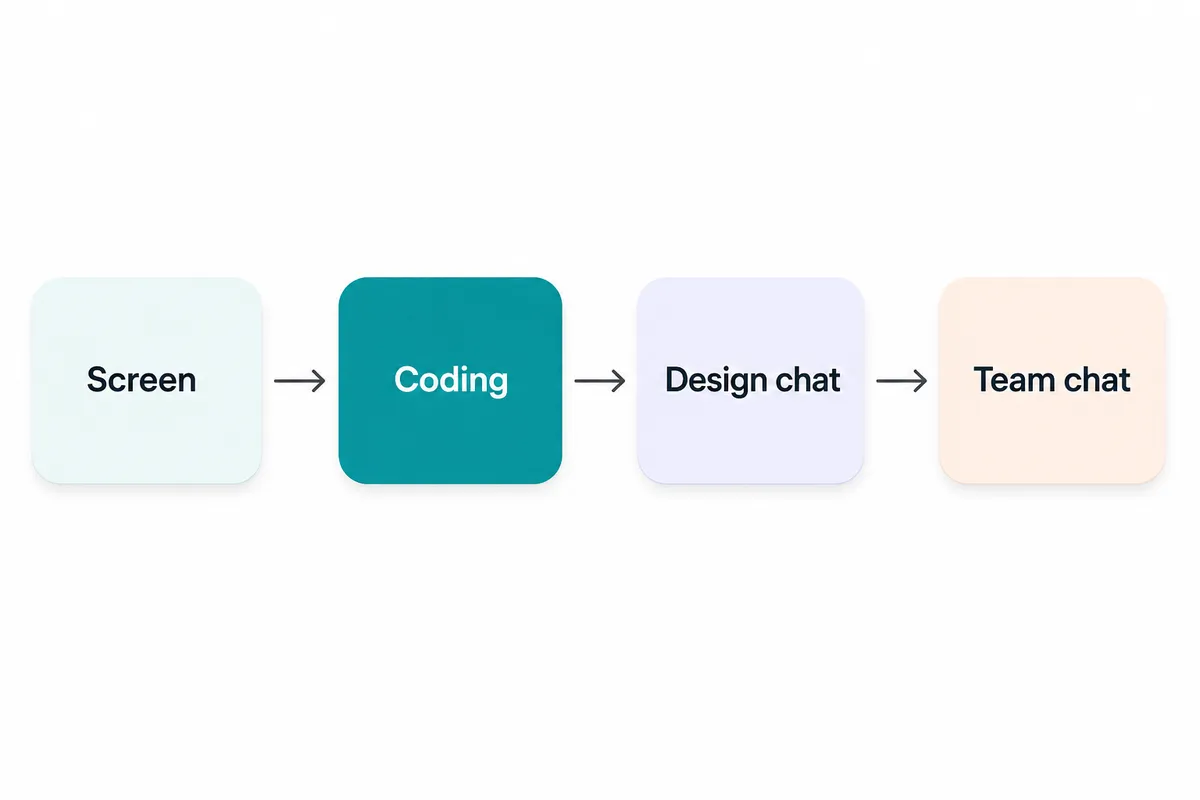
Yandex interview questions are best prepared for as a modern software engineering loop: expect an initial screen, a technical coding conversation, later interviews that may include design and project discussion, and a behavioural evaluation. Reported accounts for Yandex are thin and vary by team, so confirm the exact format with your recruiter. What you can prepare now is the transferable bar: recognising data-structure patterns, explaining trade-offs clearly, writing correct code, and discussing your work with ownership. Yandex’s interview kit contains 17 mapped DSA questions to help you practise those core coding skills.
This guide separates what is generally useful to prepare from what should be verified for your particular Yandex role. That distinction matters. A candidate who treats an uncertain process as an excuse to prepare vaguely loses time; a candidate who prepares the foundations and asks precise recruiter questions arrives with a usable plan.
The process at a glance
There is no reliable, current company-specific account that supports a fixed Yandex interview sequence, round count, platform, or timing. Candidate experiences can differ across teams, locations, and seniority. The table below is therefore a preparation model for the general shape of a software engineering loop, not a claimed Yandex script.
| Stage | Likely format | What to prepare | What it screens for |
|---|---|---|---|
| Initial screen | Recruiter or hiring conversation | Role fit, experience summary, motivation | Communication and baseline fit |
| Technical screen | Live coding or technical discussion | DSA patterns, complexity, clear narration | Structured problem solving |
| Further technical interviews | Coding, design, or project depth | Implementation, trade-offs, fundamentals | Engineering judgement |
| Team conversation | Project and collaboration discussion | Ownership stories and technical decisions | Working style and level fit |
| Final steps | Team-dependent | Questions for the team and role clarity | Mutual fit and expectations |
Use this as a checklist, then replace assumptions with facts. Ask your recruiter whether there is an online test, whether coding is live or asynchronous, whether a design discussion is expected, what language options are available, and how many conversations are planned. These are reasonable questions, not signs of poor preparation.
Initial screen — establish the role and your story
An initial screen usually establishes whether your experience, interests, location, and working preferences align with the opening. It may be brief, but it is worth preparing for because it determines the frame of later interviews.
Your goal is not to deliver a memorised biography. Give a concise account of what you build, the kinds of problems you enjoy, and why the role is a sensible next step. Keep it grounded in work you can later defend technically. If you say you led a migration, expect later questions about the architecture, risks, rollout plan, failures, and your personal decisions.
Prepare a two-minute version of your background and a longer version of two significant projects. For each project, know:
- the user or business problem;
- your specific responsibility;
- the technical constraints;
- the decision you influenced;
- what went wrong or changed;
- what you would do differently now.
This preparation pays off beyond the screen. It gives you material for technical deep dives and behavioural questions without having to invent answers under pressure.
Technical coding — demonstrate repeatable reasoning
The technical screen is the round most likely to test your ability to solve a programming problem while communicating. The prompt may vary, but the underlying evaluation is usually stable: can you turn an ambiguous problem into a correct solution, explain your choices, and reason about performance?
Treat every coding problem as a sequence rather than a race to type:
- Restate the problem and identify inputs, outputs, and constraints.
- Work through a small example aloud.
- Explain a simple approach before improving it.
- Name the data structure or pattern you intend to use.
- State time and space complexity.
- Test edge cases after implementation.
This structure makes your reasoning visible. It also catches errors before they become a rewrite halfway through the conversation. For a detailed explanation of that habit, read how to explain your thought process clearly in coding interviews.
The most efficient preparation is pattern-led rather than random. Arrays, hash maps, trees, graphs, binary search, recursion, and dynamic programming recur because they reveal how you model a problem. The free-to-browse DSA Patterns Sheet helps organise that practice around recognition rather than topic labels.
💡 Pro Tip: When you finish coding, do not stop at “this should work”. Walk through one ordinary case, one boundary case, and one failure-prone case aloud. That final minute often demonstrates more engineering maturity than a faster first draft.
Further technical interviews — coding, design, and fundamentals
Reported accounts do not establish a standard Yandex design round or a fixed later-stage technical format. Still, later interviews in a software engineering process commonly go deeper than an initial coding screen. They may return to coding with a harder or more open-ended problem, discuss the design of a component or service, or examine decisions from your past work.
For coding, prepare to justify alternatives. An interviewer may ask, “What if the input is much larger?”, “How would you reduce memory use?”, or “What changes if updates are frequent?” These follow-up questions test whether you understand the shape of your solution rather than whether you recognised a familiar exercise.
For design discussion, begin with clarification. Ask about users, scale, consistency needs, failure handling, data ownership, and what is explicitly out of scope. Then describe a simple baseline before adding complexity. A sound answer makes trade-offs explicit: a faster read path may make writes harder; caching may improve latency but introduce invalidation work; a simpler component may be easier to operate.
The distinction between component-level and architecture-level discussion is useful here. Low-level design versus high-level design explains what each format tends to assess. The Low Level Design Sheet and System Design Sheet are free to browse when you want structured practice in either area.
If fundamentals arise, do not bluff. Refresh the principles behind the systems you have used: process versus thread, database indexes, network requests, caching, transactions, and failure modes. The free Operating Systems Sheet is useful for rebuilding that vocabulary around concepts rather than memorised definitions.
Team and behavioural discussion — show ownership
Technical strength is necessary, but a software engineer is hired to work with people, make decisions under incomplete information, and learn from outcomes. A team or behavioural discussion commonly tests those capabilities through your own experience.
Prepare stories that show more than success. Strong answers include tension: a disagreement you handled, an incident you investigated, a decision you reversed, an unclear requirement you clarified, or a piece of feedback that changed your approach. Use a simple structure:
- Situation: What was happening?
- Task: What were you responsible for?
- Action: What did you personally do?
- Result: What changed, and what did you learn?
Avoid hiding behind “we”. Teams do the work together, but interviewers still need to understand your contribution. Be precise about where you made the call, where you gathered input, and where someone else led.
An AI mock interview can help you rehearse these stories aloud. The point is not to sound polished in a theatrical way. It is to become comfortable explaining complex work plainly, including uncertainty and mistakes.
Named rituals and what is actually known
No current sourced research identifies a named Yandex interview ritual, a standardised platform, or a company-wide sequence that can be described responsibly here. That does not mean your process will be unstructured; it means public reports are too thin to turn an assumption into advice.
Use the uncertainty productively. Before the first interview, ask:
- Which stages are confirmed?
- Is there a coding exercise before live interviews?
- Is a design discussion expected for this level?
- Should I prepare to discuss a past project in depth?
- What language and collaboration environment will be used?
- Is there anything the team particularly values in the technical conversation?
Write down the answers. Then make your preparation plan fit the actual process rather than an internet template. This is especially important if you are interviewing for a specialised team, where domain knowledge can shape the conversation.
Is the Yandex interview hard?
It is hard in the way most software engineering interviews are hard: the evaluation compresses problem solving, communication, implementation, and professional judgement into a small number of high-pressure conversations.
The difficulty is less about finding one obscure trick and more about being consistently clear. Candidates often know the relevant data structure but lose credit by coding before clarifying requirements, failing to test boundary cases, or staying silent while they think. Others prepare coding heavily but cannot explain the technical choices on their own résumé.
How many rounds are there? There is no dependable current public consensus on a fixed Yandex round count. Reported accounts are thin and team-dependent, so ask your recruiter for the planned sequence.
How long does the process take? A reliable Yandex-specific timeline is not available from the sourced research. Confirm expected scheduling and decision timing directly with the recruiting contact.
The practical conclusion is not to delay preparation until every detail is known. Build the broad technical foundation first, then use recruiter guidance to allocate the final stretch.
A 30-day preparation plan
Days 1–7 — rebuild core patterns
Start with common coding shapes: arrays and hash maps, two pointers, sliding windows, stacks, queues, trees, and graph traversal. Focus on explaining why a pattern fits, not merely remembering a solution.
Use the free DSA Patterns Sheet for focused review, and read the guide to graph traversal patterns if BFS and DFS still feel interchangeable. At the end of each session, explain one solved problem aloud without looking at your code.
Days 8–14 — practise under interview conditions
Work through Yandex’s interview kit, which contains 17 mapped DSA questions. Do not rush through them as a checklist. For each problem, identify the pattern, give a brute-force approach, improve it, implement it, and test it.
Use a timer for some sessions. More importantly, practise narrating. The code practice environment is useful for writing and checking solutions, but include spoken reasoning in your routine as well.
Days 15–21 — add technical depth
Alternate coding sessions with design and fundamentals review. Sketch a small service or component and explain its boundaries, data model, failure cases, and likely extension points. Refresh the systems topics most relevant to your experience so you can discuss real decisions rather than textbook definitions.
If dynamic programming is a weak point, use this guide to dynamic programming patterns to focus on state definition and recurrence reasoning rather than memorising templates.
Days 22–30 — simulate the real conversation
Run full mock sessions: one coding interview, one project deep dive, one behavioural discussion, and one design conversation if your recruiter confirms it is relevant. Review recordings or notes for communication failures: unanswered clarification questions, unexplained complexity, long silences, or vague ownership.
Keep the final days lighter. Revisit mistakes, prepare questions for the team, test your interview setup, and make sure you can discuss your strongest projects naturally.
The Yandex-specific challenge: preparing well without a public script
The unusual feature of Yandex interview preparation is not a confirmed ritual or a famous named round. It is the lack of a dependable public script. Many interview guides create false certainty by presenting a fixed sequence, exact timings, and definitive question categories. For Yandex, that confidence would not be earned by the available evidence.
Your advantage comes from treating process discovery as part of preparation. A recruiter conversation can turn broad preparation into targeted preparation quickly, but only if you ask informed questions and have already built the fundamentals.
That is why the right starting point is Yandex’s interview kit. Its 17 mapped DSA questions provide a concrete coding practice set while you clarify the rest of the loop. Pair that work with design rehearsal and behavioural stories, rather than betting everything on an unverified format.
Frequently asked questions
What kinds of Yandex interview questions should I practise?
Prioritise coding questions that test pattern recognition, complexity analysis, and clean implementation. Also prepare to discuss your projects, technical decisions, and collaboration experience.
How many interview rounds does Yandex have?
There is no reliable current public consensus on a fixed number. Reported accounts vary by team, so confirm the planned stages with your recruiter.
Does Yandex use an online assessment?
The sourced research does not establish a dependable company-wide answer. Ask whether an early coding exercise is part of your specific process.
Are Yandex coding interviews difficult?
Prepare for the standard difficulty of a software engineering coding interview: solving correctly is important, but explaining your approach, complexity, and tests is equally important.
Should I practise data structures and algorithms for Yandex?
Yes. Pattern recognition and complexity reasoning are transferable technical interview skills, and Yandex’s interview kit contains 17 mapped DSA questions.
Will there be a system design interview?
That is not confirmed by the available Yandex-specific research. Design discussions are more likely to depend on role and seniority, so ask your recruiter directly.
What programming language should I use?
Use the language in which you can write correct, readable code and explain trade-offs confidently. Confirm permitted languages before the interview.
How should I prepare for a project deep dive?
Choose two projects and prepare to explain the problem, your contribution, technical decisions, constraints, failures, outcomes, and what you would improve.
How long does the Yandex hiring process take?
A dependable Yandex-specific timeline is not available in the sourced research. Ask the recruiter about scheduling and expected next steps.
Where to start
Start with the work that remains valuable regardless of the final format: solve coding problems by pattern, explain every decision aloud, and prepare honest stories about your technical work.
Open Yandex’s interview kit to practise the 17 mapped DSA questions associated with Yandex. Then use the free-to-browse DSA Patterns Sheet to strengthen weak areas and an AI mock interview to rehearse coding explanations, project discussions, and behavioural answers.
Interview formats can change by team and role. Confirm the details with your recruiter, but do not wait for perfect certainty before building the skills every technical conversation rewards.
Topics
Related on Thita
Your next step
Practise with AI mock interviews
A spoken interview that asks follow-up questions, runs your code and ends with a written report.