
Interview
Yoodli Coaches How You Speak. What Grades Your Code and Design?
Yoodli improves spoken delivery. Learn why technical interviews also require code execution, design evaluation, and adaptive follow-up practice today.
A technical interview is not only a test of whether you can find the right answer. It is also a test of whether you can explain your reasoning, react when your first idea fails, write working code, and defend design choices when an interviewer pushes back.
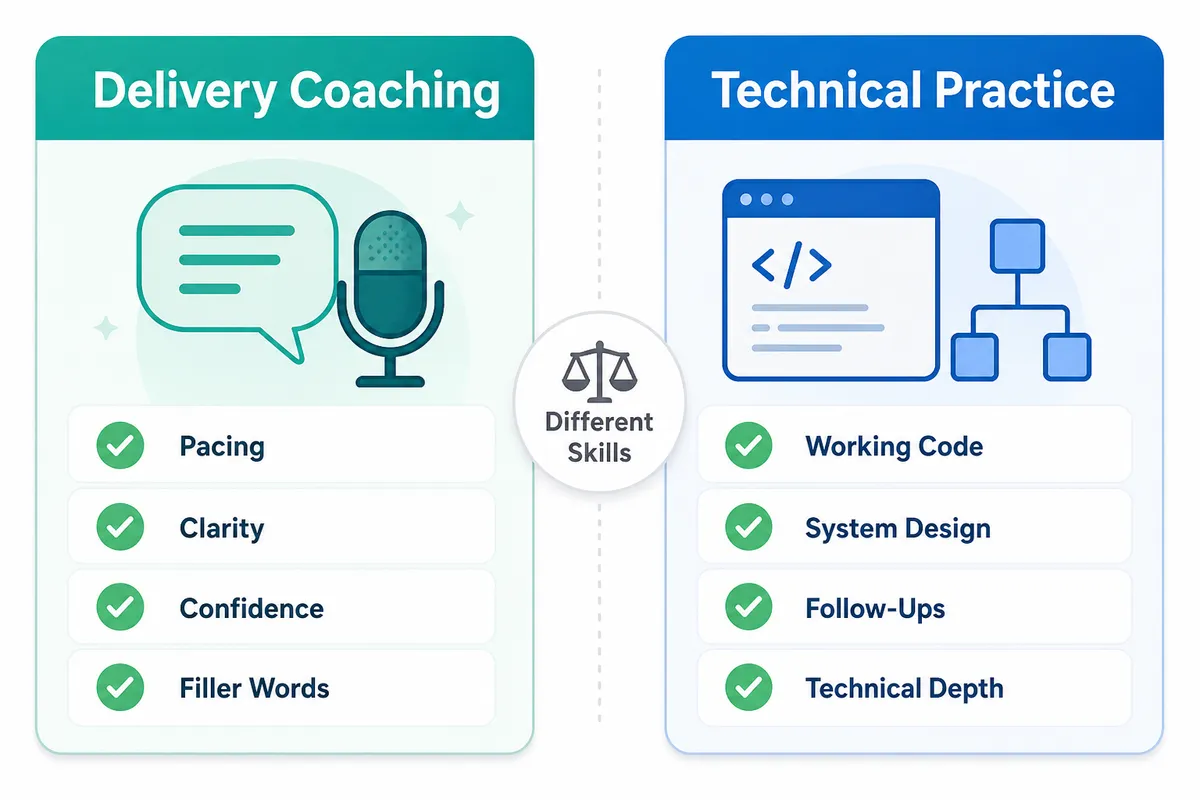
That is why tools such as Yoodli can be genuinely useful. Yoodli coaches spoken delivery: pacing, filler words, clarity, confidence, and how your answer comes across. Those are real interview skills. But candidates looking for yoodli for technical interviews should know where communication coaching ends and technical simulation begins.
A technical loop needs something else alongside speech feedback: code that compiles and runs, architecture that can be evaluated, and follow-up questions that respond to your choices. A live AI technical interview on Thita is designed for that second part.
The strongest preparation plan is not Yoodli or technical practice. It is using each tool for the job it actually does well.
What Yoodli is useful for
Interview nerves do not only make people forget answers. They also change how people speak.
You may rush through an explanation because silence feels uncomfortable. You may begin every answer with “um”, repeat the same phrase, over-explain a simple point, or finish a strong answer with an uncertain-sounding apology. None of those issues mean you are not capable. They can still affect how an interviewer experiences your answer.
Yoodli focuses on this layer of performance. It can help you notice patterns in your spoken delivery that are difficult to spot alone:
- Speaking too quickly when you feel pressure
- Using filler words repeatedly
- Losing structure halfway through an answer
- Giving answers that are too short to show reasoning
- Giving answers that are so long that the main point gets buried
- Sounding uncertain when you actually understand the subject
- Practising introductions, behavioural stories, presentations, and verbal explanations
For behavioural interviews, manager conversations, presentations, and early recruiter screens, that feedback can be especially valuable. A candidate with strong experience but unclear delivery may benefit quickly from hearing their own habits and correcting them deliberately.
💡 Pro Tip: Record yourself explaining a coding solution in two minutes. Then listen for whether you stated the problem, named your approach, discussed complexity, and explained edge cases. Delivery feedback is useful even when the subject is technical.
The important distinction is that communication coaching cannot verify whether your technical explanation is correct. A clear explanation of an incorrect algorithm is still an incorrect algorithm. A confident system design explanation may still omit a bottleneck, a failure mode, or a necessary data store.
That is the gap candidates need to fill.
Why a yoodli technical interview is not the same as a technical loop
When people search for a yoodli technical interview, they are often asking for more than speaking practice. They want the pressure and unpredictability of a real technical round.
A technical interview usually combines several forms of judgement at once:
- Problem solving: Can you identify the underlying pattern or constraint?
- Implementation: Can you turn that approach into working code?
- Testing: Can you spot edge cases and debug failures?
- Communication: Can you explain trade-offs without losing the thread?
- Adaptation: Can you respond when the interviewer changes the requirement?
- Technical depth: Can you reason about complexity, scaling, objects, APIs, data models, or distributed systems?
Speech coaching covers the fourth item well. It does not replace the other five.
Consider a common coding-round sequence:
“Find the first duplicate value in an array.”
You explain a hash-set approach clearly. You say it takes O(n) time and O(n) space. So far, your delivery may be excellent.
Then the interviewer asks:
- “Can you return the duplicate rather than a boolean?”
- “What happens if the input is empty?”
- “Can you solve it without extra memory?”
- “Please implement it.”
- “Why did this test fail?”
- “Can you make your variable names clearer?”
- “What would change if this data streamed continuously?”
The interview is no longer only about how you speak. It is about whether you can make technical decisions in real time.
The same is true in a system design round. You can sound polished while describing a notification system, but the interviewer may ask why you selected a queue, how you would handle duplicate delivery, what happens during a regional failure, or where rate limiting belongs. They are evaluating the architecture itself, not only your confidence in presenting it.
For a deeper look at what interviewers listen for while you explain, read how to think out loud in coding interviews. Good delivery matters. Correct reasoning matters more.
Speech coaching vs technical interview practice
The simplest way to compare them is to ask: what evidence does the tool use to give feedback?
A speech coach listens to your words, pace, repetition, and delivery. It can identify verbal habits and help you communicate more effectively.
A technical interview simulator needs to observe technical work. It should see the code you wrote, the test results it produced, the architecture you drew, and the trade-offs you selected. It should then ask the next question based on what actually happened.
| If you need to practise | You need feedback on |
|---|---|
| Answering “Tell me about yourself” | Structure, pace, confidence, and clarity |
| Explaining a past project | Delivery, story flow, ownership, and impact |
| Solving a DSA problem | Approach, code correctness, edge cases, and debugging |
| Handling a live coding round | Explanation, implementation, execution, and follow-ups |
| Designing a scalable system | Components, trade-offs, bottlenecks, and architecture |
| Discussing object-oriented design | Classes, interfaces, responsibilities, and extensibility |
This is why speech coaching vs technical interview practice is not a contest between a better and worse product. They are different practice environments.
A useful Yoodli alternative is not necessarily another speech coach. If your weakness is technical execution under interview pressure, you need a tool that tests execution. If your weakness is speaking too quickly, losing confidence, or rambling through an answer, a delivery coach may be exactly what you need.
⚠️ Important: Do not confuse a polished explanation with proof of technical readiness. In a real round, your interviewer can ask for code, challenge your complexity claim, introduce a constraint, or inspect the architecture you submitted.
What technical practice adds that delivery coaching cannot
The difference becomes clearest when you look at the moments candidates find hardest in real interviews.
1. Code that actually compiles and runs
A coding interview is often decided after your first implementation, not before it.
You may have chosen the right broad approach but made an off-by-one error. You may have forgotten an empty input. You may have misunderstood whether duplicates are allowed. You may have a syntax error because you have not used Java in several months.
That is why technical practice needs a real editor and real execution. You need to see what your code does, not only describe what you intended it to do.
Thita provides live voice AI interviews with a code editor that compiles and runs code. You can practise in six languages: Python, C++, Java, JavaScript, Go and C#. The AI can respond to your implementation and the direction of the interview, rather than treating your answer as a static written response.
If you want to work on coding fundamentals before a full mock, use in-browser code practice with AI feedback. Then move into a live AI interview with adaptive follow-ups when you are ready to practise the full conversation.
2. Follow-up questions that change the problem
Many candidates are prepared for a question. Fewer are prepared for the next question.
A real interviewer may accept your first solution and then ask you to reduce memory usage. They may introduce a larger input size, change a single assumption, or ask how your design behaves when one dependency fails. The best practice sessions include this movement because it is where memorised preparation tends to break down.
Adaptive follow-ups force you to do three useful things:
- Reassess assumptions rather than defend them automatically
- Explain trade-offs under pressure
- Recover when your original approach no longer fits
That recovery skill is worth practising. For practical tactics, see how to recover when you get stuck in an interview.
3. Architecture that can be evaluated
System design preparation is not just describing familiar boxes: client, API, cache, database, queue.
A meaningful practice environment needs to ask whether those components work together. Where is the source of truth? What happens when traffic spikes? How do you partition data? What is eventually consistent? How will you monitor failures? What are the trade-offs between cost, latency, and reliability?
Thita’s system design sessions use a canvas where you submit an architecture and the AI evaluates the architecture itself. That gives you feedback on the thing an interviewer would actually judge: your design decisions.
This does not mean no other options exist. Hello Interview, for example, is a real option for AI-evaluated system design work. The question is whether you want a tool focused on one type of round or a self-serve practice environment that can also cover coding, low-level design, machine coding, behavioural, product management, data science, AI and ML.
4. A realistic mix of rounds
Technical interviews are rarely only LeetCode-style coding questions.
Depending on the company and level, you may face DSA, system design, low-level design, machine coding, behavioural interviews, computer science fundamentals, product sense, SQL, statistics, or resume-based project discussion. A candidate preparing for all of these as separate, unrelated tasks often struggles to build momentum.
A good plan uses focused drills and full simulations. You might revise patterns one day, do a live coding session the next, and practise explaining your own project on the third. The 30-day technical interview preparation plan can help you organise that work without trying to do everything at once.
How to pair Yoodli with technical interview practice
You do not need to choose one platform and ignore the other. Pairing delivery coaching with technical simulation can create a more complete routine.
Here is a practical weekly structure for a candidate preparing for software engineering interviews.
Day one: solve and explain
Pick one DSA pattern. Solve two or three questions independently, then explain one solution aloud without looking at notes. Use speech coaching to notice pace, filler words, and whether your explanation has a clear beginning, middle, and end.
Day two: simulate a coding round
Do a live coding interview. Start by clarifying the question, narrate your approach, write code, run it, test edge cases, and handle follow-ups. Focus less on sounding polished and more on staying transparent when you are unsure.
Day three: review your weak point
If your code was correct but your explanation was scattered, use delivery coaching. If you sounded confident but missed edge cases, return to execution and debugging practice. Separate the symptom from the cause.
Day four: practise design or low-level design
Choose a system design prompt or an object-oriented design task. Draw the architecture, explain it aloud, and expect challenges. This is especially important for experienced candidates, where the interview often tests judgement rather than only implementation speed.
Day five: behavioural and resume practice
Use your own CV to rehearse project stories. Thita can generate resume-based interviews from your experience, which also works for non-technical roles. Then use speech coaching to tighten the stories that feel too long, vague, or overly rehearsed.
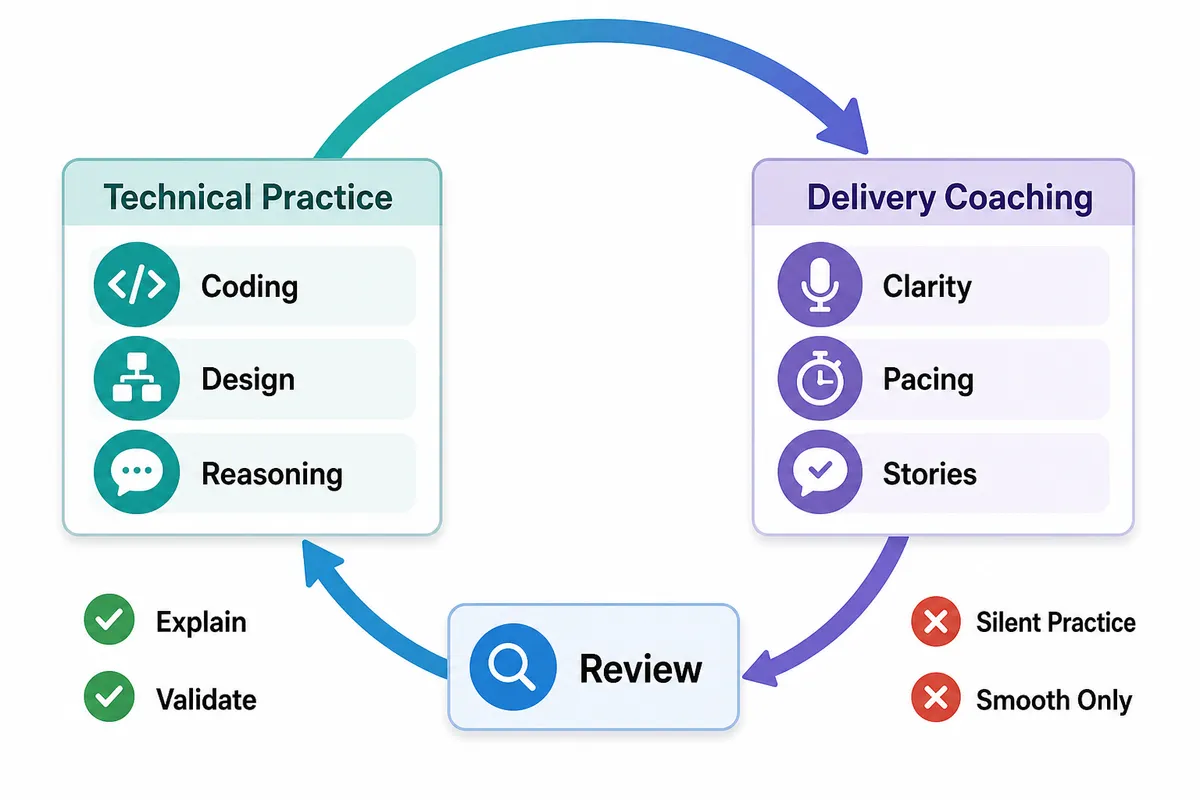
✅ Do use delivery coaching to improve how you communicate an answer.
✅ Do use a technical simulator to validate whether the answer works.
❌ Don't assume you are ready for coding rounds because you can explain a solution smoothly.
❌ Don't spend every session silently solving problems. Technical interviews are conversations, and silence is not the same as clear reasoning.
Frequently asked questions
Is Yoodli good for technical interviews?
Yoodli can be useful for the communication side of technical interviews. It helps with spoken delivery, pacing, filler words, and clarity. It does not grade your code or architecture, so pair it with technical practice that can evaluate implementation and design decisions.
What is the best yoodli alternative for coding interviews?
If you need coding interview practice rather than speech coaching, look for a platform with a live interviewer, code execution, feedback on test results, and adaptive follow-ups. Thita offers live voice AI interviews with a real code editor and technical rounds across several interview formats.
Can Yoodli tell whether my algorithm is correct?
No. Yoodli is designed for spoken communication coaching, not for compiling code, running tests, or evaluating algorithm correctness. You still need an environment that can run your implementation.
Why should code execution matter in mock interviews?
Code execution exposes syntax errors, incorrect assumptions, edge cases, and debugging habits. It also helps you practise the realistic moment when a test fails and you need to explain how you will investigate and fix it.
Can I practise system design as well as coding?
Yes. Thita supports system design practice on a canvas where the AI evaluates the submitted architecture. You can also practise low-level design and machine coding alongside DSA and behavioural rounds.
Do I need a partner for a technical mock interview?
No. AI interview practice can start when you are ready, without coordinating with a peer. This makes it easier to build repetition into a busy preparation schedule.
Can I use technical interview practice if I am not a software engineer?
Yes. In addition to engineering tracks, Thita supports behavioural, product management, data science, AI and ML interviews. Resume-based interviews generated from your own CV can also support non-technical roles.
Practise the full technical loop, not only the delivery
Clear speaking is a competitive advantage. If you explain your work calmly, structure your answers well, and avoid distracting verbal habits, interviewers can understand your strengths more easily.
But technical interviews demand proof as well as presentation. Your code must run. Your architecture must hold together. Your assumptions must survive follow-up questions.
Use speech coaching to improve how you speak. Then use a live AI technical interview practice session to test what you can actually build, debug, explain, and defend under pressure.
Start with the round you are most likely to face, then make your practice progressively less predictable.
If you are hiring rather than interviewing, visit interviews.thita.ai.
Topics
Related on Thita
Your next step
Try Thita before you decide
The Starter plan is free: pattern sheets, code execution in six languages and an AI mock interview. Pro adds more AI code feedback and mock interviews, company kits and the 90-day roadmaps.