
PM
Product Sense vs Execution Interviews: Key Differences Explained
Most product management candidates collapse when the interviewer switches from “What would you build?” to “How would you run this?” The content feels similar...
Most product management candidates collapse when the interviewer switches from “What would you build?” to “How would you run this?” The content feels similar, but the evaluation suddenly changes. That’s the core confusion behind product sense vs execution interviews in PM interviews.
This post breaks down the key differences, how interviewers think in each format, and how to practice product thinking in a way that cleanly separates what to build from how to make it work at scale.
What Are Product Sense and Execution Interviews?
At most tech companies, PM interviews are split into two major flavors:
- Product sense interview: Tests how you think about what to build and why.
- Execution interview: Tests how you think about how to deliver, operate, and improve what you’ve built.
Both are evaluating product thinking, but from very different angles.
Product Sense Interview in One Sentence
A product sense interview asks:
“Given a user, a problem, and a context, can you design the right product solution and reason clearly about trade-offs?”
You’re evaluated on:
- Understanding users and problems
- Structuring ambiguous spaces
- Generating and prioritizing solutions
- Defining success metrics at a product level
Execution Interview in One Sentence
An execution interview asks:
“Given an existing product and constraints, can you operate, improve, and make tough trade-offs to achieve outcomes?”
You’re evaluated on:
- Prioritization and trade-offs
- Metrics, diagnosis, and experimentation
- Handling ambiguity under constraints
- Risk management and alignment
These are complementary. Strong PMs can do both: invent the right product and then execute it reliably.
Side-by-Side: Product Sense vs Execution Interviews
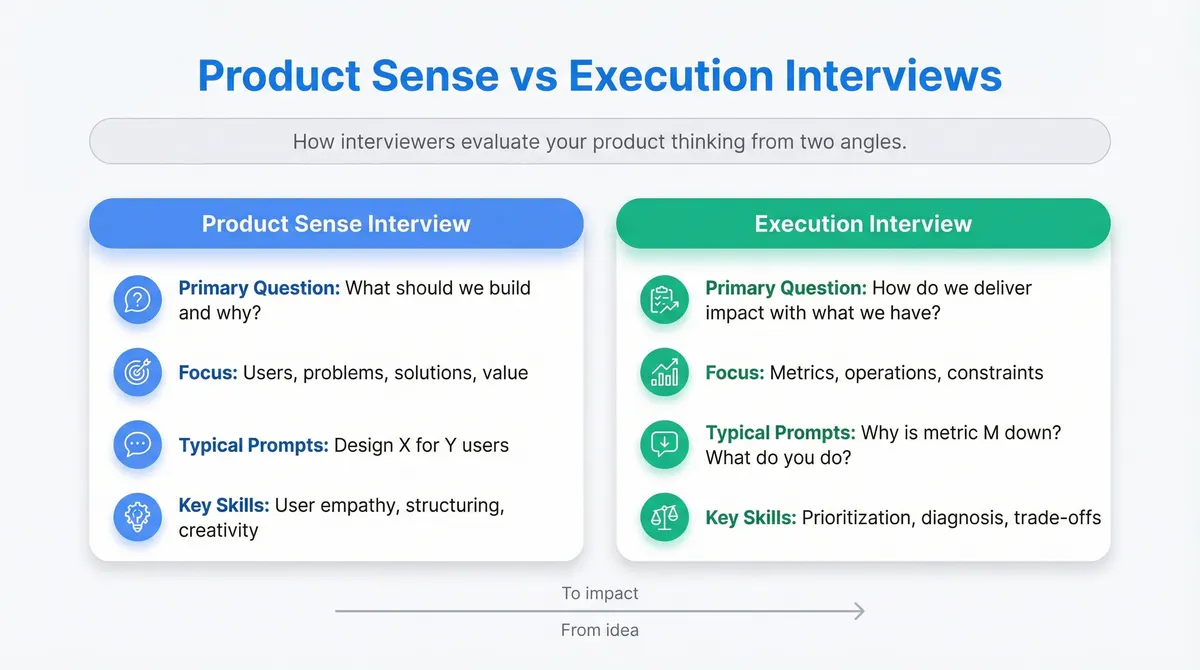
| Aspect | Product Sense Interview | Execution Interview |
|---|---|---|
| Core question | What should we build and why? | How do we deliver and improve impact with what we have? |
| Starting point | Ambiguous problem space | Existing product, roadmap, or metric trend |
| Center of gravity | Users, problems, value proposition | Metrics, constraints, operational reality |
| Typical prompt | “Design X for Y users” | “Metric M is down 20%. What do you do?” |
| Primary skills tested | Product vision, user empathy, solution creativity | Prioritization, diagnosis, execution discipline |
| Output style | Concepts, features, success metrics | Action plan, trade-offs, experiments, monitoring |
Keep this table in mind as a mental checklist: Which column am I in right now?
Inside a Product Sense Interview
What Interviewers Are Actually Testing
In a product sense interview, the interviewer wants to see if you can:
-
Clarify the problem space
- Who is the user?
- What is the core problem?
- Why does this matter to the business or ecosystem?
-
Structure ambiguity
- Break a broad prompt into clear dimensions.
- Choose a target segment.
- Decide on a focus area instead of boiling the ocean.
-
Generate and prioritize solutions
- Explore multiple approaches.
- Use explicit criteria to prioritize.
- Avoid jumping to “cool features” without rationale.
-
Define what success looks like
- Identify primary and secondary metrics.
- Explain how the product would change user behavior.
Typical Product Sense Prompt Examples
- “Design a product to help remote teams build trust.”
- “How would you improve YouTube for creators?”
- “Design a version of LinkedIn for students.”
Each of these is deliberately underspecified. The interviewer wants to see your framework, not your knowledge of that specific product.
A Simple Product Sense Framework
You don’t need a fancy acronym. A clear, logical flow is enough:
-
Clarify and frame
- Clarify the user and context.
- Ask constraints: platform, geography, time horizon.
-
Define the goal
- Business goal: e.g., increase retention, revenue, engagement.
- User goal: what problem are we solving?
-
Understand users and problems
- Segment users.
- For each segment, list key jobs-to-be-done / pain points.
- Pick 1–2 high-impact problems to focus on.
-
Explore solutions
- Propose 3–5 solution directions.
- Evaluate against explicit criteria (impact, feasibility, risk).
- Select 1–2 to go deeper on.
-
Detail the solution
- User journey and core flows.
- Edge cases and trade-offs.
- Risks and mitigations.
-
Define success
- Primary metric (e.g., weekly active creators).
- Guardrail metrics (e.g., content quality, abuse reports).
- How you’d validate early (MVP, experiments).
Concrete Example: Product Sense Walkthrough (Condensed)
Prompt: “Design a product to help new hires ramp up faster at a 1,000-person tech company.”
-
Clarify and frame
- Audience: new hires in engineering? all roles?
- Time horizon: first 90 days?
- Success for company: faster time-to-productivity; lower early attrition.
-
Define the goal
- Business goal: reduce time-to-productivity by 20%.
- User goal: feel confident and effective faster.
-
Understand users and problems
- Segments:
- New engineers
- New PMs
- New managers
- Common pain points:
- Hard to discover “how things are really done”
- Information scattered across tools
- Don’t know who to ask
- Segments:
-
Explore solutions
- Option A: Personalized onboarding checklist + progress tracker
- Option B: “Ask an expert” routing system
- Option C: Knowledge graph of people, docs, and systems
Prioritize using:
- Impact on time-to-productivity
- Implementation complexity
- Dependency on behavior change
-
Detail the chosen solution
- Suppose you choose Option A + light B:
- Day-1 dashboard with key tasks, docs, people to meet.
- Auto-populated per role, team, and location.
- Embedded “ask a question” routed to team buddies.
- Suppose you choose Option A + light B:
-
Define success
- Primary metric: median days to first meaningful contribution.
- Secondary: new hire NPS at 30/60/90 days.
- Guardrails: manager time burden, question response SLAs.
This is product sense: clarity of thinking from problem → solution → impact.
Inside an Execution Interview
What Interviewers Are Actually Testing
In an execution interview, the interviewer wants to see if you can:
-
Understand goals and constraints
- What is the product trying to achieve?
- What are the non-negotiables (compliance, SLAs, budgets)?
-
Reason with metrics
- Define a metric tree.
- Interpret trends and anomalies.
- Design experiments and monitoring.
-
Diagnose issues systematically
- When a metric moves, you have a structured approach to debug.
- You can separate hypotheses, data, and actions.
-
Make trade-offs and prioritize
- Limited engineering capacity.
- Conflicting stakeholder demands.
- Short-term vs long-term impact.
Typical Execution Prompt Examples
- “Sign-ups dropped 15% last week. How do you investigate?”
- “You have 3 features and capacity for 1 this quarter. How do you choose?”
- “Churn increased for mid-market customers. What’s your plan?”
These are less about blue-sky ideas and more about operating a system under constraints.
A Simple Execution Framework
Again, no magic acronym needed. Use something like:
-
Clarify the context
- What’s the product?
- Who are the users?
- What’s the current goal?
-
Define the metric and build a metric tree
- What exactly is the metric? (definition, formula)
- Decompose into components and drivers.
-
Explore hypotheses
- Bucket into categories: product, user, external, data/measurement.
- Prioritize by likelihood × impact × ease of validation.
-
Design investigations and experiments
- What data do you need?
- What cuts/segments will you analyze?
- What experiments or rollbacks will you run?
-
Decide and prioritize actions
- Short-term mitigations.
- Medium-term fixes.
- Long-term improvements.
-
Monitor and communicate
- How you’ll track progress.
- How you’ll update stakeholders.
Example: Execution Walkthrough (Metric Drop)
Prompt: “Daily active users (DAU) dropped 20% week-over-week for your B2C productivity app. What do you do?”
-
Clarify
- Platform(s)? (web, iOS, Android)
- Geography? Specific markets?
- Any recent launches, pricing changes, outages?
-
Define metric and metric tree
DAU can be decomposed as:
TEXT
You might sketch a metric tree:
- DAU
- New users active
- New sign-ups
- Activation rate
- Returning users active
- Retention by cohort
- Reactivation
- New users active
- Hypotheses
Bucketed:
- Product changes:
- Recent UI change increased friction.
- New bug causing crashes on Android.
- External factors:
- Seasonality (holiday, long weekend).
- Major competitor launch.
- Data issues:
- Tracking broken in latest release.
- Misconfigured analytics.
- Investigations
- Cuts of DAU:
- By platform: is the drop isolated to Android?
- By geography: specific country?
- By cohort: only new users vs all users?
- Event funnel:
- Sign-up → onboarding → first action.
- Operational checks:
- Error logs, crash rates, release notes.
- Actions
- If isolated to latest Android release:
- Immediate: hotfix or rollback.
- Short-term: add regression tests for key flows.
- Long-term: improve release gates and monitoring.
- Monitoring & communication
- Define a target recovery range and time window.
- Set up alerts on DAU and key funnel steps.
- Communicate clearly: what you know, what you don’t, what’s next.
This is execution: treating the product as a system you must keep healthy and improving.
Product Sense vs Execution: How the Mindset Shifts
The biggest mistake candidates make is using the same approach in both interviews. The underlying product thinking is shared, but the lens is different.
Lens 1: Time Horizon
- Product sense: 6–24 months out. What’s the right direction?
- Execution: This quarter and next. How do we hit goals and avoid breaking things?
Lens 2: Starting Point
- Product sense: Start from a blank-ish slate and user needs.
- Execution: Start from an existing system and its metrics.
Lens 3: Type of Trade-off
- Product sense: Which user problem and solution space to invest in.
- Execution: Which projects, experiments, and fixes to prioritize.
Lens 4: Output Shape
- Product sense: Problem framing, solution concepts, product strategy.
- Execution: Action plans, prioritization rationale, experiment design.
Common Mistakes in Product Sense Interviews
1. Jumping Straight to Features
Symptom: The candidate starts listing features within 30 seconds of the prompt.
Why it’s a problem:
- Skips understanding the user and problem.
- Signals weak product thinking; looks like “feature vending.”
Fix:
- Force yourself to spend 3–5 minutes on problem framing.
- Explicitly state: “Before jumping into solutions, I’d like to clarify the user and the problem.”
2. Overly Generic “Personas”
Symptom: “Our users are busy professionals who want to be more productive.”
Why it’s a problem:
- Too broad to drive concrete product decisions.
- Interviewer can’t see trade-off thinking.
Fix:
- Segment with clear, differentiating attributes (e.g., “individual contributors vs managers,” “new users vs power users”).
- Pick a primary segment and explain why.
3. No Prioritization
Symptom: Candidate proposes 5–10 features and treats them all as equally important.
Why it’s a problem:
- PMs must say “no” more often than “yes.”
- Interviewer wants to see decision-making, not idea volume.
Fix:
- Use an explicit prioritization lens: impact × confidence × effort.
- Pick 1–2 features to go deep on and say why you’re de-prioritizing others.
4. Missing Success Metrics
Symptom: Candidate ends with “and this will make the experience much better” without metrics.
Why it’s a problem:
- Product sense without measurement is incomplete.
- Interviewer can’t see if you understand what “good” looks like.
Fix:
- Always define at least:
- One primary metric (e.g., weekly active creators).
- One or two guardrails (e.g., abuse reports, latency).
Common Mistakes in Execution Interviews
1. Treating It Like Another Product Sense Question
Symptom: Candidate responds to “Sign-ups are down” by brainstorming new features.
Why it’s a problem:
- Execution is about operating the current system, not inventing a new one.
- Interviewer wants diagnosis and prioritization, not ideation.
Fix:
- Anchor on metrics, systems, and constraints.
- Use a metric tree and hypothesis-driven investigation.
2. Ignoring Data and Measurement
Symptom: Candidate jumps to “I’d talk to users” for every execution problem.
Why it’s a problem:
- Execution often requires fast debugging via data.
- User research is useful, but not always the first or only step.
Fix:
- Start with data: metric cuts, funnels, cohorts.
- Layer in qualitative methods where they’re most informative.
3. No Clear Prioritization Framework
Symptom: Candidate lists 10 possible actions without ordering them.
Why it’s a problem:
- PMs must prioritize under constraints.
- Interviewer wants to see how you choose.
Fix:
- Use a simple rubric:
- Impact on target metric
- Confidence (based on evidence)
- Effort / time
- Risk
- Explicitly say: “Given limited capacity, I’d start with A and B because…”
4. Not Managing Risk or Guardrails
Symptom: Candidate optimizes for one metric with no mention of side effects.
Why it’s a problem:
- Real products have guardrails (e.g., quality, trust, revenue).
- Over-optimizing one metric can cause harm.
Fix:
- Always mention potential negative side effects.
- Propose guardrail metrics and mitigations.
How to Practice Product Sense vs Execution Skills
You can train these like patterns in algorithms: recognize the interview “type” and switch to the right toolkit.
Practicing Product Sense
-
Daily prompt practice
- Take a product you use and ask:
- Who is the primary user?
- What problem does this solve?
- How would I redesign it for [students / seniors / small businesses]?
- Take a product you use and ask:
-
Structure first, then solutions
- Force yourself to write:
- 3 user segments
- 5 problems
- 3 solution directions
- Then pick 1–2 to go deep on.
- Force yourself to write:
-
Metrics thinking
- For any new feature you imagine, define:
- Primary metric
- Secondary metric
- Guardrails
- For any new feature you imagine, define:
You can simulate this style of thinking with AI mock interviews or structured prompts, similar to how engineers drill problem patterns.
Practicing Execution
-
Metric trees as a habit
- For any key metric (DAU, revenue, churn), draw a metric tree:
- Metric → components → drivers → levers
- This mirrors debugging in system design interviews or performance tuning.
- For any key metric (DAU, revenue, churn), draw a metric tree:
-
Run “what if” drills
- “What if DAU drops 10% overnight?”
- “What if conversion increases but revenue stays flat?”
- For each, list:
- Hypotheses
- Data you’d pull
- First 3 actions
-
Prioritization reps
- Create small prioritization exercises:
- 5 potential features, 2 engineers.
- Assign rough impact/effort scores.
- Decide what to do this quarter and explain why.
- Create small prioritization exercises:
Structured, pattern-based practice—similar to how you’d use a DSA patterns sheet for coding interviews—helps you quickly recognize whether an interviewer is testing product sense or execution and respond with the right structure.
Visual Framework: Recognizing the Interview Type
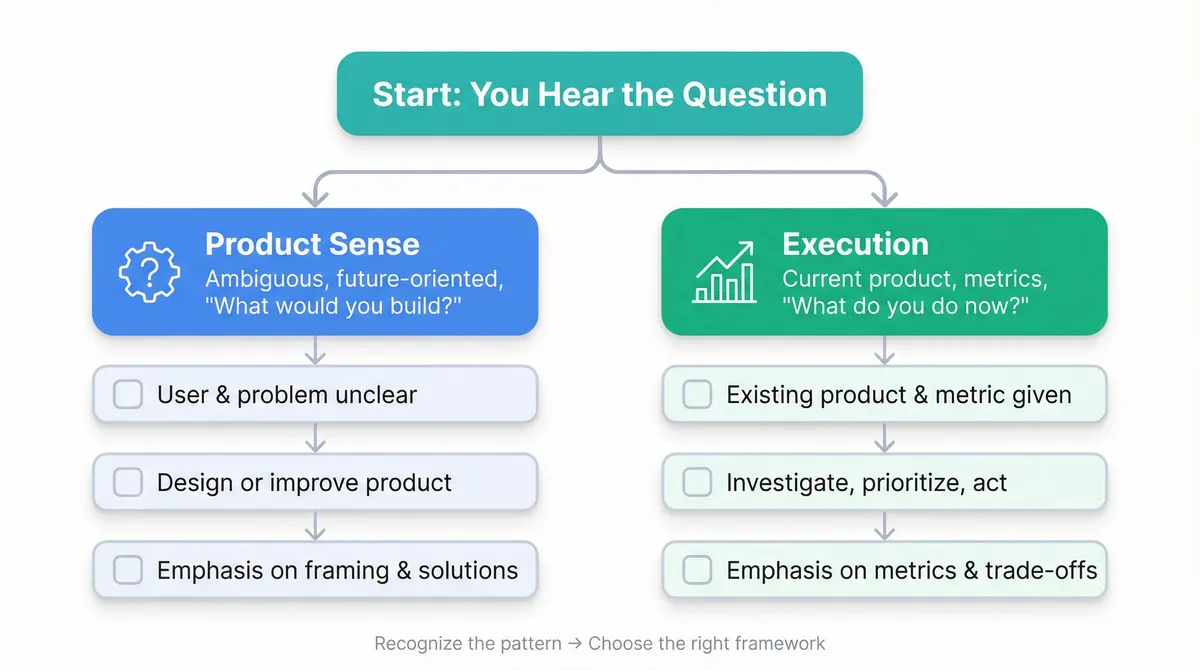
Use this mental decision tree in the first 10–20 seconds after hearing a question:
-
Is the question about:
- Designing something new?
- Or fixing/improving something existing?
-
Does the prompt mention:
- Users and use cases? → likely product sense.
- Metrics, trends, or incidents? → likely execution.
-
Is the time horizon:
- Months/years ahead? → product sense.
- This quarter / recent weeks? → execution.
Once you classify the question, pick the corresponding framework and say it out loud. For example:
- “This sounds like a product sense question; I’ll start by clarifying the user and problem, then propose and prioritize solutions.”
- “This is an execution problem; I’ll start by defining the metric, building a metric tree, and then outlining hypotheses and investigations.”
Explicitly naming your approach helps the interviewer follow your thinking.
Best Practices and Actionable Tips
For Product Sense Interviews
-
Anchor on a specific user segment
- “I’ll focus on new creators with <1,000 followers because…”
-
State your structure explicitly
- “I’ll go through: users → problems → solutions → metrics.”
-
Use trade-offs as a feature, not a bug
- “I’m choosing X over Y because it better serves [goal], even though we lose [benefit].”
-
Tie everything back to value
- “This feature matters because it reduces time-to-value for new users, which should improve activation and retention.”
For Execution Interviews
-
Start with the metric definition
- “Before we dive in, I want to define how we calculate DAU to avoid misinterpretation.”
-
Visualize the metric tree
- Even verbally: “DAU comes from both new and returning users. Returning users depend on retention by cohort…”
-
Bucket hypotheses
- “I’ll group possible causes into product changes, external factors, and data issues.”
-
Prioritize explicitly
- “Given limited time, I’ll start with the highest-likelihood, highest-impact hypotheses that are also fastest to validate.”
-
Respect guardrails
- “While optimizing conversion, I’d watch for increased refund rates and support tickets as guardrails.”
Key Takeaways
-
Product sense interviews test your ability to choose what to build and why:
- Start with user and problem.
- Structure the space.
- Generate and prioritize solutions.
- Define success metrics.
-
Execution interviews test your ability to operate and improve an existing product:
- Start with metric definition and context.
- Build a metric tree.
- Generate and prioritize hypotheses and actions.
- Consider constraints and guardrails.
-
The same underlying product thinking appears in both:
- Clarity of goals.
- Structured reasoning.
- Explicit trade-offs.
- Metric-driven decisions.
The most effective preparation mirrors how engineers prepare for system design and coding interviews: recognize patterns, apply the right frameworks, and practice with realistic prompts. Whether you’re using live mock interviews or an AI interview coach, focus on separating product sense from execution in your practice sessions.
In the interview, your edge won’t be having memorized answers. It will be the ability to quickly recognize which game you’re playing—and then execute the right playbook with clarity and discipline.