
Resume
Fresher vs Experienced Resumes: What Changes and Why It Matters
Most engineers treat their resume as a static document: write it once, tweak a few bullets, and keep reusing it. That works—until you move from “fresher” to ...
Most engineers treat their resume as a static document: write it once, tweak a few bullets, and keep reusing it. That works—until you move from “fresher” to “experienced” and suddenly the rules change.
A fresher resume is about potential. An experienced resume is about proven impact. If you keep sending a fresher-style resume after a couple of years in industry, you’re leaving a lot of signal on the table. If you’re a final-year student mimicking senior resumes from LinkedIn, you’re probably confusing recruiters.
This guide breaks down, in detail, how fresher and experienced resumes differ, why those differences exist in tech hiring, and how to evolve your resume as your career grows.
We’ll focus on engineering roles, but the principles apply broadly across tech.
1. Why Fresher vs Experienced Resumes Are Not the Same Problem
Most hiring pipelines implicitly answer two different questions:
- For freshers: “Can this person learn fast and become productive?”
- For experienced engineers: “Can this person own problems and deliver impact in a production environment?”
Your resume is the first approximation of those answers. That’s why:
- A fresher resume is optimized to show:
- Foundations (DSA, CS fundamentals)
- Learning velocity (projects, internships, hackathons)
- Signals of discipline (consistent effort, side work)
- An experienced resume is optimized to show:
- Business impact (metrics, outcomes)
- Ownership (systems, features, teams)
- Depth in a tech stack or domain
Trying to use one format for both is like using the same algorithm for O(10²) and O(10⁶) input sizes: it technically runs, but it’s not what the system is tuned for.
2. High-Level Fresher vs Experienced Resume Comparison
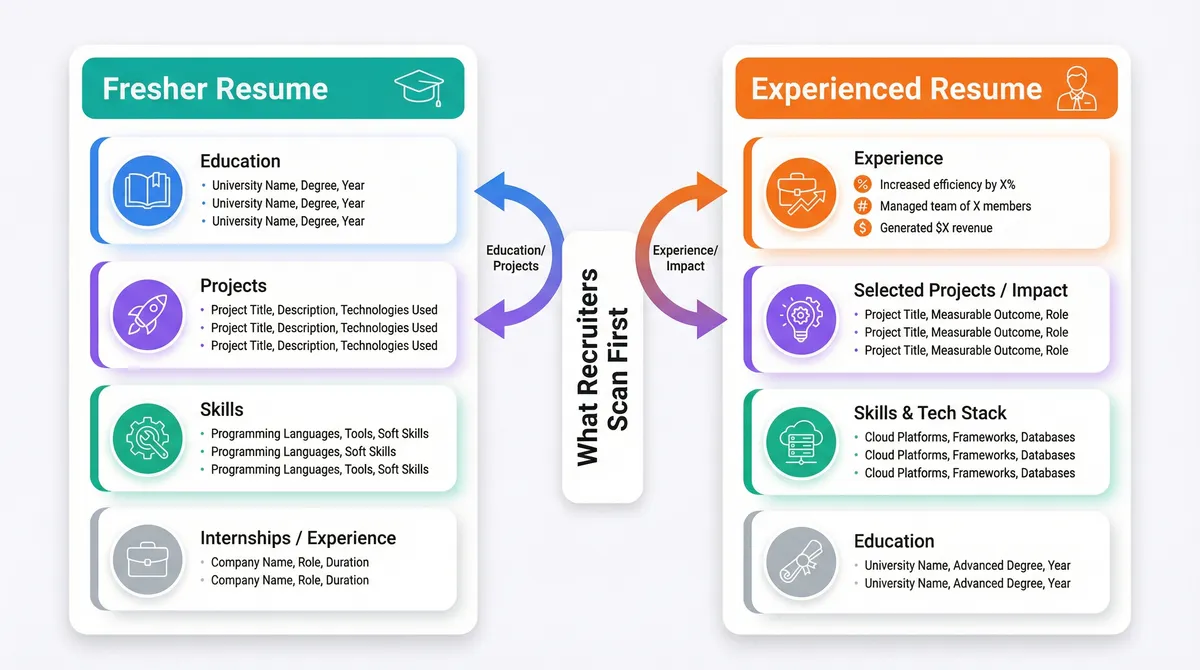
2.1 Snapshot Table
| Aspect | Fresher Resume | Experienced Resume |
|---|---|---|
| Primary goal | Show potential & fundamentals | Show impact & ownership |
| Top section focus | Education, projects | Work experience, impact metrics |
| Experience depth | Internships, academic/side projects | Production systems, teams, domains |
| Evaluation lens | “Can they learn + pass interviews?” | “Can they solve our problems reliably?” |
| Length | 1 page (almost always) | 1–2 pages (depending on years & complexity) |
| Keywords that matter | DSA, OOP, DBMS, OS, projects, internships | Systems, scale, latency, reliability, revenue, cost |
| Signal type | Leading indicators (promise) | Lagging indicators (track record) |
3. Anatomy of a Strong Fresher Resume
3.1 What Tech Hiring Managers Look For in Freshers
When reviewing fresher resumes, engineers and recruiters typically scan for:
- Foundational strength
- Algorithms & data structures
- Core CS subjects (OS, DBMS, Networks)
- Evidence of building
- Projects with non-trivial complexity
- Internships, research, open-source contributions
- Effort & initiative
- Competitive programming, hackathons
- Self-driven learning (courses, certifications used in projects)
- Communication & clarity
- Can you describe what you built and why it matters?
- Are your bullets specific or generic?
3.2 Recommended Fresher Resume Structure
A good default structure:
- Header
- Name, role (e.g., “Software Engineer”), contact, GitHub/LinkedIn/portfolio
- Education
- Degree, institute, dates, CGPA (if decent), relevant coursework
- Projects (core section)
- 3–5 meaningful projects with impact & tech stack
- Internships / Experience
- Any industry or research exposure
- Skills
- Languages, frameworks, tools, with realistic proficiency
- Achievements / Activities (optional)
- Contests, scholarships, leadership
3.3 Example Fresher Project Entry (Good vs Weak)
Weak:
Chat Application
- Built a chat app using React and Node.js
- Used MongoDB for storage
- Implemented authentication
This tells a reviewer almost nothing about difficulty, decisions, or outcomes.
Stronger:
Real-time Chat Application — React, Node.js, Socket.IO, MongoDB
- Designed a real-time chat app supporting 1:1 and group chats with typing indicators and read receipts using WebSockets (Socket.IO).
- Implemented JWT-based authentication and role-based access control for admins vs regular users.
- Optimized MongoDB schema (separate
messagesandconversationscollections) to reduce average chat history query time from ~350 ms to ~120 ms on 10k+ messages.- Deployed on Render with CI/CD via GitHub Actions; integrated basic monitoring using logs and health checks.
Notice the fresher resume still focuses on:
- Clear tech stack
- Concrete features
- Simple metrics (even if small-scale)
- Design choices
You don’t need FAANG-scale numbers; you do need specificity.
4. Anatomy of a Strong Experienced Resume
Once you’re past ~1–2 years of full-time work, your resume should pivot from “what I can build” to “what I’ve already delivered.”
4.1 What Tech Hiring Managers Look For in Experienced Engineers
Reviewers now scan for:
- Impact
- Performance improvements, reliability gains, revenue, cost savings
- Reduced manual work, improved developer productivity
- Ownership
- Systems or features you were responsible for end-to-end
- Leading projects, mentoring, cross-team collaboration
- Complexity handled
- Scale (users, QPS, data size)
- Constraints (latency, consistency, uptime)
- Technical depth
- Understanding of tradeoffs, architecture, debugging complex issues
- Trajectory
- Increasing responsibility over time
- Promotions or expanded scope
4.2 Recommended Experienced Resume Structure
Typical structure:
- Header
- Name, “Software Engineer / SDE II / Backend Engineer”, contact, relevant links
- Professional Experience (core section)
- Roles in reverse chronological order
- Each with 4–7 impact-focused bullets
- Selected Projects / Open Source (optional)
- Only if they add signal beyond your job experience
- Skills & Tech Stack
- Grouped by category (Languages, Backend, Data, Infra, etc.)
- Education
- Condensed, no need for coursework after a few years
- Additional
- Patents, talks, major OSS contributions (if any)
4.3 Example Experienced Role Entry (Bad vs Good)
Bad:
Software Engineer, XYZ Corp
- Worked on backend microservices using Java and Spring Boot
- Wrote APIs and integrated with frontend
- Participated in code reviews and agile ceremonies
This is indistinguishable from hundreds of other resumes.
Good:
Software Engineer, XYZ Corp — Payments Platform
- Owned the refunds and chargebacks service (Java, Spring Boot, PostgreSQL, Kafka) processing ~2M transactions/day with 99.98% availability.
- Reduced average refund processing time from ~18 min to ~4 min by redesigning the workflow to use idempotent, event-driven processing and batch settlement for third-party providers.
- Led migration of payment event ingestion from a monolithic consumer to Kafka-based microservices, cutting message processing lag from 45s to <5s at peak load.
- Collaborated with Risk and Compliance to implement dynamic risk scoring, reducing false-positive fraud flags by ~22% while maintaining SLA.
- Mentored 2 junior engineers, setting up onboarding docs and runbooks, which decreased average onboarding time from ~4 weeks to ~2.5 weeks.
Now the resume:
- Quantifies impact
- Shows scale and constraints
- Demonstrates ownership and collaboration
- Signals level (this reads like SDE I/II)
5. Section-by-Section: What Changes from Fresher to Experienced
5.1 Education
Fresher:
- Education is near the top.
- Include:
- Degree, institute, year
- CGPA (if ≥ ~7.5/10 or equivalent)
- Relevant coursework: DSA, Algorithms, OS, DBMS, Networks
- Academic projects (if strong and not repeated elsewhere)
Experienced:
- Education moves below Experience.
- Simplify:
- Degree, institute, year
- Optional CGPA (if strong and early career)
- Remove:
- Detailed coursework
- Minor academic projects
After ~3–4 years of experience, most hiring decisions weigh your work history far more than your GPA.
5.2 Projects
Fresher:
- Projects are the main proof that you can build.
- 3–5 projects, each with:
- Tech stack
- Problem statement
- Key features
- Results (even small-scale metrics)
- Good to show variety:
- Web app, system tool, ML model, etc., depending on your target roles
Experienced:
- Projects section becomes “Selected Projects / Open Source” or disappears if you have strong work history.
- Include only:
- Substantial OSS contributions (merged PRs, maintainership)
- Significant side projects with real users or depth
- Remove:
- Class assignments
- Toy apps (“ToDo list”, “basic portfolio”) unless they demonstrate something unique (e.g., low-level systems work, compilers, etc.)
5.3 Experience
Fresher:
- Internships, part-time roles, research assistantships.
- Focus on:
- What you built
- What you learned
- Any measurable outcome (performance improvements, adoption)
- It’s okay if scope is small; clarity matters more than scale.
Experienced:
- Experience section is the core.
- Every bullet should answer at least one of:
- What problem did you solve?
- What was your specific contribution?
- What was the measurable impact?
A simple formula:
[Action] [what you did] → [impact metric] under [constraints/context]
Example:
Designed and implemented a caching layer for product metadata (Redis) that reduced P95 latency from 420 ms to 110 ms for the product detail API at ~3k RPS.
6. How Recruiters and Hiring Managers Actually Read Your Resume
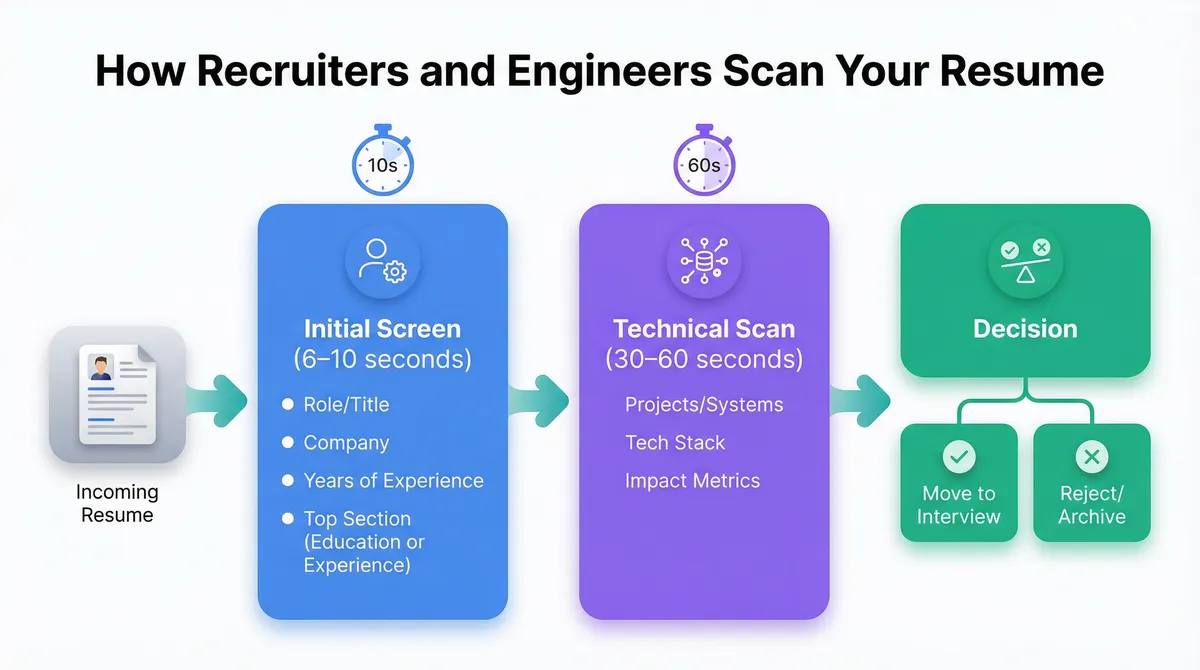
6.1 Time Budget
- Initial screen: 6–10 seconds
- Deeper scan (if promising): 30–90 seconds
This is why structure and ordering matter so much. For freshers, the first thing they see should be your education & best projects. For experienced candidates, it should be your strongest roles and impact.
6.2 Role Matching and Keywords
Both fresher and experienced resumes are often filtered by:
- ATS (Applicant Tracking Systems) keyword search
- Recruiters scanning for role-specific signals
For fresher resumes, relevant keywords might be:
- “data structures”, “algorithms”, “DBMS”, “operating systems”
- “React”, “Node.js”, “Java”, “Python”, etc.
- “internship”, “project”, “REST API”
For experienced resumes, keywords shift to:
- “microservices”, “distributed systems”, “Kafka”, “Kubernetes”
- “latency”, “throughput”, “P95”, “SLA”
- “designed”, “owned”, “led”, “migrated”, “optimized”
Don’t keyword-stuff, but do use the language that job descriptions use—accurately.
7. Common Mistakes: Fresher vs Experienced Resumes
7.1 Fresher Resume Mistakes
-
Listing skills without proof
- “C++, Java, Python, Go, Rust, Haskell…” with no project or coursework to back them.
- Fix: Only list languages you can write a non-trivial program in today.
-
Overweighting minor achievements
- “Participated in hackathon” (no result, no project link).
- Fix: Focus on outcomes: “Built X in 24 hours; won Y or implemented Z features.”
-
Wall of text project descriptions
- Long paragraphs, no bullets, no clear tech stack.
- Fix: 3–5 bullets per project, each with a clear action + detail.
-
No links
- No GitHub, no project demos, no portfolio.
- Fix: Add links, but ensure repos build and READMEs are clear.
-
Copying senior-style impact metrics
- “Increased revenue by 20%” on a student project with 5 users.
- Fix: Be honest. Use appropriate scale metrics (response time, features, number of users in your class, etc.).
7.2 Experienced Resume Mistakes
-
Still looking like a fresher resume
- Projects at the top, education detailed, experience bullets generic.
- Fix: Move Experience to the top; focus on ownership and impact.
-
Task lists instead of outcomes
- “Implemented APIs”, “fixed bugs”, “attended standups”.
- Fix: Convert tasks to outcomes: “Implemented X API → reduced Y by Z%”.
-
No scale or constraints
- “Built microservices” without mentioning QPS, data size, latency, uptime.
- Fix: Add approximate numbers: “~500 RPS”, “~10M rows”, “99.9% uptime”.
-
Irrelevant or outdated tech emphasis
- Highlighting college projects from 5 years ago instead of current domain expertise.
- Fix: Only keep older items if they add unique value (e.g., OS kernel work).
-
Overclaiming leadership
- “Led team of 10” when you were one of 10 engineers.
- Fix: Use precise language: “Collaborated with 9 engineers”, “Mentored 2 juniors”.
8. How to Evolve Your Resume Over Time (Step-by-Step)
Think of your resume as a refactoring problem. As your codebase (career) grows, the architecture (resume structure) must change.
8.1 From Final-Year Fresher to 1–2 Years Experience
Initial (Fresher):
- Top: Education, Projects
- Smaller: Internships, Skills
After ~1–2 years:
- Move Experience above Education.
- Reduce number of projects to the best 2–3.
- Start quantifying impact in your job bullets:
- Performance improvements
- Bug reductions
- Feature adoption
Example evolution of a bullet:
Fresher-style: “Worked on a REST API for user profiles using Node.js and MongoDB.”
→
Early-experience: “Implemented and maintained user profile REST APIs (Node.js, MongoDB) used by ~50k MAUs, including rate limiting and input validation to reduce profile update errors by ~30%.”
8.2 From 2–5 Years Experience
At this stage:
- Experience dominates the resume.
- Education shrinks to 1–2 lines.
- Projects only if:
- They’re substantial OSS
- They show expertise not visible from your job (e.g., compilers, ML research)
You should:
- Group experience by teams/domains if you’ve moved internally:
- “Search Platform”, “Observability”, “Payments”, etc.
- Show trajectory:
- Promotions
- Increasing scope (from owning endpoints → subsystems → cross-team initiatives)
9. Practical Patterns for Writing Strong Bullets
A simple pattern that works for both fresher and experienced resumes:
[Verb] [what you built/changed] using [tech] → [measurable or observable impact]
9.1 Fresher Examples
- “Built a URL shortener service (Node.js, Redis, PostgreSQL) with custom aliases and click tracking, handling ~50 req/s in load tests with P95 latency < 120 ms.”
- “Implemented LRU cache from scratch in C++ to understand eviction policies; benchmarked against
std::unordered_mapwith ~1.2x speedup for repeated key access patterns.”
9.2 Experienced Examples
- “Redesigned product search ranking pipeline (Java, Elasticsearch) to incorporate user click-through data, improving search result CTR by ~9.5% on A/B tests over 2 weeks.”
- “Introduced circuit breaker and retry logic for external payment provider integrations, reducing payment failure rate from 3.2% to 0.8% during provider outages.”
10. Resume Comparison: Fresher vs Experienced Example
Below is a compact comparison of how similar content might appear on a fresher vs experienced resume for a backend role.
| Scenario | Fresher Resume Version | Experienced Resume Version |
|---|---|---|
| User auth system | “Built a user authentication system with JWT and password hashing (Node.js, MongoDB).” | “Owned authentication service (Node.js, PostgreSQL) for 3 internal apps, implementing JWT-based SSO and refresh tokens, reducing login-related support tickets by ~40%.” |
| Performance optimization | “Optimized SQL queries to improve performance.” | “Refactored N+1 query patterns in order history API (Spring Boot, MySQL), reducing P95 latency from 800 ms to 220 ms at ~1.5k RPS.” |
| Team collaboration | “Worked in an agile team and attended daily standups.” | “Collaborated with frontend, QA, and DevOps to deliver checkout revamp across 3 sprints, achieving on-time delivery and <1% rollback incidents.” |
The experienced version adds:
- Ownership (“owned”, “refactored”, “collaborated with…”)
- Scale (users, RPS, tickets)
- Impact (latency, support tickets, rollbacks)
11. Best Practices and Actionable Tips
11.1 For Fresher Resumes
- Prioritize projects that demonstrate engineering thinking
- Tradeoffs, design choices, not just tutorials followed.
- Make your GitHub meaningful
- Fewer, higher-quality repos > many half-finished ones.
- Align with tech hiring expectations
- If you’re preparing for DSA-heavy interviews, mention problem-solving practice or patterns you know; a resource like a dedicated DSA for Beginners: What to Study First and in What Order can also guide your learning and signal structure in your prep.
- Use consistent formatting
- Same date formats, bullet styles, font sizes.
- Get feedback from someone in industry
- They can tell you if your projects look trivial or impressive.
11.2 For Experienced Resumes
- Start from the job description
- Mirror the language (accurately) where it matches your experience.
- Quantify wherever possible
- Latency, throughput, error rates, user counts, revenue, cost.
- Trim aggressively
- Old or low-signal content should go; keep the strongest 2–3 roles/projects.
- Show breadth and depth
- Breadth: systems you’ve touched (APIs, data pipelines, infra).
- Depth: one or two areas where you went very deep.
- Prepare stories behind bullets
- Every strong bullet should map to a story you can discuss in an interview; practicing with AI Mock Interviews vs Real Interviews: Do They Actually Help? can help you articulate these effectively.
12. Key Takeaways: What Changes and Why It Matters
-
Fresher vs experienced resumes answer different questions.
- Fresher: “Can you learn and build?”
- Experienced: “Can you own and deliver impact?”
-
Structure must evolve.
- Fresher: Education + Projects at the top.
- Experienced: Experience + Impact at the top.
-
Signal type shifts from potential to proof.
- Fresher: projects, internships, contests.
- Experienced: production systems, metrics, leadership.
-
Language and metrics become more important over time.
- Move from “built X using Y” to “built X using Y → achieved Z”.
-
Treat your resume as a living technical document.
- Refactor it as your responsibilities grow, just like you’d refactor a system that outgrows its initial design.
If you align your resume with where you are in your career—not where you wish you were—you make it easier for recruiters and engineers to say “yes” to the next step.