
Resume
Why Your Resume Gets Rejected by Tech Recruiters (And How to Fix It)
Most software engineers don’t lose opportunities because they can’t code—they lose them before anyone ever sees their code. If your resume keeps getting reje...
Most software engineers don’t lose opportunities because they can’t code—they lose them before anyone ever sees their code. If your resume keeps getting rejected by tech recruiters and application tracking systems (ATS), the problem is rarely “not enough experience.” It’s usually that your resume isn’t doing the right job.
This guide explains why your resume is getting rejected in tech hiring pipelines, and exactly how to fix it. We’ll walk through how recruiters actually screen resumes, common failure modes for software engineer resumes, and specific, practical changes you can make today.
How Tech Resume Screening Actually Works
To fix a resume that keeps getting rejected, you first need to understand the system you’re optimizing for.
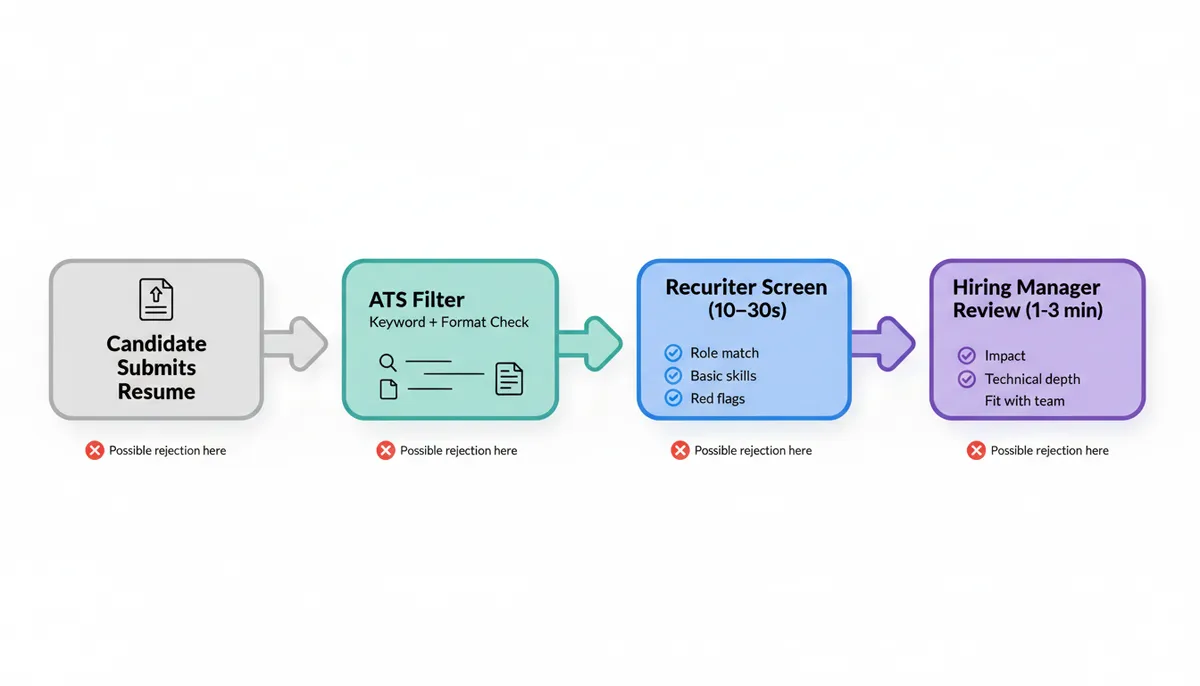
The 3 Layers of Resume Screening
Most software engineering resumes pass through three filters:
- ATS / keyword filter
- Recruiter screen (10–30 seconds)
- Hiring manager or senior engineer review (1–3 minutes)
Each layer is looking for different signals.
1. ATS / Keyword Filter
Many mid-to-large tech companies and almost all recruiting agencies use an ATS. It parses your resume and tries to answer:
- Does this resume contain the skills and technologies listed in the job description?
- Is the experience level roughly correct?
- Is the file readable (no weird formatting, images-as-text, etc.)?
If your resume gets rejected here, no human ever saw it.
2. Recruiter Screen (10–30 Seconds)
Technical recruiters are often scanning hundreds of resumes per role. In 10–30 seconds they try to answer:
- Does this candidate roughly match the role (backend vs frontend vs ML, level, location)?
- Do they have relevant technologies (e.g., React + TypeScript for a frontend role)?
- Do they show impact and stability (not hopping every 3 months without explanation)?
If the answer is “unclear,” that’s effectively a “no.”
3. Hiring Manager / Senior Engineer Review
If you pass the recruiter screen, your resume goes to someone technical. They’re looking for:
- Signals of strong engineering fundamentals
- Evidence of ownership and impact
- Complexity you’ve handled (systems, scale, ambiguity)
This is where “looks fine” resumes get quietly deprioritized in favor of “this person looks strong” resumes.
Why Your Resume Gets Rejected Before Interviews
Let’s walk through the most common reasons software engineer resumes get rejected—and how to fix each one.
1. Your Resume Fails the “Instant Role Match” Test
If a recruiter can’t tell what you do in 5 seconds, your resume is in trouble.
Symptoms
- Your title line says only “Software Engineer” with no specialization.
- Your experience bullets are generic: “Worked on various projects using different technologies.”
- You apply to a backend role but your resume looks like a mix of everything.
What Recruiters Are Actually Looking For
Recruiters are matching a role to a candidate story:
- “Backend engineer with 3–5 years, Java/Kotlin, microservices, cloud”
- “Frontend engineer with 2–4 years, React, TypeScript, modern UI stack”
- “New grad with strong CS fundamentals and projects in relevant tech”
If your resume doesn’t tell a clear story, they move on.
How to Fix It
Add a sharp, role-aligned headline.
At the top, under your name, replace:
Software Engineer
with something like:
Backend Software Engineer – Java, Spring Boot, Distributed Systems
Frontend Engineer – React, TypeScript, Design Systems
Machine Learning Engineer – NLP, Python, PyTorch
Mirror the job description language (honestly).
If the job says:
“Looking for a backend engineer with experience in Java, Spring Boot, REST APIs, and cloud-native microservices.”
Your summary and experience should explicitly mention:
- “Java”
- “Spring Boot”
- “REST APIs”
- “Microservices”
- AWS/GCP/Azure if you have it
This is not keyword stuffing; it’s making your actual skills legible to the system and to humans.
2. Your Resume Is Not ATS-Friendly (So It’s Never Read)
A surprising number of good engineers get filtered out by the ATS parser.
Symptoms
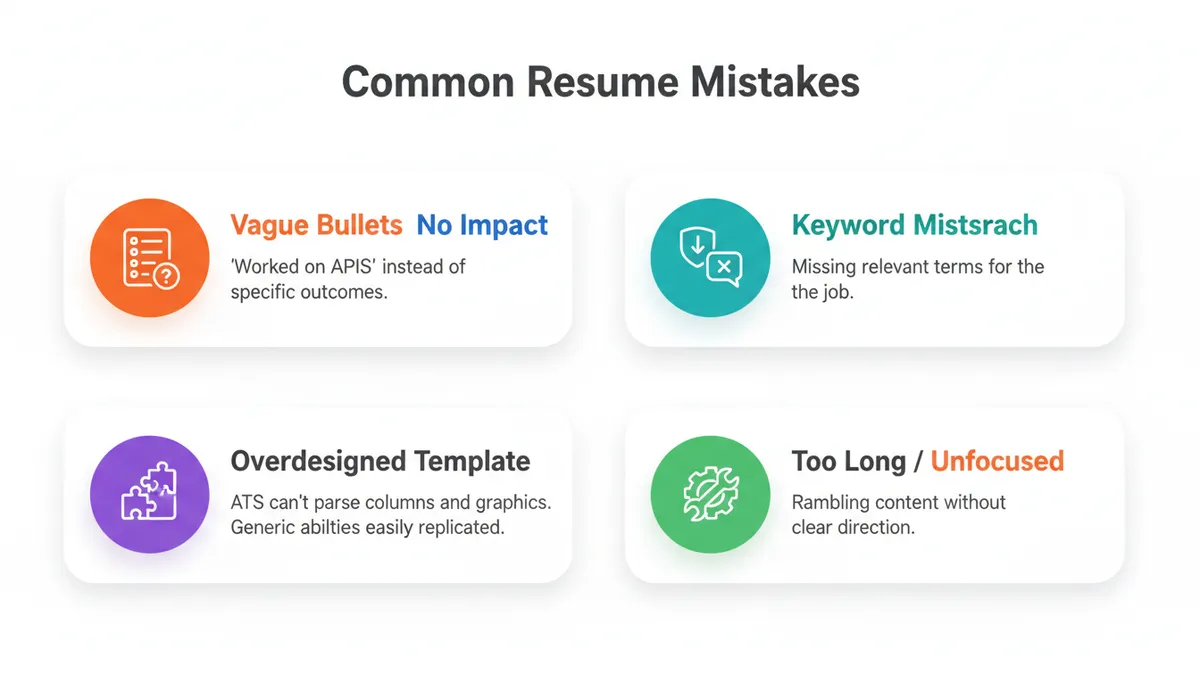
- You use a heavily designed template with columns, icons, and text inside images.
- You export a resume from a design tool (Figma/Canva) that looks great but parses poorly.
- You embed important information in headers/footers or text boxes.
What Breaks ATS Parsing
Common things that cause issues:
- Two-column layouts where sections appear out of order in the raw text.
- Icons instead of text labels for “Email,” “GitHub,” etc.
- Skills represented as progress bars or charts instead of plain text.
- Using tables or text boxes that don’t convert to linear text.
How to Fix It
Use a simple, single-column structure.
- Sections: Summary, Skills, Experience, Projects, Education.
- Left-aligned, standard fonts (e.g., Arial, Calibri, system fonts).
- No text in images, no decorative graphics.
Always test the raw text.
- Open your PDF.
- Copy all text and paste it into a plain text editor.
- Check: Is everything in a logical order? Are key skills and titles visible?
If the plain text looks broken, the ATS view is worse.
For more on optimizing your resume format for ATS, see ATS-Friendly Resume Formatting: Do's and Don'ts.
3. Your Experience Bullets Don’t Show Impact
Most software engineer resumes read like job descriptions, not evidence of performance.
Symptoms
- Bullets like: “Responsible for developing APIs using Node.js and MongoDB.”
- No numbers, no scale, no impact.
- Overuse of “Worked on,” “Helped with,” “Involved in.”
What Hiring Managers Want to See
They’re looking for:
- What you did
- How you did it
- Why it mattered (impact)
A good bullet is specific, measurable, and contextual.
How to Fix It: Use the “Action + Context + Impact” Pattern
Bad:
Worked on backend services using Java and Spring.
Better:
Designed and implemented 3 new Java/Spring Boot microservices to replace a monolith module, reducing average API latency by 35% and improving deployment frequency from monthly to weekly.
Pattern:
[Action] + [Technical context] + [Quantified impact]
When you don’t have direct business metrics, you can still quantify:
- Performance: latency, throughput, memory usage
- Reliability: error rate, uptime, incident count
- Developer productivity: build time, deployment time, test coverage
- Scope: number of users, size of data, number of services
4. Your Skills Section Is Either Weak or Misleading
The skills section is one of the fastest things recruiters scan.
Symptoms
- Long list of every technology you’ve ever touched.
- No distinction between “used once in a tutorial” and “daily driver.”
- Skills that don’t match the rest of your resume (e.g., listing Kubernetes but no mention of it in experience).
How Recruiters Interpret Skills
- They use it to check “does this candidate meet the basic tech stack requirements?”
- They cross-check it with your experience and projects. If you list Go but never mention it elsewhere, it’s a red flag.
How to Fix It
Group and level your skills.
Example:
Languages: Python (primary), Java, TypeScript
Backend: Django, Spring Boot, REST APIs, gRPC, PostgreSQL
Frontend: React, Redux, Next.js
DevOps/Cloud: Docker, Kubernetes, AWS (EC2, S3, RDS), GitHub Actions
You can optionally indicate proficiency:
Languages: Python (expert), Java (proficient), Go (working knowledge)
Only list what you can defend in an interview.
If you list it, assume you can be asked to:
- Debug code in it
- Design a small system using it
- Explain trade-offs vs alternatives
5. Your Projects Don’t Demonstrate Engineering Thinking
For students, career switchers, or early-career engineers, projects carry a lot of weight. Even for experienced engineers, projects can show breadth and initiative.
Symptoms
- Projects section is a list of GitHub links with no explanation.
- Projects are trivial (“To-Do App,” “Weather App”) with no depth.
- No mention of design decisions, scale, or trade-offs.
What Good Projects Look Like on a Resume
They show:
- A clear problem
- Non-trivial technical design
- Interesting constraints (scale, performance, UX, data)
- Measurable outcomes or complexity
How to Fix It
For each project, include:
- 1-line summary: what it is and for whom.
- Technical stack: specific technologies.
- 2–3 bullets of impact/complexity.
Example:
Real-Time Code Collaboration Tool – Web-based IDE for pair programming
Stack: React, TypeScript, Node.js, WebSockets, Redis
• Designed and implemented a real-time collaborative editor using operational transform over WebSockets, supporting 50+ concurrent users per room with <150ms latency.
• Built a custom diff algorithm to handle conflict resolution, reducing merge errors by 60% vs naive broadcast.
• Deployed to AWS (EC2, ALB, ElastiCache), configured horizontal scaling to handle traffic spikes of 10x during hackathon events.
Projects like this also become excellent topics in mock interviews or AI Mock Interviews vs Real Interviews: Do They Actually Help?.
6. Your Resume Has Hidden Red Flags
Some resumes get rejected not because they’re weak, but because they raise questions no one has time to investigate.
Common Red Flags
- Unexplained gaps: 6+ months with no explanation.
- Frequent job changes: multiple roles <1 year each without context.
- Title regression: going from “Senior Engineer” to “Junior Engineer.”
- Side projects that look like full-time jobs overlapping with employment.
How to Fix or Mitigate Them
You don’t need to write an essay; brief, factual notes are enough.
- For gaps: “Career break (family care),” “Full-time study,” “Relocation,” “Health (fully resolved).”
- For frequent changes: Focus on impact at each role; if some were contracts, label them “Contract.”
- For title regression: Clarify scope: “Title: Software Engineer; Functionally acting as Tech Lead for 4-engineer team.”
Recruiters are more comfortable when there’s a plausible, straightforward explanation.
7. Your Resume Is Too Long, Too Dense, or Too Vague
Engineers often try to include everything they’ve ever done. That usually backfires.
Symptoms
- 3–4 page resume for <10 years of experience.
- Paragraph-length bullets; walls of text.
- Repetition of the same responsibilities across roles.
What Works Better
- 0–7 years experience: 1 page is usually sufficient.
- 8–15 years: 1–2 pages with emphasis on last 5–7 years.
- Emphasize impact over exhaustive coverage.
How to Fix It
- Cut or compress older roles; keep 1–2 bullets if they’re not directly relevant.
- Remove generic bullets like “Attended team meetings,” “Collaborated with cross-functional teams” unless they’re tied to a specific impact.
- Use tight, scannable bullets (1–2 lines each).
Concrete Before/After Resume Bullet Examples
Let’s walk through some transformations.
Example 1: Backend Feature Work
Before:
Worked on backend APIs for user management in Node.js.
After:
Implemented and documented 5 new Node.js/Express user management APIs (signup, login, password reset, profile update, OAuth) used by ~120K MAUs, reducing authentication-related support tickets by 40%.
Example 2: Performance Optimization
Before:
Improved database performance.
After:
Optimized PostgreSQL queries for the billing subsystem by adding composite indexes and rewriting N+1 query patterns, reducing average invoice generation time from 12s to 1.8s for 50K+ monthly invoices.
Example 3: Frontend Work
Before:
Worked on frontend using React.
After:
Refactored a legacy jQuery-based dashboard to React/TypeScript, reducing bundle size by 30% and improving Time to Interactive by 45% on mid-range devices.
These kinds of bullets are what make hiring managers think, “This person understands impact and trade-offs.”
Common Resume Mistakes in Tech (And How to Avoid Them)
This section summarizes frequent pitfalls specific to software engineer resumes.
Mistake 1: Treating the Resume as an Autobiography
Your resume is not a complete history; it’s a filtering tool. It should answer:
- Can this person likely do this job well?
- Are they worth 60 minutes of interview time?
Optimize for signal, not completeness.
Mistake 2: Using Generic Buzzwords Without Evidence
Terms like “team player,” “self-starter,” “problem solver” are fine, but only when backed by concrete examples in your experience bullets.
Mistake 3: Ignoring the Job Description
Sending the same resume to every role misses easy wins:
- If the role emphasizes “distributed systems,” highlight your distributed systems work.
- If the role is frontend-heavy, push frontend projects higher and trim irrelevant backend details.
You don’t need a different resume for every job, but you should have 2–3 tailored variants (e.g., backend-focused, full-stack-focused, ML-focused).
Mistake 4: Underusing Your Education and Coursework (For Students)
For new grads:
- List relevant CS courses: “Data Structures & Algorithms, Operating Systems, Distributed Systems, Databases.”
- Highlight strong performance: “Top 10% in Algorithms,” “Teaching Assistant for Data Structures.”
- Mention competitive programming or practice patterns if relevant; structured DSA practice (like following a Beginner to Advanced DSA Roadmap for Software Engineers in 2026) signals seriousness.
Building a Strong Tech Resume: A Practical Checklist
Here’s a concise checklist you can use to review your resume.
Structure & Formatting
- Single-column, ATS-friendly layout.
- Clear sections: Summary, Skills, Experience, Projects, Education.
- 1 page (0–7 years) or 1–2 pages (8+ years).
- Consistent fonts, spacing, and bullet styles.
Summary & Headline
- Clear headline that matches the role (e.g., “Backend Engineer – Java, Spring Boot”).
- 2–3 line summary emphasizing years of experience, specialization, and key strengths.
- Mirrors critical keywords from the job description (honestly).
Skills
- Grouped by category (Languages, Backend, Frontend, DevOps/Cloud, Data/ML, etc.).
- Only includes skills you can defend in an interview.
- Consistent with technologies mentioned in experience and projects.
Experience
For each role:
- 3–6 bullets for recent roles, 1–3 for older roles.
- Each bullet follows Action + Context + Impact.
- At least some bullets with quantifiable outcomes (performance, scale, reliability, productivity).
- Technologies mentioned inline where relevant: “(Java, Spring Boot, PostgreSQL).”
Projects (Especially Important for Students / Switchers)
For each project:
- 1-line description (what it is, who it’s for).
- Tech stack listed.
- 2–3 bullets showing complexity and impact.
- Links to GitHub / live demo when available.
Red Flags & Gaps
- Gaps >6 months have a short, factual explanation.
- Contract roles are labeled as such.
- Titles and responsibilities tell a coherent progression story.
Example: Transforming a Weak Resume Snippet
Consider this initial experience section for a mid-level engineer:
Software Engineer, XYZ Corp (2020–Present)
• Worked on backend services using Java and Spring.
• Helped migrate database from MySQL to PostgreSQL.
• Involved in improving system performance.
• Collaborated with frontend team.
We don’t know what they actually did, how good they are, or what impact they had.
Rewritten:
Backend Software Engineer, XYZ Corp (2020–Present)
• Designed and implemented 4 Java/Spring Boot microservices to replace legacy monolith modules, reducing deployment time from 2 hours to 15 minutes and enabling independent scaling per service.
• Led migration of core customer data from MySQL to PostgreSQL (10M+ records), designing migration scripts and fallback strategy that achieved zero data loss and <5 minutes read-only downtime.
• Profiling and optimized critical billing API by rewriting inefficient join queries and adding appropriate indexes, cutting 95th percentile latency from 1.2s to 250ms under peak load.
• Partnered with frontend team to define API contracts and error handling standards, reducing integration bugs by 30% across 3 product teams.
The second version makes this person look like someone you want to interview.
How to Iterate on Your Resume Like an Engineer
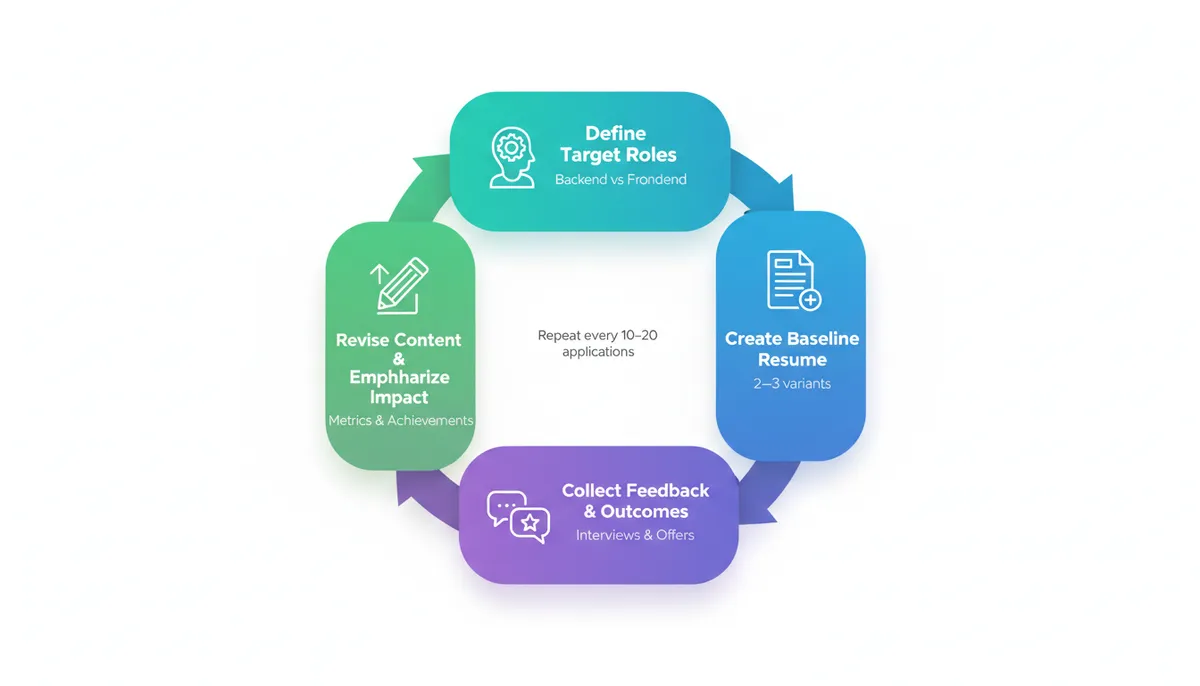
Treat your resume like a system you’re optimizing.
Step 1: Define the Target Roles
- Backend, frontend, full-stack, ML, data engineering, etc.
- Level: new grad, junior, mid, senior.
- Industry: product companies, consultancies, startups, big tech.
Step 2: Create a Baseline Resume
- One master document with everything.
- Then derive 2–3 focused variants for your main target roles.
Step 3: Collect Feedback and Signals
- Track where you’re getting:
- No response at all (likely ATS or recruiter screen failure).
- Recruiter screens but no technical interviews.
- Technical interviews but no offers (resume less of a factor here).
- Ask peers or mentors for blunt feedback.
- Use tools (including AI-based resume analysis and mock interview platforms) to spot gaps and inconsistencies.
Step 4: Iterate on Content, Not Just Design
- Add impact metrics where missing.
- Remove weak or redundant bullets.
- Align terminology with target job descriptions.
Key Takeaways: Why Resumes Get Rejected and How to Fix Yours
- Most rejections happen before anyone sees your code. Your resume must survive ATS parsing, recruiter scanning, and hiring manager scrutiny.
- Clarity beats cleverness. Make your role, skills, and impact obvious in 10 seconds.
- Impact beats activity. Replace “worked on X” with “achieved Y by doing X,” quantified where possible.
- Alignment matters. Tailor your headline, summary, and emphasis to the specific type of role.
- ATS compatibility is non-negotiable. Use simple, single-column layouts and test the raw text.
- Your resume is a living document. Iterate based on feedback and outcomes, just like you would with code.
Once your resume consistently gets you into interviews, the next bottleneck becomes performance in those interviews—data structures, algorithms, and system design. Preparing for that stage with structured practice and pattern-based learning will compound the value of a strong resume, turning more of those interviews into offers. For a comprehensive path to mastering these skills, consider following the Beginner to Advanced DSA Roadmap for Software Engineers in 2026.