
Interview
AI Mock Interview for Marketing Roles, Built From Your Resume
Practise marketing interview questions from your resume with live AI follow-ups. Prepare campaign, attribution and portfolio discussions with confidence.
Marketing interviews are rarely just a conversation about whether you know the difference between paid search and paid social. A hiring manager wants to understand how you think, what you actually owned, how you interpret imperfect performance data, and whether you can make a convincing case for your decisions.
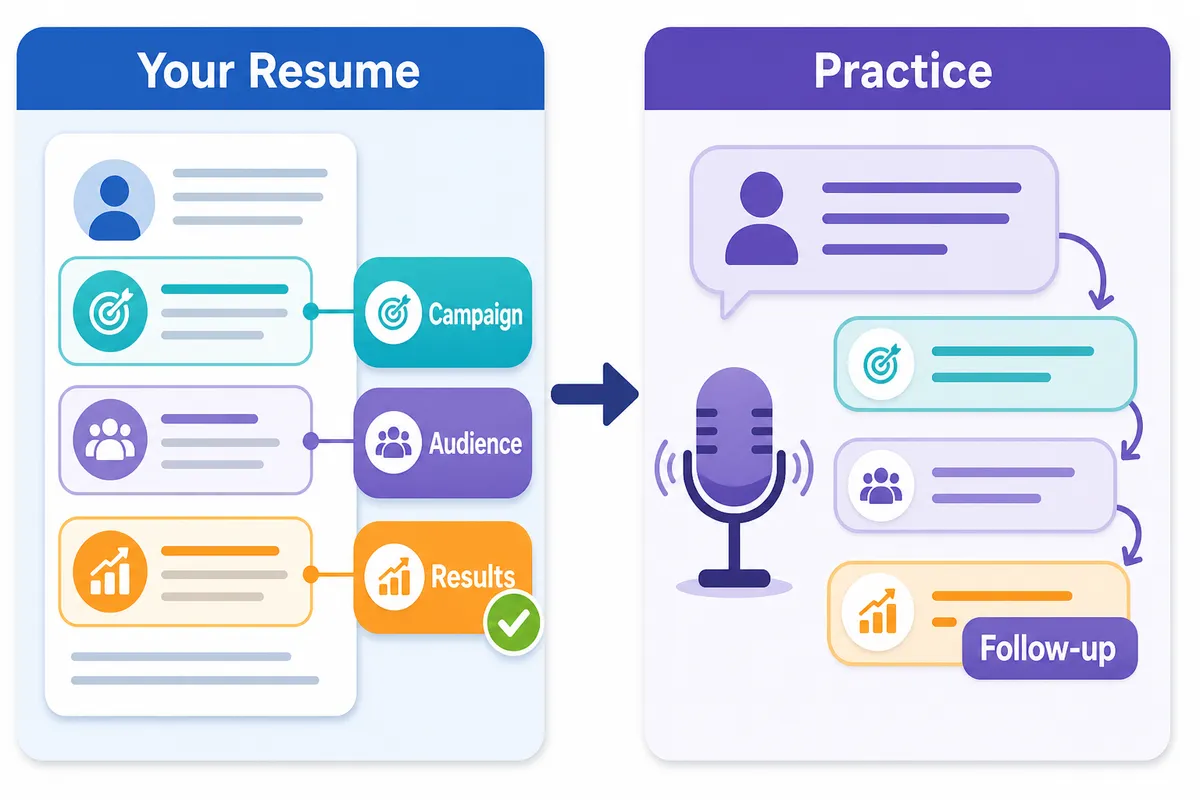
That makes generic question lists useful but incomplete. If you want to practice marketing interview questions from my resume, the most valuable questions are usually the ones that begin with a line you wrote yourself: “Tell me about the campaign that increased sign-ups by 28%.” “Why did you choose that audience?” “How do you know the campaign caused the result?”
A live AI mock interview for marketing candidates lets you rehearse those conversations aloud, with adaptive follow-ups rather than a static list of prompts. Thita’s resume-based interview surface can generate questions from your own CV, making your practice far closer to the discussion you may face with a recruiter, marketing lead or cross-functional panel.
Why marketing candidates need more than a list of questions
A listicle can help you remember common prompts:
- Tell me about a campaign you are proud of.
- How do you measure success?
- Describe a time performance missed expectations.
- How would you launch a new product?
- How do you work with sales, product or creative teams?
But the first answer is not normally the hard part. The hard part is what comes next.
A good interviewer will ask:
- “What was your specific contribution?”
- “Why was that metric the right one?”
- “What happened to conversion quality after volume rose?”
- “What would you change if you ran the campaign again?”
- “How did you separate channel impact from other factors?”
- “What did the numbers not tell you?”
These questions test judgement, communication and commercial thinking. They also expose whether you can move beyond polished marketing language into clear evidence and practical trade-offs.
That is why marketing interview practice AI should not merely score your first response. It should keep the conversation moving. If you mention an email nurture sequence, expect questions about segmentation, deliverability, conversion windows and how you decided which message to test. If you say you improved return on ad spend, expect a follow-up on attribution, incrementality or whether the result held after spend increased.
💡 Pro Tip: Do not try to memorise a flawless answer to every likely question. Prepare a small set of detailed stories, then practise adapting them to different follow-ups. Interviewers are assessing whether you understand the work, not whether you can repeat a script.
For a broader look at using AI without making your answers sound generated, read AI tools for interview preparation: benefits and pitfalls.
The marketing interview rounds you are likely to face
The exact process varies by company and seniority, but marketing candidates often encounter several of the following rounds.
1. Recruiter or talent screen
This is usually a short conversation about your background, job search and fit for the role. It may sound straightforward, but it establishes the story that follows you through the process.
Be ready to explain:
- Why you are considering a move now
- Why this company, market or customer segment interests you
- How your experience maps to the role’s priorities
- Whether your channel and industry background are transferable
- Your salary expectations and availability, where relevant
Your answer should connect your past work to the role without reciting your CV line by line. For example, a lifecycle marketer moving into a growth role might explain how retention work taught them to identify high-intent segments, build experiments and partner with product teams on activation.
⚠️ Important: “I am looking for a new challenge” is not a complete answer. It is safe but forgettable. Give the interviewer a specific reason that makes sense for this move.
2. Hiring manager interview
This is often the most resume-led part of the process. The hiring manager may walk through your campaigns, team structure, targets, decisions and results in considerable detail.
Expect questions such as:
- “Which campaign best shows how you work?”
- “How did you decide where to spend the budget?”
- “What did you own versus what did an agency, analyst or designer own?”
- “How did you prioritise competing channel opportunities?”
- “Tell me about a stakeholder who disagreed with your recommendation.”
- “What did you learn from a campaign that underperformed?”
The strongest candidates are specific without becoming lost in detail. They explain the business context, their role, the decision, the result and the learning.
A useful structure is:
- Context: What customer or commercial problem existed?
- Objective: What outcome mattered and why?
- Action: What did you decide, create, test or change?
- Evidence: What happened, including limitations in the data?
- Learning: What would you repeat, stop or improve?
This is close to the behavioural storytelling approach covered in how to use mock interviews effectively for faster improvement, but marketing stories need an additional layer: explain how your metric connected to revenue, pipeline, retention, awareness or customer behaviour.
3. Campaign or channel deep dive
For performance, growth, content, CRM, social, brand and product marketing roles, a specialist interviewer may test the depth of your channel knowledge.
A paid acquisition candidate might be asked about:
- Account structure and budget allocation
- Creative testing and audience strategy
- Landing-page conversion issues
- Frequency, fatigue and diminishing returns
- Lead quality versus lead volume
- Measurement limitations across platforms
A content or brand candidate may be asked about:
- Audience research
- Message hierarchy
- Editorial strategy
- Distribution choices
- Brand consistency
- Qualitative and quantitative success measures
A lifecycle marketer may need to discuss triggers, segmentation, experimentation, retention cohorts and how they avoided over-messaging customers.
The point is not to have one universal marketing framework. It is to show that you can choose the right framework for the problem in front of you.
4. Case study or presentation round
Some companies ask you to prepare a take-home case, present a campaign proposal or respond to a hypothetical business problem live. You may be asked to plan a launch, diagnose weak funnel performance, build a channel strategy or recommend a measurement plan.
Interviewers are usually looking for:
- A sensible problem definition
- Assumptions stated clearly
- Customer and market understanding
- Prioritised recommendations
- Appropriate metrics
- Awareness of constraints
- A presentation that makes decisions easy to follow
❌ Don't make a case presentation into a catalogue of tactics. “Run paid social, optimise SEO, launch an influencer programme and create a webinar” is not a strategy unless you explain whom each action serves, why it comes first and how you will measure it.
✅ Do say what you would need to validate. For example: “I would first check whether the drop is concentrated in mobile traffic, a particular source or a particular step in checkout. That determines whether we have an acquisition problem or a conversion problem.”
5. Portfolio and work-sample discussion
Portfolio rounds can be especially challenging because the work may have involved many people, confidential data or results that are difficult to isolate.
Bring examples that show range, but be prepared to discuss them in depth. A useful portfolio story covers:
- The original brief and business context
- The audience insight or problem you identified
- Your role and level of ownership
- The work itself: campaign, asset, experiment, launch or programme
- How stakeholders contributed
- The outcomes and what you learned
If your portfolio includes visuals, do not assume the panel will infer your thinking from the finished work. Narrate the decisions behind it. Explain what alternatives you considered, what changed after feedback and what you would improve now.
How to discuss campaign results when the numbers are messy
Most real marketing data is messy. Attribution windows vary. CRM records are incomplete. Platforms report different numbers. A campaign may run alongside a product launch, sales outreach, seasonality or a broader brand push.
The wrong response is to pretend your figures are cleaner than they are.
The better response is to show that you understand both the result and its limits.
Instead of saying:
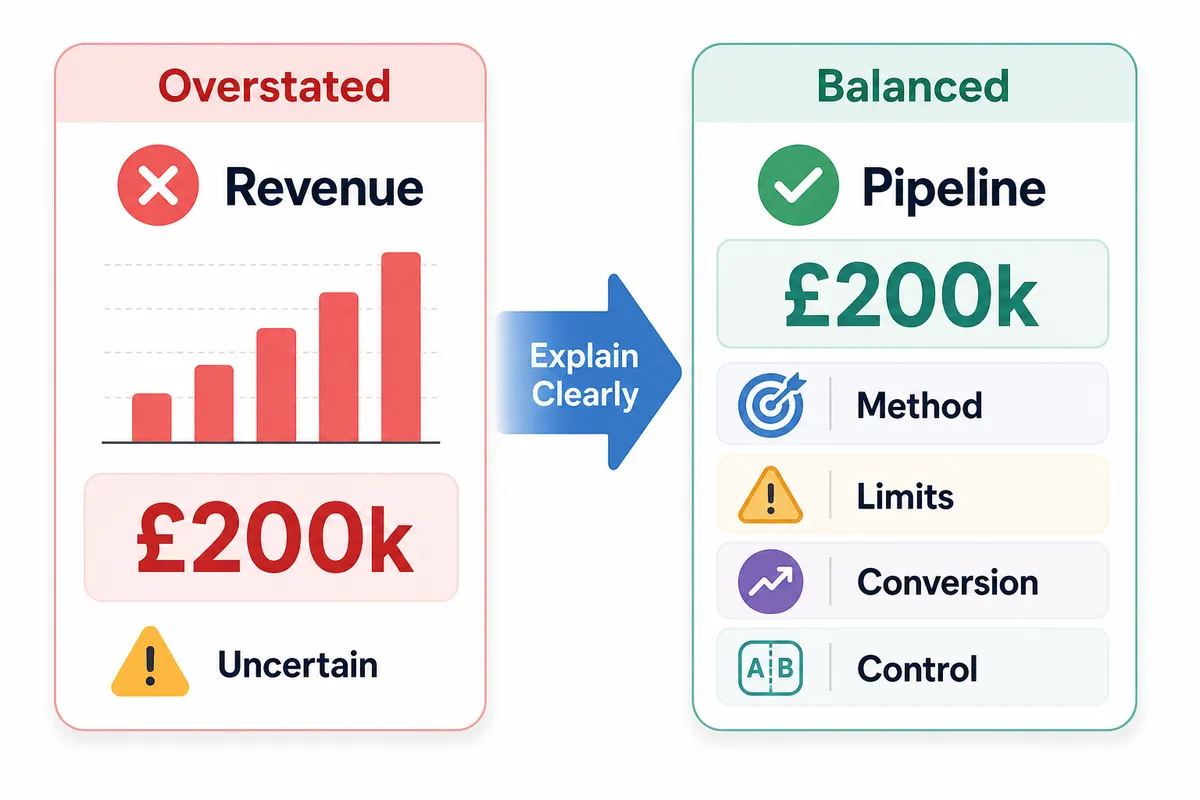
“The campaign generated £200,000 in revenue.”
Try:
“The campaign influenced £200,000 in tracked pipeline under our CRM attribution model. I would not describe all of that as purely incremental, because sales outreach and a product announcement ran during the same period. However, we saw higher conversion among the exposed segment, and the landing page test improved qualified-demo conversion compared with the control experience.”
That answer does four things:
- States the result.
- Names the measurement method.
- Acknowledges confounding factors.
- Provides supporting evidence without overstating causality.
This is valuable digital marketing interview preparation because many candidates know the vocabulary of attribution but struggle to discuss uncertainty with confidence.
Questions to rehearse about measurement
Practise answering these aloud:
- Which metric mattered most for this campaign, and why?
- What did you use as a leading indicator?
- How did you define a qualified lead or conversion?
- What attribution model did you use?
- What could have distorted the result?
- What evidence would have increased your confidence?
- What did you do when a channel looked strong in-platform but weak downstream?
- How would you measure brand impact differently from direct response?
A resume-based AI interview practice session can turn campaign claims on your CV into these kinds of follow-ups. That matters because vague bullet points often become the interviewer’s first opening: “You say you improved engagement by 40%. What changed, exactly?”
Turn your resume into interview-ready evidence
Before your marketing mock interview online session, review every bullet point on your CV. For each one, prepare the details that do not fit on the page.
Use this checklist:
✅ Do know the baseline. “Increased newsletter sign-ups by 25%” is stronger when you can explain whether that meant 200 additional subscribers or 20,000.
✅ Do separate team impact from your own contribution. “We launched” is acceptable, but explain what you led.
✅ Do define the metric. Engagement, leads and pipeline can mean very different things across companies.
✅ Do prepare one setback. A credible candidate can discuss an underperforming campaign, what they diagnosed and what changed afterwards.
❌ Don't claim credit for a result you cannot explain. A hiring manager may ask about spend, timeline, audience, creative, conversion rate and stakeholder decisions.
❌ Don't hide behind confidentiality. You can usually share ranges, percentages, relative movement, process and anonymised examples without revealing sensitive information.
If you are returning to interviews after time away, the practical preparation advice in out of practice: how to interview again can help you rebuild confidence before higher-pressure sessions.
A practical way to use AI practice before your interview
Use short, focused sessions rather than one long rehearsal.
Session one: your career story
Practise “tell me about yourself”, why this role and your strongest marketing achievement. Record where you become vague, rush or lose the commercial thread.
Session two: campaign deep dive
Choose one major campaign from your CV. Invite tough questions about the objective, target audience, budget, channel choice, creative, results and attribution.
Session three: portfolio walkthrough
Share your verbal walkthrough in a structured order. Practise explaining what the audience sees, why it mattered and what you learned.
Session four: messy metrics
Choose a project with imperfect data. Practise stating results accurately while explaining what you do and do not know.
Session five: role-specific case questions
Rehearse a launch plan, channel diagnosis or growth scenario relevant to the job description. Focus on prioritisation, not having an answer for every possible tactic.
A live AI interview practice session is particularly useful here because spoken answers reveal issues that written notes hide: overly long openings, unclear ownership, unsupported claims and answers that never quite reach a conclusion.
Frequently asked questions
Can I practise marketing interview questions from my resume?
Yes. Resume-based practice can generate interview questions from your own CV, including campaigns, channel work, measurable results and portfolio projects. This helps you prepare for the follow-ups a hiring manager is likely to ask.
What does an AI marketing mock interview assess?
It can help you practise clarity, structure, ownership, campaign reasoning, measurement discussions and how you respond to follow-up questions. Use the feedback to identify answers that are vague, overly broad or unsupported by evidence.
How should I explain campaign results if attribution is unclear?
State the reported outcome, explain the measurement method, acknowledge relevant limitations and share supporting evidence. Avoid presenting attributed revenue or platform-reported conversions as certain incremental impact unless you can justify that claim.
What marketing portfolio questions should I expect?
Expect questions about the brief, target audience, your role, key decisions, stakeholder input, performance and lessons learned. Be ready to explain why you chose an approach, not just show the finished work.
Is marketing interview practice AI useful for non-technical roles?
Yes. Resume-based interviews work for non-technical roles, including marketing. They are useful when you need to practise speaking through experience, handling behavioural questions and discussing work samples.
How many mock interviews should I do before a marketing interview?
Three to five focused sessions can be more useful than one unfocused marathon. Cover your career story, one campaign deep dive, one portfolio discussion, measurement questions and a role-specific case.
Should I memorise answers to common marketing interview questions?
Memorise your evidence, not full scripts. Know the context, action, results and learning for your best examples, then practise adapting them to different questions and follow-ups.
Practise the questions your own resume invites
Your next marketing interview will not be a generic quiz. It will be a conversation about the claims, campaigns and outcomes attached to your name.
Use a Thita live voice AI mock interview to practise your career story, defend campaign decisions, discuss uncertain attribution honestly and walk through your portfolio with confidence. Start with the experience already on your CV, then let the follow-up questions show you where your preparation needs more depth.
If you are hiring marketing talent rather than preparing for an interview, visit interviews.thita.ai.
Topics
Related on Thita
Your next step
Practise with AI mock interviews
A spoken interview that asks follow-up questions, runs your code and ends with a written report.