
Interview
Out of Practice? How to Interview Again After Years Without One
Haven't interviewed in years?
If you have been in the same job for five, eight or even fifteen years, interviewing again can feel oddly intimidating. You may be very good at your work. You may lead projects, ship reliably, manage stakeholders and solve difficult problems every week. Yet the thought of a recruiter asking, “Tell me about yourself,” can make all of that confidence disappear.
That is normal. Being out of practice for an interview after years in one role is not a sign that you are behind. It means you have not had to package your experience, explain decisions to strangers or solve unfamiliar problems under a timer for a while.
The fastest way back is not memorising answers in isolation. Start with a realistic conversation about your own background. A resume-based AI interview from your CV gives you a low-pressure first round where you can rebuild the habit of talking about your work before you face more technical or specialised formats.
Modern interviews have changed. The fundamentals have not. With a structured plan, you can become interview-ready again without pretending you are a recent graduate or trying to relearn everything at once.
Why returning to interviews feels harder than expected
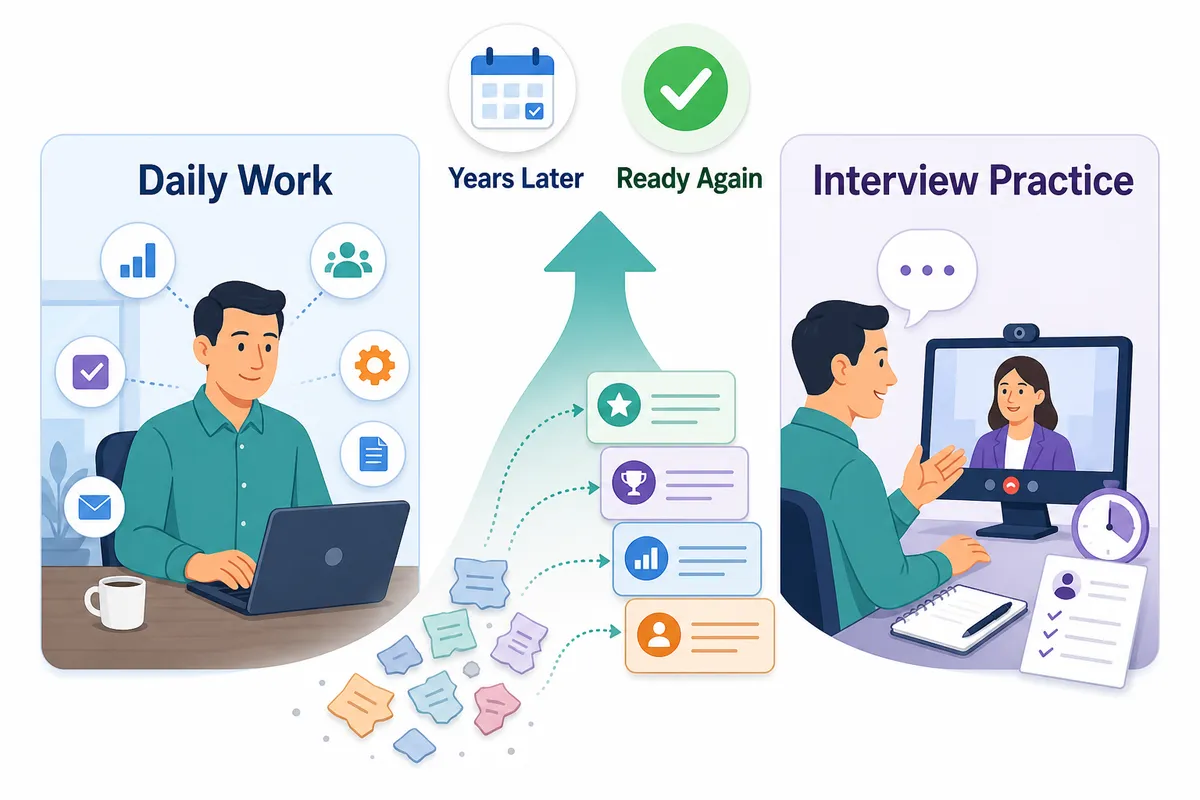
When you have not interviewed in years, your professional story exists in fragments. You remember the launch that went well, the difficult incident you helped resolve and the promotion you earned. But interviews ask you to turn those fragments into concise evidence.
That takes practice because day-to-day work and interviewing reward different behaviours.
At work, you have context. Your colleagues know the systems, customers, constraints and acronyms. In an interview, you may have two minutes to explain the same work to somebody who has never seen any of it. You need to establish the problem, your specific contribution, your decisions, the result and what you learned.
There is another complication: your last interview process may genuinely be out of date. Perhaps you remember one recruiter call, an onsite day and a few conversations. Now you may encounter a recorded video response, an online assessment, an AI screening round, a technical screen, a panel interview and a final conversation spread across several weeks.
⚠️ Important: Do not assume that being experienced means every employer will skip skills assessment. Seniority often changes the kind of question you get, not whether you will be evaluated.
The good news is that experienced candidates have a major advantage once they learn to present it. You have real judgement, trade-offs, mistakes, stakeholder challenges and measurable outcomes. The task is to retrieve those examples and communicate them clearly.
What has changed in interviews
The exact process still varies by company, location and role. But several formats are much more common than they were five or ten years ago.
More stages, with each stage serving a different purpose
A modern hiring process may include:
- A recruiter or talent screen
- A hiring-manager conversation
- An online assessment or work sample
- A live technical, case-study or functional round
- Behavioural and leadership interviews
- A final panel or cross-functional conversation
- Reference and background checks
Not every employer uses all of these. However, it is sensible to prepare for the possibility that the first conversation is not the only filter.
For technical candidates, interview loops can include data structures and algorithms, live coding, system design, low-level design, machine coding, debugging and behavioural rounds. Product managers may face product sense, metrics, execution and stakeholder scenarios. Data professionals may need SQL, statistics, experimentation and business-case discussions.
Video is routine, but video interviewing is not simple
Remote interviews are now ordinary. That does not mean they are easier.
You need to be comfortable speaking to a camera, sharing a screen, managing your notes without reading them and dealing with occasional technical problems. For a coding or presentation round, you may need to think aloud while navigating an unfamiliar editor or whiteboard.
Set up your space before the interview: reliable internet, charged device, quiet room, camera at eye level and a tested microphone. Then practise in the same environment. The point is not to create a perfect studio. It is to remove avoidable friction.
Live coding has become more conversational
For many engineering roles, writing code is only part of the assessment. Interviewers often watch how you clarify requirements, choose an approach, test edge cases and respond when something does not work.
You may be given an in-browser editor rather than a whiteboard. You may be expected to run code, explain complexity and handle a follow-up that changes the constraints. At more senior levels, the prompt may be less about recalling a textbook algorithm and more about designing maintainable software under realistic constraints.
A useful refresher is what interviewers look for in live coding rounds. The central lesson is simple: do not go silent while you work.
AI screening is now part of the landscape
Some employers use asynchronous video interviews, automated assessments or AI-supported screening before a person speaks with you. You might receive timed written prompts, recorded questions or an assessment link soon after applying.
This does not mean you need to sound scripted. It means you should be ready to communicate clearly without relying on rapport to carry the conversation. Read instructions closely, answer the question asked and leave time to check your setup.
AI can also support preparation, but it should not replace your judgement. A general assistant can help brainstorm examples, but it cannot fully recreate the pressure of explaining your own choices aloud while someone asks follow-up questions.
More emphasis on evidence, not job titles
A title alone does less work than it once did. Interviewers want to know what you personally owned, what changed because of your work and how you made decisions.
Instead of saying, “I was a senior engineer on the payments team,” prepare to say:
- What business or customer problem was the team solving?
- What was your individual responsibility?
- What constraints did you face?
- What did you decide, influence or improve?
- What was the measurable outcome?
- What would you do differently now?
That level of specificity is valuable in every interview format.
What has not changed
Despite new tools and more elaborate processes, the core evaluation is reassuringly familiar. Employers still want evidence that you can do the work and work well with other people.
They are usually looking for five things:
- Capability: Can you perform the role’s core tasks?
- Judgement: Can you make sensible decisions with incomplete information?
- Communication: Can you explain your thinking clearly?
- Collaboration: Can you work through disagreement, feedback and ambiguity?
- Motivation: Why this move, this role and this company now?
Your goal is not to deliver flawless answers. It is to make your reasoning easy to follow.
💡 Pro Tip: A strong answer usually has a visible shape: context, action, result and reflection. If your answer wanders, pause and give it that structure rather than adding more detail.
For behavioural preparation, revisit this guide to using mock interviews effectively for faster improvement. Experienced candidates often have excellent stories but need a repeatable way to tell them.
Start with the round you already own: your resume
When you are rusty at interviewing, do not begin with the hardest possible technical question or a mock panel full of unknown prompts. Begin with the material you know best: your own career.
A resume-based round is useful because it reveals gaps quickly. Can you explain why you changed roles? Can you describe your largest project without using internal jargon? Can you defend the scale or impact numbers on your CV? Can you explain a career pause, a long tenure or a move that looks sideways on paper?
These are not trick questions. They are the foundation of almost every first-round conversation.
Start by reviewing every line of your CV. For each role, prepare short notes for:
- Your remit and level of responsibility
- Two important projects or outcomes
- One difficult problem you solved
- One conflict, failure or change you handled
- One example of leadership, even without direct reports
- The reason you are now considering a move
Then practise answering questions such as:
- “Walk me through your current role.”
- “What are you most proud of from the past few years?”
- “Why have you stayed at one company for so long?”
- “Tell me about a decision you would make differently now.”
- “What are you looking for in your next role?”
- “What did you personally contribute to this project?”
A live voice AI interview based on your experience is a practical place to rehearse these questions because the follow-ups can expose where an answer is vague, overly technical or missing the result.
For non-technical roles, this may be the most important practice round. For technical roles, it is still the right first step before moving into coding, architecture or domain-specific interviews.
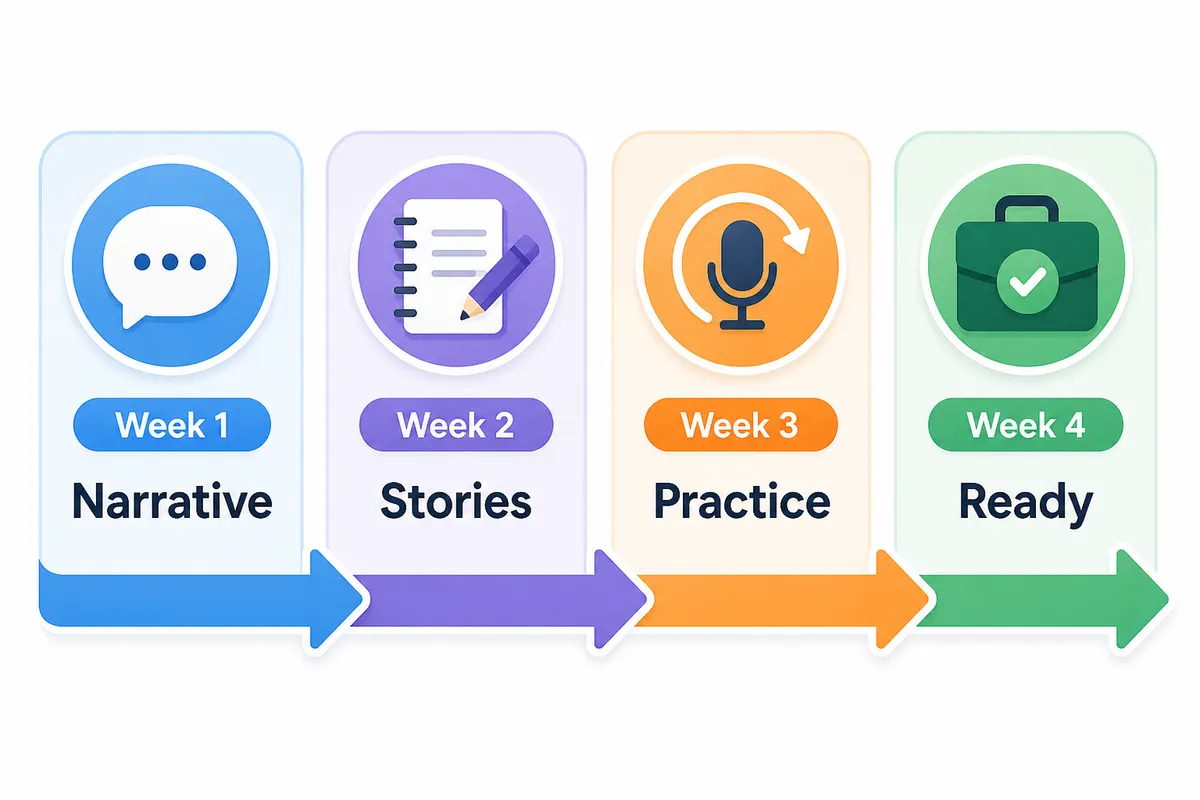
A four-week plan for interview practice after a long time
You can compress or extend this plan depending on your timeline. The order matters more than the exact number of days.
Week one: rebuild your professional narrative
Your first priority is clarity, not performance.
Update your CV and LinkedIn profile so dates, titles, skills and accomplishments agree. Pull together your key stories. Write rough bullet points rather than full scripts; memorised answers tend to sound unnatural and become hard to adapt.
Practise your introduction until it is clear and conversational. Aim for 60 to 90 seconds, not five minutes. Include where you are now, the thread that connects your experience and what you want next.
✅ Do quantify outcomes where you can: revenue, cost, time saved, reliability, adoption, quality or team impact.
❌ Don't claim ownership of a team achievement you cannot explain in detail. Follow-up questions will test the boundary of your involvement.
Week two: map your target interview loop
Look at several job descriptions, not just one. List recurring requirements and identify likely interview formats.
For example, an experienced backend engineer may need coding, API or service design, system design and leadership stories. A product manager may need product sense, prioritisation, metrics and execution examples. A data scientist may need SQL, modelling, experimentation and communication with non-technical partners.
Use company-specific information carefully. It can help you understand the likely round mix, but do not treat any online interview report as a guaranteed script. Processes change.
If you need a broader timetable, 30-day technical interview preparation guidance can help you turn a vague intention into daily practice blocks.
Week three: practise under realistic conditions
This is the week to add time limits, voice and follow-up questions.
Run at least three mock sessions covering the rounds most likely for your role. One should be resume-based or behavioural. One should test your core role skill. One should be a mixed session that forces you to switch between explanation and problem-solving.
For engineers, this could mean a live coding session followed by a behavioural question about a production incident. For product candidates, it could mean a product case followed by a stakeholder conflict scenario.
Thita supports live voice AI interviews across DSA, system design, low-level design, machine coding, behavioural, product management, data science, AI and ML. Coding practice includes an editor where you can practise in six languages: Python, C++, Java, JavaScript, Go and C#. In system design, you submit an architecture on a canvas and receive evaluation of that architecture.
The value is not merely getting a score. It is hearing yourself answer, noticing where you ramble and learning to recover when an adaptive follow-up catches you off guard.
Week four: review patterns and sharpen weak points
By now, patterns should be visible. Perhaps your technical knowledge is sound but your answers lack structure. Perhaps you communicate well but have not practised running code under pressure. Perhaps you have strong achievements but keep minimising your own contribution.
Choose one or two weaknesses only. Spend the week improving those rather than restarting everything.
✅ Do review your answers after every mock. Ask: Where did I become vague? What question surprised me? What evidence was missing?
❌ Don't spend the final days endlessly rewriting your CV. A good CV matters, but interview confidence comes from speaking about it repeatedly.
Frequently asked questions
How do I prepare if I have not interviewed in years?
Start with a resume-based conversation before moving to unfamiliar formats. Rebuild your professional story, prepare evidence for your achievements and then practise the role-specific rounds you are likely to face.
What has changed most in interviews over the past five years?
Video interviews, online assessments, AI-supported screening and multi-stage processes are more common. Technical interviews may also include live coding editors, design canvases and more adaptive follow-up questions.
Am I too old-fashioned if I am rusty at interviewing?
No. Interviewing is a learnable performance skill, not a measure of whether your experience is valuable. Your goal is to update your format and communicate your existing strengths clearly.
Should I memorise answers to behavioural questions?
Memorise the structure and key facts, not a script. Prepare a bank of stories, then adapt them to the question. This sounds more natural and helps when the interviewer asks a follow-up.
How many mock interviews should I do before applying?
Aim for at least three to five realistic sessions across your likely interview types. More is useful if you are changing industries, returning after a long break or targeting a highly competitive role.
What if I do not know which interview round I will face?
Begin with your CV and behavioural stories, because nearly every process uses them. Then study the job description, ask the recruiter what to expect and prepare the most likely functional or technical format.
Can I practise interviews for non-technical roles?
Yes. Resume-based interviews work for non-technical roles, and Thita also offers practice for behavioural, product management, data science and AI and ML interview tracks.
Start rebuilding confidence one conversation at a time
You do not need to become a different person to interview well. You need a current understanding of the process, a clear account of your experience and enough realistic practice that speaking under pressure feels familiar again.
Start with the role you know best: your own. Then build towards the rounds that make you less comfortable.
Practise a live voice AI interview with adaptive follow-ups, resume-based questions and role-specific formats whenever you are ready. ”
If you are hiring rather than interviewing, visit interviews.thita.ai.
Topics
Related on Thita
Your next step
Practise with AI mock interviews
A spoken interview that asks follow-up questions, runs your code and ends with a written report.