
Interview
Amazon System Design Interview Guide (2026)
Prepare for the Amazon system design interview with level-specific expectations, product-domain frameworks, common mistakes, and a focused preparation plan.
The Amazon system design interview is where strong engineers separate themselves from candidates who can solve coding problems but cannot yet explain how a production system should behave under real constraints. It is not primarily a test of memorised architectures. It is a test of scope control, trade-off judgement, clear communication, and whether your design decisions reflect the customer impact Amazon expects engineers to own.
For targeted technical practice, Amazon's interview kit holds 268 mapped DSA questions, 16 low-level design problems, and 14 system design problems evidenced at Amazon. The most useful way to use that material is not to race through it: use it to rehearse the decisions, diagrams and explanations that make a design answer credible.
Reported accounts describe a technically DSA-heavy Amazon loop, with system design becoming a meaningful part of the process for SDE II and L5+ candidates. Leadership Principles are also assessed throughout the loop, including technical conversations. That combination matters: a technically sound answer can still underperform if it is unclear, unstructured, detached from customer needs, or unable to defend its trade-offs.
When does system design apply at Amazon?
System design is commonly reported from SDE II and L5 upwards, where interviewers expect candidates to reason beyond one function or one service. The question is less likely to be “can you name the right database?” and more likely to be “can you turn an unclear product requirement into an architecture that can evolve?”
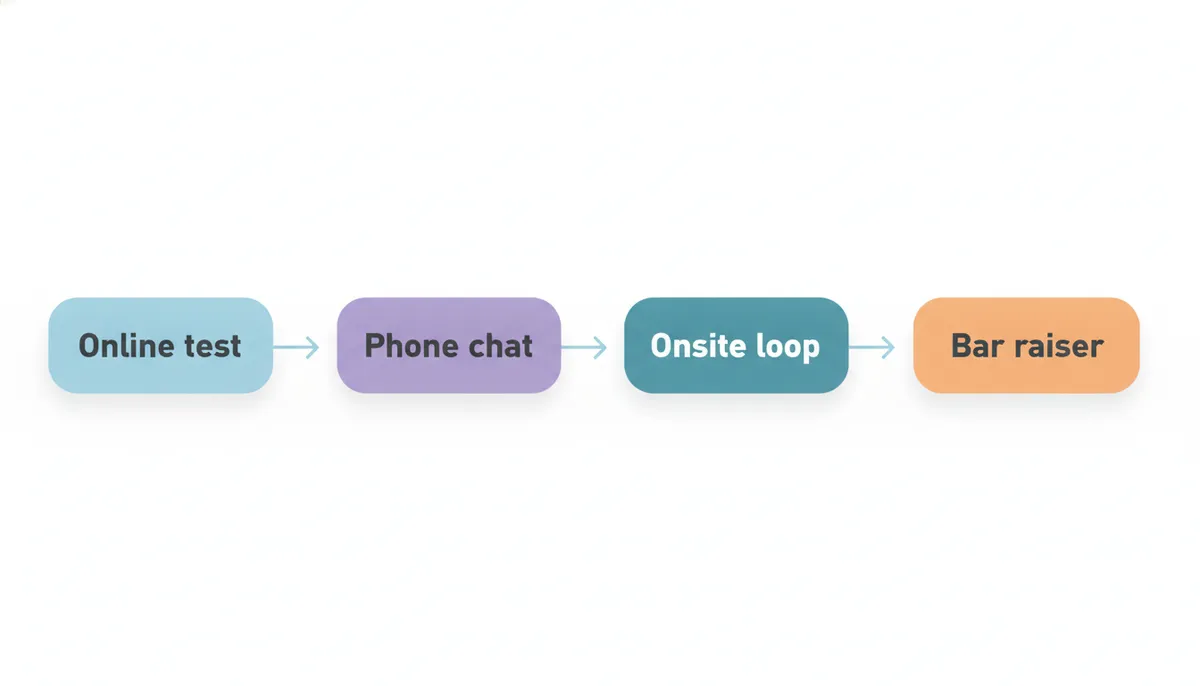
At this level, reported accounts describe onsite loops containing coding rounds alongside one or two system design conversations. The exact sequence varies by team and candidate level, so treat that as a commonly reported shape rather than a fixed policy.
There is also a newer, more tentative detail to know. SDE II+ candidate reports describe an online assessment that may include a short high-level system-design sketch in addition to coding. This is estimated rather than firmly established, and it is level-dependent. If your recruiter mentions an architecture component early in the process, confirm its format and expected depth rather than assuming it resembles a full onsite design round.
For SDE I candidates, architecture-level system design is usually not the central technical expectation in reported accounts. You should still be comfortable discussing clean APIs, sensible data models, basic scaling choices and the design of your own projects. The guide to how much system design is enough for SDE I versus SDE II interviews is useful for drawing that boundary.
What the Amazon system design interview is really testing
A good design answer has to be technically coherent. At Amazon, it also needs to show decision-making that is disciplined, customer-aware and operationally realistic.
Candidate reports describe the Bar Raiser as a cross-team evaluator with veto authority that the hiring manager cannot overrule. The Leadership Principles are reported to be assessed in every round, not reserved for a final behavioural conversation. Interviewers are commonly reported to be assigned particular Principles, take detailed notes and submit written evidence before the debrief.
That means your system-design answer is partly technical evidence and partly evidence of how you work.
Start from the customer, not the components
Candidates often begin with a queue, cache or database before agreeing on what the system must do. That is backwards. Begin by asking what the customer needs to accomplish, what success looks like, and which failures matter most.
For example, if you are designing order tracking, clarify whether the core requirement is showing a customer the latest state, preserving a trustworthy history, notifying them of changes, or enabling support agents to investigate failures. Those answers change the architecture.
This approach naturally demonstrates customer focus and helps you avoid designing an impressive but irrelevant platform.
Make assumptions visible
Amazon-style design prompts are usually broad enough that assumptions are unavoidable. Strong candidates do not hide them. They state them, explain why they are reasonable, and identify what would change if the assumptions proved wrong.
Say:
“I’ll optimise first for reliable status updates because stale order information damages customer trust. If the product later requires sub-second tracking, I would revisit the event pipeline and storage model.”
That is better than silently selecting technology. It shows ownership of the problem, not merely familiarity with components.
Prioritise the critical path
A design interview has limited time. You cannot fully design every service, every failure mode and every internal tool. Strong answers identify the core workflow first, make it work end to end, then deepen the areas that carry the greatest risk.
A reliable sequence is:
- Clarify users, goals and non-goals.
- Define the core user journey.
- Estimate scale in broad terms.
- Draw the main services and data flow.
- Choose storage around access patterns.
- Discuss failures, bottlenecks and trade-offs.
- Extend the design only where the interviewer directs.
This is not a script to recite. It is a way to ensure the interviewer can follow your thinking and intervene at useful points.
Defend trade-offs rather than claiming perfection
There is no universally correct design for a large system. A cache can improve read latency while introducing staleness. Strong consistency can improve correctness while affecting availability or throughput. A synchronous workflow can be easier to reason about while increasing coupling between services.
Interviewers learn more from a candidate who says, “I am choosing this because it protects the customer’s most important workflow, but it increases operational complexity,” than from one who presents every decision as cost-free.
The rate limiter system design guide is a useful example of this mindset. A strong rate-limiter answer is not simply a named algorithm; it explains fairness, storage, failure handling, distribution and the consequences of each choice.
Amazon’s natural system-design territory
Amazon’s products make certain design domains especially useful for preparation. This does not mean every interview prompt will resemble a consumer Amazon feature. It means these domains provide realistic ways to practise the constraints Amazon-scale systems create.
Commerce and order workflows
Think about catalogue search, inventory visibility, cart updates, checkout, order status, returns and fulfilment. These problems force you to discuss competing requirements: speed versus correctness, availability versus overselling, and customer-facing status versus internal operational state.
Useful questions include:
- Which information can be eventually consistent?
- What must be durable before a customer sees confirmation?
- How do you prevent duplicate requests from creating duplicate work?
- How do you explain delays or failures to users honestly?
High-volume read systems
Product pages, catalogues, search results, reviews and recommendations create read-heavy workloads. These are useful for practising caching, indexing, pagination, replication, invalidation and graceful degradation.
Do not stop at “put a cache in front of it”. Explain what is cached, for how long, where invalidation originates, and what happens when the cache misses or becomes unavailable. The operational behaviour is often more important than the box on the diagram.
Event-driven fulfilment and notifications
Order events, shipment updates, delivery estimates and customer notifications are excellent territory for queues, asynchronous workers, retries, dead-letter handling and observability.
The key distinction is between an event being produced, an internal service processing it, and a customer actually seeing an update. A thoughtful design makes those stages visible and gives operations teams a way to trace them.
Identity, access and platform services
Amazon’s broad product surface also makes shared services natural practice territory: account systems, permissions, audit logs, usage tracking and APIs used by many internal clients. These prompts reward clear thinking about tenancy, security boundaries, rate limits, backwards compatibility and monitoring.
The kind of design problem evidenced at Amazon often benefits from this product mindset: a concrete user workflow, substantial scale, failure-aware operations and a reasoned path from simple first version to more capable system.
A framework for answering the question
Use this structure until it becomes natural enough to adapt.
Clarify the problem
Spend the opening minutes discovering the real requirement. Ask about users, primary actions, expected load, latency sensitivity, consistency expectations, geography, privacy and the most important failure cases.
Avoid interrogation for its own sake. Ask questions that alter your design. If a requirement will not change a decision, do not let it consume the conversation.
Define the API and data model
Before drawing infrastructure, define the requests and objects the system handles. A few endpoint examples and a small data model make the rest of the discussion concrete.
For an order-status service, you might identify an order identifier, status events, timestamps, customer-facing delivery estimates and source metadata. That immediately raises useful questions about ordering, duplication and history.
Sketch the baseline architecture
Start small: client, load balancer, application service, primary data store, cache where justified, and asynchronous processing where the workflow needs it. Explain the path of a request from entry to persistence to response.
Do not introduce specialised infrastructure merely to sound senior. Every component should solve a named problem.
Estimate and locate pressure points
Use rough capacity thinking to identify what breaks first. Is the workload read-heavy? Does one record become a hotspot? Is fan-out expensive? Does storage grow indefinitely? Are peak traffic patterns predictable?
Precise arithmetic matters less than the implications. If reads dominate, discuss caching and replicas. If writes are bursty, discuss buffering. If a small number of items receive disproportionate traffic, discuss partitioning and hot-key mitigation.
Discuss reliability and evolution
Finally, explore failures and future requirements. What happens if a downstream service is slow? How are retries controlled? How are duplicate events handled? What can be monitored? How can the system change without breaking clients?
This is where many candidates show the gap between a classroom diagram and an engineering design.
For more implementation-oriented preparation, the Low Level Design Sheet is free to browse, while the System Design Sheet is free to browse for architecture practice.
What strong Amazon answers do differently
The best candidates do not necessarily draw more boxes. They make the interview easier to evaluate.
They narrate their reasoning. Interviewers cannot credit decisions they cannot hear. Explain why you are asking a question, choosing a data store or postponing an optimisation.
They organise the conversation. Signpost transitions: requirements first, then data model, then request flow, then scaling, then reliability. This makes an ambiguous prompt feel manageable.
They connect decisions to customers. Instead of saying “availability is important”, explain what a customer experiences if the system fails and what fallback behaviour protects them.
They show ownership of failure modes. A mature answer includes retries, monitoring, alerts, degraded experiences and investigation paths. It does not assume every service behaves perfectly.
They avoid premature complexity. A simple design with clear extension points is stronger than a sprawling system that cannot be explained. “Invent and Simplify” is not an invitation to omit important details; it is a reminder to make complexity earn its place.
They remain coachable. If an interviewer challenges an assumption, do not defend it reflexively. Reassess, explain the impact and adapt the design. That is closer to real engineering than winning an argument.
The same communication discipline matters in coding rounds. Read how to explain your thought process clearly in coding interviews before practising mock sessions.
A focused preparation plan
Build the foundation first
If your coding fluency is inconsistent, keep DSA preparation active alongside system design. Amazon’s technical loop is commonly reported as DSA-heavy, so system design should complement rather than replace algorithm practice.
Use the DSA Patterns Sheet, which is free to browse, to practise recognition and explanation. Prioritise being able to explain complexity, edge cases and alternative approaches. The graph traversal patterns guide is especially useful if you need to refresh graph reasoning.
Practise one design domain at a time
Do not begin with random prompts. Group practice around domains:
- commerce and inventory;
- feeds, search and high-volume reads;
- event pipelines and notifications;
- identity, permissions and audit trails;
- shared platform APIs.
For each prompt, write a short requirements list, draw a baseline design, identify the highest-risk trade-off, and list two likely follow-up questions. This produces reusable mental models without encouraging memorised answers.
Simulate the conversation, not just the diagram
A whiteboard alone does not reproduce the interview. Set a timer, speak aloud, state assumptions and record yourself if possible. Afterwards, review where you lost structure, skipped a trade-off or used a component without explaining its role.
Amazon's interview kit is useful here because it lets you rotate across DSA, low-level design and system-design practice rather than treating each as an isolated subject.
Rehearse Leadership Principle evidence
Prepare project stories that show ownership, deep investigation, simplification, urgency and delivery. Do not force a Leadership Principle slogan into a technical answer. Instead, make the behaviour visible through your choices: clarify the customer impact, investigate a failure mode, simplify a complex flow, or explain how you would measure whether the design succeeds.
An AI interview can help you rehearse both technical explanation and behavioural follow-ups. Use it to practise concise stories, not polished speeches.
Frequently asked questions
Is system design required for the Amazon interview?
Reported accounts describe system design as a meaningful part of SDE II and L5+ loops. Expectations vary by team and level, so confirm the format with your recruiter.
Does Amazon include system design in the online assessment?
SDE II+ reports describe a short high-level design sketch in some online assessments. This is estimated, level-dependent information rather than a universal reported format.
What should I expect in an Amazon system design interview?
Expect an open-ended product or platform problem where you clarify requirements, propose a baseline architecture, discuss scale, explain storage choices and defend trade-offs.
How deep should an SDE II answer go?
Go beyond a single-service solution. You should explain request flow, data modelling, scaling, reliability, observability and the trade-offs behind major decisions.
Are Leadership Principles relevant in technical rounds?
Yes. Candidate reports commonly describe Leadership Principles as assessed throughout Amazon’s loop, including coding and system-design conversations.
What is the Bar Raiser’s role?
Reported accounts describe the Bar Raiser as a cross-team evaluator who contributes independently to the final decision and can veto a hire.
Should I memorise Amazon architecture diagrams?
No. Memorise frameworks and trade-offs, not diagrams. A copied architecture often falls apart when an interviewer changes one requirement.
What domains should I practise for Amazon system design?
Commerce workflows, inventory, high-volume reads, search, notifications, fulfilment, identity and platform APIs are all useful practice domains because they create realistic scale and reliability trade-offs.
How should I practise system design under pressure?
Practise aloud with a timer. Start from requirements, narrate every major choice and leave time to discuss failures, metrics and future evolution.
Where to start
The Amazon system design interview rewards candidates who can turn ambiguity into a clear, customer-focused engineering plan. Your goal is not to produce the most complicated architecture. It is to show sound judgement: what matters first, what can fail safely, where complexity belongs and how the design can grow.
Start with Amazon's interview kit for 268 mapped DSA questions, 16 low-level design problems, and 14 system design problems evidenced at Amazon. Use the free-to-browse System Design Sheet to build architecture fluency, then rehearse the conversation in an AI mock interview.
Confirm the exact loop with your recruiter. Then practise the kind of answer that earns confidence: structured, customer-aware, technically grounded and honest about trade-offs.
Topics
Related on Thita
Your next step
Practise with AI mock interviews
A spoken interview that asks follow-up questions, runs your code and ends with a written report.