
Interview
Apple Interview Questions and Process: The Complete Guide (2026)
A complete guide to Apple's interview questions, team-owned rounds, coding and design preparation, timelines, and difficulty.
Apple interview questions are usually coding-first, followed by system design for mid-level and senior candidates, then a behavioural conversation centred on why you want to work at Apple. Reported accounts describe a team-owned process rather than one universal company loop: expect several screens and interviews, but prepare for variation in question style, technical depth and pace. For technical practice, Apple's interview kit contains 119 mapped DSA questions, 1 low-level design problem, and 1 system design problem evidenced at Apple.
The important implication is simple: do not prepare for “the Apple interview” as though every team runs the same script. Prepare a dependable coding process, clear design communication and credible stories about your engineering decisions. Then use recruiter conversations to narrow the likely team-specific emphasis.
Apple interview process at a glance
| Stage | Round | Common format | What it screens for |
|---|---|---|---|
| 1 | Recruiter or hiring-manager screen | Background, role fit and experience discussion | Motivation, relevant experience and communication |
| 2 | Coding screens | Live coding, commonly reported on CoderPad | Data structures, problem solving and language fluency |
| 3 | Onsite coding rounds | One or more live technical interviews | Correctness, complexity and collaborative reasoning |
| 4 | System design | More common for mid-level and senior roles | Technical judgement, trade-offs and scalable thinking |
| 5 | Why Apple? conversation | Behavioural and project discussion | Motivation, ownership and team fit |
Reported accounts describe roughly four to eight rounds overall. That range is wide because Apple’s loop is team-owned: the team, rather than a central question bank, reportedly shapes the questions and panel.
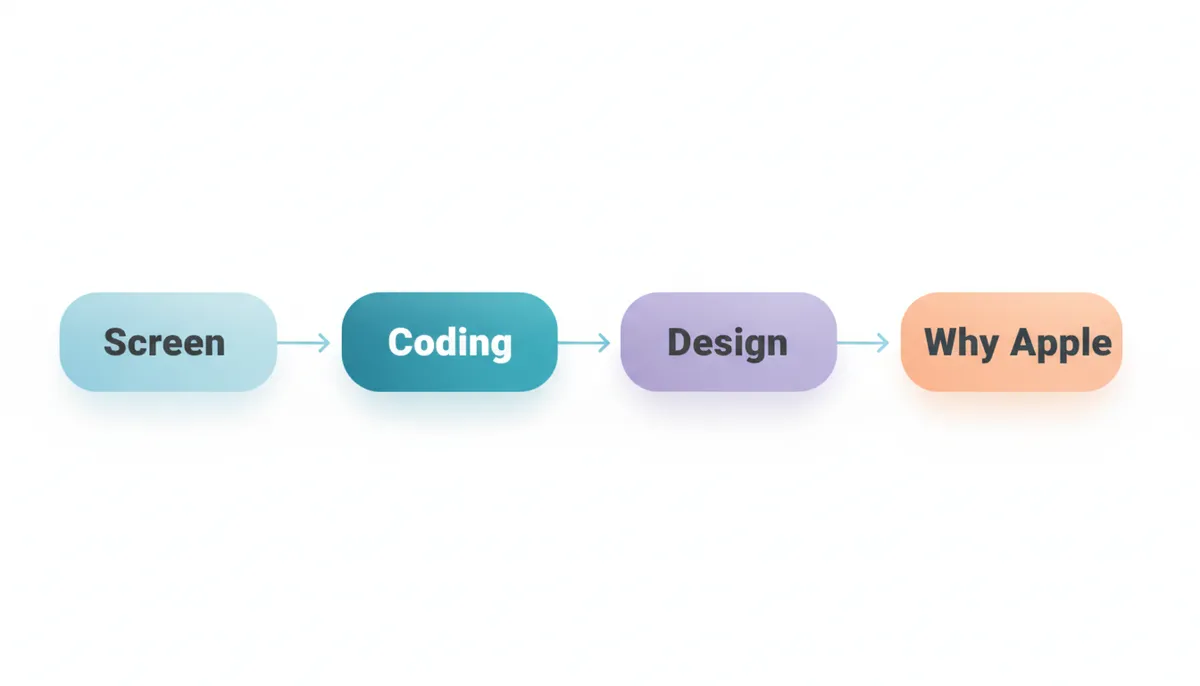
Treat this table as a preparation map, not a promise of a fixed sequence. Candidate reports are anecdotal, and Apple’s reported team ownership makes variation the central fact of the process.
Round 1 — recruiter or hiring-manager screen
The opening conversation is usually about your background, the role and why the opportunity makes sense for you. It may be run by a recruiter or a hiring manager depending on the team and hiring path.
This stage screens for whether your experience maps plausibly to the work, whether you can explain past projects clearly, and whether your interest sounds specific rather than generic. A candidate who says they want to “work on innovative products” has not yet answered the useful question. Which product constraints interest you? What engineering problem do you want to own? Why does this team’s work fit the direction you want to develop?
Prepare a concise career narrative covering what you have built, the technical decisions you owned, the work you want next and why Apple is relevant to that work. Avoid memorising a corporate speech. The strongest answer is concrete enough to invite follow-up questions about your judgement.
Rounds 2 and 3 — coding screens and onsite coding
Coding is the reported centre of gravity for Apple software engineering interviews. Accounts commonly describe one to three coding screens and onsite coding rounds, often in a shared editor such as CoderPad. Data structures, problem solving and core language depth are recurring themes.
The interviewer is not merely checking whether you can eventually reach an answer. They are assessing how safely and efficiently you work with another engineer watching. A strong performance tends to follow a recognisable sequence:
- Restate the problem and clarify assumptions.
- Work through a small example before choosing an approach.
- Explain the data structure and complexity trade-off.
- Implement the smallest correct version.
- Test edge cases aloud.
- Improve only where the improvement solves a real constraint.
This is especially valuable in a team-owned loop. Different teams may choose different problems, but clear reasoning travels well across all of them. The interviewer can credit a process they can hear.
Use Apple's interview kit to practise the mapped coding material in a focused way. For broader revision, the DSA Patterns Sheet is free to browse and organises practice around reusable problem shapes rather than a random queue of questions.
If your solutions are technically correct but interviews still feel inconsistent, work on narration. Read how to explain your thought process clearly in coding interviews and rehearse the same structure until it becomes natural.
💡 Pro Tip: Do not optimise prematurely. In a live round, a correct baseline solution, clearly tested, is stronger evidence than a clever approach that remains half-written.
Round 4 — system design for experienced roles
Reported accounts describe a system-design onsite round for mid-level and senior candidates. The exact content and rigour vary by team, so a platform, services or infrastructure role may stress different concerns from an application or product-facing role.
This round screens for how you make decisions under incomplete information. You may be asked to frame requirements, identify core flows, choose interfaces or storage, estimate scale, explain failure handling and defend trade-offs. The point is not to produce one perfect architecture. It is to show that you can make assumptions visible, prioritise important constraints and revise your design when new information appears.
For Apple specifically, reported accounts link team ownership to recurring interest in privacy-first architecture and hardware–software integration. That does not mean every team will ask the same design question. It means you should be ready to discuss how product constraints influence technical choices:
- What data is necessary, and what should not be collected?
- Where does sensitive information live and who can access it?
- Which work belongs on device, and which work belongs in a service?
- How would the design behave when connectivity is poor?
- What changes when software must interact closely with hardware limits?
The System Design Sheet is free to browse and useful for rehearsing structure: requirements first, then components, data flow, failure modes and trade-offs. If you are uncertain about the expected level of detail, how much system design is enough for SDE-1 versus SDE-2 interviews offers a practical comparison.
For class-level modelling, the Low Level Design Sheet is also free to browse. Apple’s kit includes the kind of design problem evidenced at Apple, but team variation means your underlying design method matters more than memorising one answer.
Round 5 — the “Why Apple?” conversation
The behavioural discussion is commonly reported as a genuine “Why Apple?” conversation, not an administrative final step. It screens for motivation, collaboration, ownership and whether you can explain your work with good judgement.
Expect depth rather than a list of polished achievements. Interviewers may explore a difficult technical decision, an ambiguous project, a disagreement, a failure or a time when you changed your mind. Prepare stories that establish your individual contribution without erasing the team around you.
A useful answer shape is the situation and constraint, the decision you personally influenced, the trade-off you accepted, the outcome and what you would do differently now. Reflection is often more persuasive than pretending every project was a clean success.
Use an AI mock interview to practise behavioural answers aloud. The aim is not to sound rehearsed; it is to make your examples specific, concise and easy to follow when challenged.
Apple’s defining feature: the team-owned loop
The most company-specific part of the Apple process is that reported accounts describe it as team-owned. Recruiter conversations, screens and interview panels reportedly sit within the team you applied to, and teams are reported to write their own questions rather than drawing from one centralised company bank.
That changes how you should prepare.
At companies with highly standardised loops, candidates can often narrow preparation around a familiar format. At Apple, a candidate interviewing for a privacy-sensitive service, an operating-system component, a developer tool or a hardware-adjacent product may encounter different technical emphasis even at a similar level.
Do your research before every conversation. Read the role description closely. Identify the likely product surface. Review your own experience for relevant parallels. Then ask useful recruiter questions:
- Which team will the interviews support?
- Is the role primarily product, platform, infrastructure or hardware-adjacent?
- Should I expect a design discussion at my level?
- Is there a particular language, domain or project area worth revising?
These questions are not an attempt to obtain interview prompts. They show that you prepare like an engineer: by understanding the problem context before proposing a solution.
Reported accounts also describe team matching as happening post-offer rather than pre-offer. That makes the initial team context important, while also making adaptable communication important throughout the process.
Is the Apple interview hard?
Yes, but its difficulty is less about a universally extreme question bank than uncertainty and variation.
How many rounds are there? Reported accounts describe around four to eight rounds overall. Coding rounds form the technical core, with system design more likely for mid-level and senior candidates and a behavioural conversation focused on motivation and fit.
How long does it take? Reported timelines range from four to eight weeks and can extend to three or four months. Candidate reports often identify long post-onsite silences as the main source of variance.
What makes it difficult? First, coding expectations are high enough that weak fundamentals or shaky language fluency become visible quickly. Secondly, team ownership means candidates cannot rely on one narrowly rehearsed format. Finally, the behavioural discussion rewards genuine motivation and detailed project ownership, not generic enthusiasm.
The practical response is to build range. Practise common coding patterns, articulate design trade-offs and prepare project stories that survive deeper questioning.
A 30-day Apple interview preparation plan
Week 1 — rebuild coding fundamentals
Spend the first week diagnosing your baseline. Work through arrays, strings, hash maps, trees, graphs, recursion and dynamic programming. Focus on recognising the problem shape before coding.
The dynamic programming patterns guide and graph traversal patterns guide are useful when those topics feel slow or uncertain. Use Code Practice for short, deliberate sessions rather than unstructured problem volume.
Week 2 — practise live-round communication
Continue coding, but introduce a timer and say your reasoning aloud. For each problem, practise clarifying requirements, explaining complexity and testing edge cases before you submit.
Work from Apple's interview kit during this week. Review mistakes by category: pattern recognition, implementation, complexity analysis or communication. Fixing the category is more useful than immediately attempting another unrelated problem.
Week 3 — add design and product constraints
If you are interviewing at mid-level or above, complete several system-design rehearsals. Begin every answer with requirements and explicit assumptions. Include privacy, client-device constraints, reliability and operational trade-offs where relevant to the scenario.
For low-level design, practise explaining why each class or interface exists. Avoid patterns added solely to demonstrate knowledge. A simple design with clear responsibilities is stronger than a complicated diagram without a reason.
Week 4 — simulate the full loop
Run a complete rehearsal cycle: a coding screen, a coding round with follow-up changes, a design discussion and a behavioural conversation. Keep each session realistic and review it afterwards.
Choose three project stories for the “Why Apple?” discussion: one about ownership, one about conflict or ambiguity, and one about a difficult technical decision. Make each story specific to your actual work. In the final days, reduce new material and concentrate on fluency, sleep and interview logistics.
Frequently asked questions
What coding topics are common in Apple interview questions?
Reported accounts commonly mention data structures, core problem solving and language depth. Prepare arrays, strings, hash maps, trees, graphs, recursion and complexity reasoning rather than relying on one topic.
Does Apple have an online assessment?
An online assessment is reported less consistently than at some other large technology companies. Candidate experiences vary by team and role, so confirm the expected format with your recruiter.
Does Apple ask system design questions?
Reported accounts describe a system-design onsite round for mid-level and senior candidates. The depth and content vary by team.
Is Apple’s interview process standardised?
Reported accounts describe the loop as team-owned, with teams writing their own questions rather than using one central company-wide question bank.
How many Apple interview rounds are there?
Candidate reports commonly describe four to eight rounds overall, including recruiter or hiring-manager discussion, coding interviews, possible design and behavioural conversations.
How long does the Apple hiring process take?
Reported timelines are commonly four to eight weeks, though some candidates describe a process lasting three or four months. Post-onsite waiting can create substantial variation.
What does “Why Apple?” mean in the interview?
It is commonly reported as a behavioural conversation about your motivation, product interest, engineering values and past work. A specific, evidence-based answer is stronger than broad praise.
Should I prepare low-level design for Apple?
It is useful if your role involves object-oriented design, application architecture or senior technical ownership. The emphasis varies by team, so ask your recruiter what form of design discussion to expect.
What language should I use for Apple coding interviews?
Use the language in which you can solve problems, explain trade-offs and handle edge cases most confidently. Core language fluency matters more than choosing a fashionable language.
Where to start
Apple rewards candidates who can adapt their technical judgement to a real team context. Start with dependable coding fundamentals, then add design practice and project stories that make your motivation credible.
Open Apple’s interview kit to practise the 119 mapped DSA questions, 1 low-level design problem, and 1 system design problem evidenced at Apple. The sheets are free to browse, and an AI mock interview can help you rehearse both coding communication and the “Why Apple?” conversation.
Interview processes change and differ across teams. Confirm the round structure, expected level and interview format with your recruiter before finalising your preparation plan.
Topics
Related on Thita
Your next step
Practise with AI mock interviews
A spoken interview that asks follow-up questions, runs your code and ends with a written report.