
Interview
Bloomberg Coding Interview Questions: Patterns and Prep Guide (2026)
Prepare for Bloomberg coding interviews with the key DSA pattern families, assessment and Superday expectations, recognition drills, and a focused practice.
Bloomberg coding interview questions reward a particular kind of speed: not typing speed, but the ability to recognise a familiar algorithmic shape before a prompt has consumed too much of your working memory. Reported accounts describe a process that combines coding screens with a Superday containing technical, design and behavioural conversation. That makes Bloomberg broad rather than narrowly puzzle-led.
For the coding portion, the pattern mix is the useful starting point. Bloomberg's interview kit holds 126 mapped DSA questions and five low-level design problems evidenced at Bloomberg. The DSA set gives you enough range to practise recognition across the recurring families instead of memorising disconnected solutions.
The central preparation mistake is treating every coding prompt as a fresh problem. Strong candidates quickly classify the input, constraints and required output, then test the most likely pattern family. This guide explains the families to prioritise, how the assessment and live rounds differ, and how to prepare for the design and behavioural parts that can still decide the outcome after a clean technical performance.
Bloomberg’s round shape: broad technical preparation matters
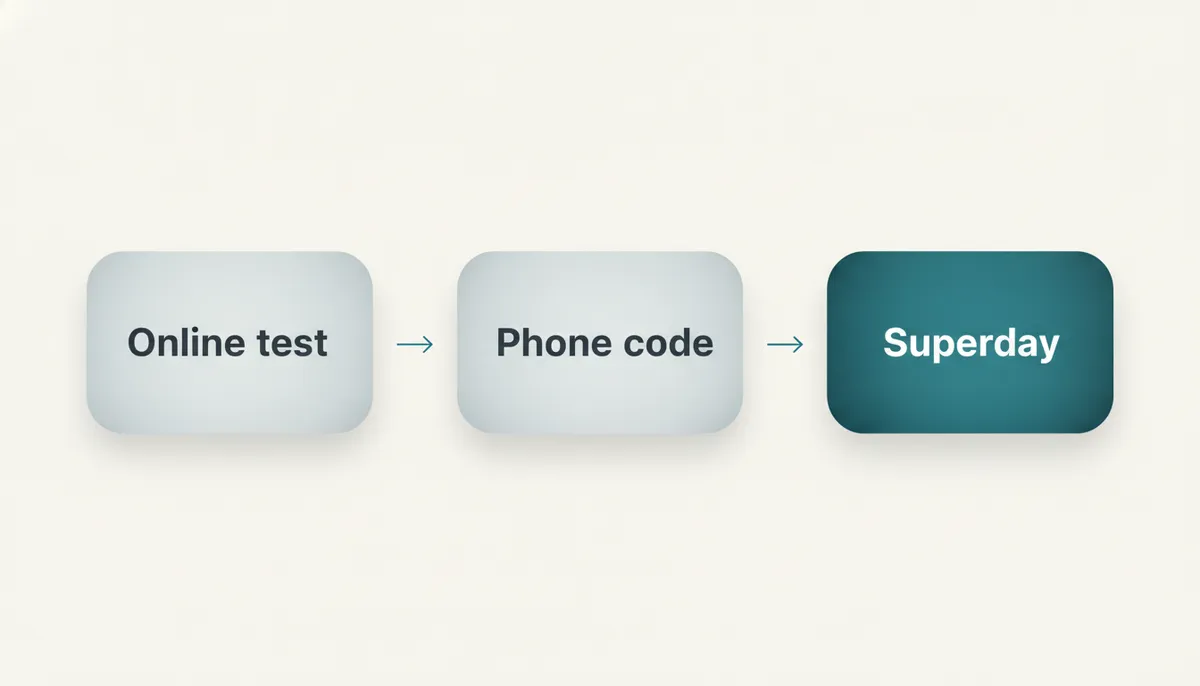
Reported accounts describe an initial recruiter conversation, one or two coding-focused phone screens, followed by a Superday with several back-to-back conversations. Coding, system design and behavioural evaluation are commonly reported as part of that final stage. Exact sequencing varies by role, seniority and team, so use the outline as a preparation model rather than a fixed script.
The technical loop has three distinct demands:
- Algorithmic coding: turning an ambiguous prompt into a correct, efficient solution while explaining your reasoning.
- Design discussion: structuring components, responsibilities and trade-offs clearly, especially where a system needs to respond reliably to changing data or real-time events.
- Behavioural and mission fit: showing genuine interest in Bloomberg’s product environment, communicating well and discussing your own work with specific ownership.
Candidates often over-invest in the first of these because it is easiest to measure. Yet reported Bloomberg experiences repeatedly flag behavioural fit as meaningful. You need a credible account of why the company’s combination of financial information, data infrastructure and real-time products interests you—not a generic answer that could apply to any engineering job.
The DSA pattern families to prioritise
The Bloomberg coding interview is best approached through pattern families, not a long question list. The families below are valuable because they teach a reusable decision process: recognise the signal, choose the data structure, state the invariant and implement without losing control of edge cases.
Arrays, strings and hashing
This is the foundation layer. Prompts involving frequencies, membership checks, duplicate handling, grouping, pair relationships or a need for constant-time lookup often point to a hash map or set. The coding is usually short; the judgement is in selecting the right representation and keeping updates consistent.
Practise asking: what must I remember from earlier in the input, and can that memory be indexed directly? If the answer is yes, hashing is likely the first place to look.
The trap is reaching for sorting automatically. Sorting can be perfectly valid, but it changes the complexity profile and can obscure a simpler one-pass solution. Be ready to compare the alternatives aloud.
Two pointers and sliding windows
When the input is ordered, can be ordered, or asks about contiguous ranges, think in pointers and windows. These patterns are especially useful when brute force would repeatedly revisit the same elements.
Two pointers tend to fit pair or interval relationships. Sliding windows fit a contiguous segment where validity can be restored by moving one boundary. In a live Bloomberg coding round, do not simply announce “sliding window”; explain the condition your window maintains and when the left pointer moves.
That invariant is what makes the solution trustworthy. It also gives you a natural way to debug when the interviewer asks about empty inputs, repeated values or a boundary case.
For a deeper explanation of the recognition cues, read how to identify the right DSA pattern in a coding interview.
Binary search and sorted-space reasoning
Binary search is not only about locating an item in a sorted array. It is also a way to search an answer space when a proposed answer can be checked with a monotonic condition. The recognition cue is often a threshold: minimum capacity, earliest feasible point, maximum valid value or a decision that changes from false to true once.
The difficult part is defining the predicate precisely. Before coding, say what feasible(mid) means, why it is monotonic and which bound moves for each result. This prevents the off-by-one mistakes that otherwise turn a good idea into a failed implementation.
The binary search patterns guide is useful if you know the basic loop but hesitate when the target is an answer rather than an array element.
Trees, graphs and traversal
Bloomberg operates in a domain where relationships, dependencies and streams of changing information matter. That does not mean every prompt is finance-specific, but it does make graph and tree fluency worthwhile. Be comfortable recognising when a problem is really about traversal, connectivity, ordering or shortest paths.
Use breadth-first search when the problem asks for nearest, minimum-step or level-by-level behaviour. Use depth-first search when you need exhaustive exploration, recursive structure, component discovery or backtracking. The best signal to communicate is not the name of the traversal but why it matches the output requirement.
A refresh on graph traversal patterns with DFS and BFS can help turn that choice into a quick reflex.
Intervals, heaps and ordered processing
Prompts involving schedules, overlapping activity, top values, merging streams or repeatedly selecting the next item commonly lead to sorting, heaps or interval sweeps. These families matter because they test whether you can identify an ordering that makes the rest of the work simple.
With intervals, define what counts as overlap and decide whether touching endpoints should merge. With heaps, explain what the heap contains, why its size stays bounded and what operation dominates the runtime. Those details distinguish a robust solution from one that works only on the happy path.
Dynamic programming when choices compound
Dynamic programming is usually not the first family to prioritise for recognition speed, but it becomes important once straightforward greedy reasoning breaks down. Look for repeated subproblems, a sequence of choices where local optimisation is unreliable, or a state that can be defined by position, capacity or prior decision.
Do not jump directly to a table. Start with the brute-force recurrence, identify the repeated state and then explain the memoisation or iteration order. That narration shows that you understand the structure rather than recalling a template.
If this is your least comfortable area, dynamic programming pattern practice is a sensible companion to timed coding work.
What recognition speed actually means
Recognition speed is not guessing the answer after reading the first line. It is a disciplined sequence that should happen early in every round:
- Restate the problem in your own words and clarify the output.
- Identify the input shape: sequence, graph, intervals, tree, stream or search space.
- Estimate the brute-force route and why it will not meet the constraints.
- Name the data structure or invariant that removes repeated work.
- Verify the approach on a small example before writing the full implementation.
The aim is to make your first few minutes legible. Interviewers can work with a candidate who explores a plausible route, rejects it for a stated reason and improves it. They cannot easily evaluate a candidate who codes silently for ten minutes and then produces a half-formed answer.
Practise this by placing a short limit on the classification stage. Read a prompt, write only the likely family, core data structure and complexity target, then stop. Repeat across unfamiliar problems. This trains the skill Bloomberg-style coding rounds actually expose: moving from wording to structure quickly.
The free DSA Patterns Sheet is organised for exactly this kind of practice. Browse it by pattern, then mix families once recognition becomes more reliable.
Assessment and phone screens: accuracy before cleverness
An online assessment, where used for a role, is primarily a filtering environment. You are balancing implementation speed, correctness and the discipline to test before submitting. Standard patterns matter because there is little time to invent a sophisticated alternative.
For assessments, prioritise:
- clean input handling and familiar language templates;
- correct baseline solutions before optimisation;
- adversarial test cases for empty, repeated and boundary values;
- complexity checks before the final submission;
- time awareness, so one difficult prompt does not consume the whole session.
Phone screens shift the balance. Your code still needs to work, but the discussion becomes observable. Reported accounts describe coding-focused screens, so treat communication as part of the technical answer. Clarify assumptions, propose a baseline, optimise deliberately and narrate test cases as you go.
Use in-browser code practice for implementation repetition, but occasionally practise aloud as well. A solution that feels automatic in a quiet editor can become surprisingly difficult when you must justify every decision to another engineer.
Superday: prepare for context switching
The Superday format is demanding because it compresses several different forms of evaluation into one day. A candidate may move from a coding discussion into design reasoning and then into a conversation about collaboration, motivation and past technical decisions. The risk is not only fatigue; it is carrying the wrong communication style from one room into the next.
For coding, be concise and explicit. For design, widen the frame: clarify requirements, identify core entities or services, discuss failure modes and explain trade-offs. For behavioural discussion, be specific about your own contribution, what changed because of your decision and what you learned.
The kind of low-level design problem evidenced at Bloomberg is useful for practising class responsibilities, extensibility and clear interfaces. Bloomberg's interview kit combines that design practice with the company-mapped DSA material, so you can alternate between algorithmic recognition and object-level design rather than treating them as unrelated skills.
For architecture-level discussion, the System Design Sheet is free to browse. It is also worth understanding the boundary between object design and system architecture; low-level design versus high-level design explains what each format tends to assess.
A four-week Bloomberg practice plan
Week one: establish pattern recall
Work through arrays, hashing, two pointers, sliding windows and binary search. Do not chase volume blindly. After each attempt, record the recognition cue you missed or used correctly. Your target is to explain the invariant and complexity before implementation.
Week two: add structural patterns
Focus on trees, graphs, heaps, intervals and dynamic programming. Alternate untimed learning with timed implementation. At the end of each session, explain your final solution aloud in two minutes as though you were wrapping up a phone screen.
Week three: simulate live coding
Use mixed prompts and a timer. Start every attempt by clarifying, proposing a baseline and stating the optimised route before coding. Review not only whether you solved it, but whether another engineer could follow your decisions.
Add low-level design sessions using the free Low Level Design Sheet. Build the smallest working core first, then improve names, responsibilities and extension points. Avoid designing a large abstraction hierarchy before proving the central flow works.
Week four: rehearse the whole Superday
Alternate coding, design and behavioural sessions so that context switching becomes familiar. Prepare a concise motivation narrative, along with several project stories covering ownership, disagreement, failure, delivery pressure and a technical trade-off.
An AI mock interview is useful for rehearsing both technical explanation and behavioural answers. Treat feedback as evidence: if you routinely omit constraints, rush assumptions or make your contribution vague, fix the process rather than merely revising one answer.
Common Bloomberg interview mistakes
Solving the wrong problem efficiently. Candidates sometimes infer missing requirements without checking them. Ask a short clarifying question before committing to an approach.
Naming a pattern without explaining it. “This is BFS” is not enough. State what the queue represents, why it gives the right order and what the complexity is.
Optimising before establishing correctness. A simple solution gives the discussion a foundation. It also lets you compare approaches instead of presenting an unexplained leap.
Treating design as a vocabulary test. Good design discussion is about responsibilities and trade-offs, not performing a catalogue of patterns. Use an abstraction only when the requirement makes variation likely.
Giving generic behavioural answers. Bloomberg’s product environment is distinctive. Connect your motivation to real-time information, data quality, engineering reliability or the kind of users the product serves. Then support it with a concrete example from your own work.
Frequently asked questions
Are Bloomberg coding interview questions mostly LeetCode-style?
The coding rounds are commonly reported as algorithmic and data-structure focused, so pattern-based practice is useful. The broader loop also includes design and behavioural discussion.
Which DSA patterns should I study first?
Start with hashing, arrays and strings, two pointers, sliding windows, binary search, trees and graphs. These give strong coverage of common input shapes and complexity trade-offs.
Is Bloomberg’s interview difficult?
It is challenging because the loop is broad. You need reliable coding fundamentals, clear technical communication, design reasoning and credible behavioural preparation.
Does Bloomberg have an online assessment?
An online assessment is not consistently reported across accounts. Prepare for timed coding anyway, because the skills transfer directly to early technical screening.
What happens in a Bloomberg Superday?
Reported accounts describe several back-to-back conversations that can include coding, system design and behavioural evaluation. The exact agenda varies by role and team.
How should I practise for the live coding screen?
Practise explaining your approach before you code, state time and space complexity, and test edge cases aloud. This guide to explaining your thought process offers a useful structure.
Should I prepare low-level design?
Yes. The kind of low-level design problem evidenced at Bloomberg rewards sound class responsibilities, extensibility and practical trade-off discussion.
Do behavioural answers matter at Bloomberg?
Yes. Reported accounts commonly describe behavioural fit and genuine interest in Bloomberg’s mission as meaningful parts of the process, including for technically strong candidates.
How do I avoid running out of time in coding rounds?
Recognise the likely pattern early, implement the simplest correct version first and reserve time for edge cases. Timed mixed-pattern practice is more effective than solving only familiar problems.
Start with the highest-leverage practice
The practical goal is not to memorise Bloomberg coding interview questions. It is to build fast pattern recognition, steady live explanation and enough design and behavioural rehearsal to stay composed across a varied Superday.
Open Bloomberg's interview kit to practise the 126 mapped DSA questions and five low-level design problems evidenced at Bloomberg. Then use the free sheets to broaden weak areas and an AI mock interview to rehearse the part of the process where communication matters as much as the final answer.
Topics
Related on Thita
Your next step
Practise with AI mock interviews
A spoken interview that asks follow-up questions, runs your code and ends with a written report.