
Interview
Bloomberg Interview Questions and Process: The Complete Guide (2026)
A practical guide to Bloomberg interview questions, Superday rounds, technical and behavioural expectations, difficulty, and a focused 30-day preparation plan.
Bloomberg interview questions typically span coding, system design and behavioural discussion. Reported accounts describe a recruiter conversation, one or two coding phone screens, then a Superday with three or four back-to-back interviews. The technical bar is broad, but strong technical performance alone may not be enough: candidates are also assessed on communication, project depth and genuine interest in Bloomberg's mission. For focused coding preparation, Bloomberg's interview kit contains 126 mapped DSA questions and five low-level design problems evidenced at Bloomberg.
This guide explains each reported stage, what interviewers are likely screening for, how difficult the loop feels in practice, and how to prepare over thirty days without treating the process as a random collection of puzzles.
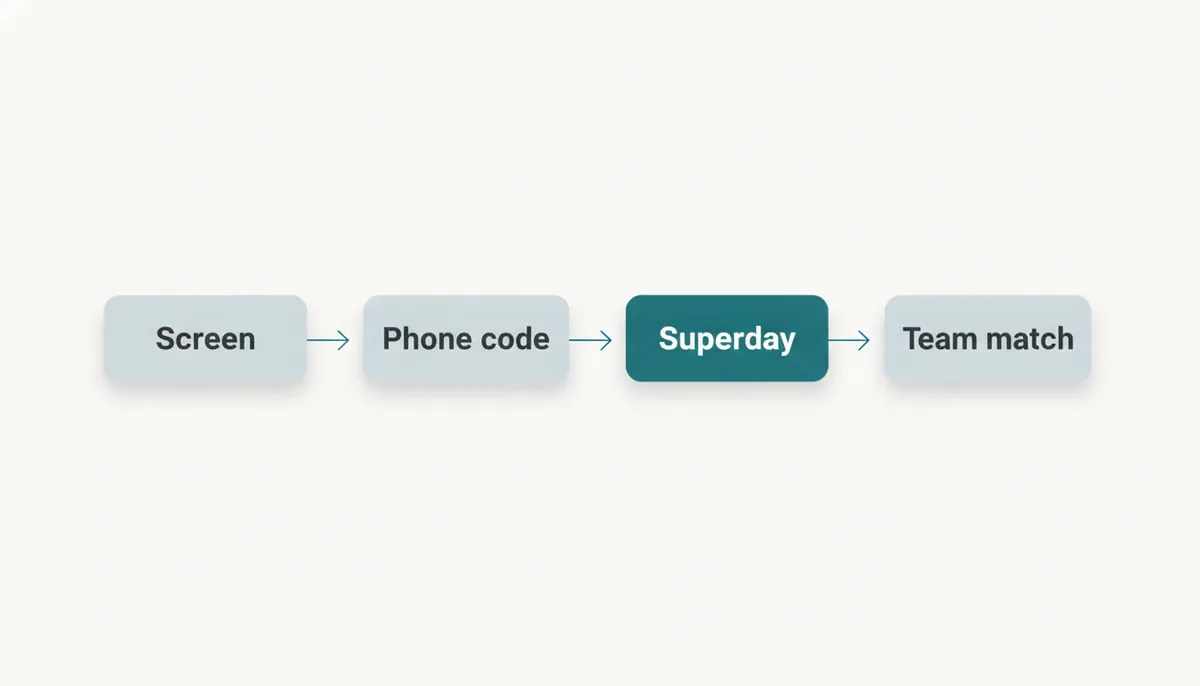
The process at a glance
| Stage | Format | What it screens for |
|---|---|---|
| Recruiter conversation | Initial discussion about role, experience and motivation | Role fit, communication and interest in Bloomberg |
| Coding phone screen | One or two remote technical conversations | Core DSA skills, code quality and problem-solving process |
| Superday coding round | Live coding with an engineer | Structured reasoning, correctness and complexity awareness |
| Superday system design round | Discussion-led technical design exercise | Trade-offs, scalability thinking and technical communication |
| Superday behavioural round | Project and collaboration discussion | Ownership, judgement, teamwork and motivation |
Reported accounts describe this as the usual shape rather than a guaranteed script. Teams, seniority and hiring needs can alter the sequence, and your recruiter remains the best source for the exact format of an upcoming loop.
Recruiter conversation — motivation and role alignment
The recruiter conversation is not usually the hardest stage, but it is where the interview process acquires context. Expect questions about your background, the kind of engineering work you want to do, your availability and why Bloomberg is on your list.
Prepare a concise answer to “Why Bloomberg?” that is more specific than “it is a well-known finance company”. Bloomberg operates at the intersection of software, data, markets and real-time information. You do not need prior financial-services experience to communicate a credible reason for applying, but you should show curiosity about building reliable systems for users who make time-sensitive decisions.
This is also the right moment to clarify the role level, likely interview stages and whether the team expects particular domain knowledge. Do not treat those questions as administrative details. They determine how much time you should allocate to coding, design and behavioural preparation.
A useful answer structure is simple:
- what you have built and the type of engineering problems you enjoy;
- why Bloomberg's product and operating environment interest you;
- what you hope to learn or contribute in this particular role.
Avoid memorising a corporate-sounding speech. A clear, personal explanation is more convincing than an elaborate answer that falls apart under a follow-up question.
Coding phone screens — fundamentals under discussion
Reported Bloomberg interview experiences commonly include one or two phone screens centred on coding. These rounds test familiar data structures and algorithms, but a successful answer is not merely a correct implementation. Interviewers need to see how you turn an unclear prompt into a workable plan.
Start by restating the problem, asking about constraints and giving a straightforward solution before optimising it. Then explain why your final approach has the time and space complexity it does. This sequence makes your reasoning visible and prevents a common failure mode: writing code quickly, discovering an edge case late, and silently rebuilding the solution.
The core material is conventional interview territory: arrays, strings, hash maps, linked structures, trees, graphs, sorting, searching, recursion and dynamic programming. Pattern recognition matters because it gives you a reliable starting point when the prompt is unfamiliar. The DSA Patterns Sheet is free to browse and helps you practise by problem shape rather than by a long, unstructured list.
For Bloomberg-specific coding work, use Bloomberg's interview kit to prioritise the mapped questions, then practise explaining each solution aloud. The goal is not to memorise an editorial. It is to learn how to arrive at a reasonable approach in front of another engineer.
If you regularly find yourself recognising a solution only after seeing it, read how to identify the right DSA pattern in a coding interview. It is especially useful for turning post-solution review into a repeatable recognition habit.
💡 Pro Tip: Narrate your checkpoints: constraints, brute force, improved approach, complexity, edge cases and tests. That structure is easy for an interviewer to follow and easy for you to recover if you get stuck.
Superday coding — execution, clarity and collaboration
The defining Bloomberg ritual reported by candidates is the Superday: a concentrated set of back-to-back interviews in a single day. One of those conversations is typically a coding round, but its pressure is different from a standalone phone screen. You need to reset quickly between sessions, maintain energy and communicate with consistency.
This round screens for more than algorithm knowledge. Interviewers are looking for whether you can collaborate in real time: clarify requirements, weigh alternatives, accept a hint productively and test your work before declaring it finished.
A solid live-coding rhythm looks like this:
- Confirm what the input and output mean.
- Describe a simple baseline solution.
- Improve it only when the constraints justify doing so.
- State complexity before writing the final implementation.
- Test ordinary, boundary and awkward cases aloud.
Candidates often lose credit by treating a live interview like a silent online judge. The interviewer cannot evaluate reasoning that stays in your head. Use what interviewers actually look for in live coding rounds as a checklist for the communication behaviours that matter alongside correctness.
If typing fluency or test discipline is your weak point, in-browser code practice can help you rehearse implementation and feedback loops without adding setup friction.
✅ Do: Say what you are testing and why.
❌ Don't: Wait until the end to discover that your approach fails on empty input, duplicates or a boundary condition.
Superday system design — trade-offs, not a perfect diagram
Reported accounts commonly include a system design discussion during Bloomberg Superday. The exact prompt varies by level and team, but the evaluation is likely to focus on how you reason about a system rather than whether you reproduce a polished architecture diagram from memory.
At junior levels, the conversation may stay closer to component boundaries, APIs, data flow and operational trade-offs. At more experienced levels, expect greater depth on scale, reliability, data consistency, failure handling and the consequences of design choices.
A practical response has a clear progression:
- establish the users, key actions and constraints;
- define the most important data flows;
- identify core services, storage and interfaces;
- discuss scaling and failure points;
- explain trade-offs rather than presenting every choice as obvious.
Do not jump straight to queues, caches and databases because they sound architectural. Start with the problem the component solves. Then make each addition earn its place through a requirement: latency, availability, throughput, auditability or recovery.
The System Design Sheet is free to browse for broad system-design practice, while how much system design is enough for SDE-1 vs SDE-2 interviews can help you calibrate depth to your target role.
Low-level design can also appear in the broader technical conversation. The kind of design problem evidenced at Bloomberg rewards clean responsibilities, extensibility and sensible object boundaries rather than pattern-heavy code. The Low Level Design Sheet is free to browse if you need to strengthen those fundamentals.
Superday behavioural round — project ownership and genuine interest
Behavioural fit is repeatedly mentioned in reported Bloomberg experiences because technically strong candidates can still struggle when their motivation, ownership or communication feels unconvincing.
Expect project questions that move beyond your résumé summary:
- What exactly did you own?
- What was difficult or uncertain?
- Which technical decision did you influence?
- What went wrong after release?
- What would you change now?
- How did you handle disagreement with a colleague or stakeholder?
The best answers are specific and balanced. Explain the context, your individual contribution, the decision you made and the result. Include what you learned. A story in which everything succeeded effortlessly rarely demonstrates good judgement; a story about an imperfect decision that you investigated and improved often does.
Bloomberg's environment makes the motivation question especially important. Its products serve people who rely on information quality, speed and reliability. You do not need to pretend to be a markets expert, but you should be prepared to discuss why real-time, data-intensive engineering appeals to you.
Practise these answers aloud. An AI mock interview can simulate behavioural follow-ups and expose where an answer becomes vague, overly technical or too dependent on “we” instead of “I”.
Is the Bloomberg interview hard?
Yes, primarily because it is broad.
The reported loop combines coding, system design and behavioural evaluation in a compressed Superday format. Candidates who prepare only for DSA may be uncomfortable in a design conversation; candidates with strong technical answers may still be assessed critically on project ownership, communication and motivation.
How many rounds are there? Reported accounts describe a recruiter conversation, one or two coding phone screens and a Superday containing three or four back-to-back interviews. The exact count varies by role and team.
How long does the process take? Available reported accounts do not establish a consistent end-to-end timeline. Scheduling can vary substantially by team, location and hiring urgency, so ask your recruiter for the expected sequence and decision timing.
The difficulty is manageable when you prepare by round type. The unhelpful approach is spending every hour on coding puzzles and hoping the rest feels intuitive. Build technical range, then rehearse how you explain your thinking.
A 30-day Bloomberg preparation plan
Week 1 — rebuild coding pattern recognition
Refresh arrays, strings, hashing, two pointers, sliding windows, trees, graphs and binary search. Focus on recognising the pattern before writing code. Keep a short error log: missed constraints, complexity mistakes and edge cases you forgot.
Use the free-to-browse DSA Patterns Sheet, and review binary search patterns if that topic tends to slow you down.
Week 2 — practise live coding behaviour
Shift from untimed solving to interview-style sessions. Speak aloud, clarify assumptions and test every solution. After each problem, review not only whether you solved it, but whether another engineer could follow your route to the answer.
Work through the mapped coding set in Bloomberg's interview kit. It contains 126 mapped DSA questions and five low-level design problems, giving you a company-focused set for technical practice.
Week 3 — add design and project depth
Spend part of each session on system-design structure: requirements, APIs, data models, scaling and failures. On alternate days, practise low-level design by identifying entities, responsibilities and likely extensions before coding.
Also prepare two or three project stories. Each should show a decision, conflict, setback or trade-off you can discuss in detail. Keep your explanations understandable to both a deeply technical interviewer and a hiring manager.
Week 4 — rehearse the Superday
Run a mock sequence: coding, behavioural discussion, design discussion, then another coding exercise. The point is not endurance for its own sake. It is learning how to reset after a difficult answer and bring the same clarity to the next conversation.
Use an AI mock interview for coding, system-design or behavioural practice. Finish the week by revisiting your error log rather than chasing unfamiliar topics at random.
Bloomberg-specific preparation: think in real-time information systems
Bloomberg is distinctive because its engineering context is closely tied to the delivery of financial information where freshness, correctness and reliability all matter. That gives your preparation a useful lens for both technical and motivational answers.
When discussing system design, ask yourself questions that fit this environment:
- How quickly must new information reach users?
- What happens when data arrives late, twice or out of order?
- Which parts of the system need a clear audit trail?
- How do consumers know whether they are reading current information?
- What reliability trade-off is acceptable when users make time-sensitive decisions?
You do not need to invent financial-domain expertise. The value is in showing that you can connect technical choices to the product's real-world use. A cache is not merely a cache; it affects freshness. Retry logic is not merely resilience; it can create duplicate events. Monitoring is not merely operational polish; it helps detect whether information is delayed or incomplete.
That same connection strengthens “Why Bloomberg?” answers. Talk about the engineering challenge of dependable, high-volume information systems if it genuinely interests you. It is far more credible than trying to force a generic enthusiasm for finance.
Frequently asked questions
What is the Bloomberg interview process?
Reported accounts describe a recruiter conversation, one or two coding phone screens and a Superday containing coding, system design and behavioural interviews. The exact sequence can vary by role and team.
What is Bloomberg Superday?
Superday is the commonly reported name for Bloomberg's concentrated interview day, where candidates complete several back-to-back conversations. It is a named format rather than a separate job level or technical test.
Does Bloomberg ask DSA questions?
Yes. Coding phone screens and Superday coding interviews commonly assess data structures, algorithms, complexity reasoning and implementation quality.
Does Bloomberg ask system design questions?
Reported accounts commonly describe a system-design discussion during Superday. The expected depth is likely to depend on seniority and the role's engineering scope.
Are Bloomberg interviews difficult?
They can be difficult because the process tests multiple skills: coding, design, communication, behavioural judgement and motivation. The broad evaluation is often more challenging than any single technical prompt.
How should I prepare for Bloomberg coding interviews?
Practise core DSA patterns, explain your approach aloud, state complexity clearly and test edge cases. Use timed sessions once you are comfortable with the fundamentals.
How should I answer “Why Bloomberg?”
Connect your own interests to Bloomberg's work with data, real-time information and dependable software. Be specific about the type of engineering challenge that appeals to you.
Is finance knowledge required for a Bloomberg software engineering interview?
Reported process descriptions do not make finance knowledge a universal requirement. Curiosity about the product environment and an ability to discuss its engineering challenges are more useful than pretending to have specialist expertise.
What should I expect in Bloomberg behavioural interviews?
Expect detailed questions about projects, ownership, collaboration, setbacks and decisions. Prepare stories that make your individual contribution and judgement clear.
Where to start
The highest-leverage Bloomberg preparation is balanced preparation: sharpen coding fundamentals, practise discussing design trade-offs, and make your project stories specific enough to survive follow-up questions.
Open Bloomberg's interview kit to practise the 126 mapped DSA questions and five low-level design problems evidenced at Bloomberg. Then use the free-to-browse sheets and an AI mock interview to rehearse the wider technical and behavioural loop.
Interview processes change, so confirm the current round structure, expected preparation areas and scheduling details with your recruiter.
Topics
Related on Thita
Your next step
Practise with AI mock interviews
A spoken interview that asks follow-up questions, runs your code and ends with a written report.