
Interview
ByteDance Coding Interview Questions: Patterns and Prep
ByteDance coding interview questions, pattern families and the sequential round shape: prepare for the assessment, live coding and culture stages.
ByteDance coding interview questions reward a particular kind of preparation: fast pattern recognition, clear live reasoning and the ability to keep solving when the difficulty rises. The company’s reported loop is coding-heavy, but its strictly sequential structure makes consistency as important as any individual solution. You clear one stage before the next is unlocked.
For focused technical preparation, ByteDance’s interview kit holds 66 mapped DSA questions. The useful way to approach that set is not as a question list to memorise. It is a map of recurring pattern families: the signals that tell you whether a prompt wants a window, a hash-based lookup, a traversal, a search boundary or a dynamic programme.
Reported accounts describe a HackerRank assessment followed by live coding rounds that increase in difficulty. Senior candidates may also encounter a system-design discussion, while the final culture stage evaluates ByteStyle separately. That means your preparation needs three modes: solve under time pressure, explain under observation and communicate the working style behind your technical decisions.
The ByteDance pattern mix: broad fundamentals, rising pressure
The central feature of ByteDance’s technical preparation is breadth under a tightening clock. Candidate reports commonly describe an online assessment, then live coding rounds that move from an initial problem-solving screen towards harder medium-to-hard work. The exact prompt varies, but the skills that transfer are highly stable.
The ByteDance interview kit is most useful when you treat it as a pattern-recognition drill. Every completed problem should answer two questions:
- What detail in the prompt revealed the pattern?
- What alternative approach did I reject, and why?
That second question matters because live interviews test judgement as well as implementation. A candidate who can explain why a brute-force scan is too slow, why a hash map removes repeated work, or why a binary-search condition is monotonic is demonstrating much more than recall.
The recurring families worth prioritising are these.
Arrays, strings and hash-based lookups
These are foundational because they test whether you can make a direct representation choice. A string prompt may be solved by counting, indexing, grouping, scanning from both ends or maintaining a moving window. The trick is not learning a separate solution for each variation. It is recognising the constraint that changes the tool.
Repeated membership checks often point to a set or map. Frequency conditions suggest counting. A contiguous subarray or substring condition frequently points to a sliding window. Pairing or complement logic often suggests a lookup table.
Practise saying the clue aloud before you code: “The range is contiguous, so I will maintain a window,” or “I need fast membership checks, so I will store earlier values.” It makes your reasoning visible and gives the interviewer a chance to redirect you early.
Two pointers and sliding windows
These families are related, but they are not interchangeable. Two pointers often fit ordered data, pair relationships or inward scans. A sliding window fits a continuously changing contiguous range where you need to maintain a valid condition.
Recognition speed here means noticing the word contiguous without automatically forcing a window. Ask whether the window can be updated incrementally. If removing the left item and adding the right item lets you preserve the relevant state, a window is promising. If every change requires recomputing everything, it may not be.
Use the DSA Patterns Sheet to practise these families side by side. It is free to browse, which makes it useful for comparing near-neighbour patterns rather than treating them as isolated techniques.
Trees, graphs and traversal choices
Traversal questions test whether you can turn a story into a graph model before you worry about code. Dependencies, routes, relationships, transformations and connected components are all signals that nodes and edges may be hiding behind the wording.
The first choice is often depth-first search or breadth-first search. Depth-first search is natural when you need to explore structure, build paths, detect cycles or calculate information from children upwards. Breadth-first search is natural when distance, layers or the fewest transitions matter.
A common live-round failure is naming a traversal before defining the graph. Start with the model instead:
“I will represent each item as a node. This relationship becomes an edge. Because the question asks for the shortest number of transitions, breadth-first search gives the right ordering.”
For a deeper comparison of the signals behind those choices, read graph traversal patterns: DFS and BFS.
Binary search beyond sorted arrays
Binary search is easy to recognise when an array is sorted. It is harder, and more valuable, when the search space is an answer rather than an index.
The key signal is monotonicity: if a proposed answer works, do all larger values work too? Or if it fails, do all smaller values fail too? Once you can define a yes-or-no feasibility check, you can often search for the boundary.
In an interview, do not merely say “I will use binary search.” State what is being searched and what makes the condition monotonic. That explanation prevents the technique from sounding like a reflex.
Our guide to binary search patterns is useful for practising the boundary logic, especially the difference between finding any valid value and finding the first or last valid value.
Dynamic programming and state design
Dynamic programming is rarely the first thing you should reach for. It becomes appropriate when a problem has overlapping subproblems and when the best answer can be built from earlier states.
The practical skill is defining the state clearly enough that another engineer can understand it. What does dp[i] mean? What does a transition represent? Which earlier result is needed? Can the storage be reduced?
Candidates often lose time by writing a recurrence before articulating the state. Reverse that order. Explain the smallest meaningful subproblem, then the choice that connects it to larger cases. This makes debugging dramatically easier.
For structured practice, dynamic programming patterns breaks down the recurring state shapes and helps you distinguish them from greedy approaches.
The reported ByteDance round shape
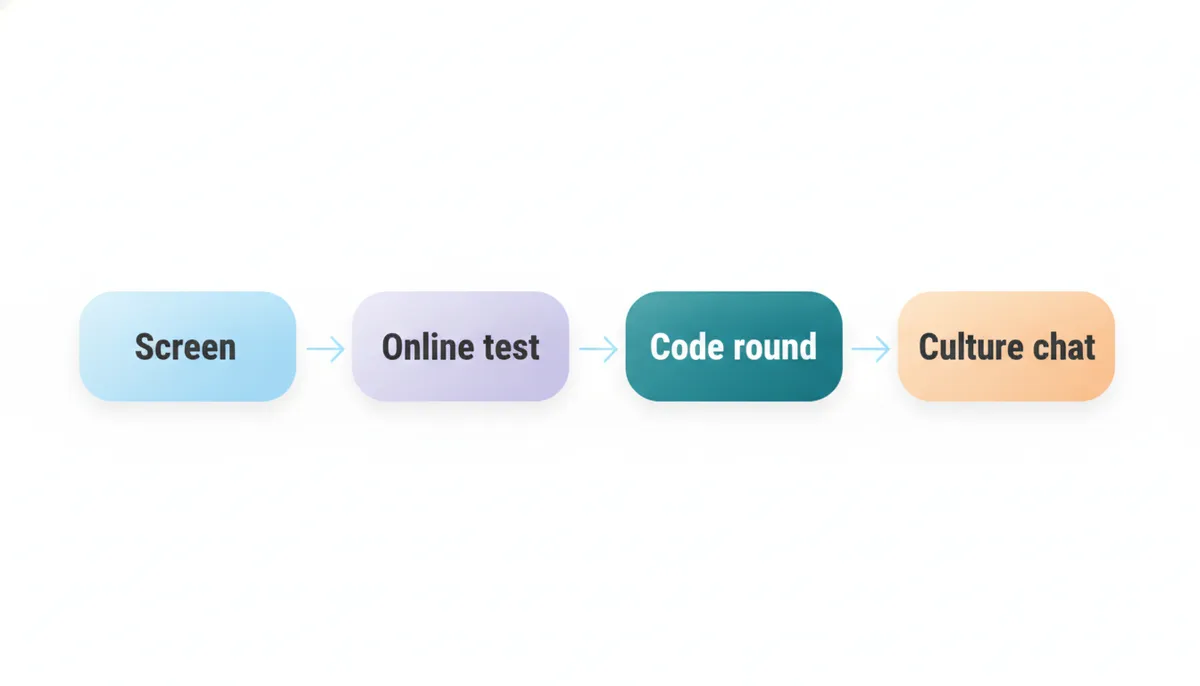
Reported accounts describe a sequential process rather than a single-day onsite loop. That structural detail changes how you should prepare. You do not need to perform every skill on one day, but you do need to clear each gate cleanly enough to reach the next one.
The reported sequence commonly includes:
| Stage | Reported focus | What to prepare |
|---|---|---|
| Recruiter screen | Role fit and experience | Concise project narrative and motivations |
| Online assessment | Timed coding | Pattern recognition and edge-case checks |
| Live coding | Increasing coding difficulty | Spoken reasoning and clean implementation |
| System design | Senior or L4+ candidates | Scope, trade-offs and scalable components |
| Hiring-manager round | Project depth and level fit | Ownership, decisions and collaboration |
| ByteStyle round | Culture and working style | Specific examples with clear outcomes |
Treat this as a reported shape, not a fixed company policy. Team, level and hiring need can change the order or emphasis. The reliable takeaway is the sequential gating: preparing only for an initial coding screen is not enough if you are moving through the full loop.
The online assessment
The online assessment is commonly reported to run through HackerRank. This is where recognition speed has its most obvious payoff. You need to identify a viable approach quickly, implement it without unnecessary ceremony and reserve time for edge cases.
Recognition speed does not mean rushing. It means reducing unproductive exploration. A strong workflow is:
- Restate the input, output and constraints.
- Name the simplest correct approach.
- Identify why it will or will not meet the expected complexity.
- Select the pattern family.
- Test the idea on a small example before coding.
Use in-browser code practice to make that workflow habitual. The goal is to shorten the period between reading a prompt and committing to a justified plan.
The live coding rounds
Candidate reports describe live rounds with rising difficulty. In these sessions, the interviewer can assess how you clarify ambiguity, revise an approach and recover from a bug. A correct final answer is important, but so is the path you take to reach it.
Speak in short checkpoints. Announce your model, your intended complexity and the invariant your code maintains. Then test deliberately: empty input, smallest input, duplicate values, boundary positions and unusually large cases. This prevents the silent scramble at the end that turns a sound solution into an incomplete one.
Read how to explain your thought process clearly in coding interviews before you begin mock practice. Clear narration is a skill you can rehearse, not a personality trait you either have or lack.
System design for experienced candidates
For senior or L4+ candidates, reports describe a system-design round. This is a different mode from coding puzzles. The interviewer is looking for how you scope an open problem, identify requirements, choose components and reason about trade-offs.
Do not jump immediately to a diagram of services. Start with users, core flows, data, scale assumptions and failure modes. Then explain why each major component exists. If the interviewer changes a requirement, adapt the design rather than defending your first answer.
The System Design Sheet is free to browse and can help you rehearse the building blocks. For level-specific expectations, how much system design is enough for SDE-1 versus SDE-2 interviews provides a useful framework.
ByteStyle is a separate gate
Reported accounts describe a final HR or culture stage focused on ByteStyle, ByteDance’s named values framework. This is not a post-coding formality. It is a separately scored part of the process, so prepare it with the same care as your technical rounds.
Your best material is specific. Prepare stories that show candour, pragmatic decision-making, collaboration across disagreement, learning from a mistake and taking responsibility when something was unclear or failing. Avoid polished but vague claims such as “I am a team player.” Instead, explain the situation, your action, your reasoning and what changed.
An AI mock interview can help you practise behavioural answers aloud. Aim for directness: what did you personally do, what trade-off did you make and what would you change now?
A focused preparation plan
Start with pattern families
Spend your first preparation block building reliable recognition across arrays, hashing, windows, pointers, trees, graphs, binary search and dynamic programming. Do not measure progress by how many prompts you have opened. Measure it by whether you can classify a new problem before seeing its solution.
Work through ByteDance’s interview kit in mixed order. Mixing patterns is harder than drilling one category at a time, but it is closer to the actual assessment experience.
Add timed implementation
Next, practise writing complete solutions under a timer. Use your usual interview language and remove dependencies on snippets you cannot recreate. Each session should end with a brief review:
- Did I identify the right pattern quickly?
- Did I state complexity before implementation?
- Which edge case did I miss first?
- Was my code easy to explain?
The review is where speed becomes repeatable rather than accidental.
Rehearse live communication
Then shift from solo solving to narrated solving. Record yourself or use a mock environment. Explain assumptions before you code, describe your data structures and narrate tests at the end.
The AI interview practice tool is especially useful here because it forces you to make your reasoning audible. A solution that exists only in your head cannot be evaluated fairly in a live round.
Prepare your project and ByteStyle stories
Finally, prepare a compact set of project stories. Each should cover ownership, technical judgement, a difficult decision, disagreement, failure or iteration. Be precise about your contribution. “We” is appropriate for context, but the interviewer still needs to understand what you did.
Keep technical preparation active while you practise these stories. The sequential loop rewards candidates who can transition cleanly from coding to design discussion to culture conversation.
Frequently asked questions
Are ByteDance coding interview questions difficult?
Reported accounts describe a coding-heavy process with difficulty rising across live rounds. Strong fundamentals and fast pattern recognition matter more than obscure tricks.
Does ByteDance use an online assessment?
Candidate reports commonly describe a HackerRank online assessment before later technical stages.
What patterns should I prioritise first?
Start with arrays, hashing, two pointers, sliding windows, trees, graphs, binary search and dynamic programming. These families build the recognition skills that transfer across prompts.
How should I prepare for live coding rounds?
Practise talking through your approach before you write code. State the data structure, complexity and edge cases, then test your implementation aloud.
Is the ByteDance interview process sequential?
Reported accounts describe a strictly sequential process in which candidates clear a stage before the next round is unlocked.
Does ByteDance include system design?
Candidate reports describe a system-design round for senior or L4+ candidates. Scope and expectations can vary by team and level.
What is ByteStyle in the interview process?
ByteStyle is the reported values framework used in the culture stage. Prepare specific examples that demonstrate judgement, candour, learning and collaboration.
Should I memorise solutions?
No. Memorised code breaks when the prompt changes. Learn to recognise the underlying pattern, explain the trade-off and adapt the implementation.
How can I improve recognition speed?
After every problem, identify the clue that should have revealed the pattern earlier. Repeating that reflection builds faster classification over time.
Where to start
Begin with the pattern families that appear across timed and live coding: hashing, windows, traversal, binary search and dynamic programming. Then practise explaining those choices under pressure, because ByteDance’s reported sequential loop rewards dependable performance at every stage.
Open ByteDance’s interview kit to practise the 66 mapped DSA questions associated with ByteDance. Pair that work with the free-to-browse DSA Patterns Sheet, timed code practice and an AI mock interview for live coding and ByteStyle rehearsal.
Interview processes vary by level, team and hiring needs. Confirm the current format with your recruiter before the process begins.
Topics
Related on Thita
Your next step
Practise with AI mock interviews
A spoken interview that asks follow-up questions, runs your code and ends with a written report.