
Interview
Coupang Interview Questions and Process: The Complete Guide (2026)
Prepare for Coupang software engineering interviews with a practical guide to coding, design and behavioural rounds, plus a focused 30-day plan.
Coupang interview questions are best approached as a modern software engineering loop: prepare to explain code clearly, reason about complexity, discuss design trade-offs, and demonstrate ownership of work you have shipped. Reported company-specific accounts are thin and likely vary by team, level and location, so confirm the exact format with your recruiter. For focused coding practice, Coupang's interview kit holds 4 mapped DSA questions with worked solutions and practice support.
This guide gives you a practical preparation framework for the full loop without pretending there is one fixed Coupang script. Use it to prepare the transferable skills that matter across technical screens, coding discussions, design conversations and behavioural interviews.
The process at a glance
Because there is no reliable, current public account of a standardised Coupang interview sequence, treat this as a preparation map rather than a promised schedule. A recruiter can tell you which stages apply to your role.
| Stage | Common format | What it may screen for | How to prepare |
|---|---|---|---|
| Initial screen | Recruiter or hiring conversation | Role fit, experience, motivation | Know your projects and target role |
| Technical coding | Live coding or shared editor | Problem solving, code quality, complexity | Practise patterns and narrate decisions |
| Design discussion | Design or architecture conversation | Trade-offs, scope control, technical judgement | Clarify requirements before proposing a system |
| Team conversation | Hiring manager or panel discussion | Ownership, collaboration, level fit | Prepare detailed project stories |
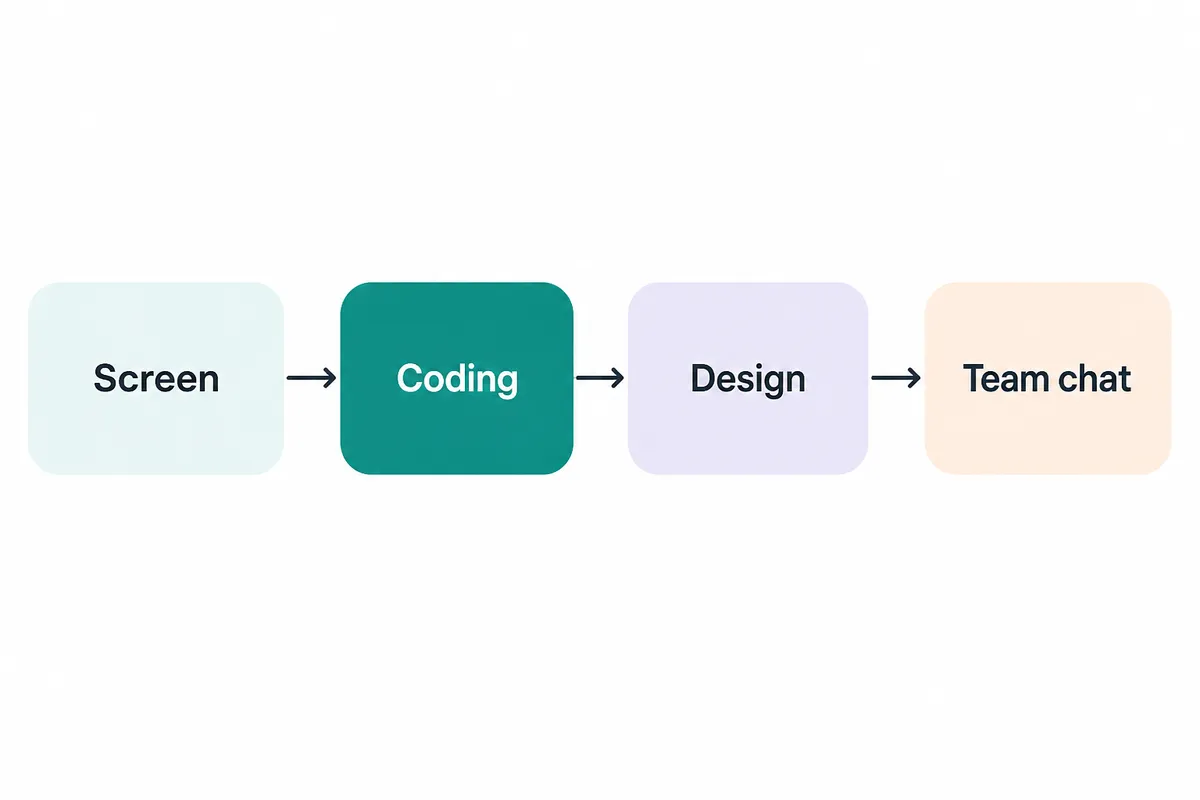
The useful implication is simple: do not wait for exact round details before starting. Coding fluency, clear communication and evidence of sound engineering judgement transfer across formats. If your recruiter later confirms a particular emphasis, you can shift more preparation time towards that stage.
Initial screen — establish fit before the technical work
An initial conversation commonly establishes whether your background matches the opening, the level and the team’s immediate needs. It may be with a recruiter, a hiring manager or another early-stage interviewer. The format varies, but the preparation is consistent.
Be ready to give a short, coherent account of your recent work. Focus on the problem, your individual contribution, the technical decision you made, the result and what you learned. “We built” is not enough on its own. A strong answer separates your ownership from the wider team’s work without diminishing collaborators.
Prepare concise answers to questions such as:
- What kind of engineering work are you looking for next?
- Which project best demonstrates your technical strengths?
- Why did you choose a particular design or technology?
- What was difficult about the work?
- What would you change if you repeated it now?
This is also the right time to ask for practical clarity. Ask whether the next technical conversation is coding, design, project-focused or mixed; whether you will use a shared editor; and whether the role is more product, platform, infrastructure or data oriented. Those questions are preparation, not administration.
💡 Pro Tip: Do not memorise a polished life story. Memorise the structure of your examples, then practise adapting them to the question in front of you.
Technical coding — show your reasoning, not only your answer
A coding round generally tests whether you can turn an ambiguous prompt into correct, maintainable code while communicating your choices. The strongest candidates do not rush into implementation. They first make the problem concrete.
A dependable sequence is:
- Restate the problem in your own words.
- Ask about inputs, constraints and edge cases.
- Describe a straightforward approach.
- Improve it if the constraints justify doing so.
- State time and space complexity.
- Write code in small, explainable steps.
- Test it aloud with normal and awkward cases.
That sequence makes your reasoning visible. In an interview, invisible reasoning earns little credit. Even when you recognise a familiar pattern immediately, take a moment to explain why it fits. Interviewers need to see that you can distinguish a sliding-window problem from a graph traversal problem rather than merely recall a memorised solution.
Coupang's interview kit is a useful starting point for practising the coding shapes evidenced at Coupang. Work through the editorials only after you have made a serious attempt. The learning happens in comparing your initial model of the problem with a cleaner one.
For broader coverage, the DSA Patterns Sheet is free to browse and groups problems by the underlying technique. Pair it with code practice when you want to build the habit of producing tested code rather than stopping at an outline.
If pattern selection is your weak point, read how to identify the right DSA pattern in a coding interview. If communication is the issue, how to explain your thought process clearly in coding interviews gives a practical framework.
✅ Do: Say what you are testing and why as you test it.
❌ Don’t: Write a complete solution silently, then discover an edge case after time has gone.
Design discussion — demonstrate judgement under ambiguity
Many software engineering loops include a design-focused conversation, especially for experienced roles. The exact depth can vary considerably: some conversations centre on class and object design, while others examine services, data flow, scale, reliability and trade-offs.
Since public Coupang-specific round accounts are not strong enough to support a fixed claim, prepare for both possibilities. The important skill is not arriving with a favourite architecture. It is showing that you can make proportionate decisions from incomplete requirements.
Start a design answer by establishing the problem:
- Who uses the system and what is the critical user flow?
- What needs to be correct immediately?
- What can be eventually consistent or delayed?
- What scale, latency and availability expectations matter?
- Which failures would be unacceptable?
- What assumptions are you making?
Then build from the smallest credible version. Identify the core data model, main components and interfaces before introducing queues, caches, replicas or elaborate abstractions. Every component should solve a stated problem. If you cannot explain why it exists, it probably does not belong in the first version.
The System Design Sheet is free to browse and is useful for rehearsing the vocabulary of trade-offs: throughput, latency, consistency, failure handling and operational simplicity. For class-level work, the Low Level Design Sheet is also free to browse and can help you practise identifying responsibilities, boundaries and extension points.
A common failure mode is over-design. Candidates sometimes introduce complex patterns before agreeing on the basic flow, which creates a design that sounds sophisticated but cannot be defended. A simpler design with clearly stated limitations is usually stronger than a sprawling one with unexamined assumptions.
For a sharper distinction between design formats, read low-level design vs high-level design: what interviews actually expect.
Team and behavioural conversations — make ownership credible
A behavioural or hiring conversation is not a break after the technical work. It tests whether you can be trusted with ambiguous work, collaborate during disagreement and learn from outcomes that did not go to plan.
Prepare a small set of project stories that can be adapted across themes:
- A difficult technical decision
- A production issue or failure
- A disagreement with a colleague
- A time you improved an unclear process
- A project where you had to influence without authority
- A piece of work you would approach differently now
Use a simple situation, action and outcome structure, but keep the technical substance. Explain what you personally noticed, decided, communicated and changed. Quantified impact can be helpful when it is real, but the quality of your judgement matters more than polished metrics.
Avoid two extremes. Do not make every story a heroic solo achievement, and do not hide entirely behind “we”. Good engineering requires collaboration, but interviewers still need to understand your specific role.
Practising aloud is essential. An AI mock interview can help you rehearse behavioural answers, technical explanations and follow-up questions when you do not have a practice partner.
Named rituals and what to confirm
No named Coupang-specific interview ritual, standard platform or fixed time limit could be reliably sourced for this guide. That is worth stating plainly because invented certainty is worse than a useful preparation plan.
Ask your recruiter:
- Which stages are confirmed for this role?
- Is there an online exercise before live interviews?
- Will technical rounds include coding, design or both?
- Is the interview focused on a particular language or domain?
- Is there a project deep dive or manager conversation?
- What preparation materials can the team share?
These questions make your preparation more efficient and signal that you take the process seriously. They also prevent you from treating generic internet advice as a company policy.
Is the Coupang interview hard?
It can be demanding because software engineering interviews test several different abilities in a short period: coding fluency, problem decomposition, complexity reasoning, design judgement and communication. The difficult part is often switching between those modes rather than any single question.
How many rounds are there? Public reports do not establish a dependable standard count for Coupang. The sequence can vary by team, level and hiring path, so confirm the schedule with your recruiter.
How long does the process take? There is no sourced company-wide timeline to rely on. Build your preparation around the date of your next confirmed stage rather than an assumed end-to-end duration.
The good news is that the skills overlap. Better pattern recognition improves your coding speed; explaining code aloud improves design conversations; project stories improve both team discussions and hiring-manager interviews.
A 30-day preparation plan
Week 1 — build coding consistency
Spend the first week revisiting the core patterns behind common interview problems: arrays, hash maps, two pointers, sliding windows, stacks, trees, graphs and binary search. Your goal is not to collect solved problems. It is to recognise the shape of a new prompt quickly.
Use Coupang's interview kit for company-mapped practice, then broaden with the free DSA Patterns Sheet. Keep a short error log: missed edge cases, unclear complexity explanations, syntax slips and patterns you confused.
Week 2 — practise live communication
Continue coding, but now narrate every session aloud. Set a timer, clarify assumptions, explain complexity and test your solution verbally. Record yourself occasionally. You will notice filler phrases, unexplained jumps and moments where your logic is clear in your head but unclear in speech.
The guide to live coding interviews and what interviewers actually look for can help you turn practice into a repeatable interview routine.
Week 3 — add design and project depth
Alternate coding sessions with design practice. Take a familiar product feature and explain its users, data model, core flow, failure cases and trade-offs. Keep designs deliberately small at first. Only add complexity when a requirement demands it.
At the same time, write rough notes for your strongest project stories. Include technical details: architecture constraints, alternatives rejected, incidents handled and evidence that your choice improved the outcome.
Week 4 — simulate the real experience
Run mixed rehearsals. Start with a coding prompt, move to a design question, then answer project follow-ups while tired. That transition is valuable because real interview days rarely isolate one skill.
Use an AI mock interview to practise under conversational pressure. After each rehearsal, review only a few things: where you lost structure, where you made an unstated assumption and where you could have tested more carefully.
💡 Pro Tip: In the final days, prioritise sleep, concise review and confidence in your process. Trying to learn entirely new topics at the last minute often makes familiar skills feel less reliable.
The Coupang-specific preparation principle: verify, then adapt
The most important Coupang-specific fact available to candidates is not a named ritual or fixed interview timetable. It is that publicly reported detail is thin enough that you should not build your plan around confident-looking but unsourced claims.
That changes how you prepare. Instead of betting everything on a rumoured format, build a strong transferable base, ask direct recruiter questions and adapt when you receive the actual schedule. This is especially useful if your role is specialised: product engineering, backend systems, mobile, infrastructure and data work can reasonably lead to different technical conversations.
Treat your recruiter’s guidance as the source of truth for your process. Treat the rest of your preparation as insurance: the ability to clarify, reason, implement, test and explain remains valuable whichever format appears.
Frequently asked questions
What kinds of Coupang interview questions should I expect?
Prepare for coding, design and project-experience questions. Public company-specific reporting is limited, so confirm the precise format with your recruiter.
Does Coupang use coding interviews?
Technical coding is a common part of modern software engineering hiring. Prepare to discuss your approach, complexity and tests aloud.
How should I prepare for Coupang coding questions?
Start with Coupang's interview kit, then practise recognising patterns, writing clean code and explaining your choices.
How many interview rounds does Coupang have?
There is no reliably sourced standard count. Team, level and hiring route can affect the sequence.
Will there be a system design round?
Design discussion is common for experienced engineering roles, but you should confirm whether it applies to your role.
What should I say in a behavioural interview?
Use detailed examples of ownership, technical judgement, collaboration, failure recovery and learning. Be clear about your own contribution.
Should I practise a particular programming language?
Use the language in which you can write correct, readable code most confidently, unless the recruiter gives a specific instruction.
What should I ask the recruiter?
Ask about the confirmed stages, technical format, expected language, role domain and any preparation guidance the team can share.
Is it enough to memorise solutions?
No. Interviewers can probe assumptions, complexity, edge cases and alternatives. Practise adapting your reasoning to unfamiliar prompts.
Where to start
Begin with the part you can control: consistent technical practice and clear communication. Work through 4 mapped DSA questions in Coupang's interview kit, use the free sheets to broaden your foundations, and rehearse explaining your work aloud.
Open Coupang's interview kit to start practising mapped coding questions with worked guidance. Then use an AI mock interview to rehearse the technical and behavioural conversations that turn preparation into interview performance.
Interview formats can change by role and team. Confirm the details with your recruiter, then adapt this plan to the process you are actually scheduled to complete.
Topics
Related on Thita
Your next step
Practise with AI mock interviews
A spoken interview that asks follow-up questions, runs your code and ends with a written report.