
Interview
Databricks Interview Questions and Process: The Complete Guide (2026)
Reported Databricks interview questions, loop stages, CoderPad expectations, data-system design focus, difficulty, and a focused 30-day preparation plan.
Reported Databricks interview questions span live coding, runnable implementation and design discussions grounded in data-intensive systems. Candidate accounts commonly describe a recruiter screen, a technical CoderPad screen, an onsite loop, and team matching. The practical headline is simple: code is expected to compile and run against test cases, so clear reasoning alone is not enough. You need a working solution, sensible complexity, and the ability to explain trade-offs in systems involving storage, distributed jobs and concurrent work.
For focused coding practice, Databricks's interview kit holds three mapped DSA questions. Use it alongside timed practice and mock interviews rather than treating any question set as a prediction of an exact future prompt.
The process at a glance
| Stage | Reported format | What it screens for | How to prepare |
|---|---|---|---|
| Recruiter screen | Initial conversation | Role fit, experience, motivation | Know your project story and interests |
| Technical screen | CoderPad coding round | Correctness, communication, runnable code | Practise coding against tests |
| Onsite loop | Reported as several interviews | Coding depth, design judgement, collaboration | Alternate coding and design rehearsal |
| Team match | Conversations with potential teams | Technical fit and working style | Connect your experience to team needs |
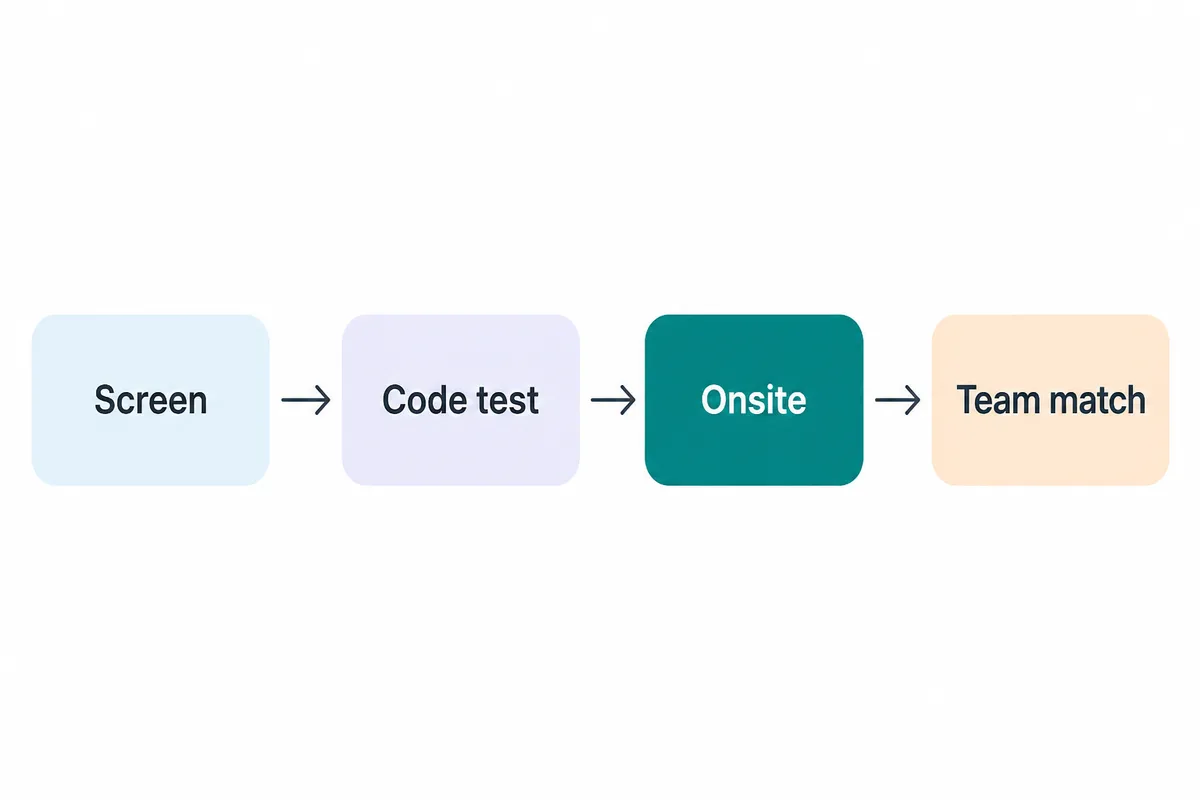
Reported accounts are anecdotal rather than a company-published specification. Exact sequencing, interview focus and staffing needs can vary by level and team, so use this as the commonly reported shape and confirm your particular loop with your recruiter.
Round one — recruiter screen
The recruiter screen is where the process begins. It is usually less about testing implementation detail and more about establishing whether your background, interests and expectations fit the role under discussion.
Prepare a concise account of your recent work. Focus on decisions you made, constraints you encountered, and measurable outcomes where you can explain the context clearly. A data-platform company may care less about a polished product narrative than whether you can articulate how a system behaved under load, how you investigated an incident, or why you selected one technical approach over another.
Do not memorise a speech. Instead, prepare adaptable stories around ownership, a difficult technical decision, a disagreement, an operational problem and a project you would approach differently today. The best answers show judgement without making every answer sound heroic.
What this stage screens for: communication, motivation, relevant experience and basic alignment with the role.
Round two — technical coding screen
Candidate reports describe a technical screen in CoderPad. The important practical constraint is that your code should compile and run against test cases. That changes how you should practise.
A solution that is conceptually correct but does not execute is difficult to evaluate. Start by clarifying inputs, outputs and constraints. State the straightforward approach, explain why it may not be sufficient, then describe the data structure or pattern you plan to use. Once you begin coding, aim for a complete working version before refining.
The underlying material is familiar software interview territory: arrays, strings, hash maps, trees, graphs, recursion, sorting and complexity analysis. What makes a live CoderPad setting harder is the combination of implementation speed and narration. You need to write syntactically sound code while making your assumptions visible.
The DSA Patterns Sheet is free to browse and is useful for practising recognition before you start typing. Pair it with in-browser code practice so that you can test edge cases rather than stopping at an elegant-looking answer. For a stronger communication routine, read how to explain your thought process clearly in coding interviews.
✅ Do: Talk through test cases before the interviewer asks for them.
❌ Don't: Leave compilation, imports and boundary conditions until the final minute.
Round three — the onsite coding discussions
Reported accounts describe an onsite loop of several interviews. The exact mix can differ by team, but coding remains a central part of the process. This is usually where interviewers can probe beyond whether you can eventually reach a solution.
Expect follow-up questions. A working baseline may be extended with a larger input size, a memory constraint, a changed requirement or a request to justify complexity. The interviewer is looking for whether you can revise a solution deliberately rather than discard it and start again.
Practise a repeatable live-coding sequence:
- Restate the problem and ask the highest-value clarifying question.
- Walk through a small example.
- Compare a direct solution with a more efficient one.
- State time and space complexity before coding.
- Build the core implementation.
- Test normal, empty and boundary inputs aloud.
- Explain what you would change if the constraints grew.
This sequence prevents a common failure mode: coding quickly before you have established the problem you are solving. Our guide to what interviewers actually look for in live coding interviews explains why communication affects the score even when the final code is correct.
Midway through your preparation, revisit Databricks's interview kit and solve the mapped questions in a simulated editor. Write, run and correct the code yourself before comparing your approach with an editorial.
What this stage screens for: problem decomposition, implementation discipline, complexity reasoning and the ability to collaborate while solving.
Round four — data-intensive system design
Design discussions are where Databricks becomes meaningfully different from a generic software interview loop. Candidate reports describe design work that skews towards storage, distributed job scheduling, concurrency and data-intensive workloads.
That does not mean you should memorise a single “Databricks system design question”. Design attribution is inherently less certain than broad round shape, and the useful preparation is transferable. Learn to reason from workload to architecture.
For example, when discussing a storage-heavy service, establish the read and write paths before naming technologies. Ask what the data looks like, how large it becomes, whether reads are latency-sensitive, how failures are handled, and what consistency the user actually needs. For distributed job scheduling, define the job lifecycle, worker ownership, retries, idempotent operations, queueing, fairness and observability.
A strong answer makes trade-offs explicit:
- Choose a simple baseline before introducing scale.
- Separate control flow from data flow.
- Explain what happens when a worker fails halfway through work.
- Identify what should be durable and what can remain ephemeral.
- Name metrics that would reveal bottlenecks or backlog.
- State where stronger consistency is worth the operational cost.
The System Design Sheet is free to browse and can help you practise structuring these conversations. If you are unsure where class-level design ends and distributed architecture begins, low-level design vs high-level design is a useful distinction to learn before your interview.
What this stage screens for: system judgement, trade-off reasoning, operational thinking and the ability to communicate under ambiguity.
Round five — team match
Reported accounts place team matching after the core technical loop. This stage is not simply a ceremonial final conversation. It is an opportunity for potential teams to understand where your experience fits and for you to test whether the work matches what you want to do.
Be ready to discuss your technical preferences without being rigid. If you enjoy systems work, explain the kind of ownership you want: platform reliability, developer tooling, distributed services, storage, query performance or another area relevant to your experience. If your background is product engineering, identify the parts of that work that translate to data systems: reliability, performance, integration complexity or customer-facing operational concerns.
Ask grounded questions. What does the team own? What are the current technical constraints? How are design decisions reviewed? What does success look like in the first months? These questions signal that you think beyond the interview problem.
What this stage screens for: team alignment, depth of interest, communication and practical expectations.
The Databricks-specific preparation point: make the code real
Many interview guides advise candidates to communicate clearly. That is good advice everywhere. The Databricks-specific point from reported accounts is more concrete: code is evaluated in CoderPad against test cases, so it must compile and run.
Treat every practice question as a small engineering task, not a whiteboard outline. Use a function signature, construct inputs, run examples and deliberately test failure paths. If your chosen language requires imports, helper methods or careful type handling, rehearse those details until they are automatic.
This matters especially for candidates who are strong at explaining algorithms but less practised at implementing them in a shared editor. A clean explanation cannot rescue code that never runs. Conversely, a modest but working solution, carefully tested and clearly explained, gives the interviewer something solid to evaluate.
For systems preparation, bring the same mindset to design. Do not stop at boxes and arrows. Explain how a job is retried, how duplicate work is detected, how state is observed and what happens when a dependency is slow. The difference is not more jargon; it is following the system through an unhappy path.
Is the Databricks interview hard?
Yes, particularly if your preparation has focused only on isolated algorithm puzzles.
The coding bar is not just about discovering an efficient approach. Reported CoderPad interviews reward implementation accuracy, test discipline and clear communication. That makes the process difficult for candidates who can solve problems eventually but have not practised producing reliable code under observation.
The design side adds a different kind of challenge. Data-intensive systems force you to discuss failure, throughput, storage, scheduling and concurrent work in a connected way. You do not need to know every infrastructure detail, but you do need to reason from requirements to trade-offs.
How many rounds are there? Reported accounts describe a recruiter screen, a technical screen, an onsite loop of four to five interviews, and team matching. The exact onsite composition can vary by level and team.
How long does it take? The available research does not establish a reliable end-to-end timeline for Databricks. Ask your recruiter about scheduling, decision timing and team-match expectations rather than relying on a generic estimate.
A 30-day Databricks preparation plan
Days 1–7 — restore coding fluency
Work through core patterns: hashing, two pointers, sliding windows, trees, graphs and binary search. Focus on recognising the shape of a problem quickly, then implementing it without relying on autocomplete or external references.
Use the free-to-browse Operating Systems Sheet to refresh process, thread, memory and scheduling fundamentals. Those concepts support both practical coding discussions and distributed-design reasoning.
Days 8–14 — practise runnable solutions
Move from untimed study to timed CoderPad-style sessions. Each session should end with code that runs against your own tests. Build a short checklist: empty input, one-element input, duplicate values, large values, invalid assumptions and complexity limits.
Read how to identify the right DSA pattern in a coding interview if you find that you know techniques individually but struggle to select one quickly.
Days 15–21 — build design depth
Choose data-heavy design prompts and practise a consistent structure: requirements, scale assumptions, core entities, APIs, storage, execution flow, failure handling, observability and trade-offs. Spend time on storage and job-processing scenarios because they resemble the kind of design problem evidenced at Databricks.
Do not jump immediately to a complex distributed architecture. First explain the smallest system that works, then show how you would evolve it when load, reliability or latency requirements change.
Days 22–30 — rehearse the full loop
Alternate live coding, design and behavioural practice. Use AI mock interviews to rehearse explaining decisions aloud and receiving follow-up questions. The goal is not to sound scripted; it is to make your reasoning observable.
In the final days, revisit weak areas rather than cramming new topics. Prepare project stories for the recruiter and team-match conversations, and practise writing code that compiles on the first serious attempt.
Frequently asked questions
What does the Databricks interview process look like?
Reported accounts describe a recruiter screen, a CoderPad technical screen, an onsite loop and team matching. Details can vary by role and team.
Does Databricks use CoderPad?
Candidate reports commonly describe the technical screen as taking place in CoderPad, with code expected to compile and run against test cases.
What coding topics should I practise?
Prioritise core data structures, algorithm patterns, complexity analysis and implementation accuracy. Practise explaining your approach while coding.
Are Databricks interview questions hard?
They can be difficult because the process combines coding correctness, live communication and data-intensive design reasoning. Difficulty also depends on level and team.
Does Databricks ask system design questions?
Reported accounts describe design discussions with a focus on storage, distributed job scheduling, concurrency and data-intensive workloads, especially where the role calls for that depth.
Should I write pseudocode or complete code?
Practise complete, runnable code. Reported accounts emphasise compilation and test cases, so implementation details matter.
How should I prepare for the design round?
Start from requirements and workload, then explain data flow, storage choices, failure handling, retries, observability and trade-offs. Avoid presenting technology names without reasoning.
What should I discuss in the recruiter screen?
Prepare clear examples of ownership, technical decisions, operational challenges and the kind of work you want next. Be specific about your individual contribution.
How long does the Databricks process take?
A reliable company-wide timeline was not established in the available reports. Confirm the expected schedule directly with your recruiter.
Where to start
The most useful first step is to practise producing code that works under live-interview constraints: clarify, implement, run tests and explain your decisions. Then add design rehearsal focused on data flow, storage, job execution and failure handling.
Open Databricks's interview kit to practise the three mapped DSA questions associated with Databricks. Combine that work with the free-to-browse sheets, timed code practice and an AI mock interview to rehearse the explanations that make your technical judgement visible.
Interview processes change, and team-level variation is real. Confirm the current format, interview tools and role expectations with your recruiter before finalising your preparation plan.