
Interview
Docusign Interview Questions and Process: The Complete Guide (2026)
Prepare for Docusign interview questions with a round-by-round guide to coding, design and behavioural interviews, plus a focused 30-day plan for engineers.
Reported accounts describe the Docusign software engineering interview process as a five-round sequence: recruiter screen, two coding rounds, a design discussion, and a behavioural or hiring-manager conversation. Coding is commonly reported as medium-to-hard, with success depending on clear problem solving, complexity reasoning, and communication as much as reaching a correct solution. Start with Docusign's interview kit, which holds three mapped DSA questions for focused practice.
The precise format can vary by team, level, location and hiring need, so use this guide as a preparation map rather than a fixed script. Confirm your own interview format with the recruiter early, then prepare for both the technical bar and the conversations that establish level fit.
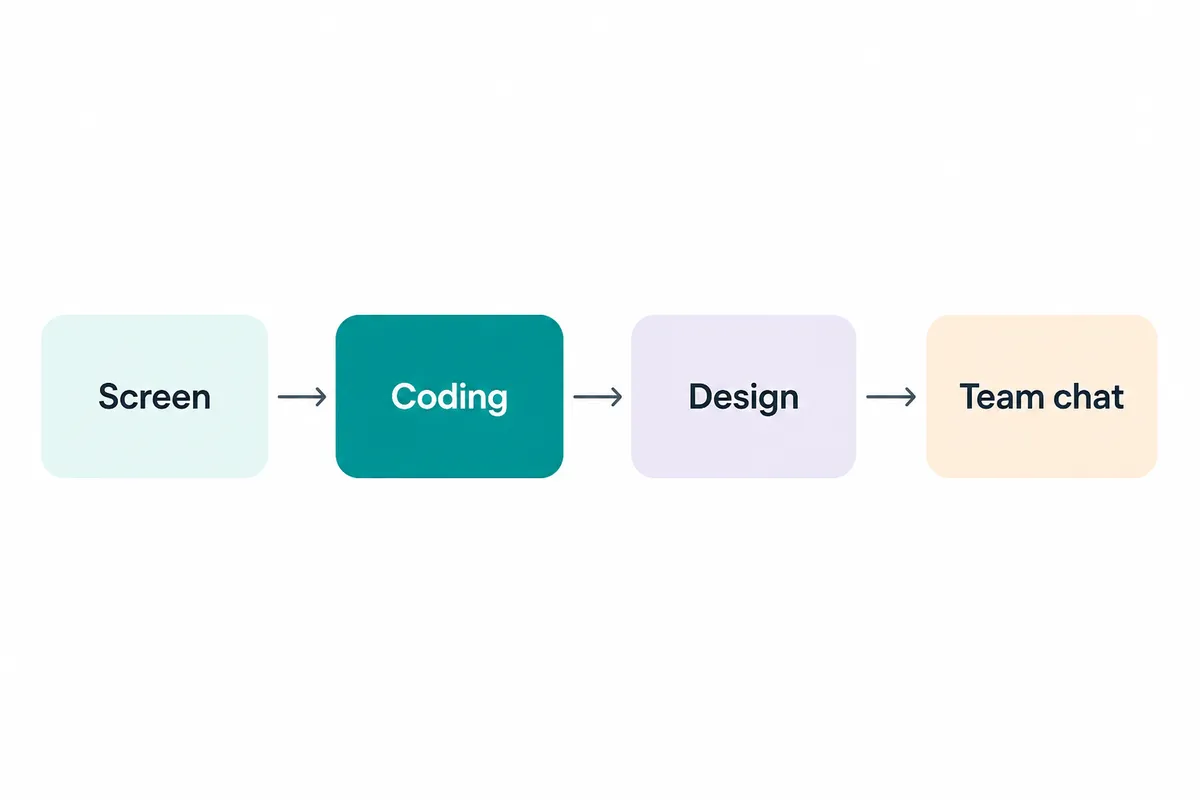
The process at a glance
| Round | Common format | What it screens for | How to prepare |
|---|---|---|---|
| Recruiter screen | Introductory conversation | Motivation, availability, role fit | Explain your experience and why the role fits |
| Coding round one | Live technical problem solving | Core data structures, clean reasoning | Practise patterns and narrate your choices |
| Coding round two | Harder live coding discussion | Depth, edge cases, complexity trade-offs | Solve under time pressure and test aloud |
| Design round | Design and technical discussion | Structure, trade-offs, practical engineering judgement | Clarify requirements before proposing a solution |
| Behavioural or hiring-manager round | Project deep dive and collaboration discussion | Ownership, communication, scope and level fit | Prepare detailed stories from your work |
Reported accounts describe this as a five-round process, but candidates should expect variation. A senior role may put more weight on design and technical leadership; an earlier-career role may concentrate more heavily on coding fundamentals. The useful constant is that every technical answer needs an explanation, not merely working code.
Round one — recruiter screen
The recruiter conversation is usually the first chance to understand the role, team and process. It is also where you should remove uncertainty from your preparation plan.
Expect questions about your background, current work, interest in Docusign, notice period, location preferences and salary expectations. You do not need a rehearsed company speech, but you do need a coherent reason for making a move. Connect your interests to the role’s technical scope, the sort of problems you want to own, and the environment in which you do your best work.
Use the call to ask practical questions:
- Which level is the role calibrated for?
- Are the coding rounds live, collaborative or assessment-led?
- Is the design discussion low-level, high-level, or based on a past project?
- Will the hiring-manager conversation include a technical project deep dive?
These questions are not administrative details. They determine how you allocate the next few weeks of preparation.
What it screens for: communication, motivation, professional clarity and whether your experience broadly matches the opening.
Best preparation: have a concise two-minute career narrative. Cover where you have worked, the systems or features you owned, what you want next, and why this role makes sense now.
Rounds two and three — coding interviews
The coding rounds are commonly reported as medium-to-hard rather than as simple syntax tests. Candidate reports mention recurring preparation areas including monotonic stacks, heap-plus-greedy reasoning, tree traversal, recursion and dynamic programming.
That list matters less than the underlying habits. An interviewer is usually trying to see whether you can turn an unfamiliar problem into a sequence of sensible decisions:
- Clarify inputs, outputs and constraints.
- State a straightforward approach before jumping to the optimal one.
- Identify the bottleneck.
- Choose a data structure that removes that bottleneck.
- Explain time and space complexity.
- Test normal, boundary and failure cases aloud.
A candidate who reaches the right answer silently can be difficult to assess. A candidate who communicates a sound approach, checks assumptions and responds well to prompts gives the interviewer far more evidence. Read what interviewers actually look for in live coding rounds before your first mock: it explains why explanation quality changes the outcome.
For targeted repetition, Docusign's interview kit provides three mapped DSA questions. Use them as diagnostic practice: identify the pattern before reading an editorial, solve without help, then revisit the problem and explain the solution as if an interviewer had interrupted you twice.
The DSA Patterns Sheet is free to browse and is useful for rebuilding recognition speed across common interview shapes. If you routinely know how to code but hesitate over which approach applies, start with how to identify the right DSA pattern in a coding interview.
What these rounds screen for: structured problem solving, data-structure fluency, complexity awareness, debugging discipline and collaborative communication.
✅ Do: say what you are optimising for before you write code.
❌ Do not: spend several minutes coding in silence and reveal your reasoning only after the solution is complete.
Round four — the design discussion
Reported accounts include a design round after the coding interviews. The exact style can vary significantly by role and team, so do not assume every candidate receives the same prompt or depth. For experienced engineers, expect more attention to trade-offs, interfaces, reliability and how a system evolves when requirements change.
A good design answer begins by narrowing the problem. Ask what scale matters, who the users are, what the critical actions are, and which constraints are real rather than hypothetical. Then work from a simple version towards the parts that deserve detail.
A dependable structure is:
- Define the user-facing flow and success criteria.
- Identify the main entities, services or components.
- Explain data ownership and interfaces.
- Discuss failure cases and operational trade-offs.
- Return to the highest-risk requirement and show how the design handles it.
Do not turn the round into a catalogue of technologies. Good design judgement is selective. Explain why a component exists, what problem it solves, and what cost it introduces.
The System Design Sheet is free to browse for practising system-level reasoning, while the Low Level Design Sheet is free to browse when you need to strengthen class design, object boundaries and extensibility. If you are unsure which style applies to your level, read how much system design is enough for SDE-1 versus SDE-2 interviews.
What it screens for: requirement clarification, practical trade-offs, technical communication, system thinking and judgement under ambiguity.
Round five — behavioural and hiring-manager discussion
The final conversation is not a formality. It often tests whether your technical depth matches the level being considered and whether you can work effectively through ambiguity, feedback and competing priorities.
Prepare stories that demonstrate:
- Ownership of a difficult technical decision.
- A project that did not go as planned.
- A disagreement resolved through evidence or collaboration.
- A time you improved reliability, quality or delivery.
- A situation where you learned a new area quickly.
Use a clear structure: context, your responsibility, the actions you took, the result, and what you learned. Avoid hiding behind “we”. Teams do the work together, but the interviewer needs to understand your personal contribution, judgement and influence.
Practise answering follow-up questions, because that is where vague stories tend to unravel. What alternative did you reject? What metric changed? What did you personally implement? What would you change now? An AI interview is useful for rehearsing behavioural answers aloud and receiving feedback on clarity, structure and specificity.
What it screens for: ownership, collaboration, self-awareness, technical leadership potential and level fit.
Is the Docusign interview hard?
Yes, but the difficulty is manageable when you prepare for the full loop rather than treating it as a list of coding puzzles.
The coding bar is commonly reported as medium-to-hard. That means memorising a handful of solutions is unlikely to be enough. You need to recognise patterns, reason about complexity, write readable code and adapt when an interviewer changes a constraint.
The design discussion adds a different kind of challenge: ambiguity. There may not be one perfect answer. What matters is whether you can make assumptions visible, build a sensible first version and defend trade-offs without over-engineering.
How many rounds are there? Reported accounts describe five: recruiter screen, two coding rounds, design, and behavioural or hiring-manager discussion.
How long does it take? The sourced shape establishes the rounds, not a reliable end-to-end timeline. Ask your recruiter when each stage is likely to happen and whether feedback will be batched between rounds.
The most common preparation mistake is focusing exclusively on coding. Coding may open the door, but design communication and project depth are what show that you can operate as an engineer inside a team.
A 30-day Docusign preparation plan
Days one to seven — rebuild coding fundamentals
Focus on arrays, strings, hash maps, stacks, heaps, trees and recursion. Solve fewer problems with more discipline: clarify, outline, code, test and explain complexity every time.
Use the free DSA Patterns Sheet to practise by recognisable problem shape rather than random topic. For dynamic-programming confidence, study dynamic programming patterns for coding interviews.
Days eight to fourteen — practise live-round habits
Set a timer and simulate an interviewer. Speak while solving. Start with a brute-force approach, improve it, and test edge cases before declaring completion.
Alternate tree traversal, stack-based problems, heap selection and dynamic programming. Review recordings or notes from each session and identify one communication habit to improve the next day.
Days fifteen to twenty-one — add design structure
Practise turning vague prompts into clear requirements. For each exercise, write down assumptions, sketch components, identify data movement and discuss one failure mode.
Do not aim for maximal complexity. Aim for a design you can explain, revise and defend. The free System Design Sheet can help you structure these sessions.
Days twenty-two to thirty — integrate the loop
Run complete mocks: one coding session, one design conversation and one behavioural discussion each week. Use Docusign's interview kit for focused coding revision, then switch to unfamiliar questions so you do not rely on recognition alone.
Finish by refining your project stories. Your goal is to enter the hiring-manager round with examples that are specific, concise and robust under follow-up.
The Docusign-specific coding signal: pattern range
The most useful company-specific signal in reported Docusign accounts is not one named ritual or a single favoured platform. It is the breadth of coding patterns candidates mention together: monotonic stack problems, heap-plus-greedy choices, tree traversal, recursion and dynamic programming.
That combination rewards flexible recognition. A monotonic-stack problem tests whether you can spot ordering constraints hidden in an array. Heap-plus-greedy questions test whether you can make a locally sensible choice while maintaining the right candidates. Trees and recursion reveal whether you can manage state and base cases cleanly. Dynamic programming tests whether you can identify repeated subproblems rather than brute-force them.
Practise saying the pattern name only after you have justified it from the constraints. In a real interview, naming a technique is not evidence by itself; connecting it to the problem is.
Frequently asked questions
How many rounds are in the Docusign interview process?
Reported accounts describe five rounds: a recruiter screen, two coding rounds, a design round, and a behavioural or hiring-manager conversation. The sequence may vary by team and level.
What coding topics should I prepare for?
Candidate reports commonly mention monotonic stacks, heaps with greedy reasoning, tree traversal, recursion and dynamic programming. Build broad pattern recognition rather than expecting a fixed question list.
Is the Docusign coding interview difficult?
It is commonly reported as medium-to-hard. Clear reasoning, complexity analysis, testing and communication are as important as arriving at a correct solution.
Does Docusign have a system design round?
Reported accounts describe a design round. Its exact depth can vary by team and seniority, so confirm whether your interview will focus on system design, lower-level design or a project discussion.
How should I prepare for the behavioural interview?
Prepare detailed examples of ownership, conflict resolution, delivery under pressure, technical decisions and learning from setbacks. Focus on your own contribution, not only the team outcome.
What should I ask the recruiter?
Ask about the level, round order, technical format, expected design depth, interviewer roles and expected timeline. These details help you prioritise preparation.
Should I practise coding aloud?
Yes. Live coding evaluates your reasoning process as well as code quality. Explaining assumptions, alternatives and edge cases makes that process visible.
Is dynamic programming important for Docusign interviews?
Candidate reports include dynamic programming among the recurring areas. Prepare it alongside trees, recursion, heaps and stack-based reasoning rather than treating it as an isolated topic.
What is the best way to practise before the interview?
Combine timed coding, design discussions and behavioural rehearsal. Use unfamiliar questions regularly so you practise adapting rather than recalling.
Where to start
Start with the technical foundation, then rehearse the conversations around it. Solve coding problems under a timer, explain every decision aloud, and practise turning uncertain design prompts into a clear first version.
Open Docusign's interview kit to work through the three mapped DSA questions, then use an AI mock interview to rehearse coding explanations, design trade-offs and behavioural stories before the real loop.
Interview formats change, and team-level variation is real. Confirm your process with the recruiter, but prepare for the reported five-round shape with enough breadth to handle the unexpected.
Topics
Related on Thita
Your next step
Practise with AI mock interviews
A spoken interview that asks follow-up questions, runs your code and ends with a written report.