
Interview
DoorDash Interview Questions and Process: The Complete Guide (2026)
A round-by-round guide to DoorDash interview questions: coding, CodeCraft, debugging and behavioural preparation for the reported engineering loop.
DoorDash interview questions reportedly span a recruiter screen, a live technical screen, and an onsite loop of three to four conversations. The distinctive part is not simply solving coding puzzles: candidate reports describe a practical CodeCraft round where you build a small working service, alongside a separate debugging exercise. Prepare to explain decisions, turn an incomplete brief into running code, and investigate unfamiliar failures methodically.
For coding preparation, DoorDash's interview kit holds six mapped DSA questions associated with the company. Use it to practise common coding patterns, then rehearse the practical and communication-heavy parts of the loop separately.
Reported processes vary by team, level and hiring need. Treat this guide as a useful shape of the process rather than a fixed company policy, and confirm the exact format with your recruiter.
The process at a glance
| Stage | Reported format | What it screens for | Best preparation |
|---|---|---|---|
| Recruiter screen | Thirty-minute conversation | Role fit, experience, motivation | Clear project narrative |
| Technical screen | Sixty-minute live technical round | Coding fluency, reasoning, communication | Timed pattern practice |
| Onsite loop | Three to four conversations | Practical engineering judgement | Build, test and explain |
| CodeCraft | Small working service | Scope control, code quality, delivery | End-to-end implementation |
| Debugging | Investigate broken behaviour | Diagnosis, method, calm reasoning | Read, reproduce, isolate |
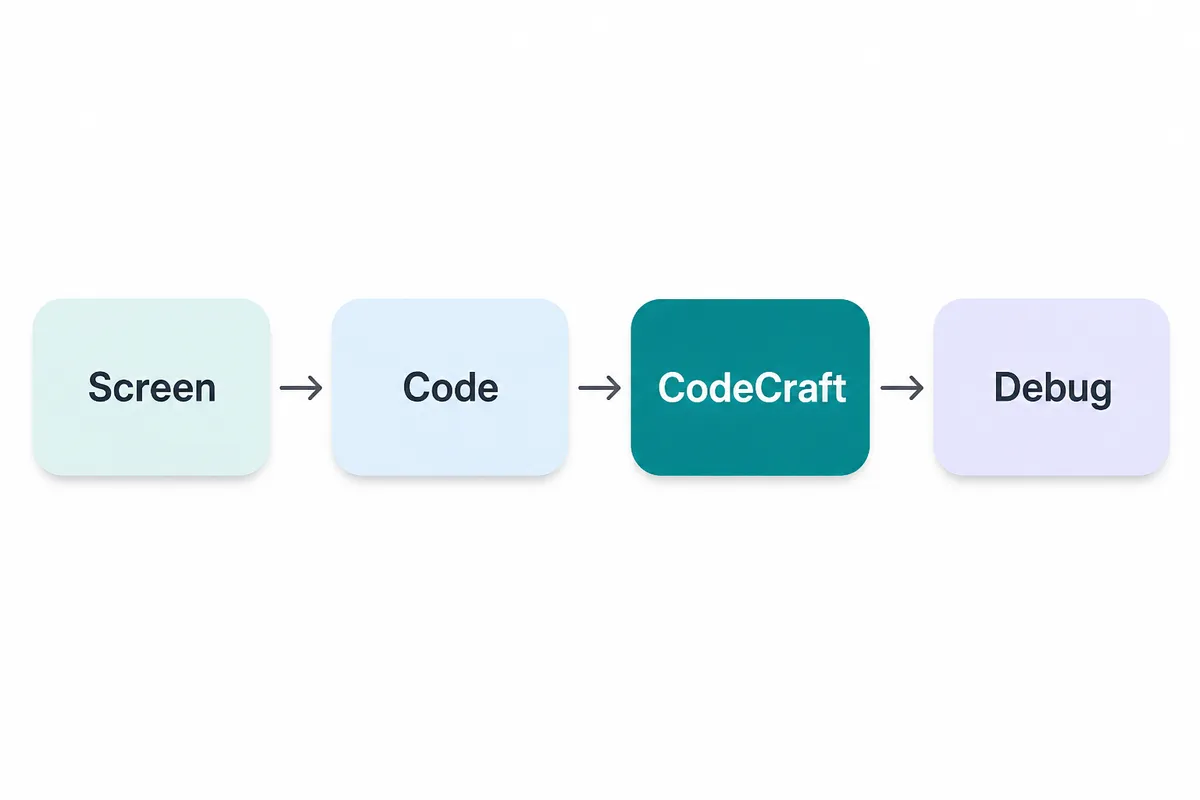
The onsite is reported as a group of conversations rather than a single uniform test. CodeCraft and debugging are the most clearly differentiated formats in candidate accounts; the exact order and the remaining onsite discussion can vary. That matters for preparation: do not spend every hour on isolated algorithm drills if the role may also ask you to ship, inspect and defend practical code.
Round 1 — the recruiter screen
Reported accounts describe an initial recruiter conversation of around thirty minutes. This is usually the point at which the company and candidate establish mutual fit: what role is being considered, what you have worked on, why you are looking, and whether your background lines up with the team’s needs.
The mistake is treating this as administrative. A vague account of your experience creates uncertainty before the technical process begins. Prepare a concise version of your story that answers three questions:
- What systems or features have you personally owned?
- What technical decisions did you make, and why?
- Why does this kind of product and engineering problem interest you now?
Keep the story concrete. “I worked on a payments service” is a headline. “I owned retry behaviour after we found duplicate requests under load” is evidence of judgement. You do not need a polished speech, but you should be able to explain your work without searching for examples.
If the recruiter can share the role level, language expectations, onsite format or whether practical tooling is available, ask. Those details should shape the final weeks of your preparation.
Round 2 — the technical screen
The reported technical screen lasts sixty minutes. Expect a live environment where the interviewer is evaluating more than whether your final answer compiles. They need to see how you understand a problem, select an approach, handle constraints and communicate while coding.
Start with clarification rather than code. Restate the input and output, ask about edge cases, and name the constraints that change the solution. Then outline the approach before typing. This creates a shared plan and gives the interviewer something useful to assess if time becomes tight.
For a standard coding question, a reliable sequence is:
- Describe the straightforward solution first.
- Identify the bottleneck.
- Explain the data structure or pattern that removes it.
- State time and space complexity.
- Code in small pieces and test edge cases aloud.
The DSA Patterns Sheet is free to browse and helps you organise practice around recognition: sliding windows, graph traversal, binary search, hashing and other reusable shapes. Pair it with how to identify the right DSA pattern in a coding interview if you often know the concepts but struggle to choose an approach quickly.
💡 Pro Tip: Narrate uncertainty productively. “I can solve this with sorting in this complexity, but I think a hash map avoids that cost; let me verify the duplicate case” sounds like engineering. Going silent while you experiment does not.
Round 3 — the CodeCraft round
CodeCraft is the DoorDash-specific format to prepare for. Candidate reports describe it as a practical exercise: build a small working service rather than solve a self-contained puzzle. That changes what good performance looks like.
A coding puzzle often rewards finding the key insight. A practical service exercise also rewards deciding what not to build. You may need to make reasonable assumptions, choose a simple model, expose a usable interface, keep state understandable, and demonstrate the main flow before time runs out.
The kind of design problem evidenced at DoorDash is useful practice for this mindset, but the strongest preparation is implementation. Open DoorDash's interview kit for the mapped coding set, then use each exercise as a prompt to practise the habits around it: clarify requirements, define the core data model, write a happy path, and test failure cases.
A good CodeCraft approach is deliberately unglamorous:
First, establish the smallest useful version. Identify the central action a user or system must complete. Write that first and make it run. Avoid speculative abstractions while there is no working flow.
Second, make state and boundaries visible. Keep data ownership clear. Name entities plainly. Separate input handling, domain logic and persistence-like state only where doing so makes the code easier to change.
Third, add the likely extension. Once the core service works, ask what requirement is most likely to arrive next: another status, a new rule, a cancellation path, a different selection policy. Improve the design only where that extension justifies it.
Finally, demonstrate it. A short driver, basic tests or a clear walkthrough matters. Working code gives you something concrete to discuss when the interviewer asks about trade-offs.
The Low Level Design Sheet is free to browse and is useful for strengthening the class, responsibility and interface decisions that practical exercises expose. For the distinction between object-level structure and broader service design, read low-level design vs high-level design: what interviews actually expect.
⚠️ Important: Do not confuse “practical” with “build everything”. Time-box the first working version. A modest service that runs, handles core cases and has clearly explained limitations is stronger than an elaborate design that never becomes usable code.
Round 4 — the debugging exercise
A separate debugging round is another reported feature of the DoorDash onsite. This tests a different engineering muscle from starting with a blank file. Instead of inventing a solution, you must make sense of code or behaviour that already exists.
The interviewer is likely looking for a method, not a dramatic guess. Strong candidates narrow the search space deliberately:
- reproduce or restate the observed failure;
- identify what should happen instead;
- inspect inputs, outputs and assumptions;
- isolate the smallest failing case;
- form a hypothesis;
- test it before changing several things at once;
- explain how they would prevent the issue returning.
The weak version of debugging is jumping to a familiar culprit: “it is probably a null value” or “there must be a race condition”. The stronger version is evidential: “this branch is only reached when the key is absent; I would verify that assumption with this input, then inspect where the key is created.”
Practise reading code you did not write. Take an old project, a colleague’s repository, or a deliberately flawed implementation. Give yourself a short window to identify the symptom, write down hypotheses, and choose the next observation that would distinguish between them. This is more valuable than passively reading debugging advice.
The Code Practice workspace can help you keep coding fluency sharp, while what interviewers actually look for in live coding rounds explains why clear reasoning is often scored alongside correctness.
AI-assisted work: prepare for the judgement, not the novelty
Candidate reports also suggest a movement towards an AI-assisted working session using real AI coding tools. This appears directional rather than a universal or fixed format, so do not assume it will be part of every DoorDash loop. Ask your recruiter if tools are permitted and what environment will be used.
If an AI tool is available, the evaluation is still yours. Treat it as you would in real engineering work: provide useful context, inspect generated code, test claims, notice missing edge cases and reject an answer that does not fit the constraints. Blind acceptance is not leverage; it is an unexamined dependency.
Practise the same standard with or without assistance. You should be able to explain why a suggestion is correct, where it could fail, and how you would validate it. An AI mock interview is useful for rehearsing technical explanations, debugging discussions and project stories aloud.
Is the DoorDash interview hard?
Yes, because it appears to test range rather than one narrow skill.
The reported process includes a recruiter screen, a sixty-minute technical screen, and an onsite loop of three to four conversations. Within that onsite, CodeCraft and debugging create practical demands that are not fully captured by grinding isolated coding questions. A candidate can be fast at algorithms and still struggle if they cannot choose a sensible scope, produce a working service, or investigate a failure without random edits.
How many rounds are there? Reported accounts describe two preliminary conversations followed by an onsite of three to four conversations. The exact composition can vary by team and level.
How long does the full process take? The available reports do not establish a dependable end-to-end timeline. Ask your recruiter about scheduling, decision timing and whether all onsite conversations happen together.
What makes it difficult? The switch between modes. You may need to solve a coding problem, build practical code, diagnose existing code and discuss your decisions clearly. Preparation should therefore alternate between those skills rather than treating them as separate topics for the final week.
A 30-day DoorDash preparation plan
Days 1–7 — rebuild coding speed
Work through core DSA patterns under moderate time pressure. Focus on recognising the shape before coding: maps for lookup, two pointers for ordered constraints, graph traversal for reachability, and binary search for monotonic answers.
Use the six mapped DSA questions in DoorDash's interview kit as company-relevant practice, then broaden with the free-to-browse DSA sheet. At the end of every problem, explain your solution aloud as if an interviewer had interrupted you halfway through.
Days 8–14 — build small services
Choose short prompts and build the smallest working version from an empty file. Keep each session focused on one core workflow. Add basic tests or a driver. Afterwards, list the assumptions you made and the extension you would tackle next.
Do not optimise prematurely. The goal is to develop a repeatable delivery sequence: clarify, model, implement, test, then refine. That sequence is the useful preparation for a CodeCraft-style exercise.
Days 15–21 — practise debugging and design judgement
Spend alternate sessions on debugging and code review. Take a flawed implementation and trace it from symptom to cause. Force yourself to state one hypothesis at a time and choose a test that can disprove it.
On the other days, practise explaining design choices. Why is a field stored here? Why is this interface necessary? What happens when a requirement changes? This is where you replace pattern memorisation with judgement.
Days 22–30 — simulate the loop
Run full rehearsals: one timed coding round, one practical build, one debugging session and one project discussion. Keep notes on repeated failures: silent reasoning, weak tests, unclear assumptions, rushed code structure or stories that blur your own contribution with the team’s.
The AI Interview tool can provide a low-friction way to practise speaking under pressure. For communication mechanics, use how to explain your thought process clearly in coding interviews.
Frequently asked questions
What are the main DoorDash interview rounds?
Reported accounts describe a recruiter screen, a sixty-minute technical screen and an onsite loop of three to four conversations. CodeCraft and a separate debugging exercise are the distinctive reported onsite formats.
What is the DoorDash CodeCraft round?
Candidate reports describe CodeCraft as a practical exercise where you build a small working service. It rewards sensible scope, readable code, testing and clear trade-off discussion.
Does DoorDash ask coding questions?
Reported accounts include a live technical screen. Prepare standard coding patterns, complexity analysis and verbal explanation alongside practical implementation skills.
How long is the technical screen?
The technical screen is reported as sixty minutes. Confirm the current format with your recruiter because team and role variation is possible.
Is the DoorDash interview harder than a normal coding interview?
It can feel harder because the loop reportedly tests coding, practical delivery and debugging rather than only puzzle solving. The challenge is switching between those modes effectively.
How should I prepare for the debugging round?
Practise reproducing failures, narrowing inputs, writing hypotheses and testing them one by one. Explain your method before proposing a fix.
Should I use AI tools to prepare?
Use them to practise reviewing, validating and improving code, not to avoid understanding it. Reports suggest an AI-assisted working session may be moving into some processes, but it should not be assumed for every loop.
Do I need low-level design knowledge?
Practical service-building benefits from clear responsibility boundaries, simple data models and change-friendly code. Focus on applying those ideas in working code, not reciting design-pattern definitions.
How long does the DoorDash process take?
A reliable end-to-end timeline was not established in available reports. Your recruiter is the best source for the current scheduling and decision process.
Where to start
Start with the technical fundamentals, but do not stop there. The highest-leverage preparation for a reported DoorDash loop is practising the hand-off from idea to working code: clarify the brief, implement a useful core, test it, then explain what you would change next.
Open DoorDash's interview kit to practise the six mapped DSA questions, use the free-to-browse sheets to strengthen your fundamentals, and rehearse practical conversations with an AI mock interview. Confirm the current format with your recruiter before the onsite, especially if you are told that practical tools or an AI-assisted session may be involved.
Topics
Related on Thita
Your next step
Practise with AI mock interviews
A spoken interview that asks follow-up questions, runs your code and ends with a written report.