
Interview
Expedia Interview Questions and Process: The Complete Guide (2026)
Prepare for Expedia software engineering interviews with a clear round-by-round framework, transferable coding and design practice, and a focused 30-day plan.
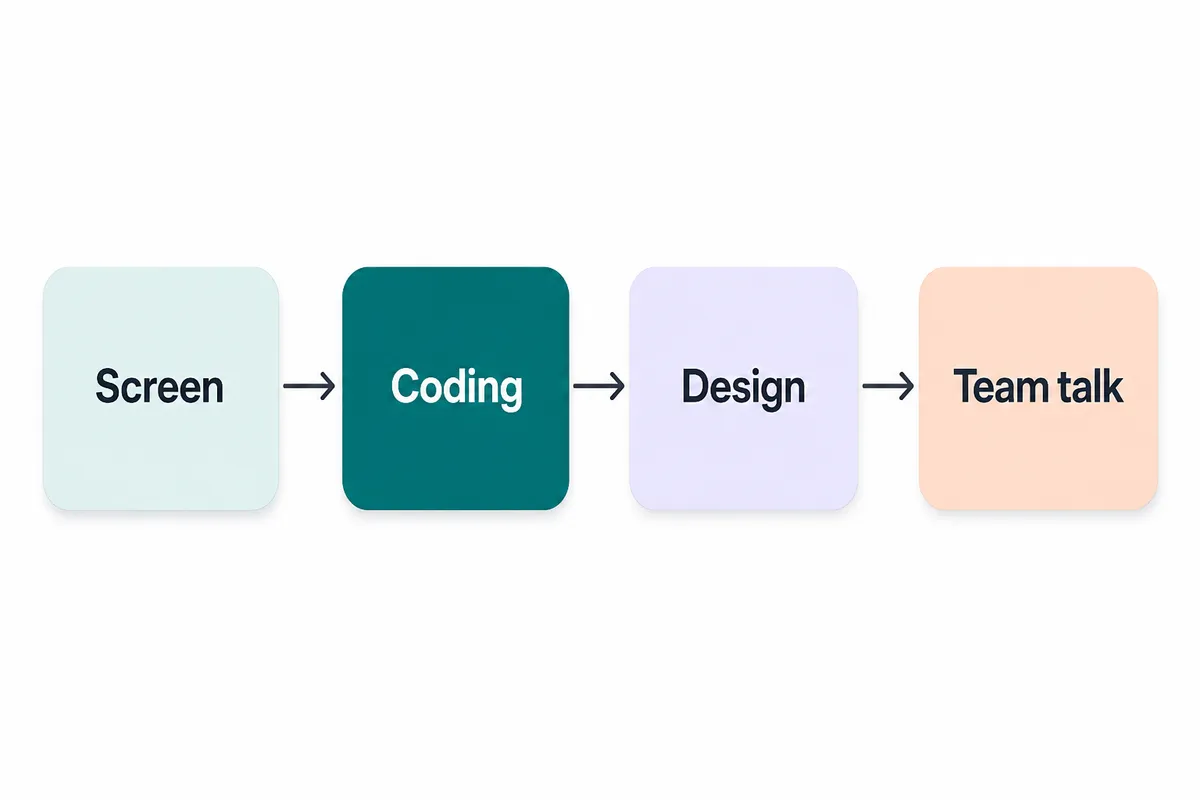
Expedia interview questions are best approached as a modern software engineering loop: expect an initial screen, a technical coding conversation, design discussion for relevant roles, and behavioural evaluation of how you work with others. Reported company-specific accounts are thin and can vary by team, so confirm the exact format with your recruiter. Meanwhile, prepare the transferable skills that travel across every version of the loop: recognising coding patterns, explaining trade-offs, writing reliable code, and discussing your past work clearly.
For focused coding practice, Expedia's interview kit contains 15 mapped DSA questions. Use it as a company-relevant starting point, then practise explaining every solution as though an interviewer is listening.
The process at a glance
There is no well-sourced, fixed Expedia interview script to rely on. Rather than memorising an uncertain sequence, prepare for the stages commonly found in software engineering hiring and ask your recruiter which ones apply to your role.
| Possible stage | Typical format | What it may screen for | Best preparation |
|---|---|---|---|
| Initial screen | Conversation about background and role | Motivation, experience, communication | Know your projects and goals |
| Coding screen | Live problem solving | Problem framing, code quality, complexity | Practise patterns aloud |
| Technical loop | Coding and technical discussion | Depth, debugging, collaboration | Explain decisions as you work |
| Design discussion | Structured technical conversation | Trade-offs, scope, system thinking | Clarify requirements first |
| Team conversation | Project and behavioural questions | Ownership, teamwork, judgement | Prepare detailed work stories |
The useful distinction is between a process shape and a promise. A recruiter may confirm a different sequence, combine stages, or tailor the discussion to the team’s technical work. That does not make preparation uncertain; it means your preparation should be resilient.
Round one — the initial screen
An initial conversation usually establishes whether your background, interests and level align with the opening. Treat it as an interview, not administration. The person speaking with you may be checking how clearly you describe your experience, why you are considering the role, and whether your expectations fit the team.
The strongest answers are concrete. Instead of saying you “worked on a service”, explain the problem it solved, the part you owned, the decision you made, and the outcome. You do not need an overly rehearsed story, but you should be able to give a clear overview without wandering through every implementation detail.
Prepare a short account of your recent work, then prepare deeper versions for follow-up questions. Be ready to discuss a difficult technical choice, a disagreement, a failure, and a project whose result changed how you work.
💡 Pro tip: Ask for the format while the conversation is still open. A useful question is: “Which skills will the technical stages focus on, and is there a separate coding or design discussion?” This is more valuable than relying on an old online account.
Round two — the coding screen
A coding screen commonly tests whether you can turn an ambiguous prompt into a correct, efficient solution while communicating your reasoning. Even if the problem itself is familiar, the evaluation is rarely limited to the final code.
A dependable approach has five parts:
- Restate the problem and clarify the inputs, outputs and constraints.
- Talk through a simple solution before reaching for the efficient one.
- Name the data structure or pattern you plan to use.
- State expected time and space complexity.
- Test edge cases aloud after coding.
This structure prevents a common failure mode: silently writing a solution that is nearly right but never demonstrating that you have considered duplicates, empty inputs, boundary conditions or large input sizes.
Pattern recognition matters because it saves working memory. If you recognise a sliding-window shape, a graph traversal, or a binary-search condition early, you can spend more attention on explaining the trade-off and verifying the implementation. The free-to-browse DSA Patterns Sheet is designed for exactly that kind of deliberate practice. For a deeper method, read how to identify the right DSA pattern in a coding interview.
✅ Do: Say what you are checking before you test the code.
❌ Don’t: Wait until the interviewer finds an edge case for you.
Round three — the wider technical discussion
A later technical conversation may combine coding with questions about engineering fundamentals, prior projects, debugging choices, or how you would improve a solution after it works. This is where breadth can matter as much as raw puzzle-solving ability.
Interviewers often learn more from the refinement conversation than from the first answer. Can you identify the bottleneck in your approach? Can you explain why a hash-based approach changes the complexity? Can you make a function easier to test? Can you describe what you would log, monitor or revisit in production?
Prepare by revisiting completed coding problems instead of always chasing new ones. After solving a problem, ask yourself:
- What assumption did I make?
- What breaks at larger scale?
- Which test would expose the most likely bug?
- How would I explain this to a teammate reviewing my code?
- What would I change if the requirement changed?
This is also a good point to practise under realistic conditions. In-browser code practice gives you a place to work through solutions without turning every session into passive reading. For communication habits, see what interviewers actually look for in live coding rounds.
Round four — the design discussion
For roles where design is included, the goal is usually not to recite a memorised architecture. It is to show structured judgement: how you clarify the problem, choose a sensible scope, make trade-offs visible, and adapt when a requirement changes.
Start with questions. Who uses the system? What is the core action? What must happen immediately, and what can happen later? What reliability or data constraints matter? A candidate who asks sensible questions is showing that they do not treat every problem as identical.
Then build from the smallest useful design. Identify the main components, the data that flows between them, and the failure cases that genuinely matter. Avoid adding databases, queues, caches or elaborate abstractions merely because they sound sophisticated. Every component should solve a stated problem.
At lower levels, this may mean class design, responsibilities and testable interfaces. At more experienced levels, it can extend to services, data flow, scale and operational trade-offs. The free-to-browse Low Level Design Sheet and System Design Sheet can help you practise both modes. If the boundary between them is unclear, start with low-level design vs high-level design: what interviews actually expect.
The kind of design problem evidenced at Expedia should be treated as a practice prompt, not a prediction of a fixed interview question. The important skill is adapting a sound process to an unfamiliar prompt.
Round five — the team and behavioural conversation
A behavioural discussion checks whether your technical ability translates into effective work with other people. Strong candidates often under-prepare this stage because it feels less technical. That is a mistake.
Prepare examples that show ownership, disagreement, learning, delivery under pressure, and handling uncertainty. Use a simple structure: explain the context, your responsibility, the action you took, and what changed as a result. Be precise about your contribution. “We” is useful for describing a team, but the interviewer still needs to understand what you decided and did.
Do not force every answer into a success story. A well-explained failure can demonstrate sound judgement if you can show what you learned, what you changed, and how you would act differently now.
Practise speaking your examples aloud. AI mock interviews can help you rehearse concise answers and become more comfortable with follow-up questions.
Named rituals: what is known and what is not
No sourced Expedia-specific named ritual, platform, time limit or fixed round count is available in the current research. That matters because it is easy to mistake generic interview advice for a reliable company rule.
The practical response is not to prepare less. It is to prepare broadly, then use recruiter confirmation to narrow the focus. Ask whether the role includes live coding, design, project discussion, a take-home exercise, or a separate behavioural stage. Ask whether there are particular languages, domains or engineering areas worth reviewing.
That approach is more reliable than treating an unverified forum post as a contract.
Is the Expedia interview hard?
It can be challenging because the uncertainty is part of the preparation problem. There is no dependable public consensus on how many Expedia rounds every candidate receives or how long the full process takes. Reported accounts are thin, and team-level variation is the honest expectation.
The technical bar itself is best understood through transferable skills. Coding interviews are hard when pattern recognition is slow, complexity reasoning is vague, or communication disappears once you begin typing. Design interviews are hard when candidates jump into solutions before establishing requirements. Behavioural interviews are hard when project ownership becomes unclear under follow-up questions.
The good news is that these are practisable skills. You do not need to predict an exact question to improve at framing, solving, testing and explaining one.
A 30-day Expedia preparation plan
Days 1–7: rebuild coding fluency
Review core patterns: arrays, strings, hash maps, two pointers, sliding windows, trees, graphs and binary search. Solve deliberately rather than quickly at first. For every solution, write down the pattern, complexity and edge cases.
Use Expedia's interview kit for the 15 mapped DSA questions, and keep a short error log. Repeated mistakes are more useful than a growing list of completed problems.
Days 8–14: practise live reasoning
Move from silent solving to narrated solving. Set a timer, read a problem once, clarify it aloud, and explain your approach before coding. Record yourself if possible. The goal is not polished performance; it is noticing where your explanation becomes vague.
Read how to explain your thought process clearly in coding interviews, then repeat a few earlier problems with better structure.
Days 15–21: add design and fundamentals
Practise one design prompt at a time. Start with requirements, identify the smallest viable design, then introduce a changed requirement and adapt it. Review language fundamentals relevant to your preferred stack, plus the database, networking or operating-system concepts most relevant to your work.
The free-to-browse DBMS Sheet is useful when you need to refresh data modelling and storage fundamentals without turning revision into a broad, unfocused course.
Days 22–30: simulate the full conversation
Alternate coding, design and behavioural sessions. In coding practice, prioritise calm explanation and testing. In design practice, prioritise assumptions and trade-offs. In behavioural practice, prioritise specific examples from your own work.
Finish the plan by asking your recruiter for the current process details. Use that answer to shift the final sessions toward the stages actually scheduled.
The Expedia-specific preparation advantage: prepare for variation
The most company-specific advice here is also the least glamorous: do not optimise your entire preparation around an unsupported claim about Expedia’s loop.
Because public reports do not establish a reliable Expedia ritual or fixed interview sequence, your edge comes from being ready for variation. A candidate who has rehearsed only one narrow format can be unsettled by a project deep-dive or a design follow-up. A candidate who has practised transferable engineering communication can adapt.
Build a preparation pack before you know the exact stages:
- a concise introduction to your recent work;
- several coding patterns you can explain and implement cleanly;
- a structured way to approach a design prompt;
- examples of ownership, disagreement and learning;
- questions for the recruiter about the role’s actual format.
That is not generic preparation disguised as company research. It is the rational response to Expedia-specific uncertainty.
Frequently asked questions
What types of Expedia interview questions should I prepare for?
Prepare for coding questions, discussion of your past projects, technical fundamentals, possible design questions, and behavioural follow-ups. Confirm the role-specific format with your recruiter.
How many interview rounds does Expedia have?
There is no reliably sourced public round count for Expedia across teams and levels. Treat the process as variable and ask your recruiter for the current sequence.
Does Expedia have a coding interview?
A technical coding conversation is a common part of modern software engineering hiring. Prepare for live problem solving and confirm the exact format for your role.
Are Expedia interview questions difficult?
Difficulty depends on role, team and your preparation. The key challenge is usually combining correct problem solving with clear communication, complexity reasoning and testing.
Should I practise DSA for Expedia interviews?
Yes. Pattern recognition and clean implementation are transferable technical skills. Expedia's interview kit provides 15 mapped DSA questions for focused practice.
Should I prepare system design?
Prepare design fundamentals if you are interviewing for an experienced role or if your recruiter confirms a design stage. Start by learning to clarify requirements and explain trade-offs.
What should I say in a behavioural interview?
Use specific examples from your work. Explain the context, your role, the action you took, the result and what you learned.
How long does the Expedia interview process take?
Current research does not establish a dependable company-wide timeline. Ask your recruiter about expected scheduling and decision timing.
What language should I use in a coding interview?
Use the language in which you can write correct, readable code quickly and explain your choices clearly. Fluency matters more than novelty.
Where to start
Start with the preparation you can control: coding patterns, verbal reasoning, design structure and credible stories from your own work. Then use recruiter confirmation to focus your final practice on the actual Expedia loop you will face.
Open Expedia's interview kit to practise the 15 mapped DSA questions, use the free-to-browse sheets to strengthen fundamentals, and rehearse your delivery with an AI mock interview. The aim is not to memorise an uncertain process. It is to arrive ready to reason clearly in whichever format the team uses.
Topics
Related on Thita
Your next step
Practise with AI mock interviews
A spoken interview that asks follow-up questions, runs your code and ends with a written report.