
Interview
From Beginner to Job-Ready Developer: A Realistic 6-Month Study Plan
Most “6 month coding roadmap” articles quietly assume you already know how to code. If you’re a true beginner who wants to become a job-ready developer in si...
Most “6 month coding roadmap” articles quietly assume you already know how to code. If you’re a true beginner who wants to become a job-ready developer in six months, you need something more concrete: what to learn, in what order, and how to measure if you’re actually on track for a software engineering role.
This guide lays out a realistic, structured 6‑month software engineer study plan—from zero to employable junior developer—optimized for people targeting technical interviews. It’s aggressive but achievable if you can commit 15–20 focused hours per week.
We’ll cover:
- What to learn each month (concepts, projects, and interview prep)
- How to integrate data structures and algorithms from the start
- How to avoid common traps that waste months
- How to know when you’re truly “job ready”
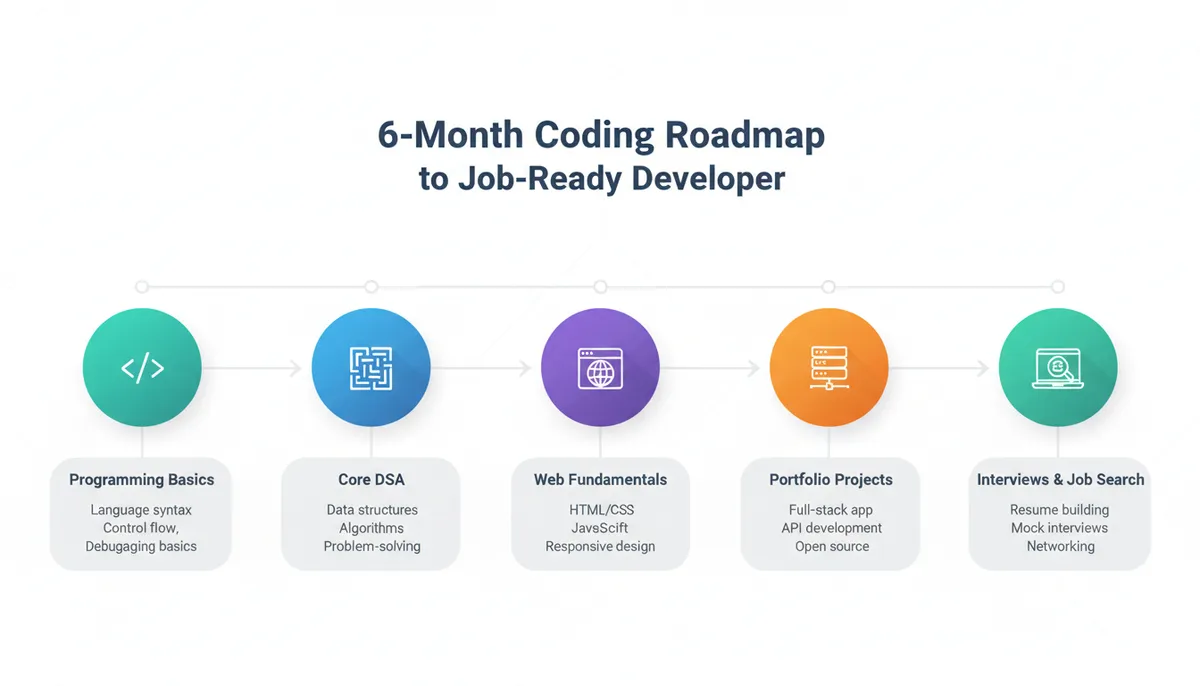
Overview: The 6-Month Coding Roadmap at a Glance
Here’s the high-level 6 month coding roadmap:
- Month 1: Foundations of Programming
- Month 2: Core DSA + Problem Solving
- Month 3: Web Fundamentals + Practical Projects
- Month 4: Deeper DSA + System Thinking
- Month 5: Build & Polish Portfolio Projects
- Month 6: Interview Preparation & Job Search Execution
Think of it as three parallel tracks that gradually intertwine:
- Programming fundamentals (syntax, control flow, debugging)
- Data structures & algorithms (DSA patterns, complexity)
- Practical development (web apps, projects, Git, deployment)
You don’t need to master everything before applying. You need enough depth in a coherent stack, plus evidence (projects, GitHub) and interview readiness.
Month 1: Learn One Language Really Well
1.1 Choose a Primary Language
For this 6 month coding roadmap, pick one general-purpose language that is:
- Widely used in industry
- Interview-friendly
- Beginner-friendly
Good options:
- Python – great for beginners, strong in scripting, data, backend
- JavaScript/TypeScript – essential for web, full-stack roles
- Java – common in large companies, strong typing, widely used in interviews
If you’re undecided, Python is a strong default.
1.2 Core Concepts to Master in Month 1
Your goal this month is to become comfortable writing and reading basic programs. Focus on:
-
Syntax & types
- Variables, primitive types (int, float, string, bool)
- Expressions and operators
-
Control flow
if/elseforandwhileloopsbreak,continue
-
Functions
- Parameters, return values
- Local vs global scope
- Basic recursion (factorial, Fibonacci)
-
Data structures (language-level)
- Arrays/lists, dictionaries/maps, sets, tuples
- Indexing, iteration, basic operations (insert, delete, search)
-
Basic I/O and error handling
- Reading input, printing output
- Try/catch (or equivalent) for simple error handling
-
Tooling
- Using a code editor/IDE (VS Code, IntelliJ, etc.)
- Running code from terminal
- Basic debugging (breakpoints, stepping through code)
Example: Simple Problem in Python
PYTHON
- Time complexity: O(n)
- Space complexity: O(1) additional space
1.3 Daily/Weekly Structure for Month 1
-
Weekdays (2 hours/day)
- 60–90 minutes: follow a structured course on your chosen language
- 30–60 minutes: solve 2–3 basic problems (loops, conditionals, arrays)
-
Weekends (3–4 hours/day)
- Build tiny scripts (e.g., number guessing game, simple calculator)
- Review and rewrite code from memory
1.4 Milestones by End of Month 1
You can:
- Write small programs (100–200 lines) without constantly looking up syntax
- Use loops, conditionals, and functions comfortably
- Solve basic algorithmic problems (sum of array, max/min, simple string parsing)
- Debug simple issues (off-by-one, wrong condition, etc.)
Month 2: Core DSA and Problem Solving
You can’t become a job ready developer without being able to reason about performance and solve algorithmic problems. Month 2 is where you start structured data structures and algorithms (DSA).
2.1 Focus Topics for Month 2
-
Big-O notation
- Time vs space complexity
- Common complexities: O(1), O(log n), O(n), O(n log n), O(n²)
-
Arrays and strings
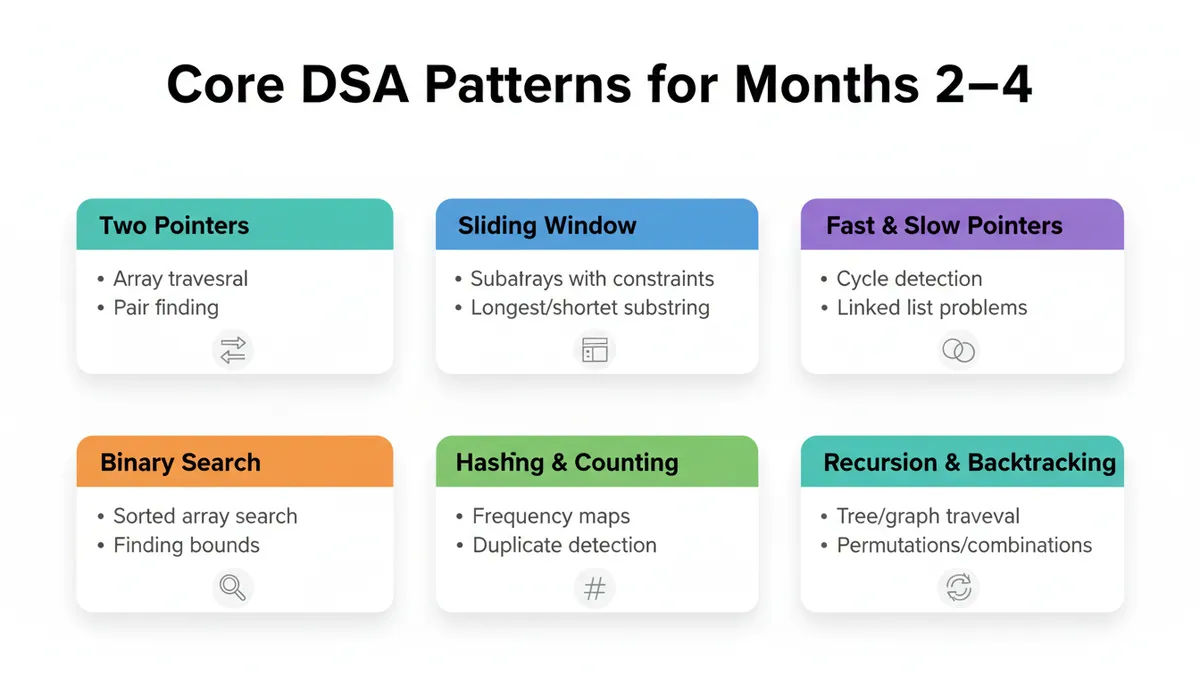
- Two-pointer patterns
- Sliding window
- Prefix sums
-
Hash-based structures
- Hash maps/dictionaries
- Hash sets
- Frequency counting, lookups
-
Basic recursion and backtracking
- Factorial, Fibonacci (with and without memoization)
- Simple subset generation
-
Sorting and searching
- Built-in sort vs implementing simple sorts (e.g., insertion sort)
- Binary search and variations
This is where pattern-based learning shines. Instead of memorizing solutions, learn patterns like “two pointers”, “fast-slow pointers”, “sliding window”, etc., and apply them to multiple problems. Thita’s DSA for Beginners: What to Study First and in What Order can serve as a roadmap here.
2.2 Example: Sliding Window Pattern
Problem: Find the length of the longest substring without repeating characters.
Python implementation:
PYTHON
- Time: O(n)
- Space: O(min(n, k)) where k is alphabet size
2.3 Weekly Plan for Month 2
-
3–4 days/week (2 hours/day):
- Learn 1–2 new patterns or data structures
- Watch/read explanations, then implement from scratch
-
3–4 days/week (2 hours/day):
- Solve 3–5 problems per session targeting that pattern
- Always:
- Write brute-force version first
- Analyze complexity
- Optimize using pattern
You’re building the habit of thinking in patterns, not memorizing questions.
2.4 Milestones by End of Month 2
You can:
- Explain time/space complexity of simple functions
- Implement and use arrays, lists, maps, sets in your language
- Recognize when to use:
- Two pointers (sorted arrays, opposite ends)
- Sliding window (subarrays/substrings with constraints)
- Hash map (frequency counting, lookups)
- Solve easy and some medium DSA problems in 20–30 minutes
Month 3: Web Fundamentals and First Real Projects
You now have basic programming and DSA foundations. Month 3 adds real-world development so you can start building things employers care about.
3.1 Choose Your Stack
For a job-ready developer in 6 months, full-stack web is the most accessible path:
- Frontend: HTML, CSS, JavaScript (or TypeScript)
- Backend:
- If you started with JS: Node.js + Express
- If you started with Python: Flask or FastAPI
- If you started with Java: Spring Boot (steeper learning curve)
You don’t need to master a big frontend framework (React, Vue) this month, but you should understand:
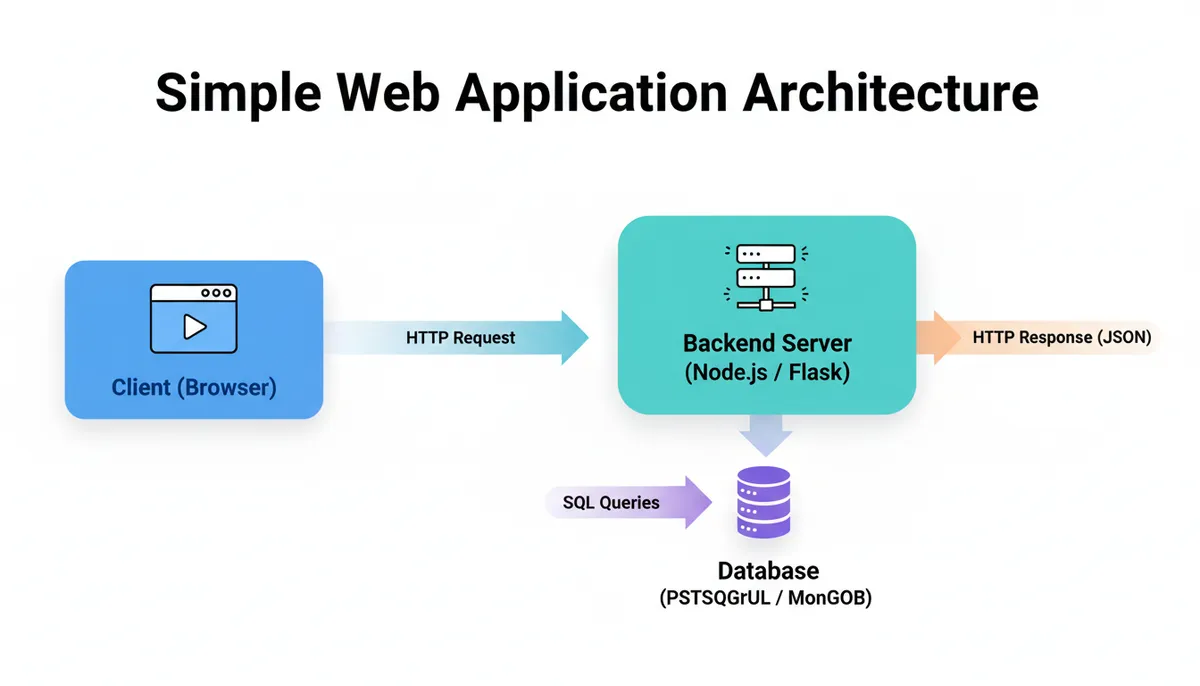
- How the web works (HTTP, requests/responses, status codes)
- RESTful APIs basics
- JSON as data format
3.2 Core Web Concepts for Month 3
-
Frontend basics
- HTML structure (tags, forms, semantic elements)
- CSS layout (flexbox, basic responsive design)
- DOM manipulation with JavaScript
-
Backend basics
- Setting up a simple HTTP server
- Routing (GET, POST, PUT, DELETE)
- Handling JSON request/response
- Basic input validation
-
Persistence
- Simple database usage (SQLite, PostgreSQL, or MongoDB)
- CRUD operations (Create, Read, Update, Delete)
-
Tooling
- Git and GitHub basics (commit, branch, merge, pull request)
- Using Postman or curl to test APIs
3.3 Your First Real Project
Build a small but complete application. Examples:
- Task manager (to-do list with user accounts)
- Habit tracker
- Simple blog with comments
Features to include:
- User registration/login (even if simplified)
- CRUD operations on at least one main resource
- Basic validation (e.g., required fields, min/max lengths)
- Persistent storage (database, not just in-memory)
Focus on:
- Clean separation of concerns (routes/controllers vs business logic vs database access)
- Simple, readable code over cleverness
- Clear API design
3.4 Balancing DSA and Web Dev
Don’t drop algorithms. In Month 3:
- ~60% time: Web fundamentals + project
- ~40% time: Continue solving 3–5 DSA problems on 3 days/week
This keeps your interview prep moving while you build demonstrable skills.
3.5 Milestones by End of Month 3
You can:
- Explain how a web request flows from browser to server to database and back
- Build and deploy (e.g., to Render, Railway, or similar) a small full-stack app
- Use Git confidently for your own projects
- Continue solving easy/medium DSA problems regularly
Month 4: Deeper DSA and System Thinking
You’re now writing real code. Month 4 deepens your algorithmic skills and introduces systems concepts that show up in interviews and real work.
4.1 Advanced DSA Topics for Month 4
-
Linked lists
- Singly vs doubly linked
- Reversal, cycle detection (fast/slow pointers)
-
Stacks and queues
- Using arrays/lists vs linked lists
- Typical problems (valid parentheses, sliding window maximum)
-
Trees
- Binary trees, binary search trees
- Tree traversals (preorder, inorder, postorder, level-order)
- Basic recursion on trees
-
Graphs (intro level)
- Representation (adjacency list)
- BFS and DFS
- Simple pathfinding or connectivity problems
-
Dynamic programming (DP) basics
- Top-down with memoization
- Bottom-up tabulation
- Classic problems: Fibonacci, coin change, knapsack variants (simplified)
This is where a structured pattern library (like Thita’s 94 patterns) is valuable: instead of ad-hoc exposure, you systematically cover tree traversal, graph traversal, DP on sequences, etc. See Master Graph Traversal Patterns (DFS & BFS): 11 templates for Coding Interviews for a deep dive into graph traversal patterns.
4.2 Example: BFS on a Graph
PYTHON
- Time: O(V + E)
- Space: O(V)
4.3 Systems & Architecture Concepts
You don’t need to design Google’s infrastructure, but understanding these will help:
-
HTTP and REST deeper
- Idempotent methods (GET, PUT, DELETE)
- Status codes (2xx, 4xx, 5xx)
-
State and sessions
- Cookies, JWTs (at a conceptual level)
-
Basic concurrency concepts
- What is a thread? What is async I/O?
- Why race conditions happen (conceptual)
-
Logging and monitoring (basic)
- Logging levels (info, warn, error)
- Reading logs to debug
These concepts make you more effective on real teams and help in behavioral/“system design lite” interviews for junior roles.
4.4 Milestones by End of Month 4
You can:
- Implement and traverse basic tree and graph structures
- Solve a subset of graph and DP problems with guidance
- Explain how your project handles requests, state, and errors
- Read and reason about code you didn’t write (open-source snippets, tutorials)
Month 5: Build and Polish Portfolio Projects
By now you have enough skills to build things that look like real products. Month 5 is about depth over breadth: 1–2 solid projects instead of 10 toy apps.
5.1 What Makes a “Job-Ready” Project?
Aim for:
-
Real user workflows
- Authentication (login, registration, password reset)
- Role-based behavior (e.g., admin vs regular user)
-
Non-trivial data model
- At least 3–4 related entities (e.g., Users, Projects, Tasks, Comments)
-
Clean API & modular design
- Separate layers (routes/controllers, services, data access)
- Error handling and input validation
-
Deployed and documented
- Live demo URL
- README with:
- Overview
- Tech stack
- Architecture diagram
- Setup instructions
- Screenshots or GIFs
Example project ideas:
- Project management tool (Kanban-style boards)
- Budget tracking app with analytics
- Learning tracker with spaced repetition logic
5.2 Example: Basic Architecture for a Portfolio App
-
Frontend:
- SPA (single-page application) using React or vanilla JS
- Routing between pages (dashboard, profile, etc.)
-
Backend:
- REST API with authentication
- CRUD endpoints for main entities
- Input validation and error responses
-
Database:
- Relational (PostgreSQL/MySQL) or NoSQL (MongoDB)
- Proper indexing on frequently queried fields
-
DevOps basics:
- Environment variables for secrets
- Separate dev and production configurations
- Simple CI (run tests on push) if possible
5.3 Improving Code Quality
This month, start thinking like a professional developer:
-
Testing
- Unit tests for core logic
- Integration tests for key endpoints
-
Refactoring
- Extracting reusable functions/components
- Reducing duplication
-
Code style
- Linting (ESLint, flake8, etc.)
- Consistent formatting (Prettier, Black)
-
Documentation
- Docstrings/comments where needed
- High-level architecture notes
5.4 Continued DSA Practice
At this stage:
- Focus on medium difficulty problems in common patterns
- Simulate timed sessions (45–60 minutes, 2–3 problems)
- Start mixing in problems similar to those asked by companies you target, using resources like Most Important DSA Topics for Coding Interviews (Ranked by Frequency) to prioritize topics.
5.5 Milestones by End of Month 5
You have:
- 1–2 deployed, polished projects with:
- Auth
- Database
- Non-trivial logic
- A GitHub profile with:
- Regular commits
- Clear READMEs
- Some unit tests
- The ability to walk through your code and design decisions verbally
Month 6: Interview Preparation and Job Search Execution
You now have skills and portfolio; Month 6 is about packaging and presenting them, and closing gaps exposed by mock interviews.
6.1 DSA and Coding Interview Prep
-
Daily coding practice (1–2 hours):
- Mix of easy/medium problems across core patterns
- Time-bound: solve each in 20–30 minutes
- After solving:
- Analyze complexity
- Reflect: which pattern did this use?
-
Mock interviews (2–3 per week):
- Simulate 45–60 minute sessions
- Practice thinking aloud, clarifying requirements, and testing your code
- Use AI-based mock interviews (e.g., Thita’s AI Interview Practice: Free Mock Interview Simulator with Real-Time Feedback for Technical Interviews) or peers
Focus topics:
- Arrays, strings, hash maps, two pointers, sliding window
- Trees and graphs (traversals, BFS/DFS)
- Basic DP on sequences (e.g., max subarray, climbing stairs variants)
6.2 System Design Lite for Juniors
Some companies ask simplified system design questions even for junior roles. Prepare to discuss:
- How you’d design a simplified version of:
- URL shortener
- Chat application
- News feed
Focus on:
- Clear APIs
- Data modeling
- Basic scalability ideas (caching, horizontal vs vertical scaling) at a high level
6.3 Resume, Profile, and Applications
-
Resume
- One page, focused on:
- Projects (with tech stack and measurable impact)
- Relevant coursework or certifications
- Skills (languages, frameworks, tools)
- Use bullet points that start with strong verbs and quantify where possible
- One page, focused on:
-
Online presence
- GitHub: pin your best projects
- LinkedIn: complete profile, clear headline (e.g., “Junior Full-Stack Developer | Python & React”)
- Portfolio site (optional but nice): simple page linking to projects and GitHub
-
Application strategy
- Aim for 10–20 targeted applications per week
- Tailor resume slightly for each role (highlight matching skills)
- Keep a simple spreadsheet of applications, status, and follow-ups
6.4 Behavioral Interview Prep
Technical skills aren’t enough. Prepare for:
-
Common behavioral questions:
- “Tell me about yourself.”
- “Describe a challenging bug you fixed.”
- “Tell me about a time you learned something quickly.”
-
Use the STAR method (Situation, Task, Action, Result) to structure answers.
-
Draw stories from:
- Your projects
- Past non-tech jobs or school experiences
- Open-source contributions (if any)
6.5 Milestones by End of Month 6
You:
- Can solve common interview-style problems under time pressure
- Can explain your projects and tradeoffs clearly
- Have a resume, GitHub, and (optionally) portfolio site that tell a coherent story
- Are actively interviewing or in application pipelines
Common Mistakes That Derail a 6-Month Plan
1. Trying to Learn Too Many Languages/Frameworks
Spreading yourself across Python, JavaScript, Java, and Go in six months leads to shallow knowledge. For this 6 month coding roadmap:
- Pick one main language and one primary stack
- Learn adjacent tools only when needed for your projects
2. Only Doing Tutorials, No Projects
Tutorials feel productive but don’t create integration skills. Mitigate by:
- Converting every tutorial into a small variant project
- Building at least one end-to-end app by Month 3
3. Ignoring DSA Until the End
Cramming algorithms in Month 6 rarely works. Instead:
- Start DSA in Month 2
- Maintain consistent, low-friction practice throughout
4. Over-focusing on LeetCode Grinds
Solving 500 problems is unnecessary for most entry-level roles. Focus on:
- Patterns, not counts
- Understanding why solutions work
- Being able to derive them under pressure
5. Not Practicing Communication
Many candidates can code but struggle to:
- Clarify requirements
- Explain tradeoffs
- Walk through their thought process
Mock interviews and talking through your solutions out loud are critical. An AI coach like Thita’s How to Use AI Tools Like ChatGPT for Interview Preparation (Without Becoming Dependent) can help you get used to articulating reasoning clearly.
Best Practices to Make This Software Engineer Study Plan Work
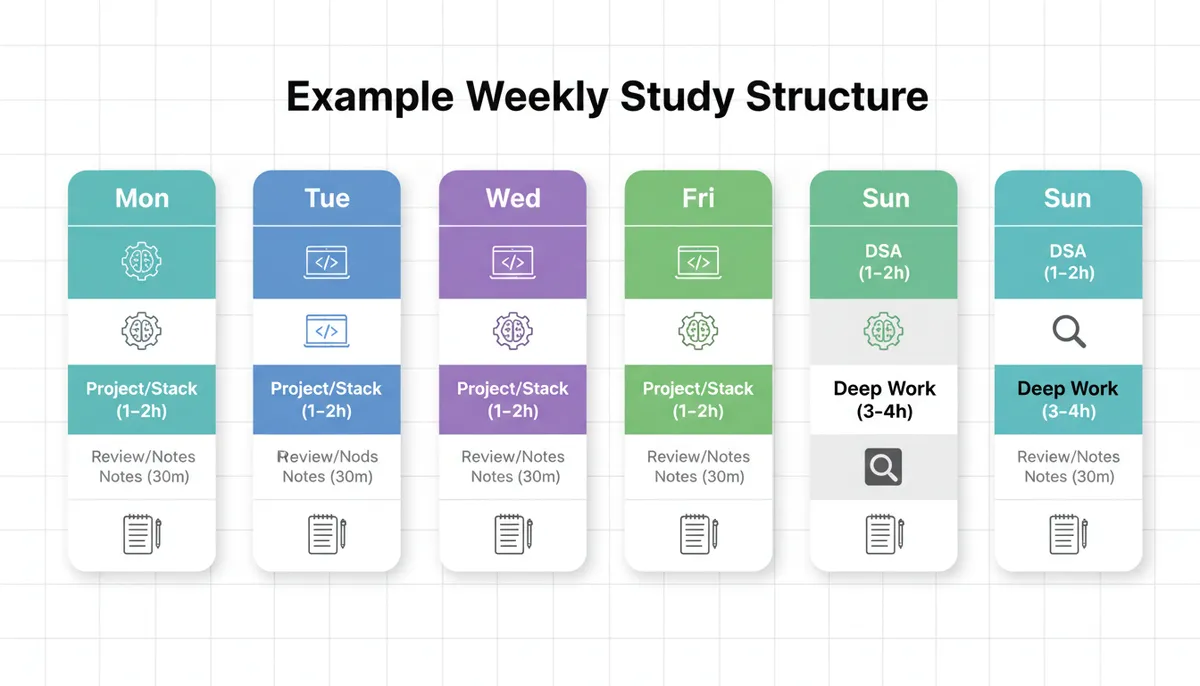
1. Timeboxing and Routine
- Set fixed daily blocks (e.g., 7–9pm weekdays, 3–6pm weekends)
- Use a timer (Pomodoro: 25 minutes focus, 5 minutes break)
- Treat it like a part-time job
2. Feedback Loops
- Weekly review:
- What did I learn?
- What did I build?
- Which problems still confuse me?
- Adjust next week’s focus accordingly
3. Depth Over Breadth
- It’s better to:
- Know one stack (e.g., Python + FastAPI + PostgreSQL) well
- Have 2 strong projects
- Than:
- Skim 5 frameworks
- Have 10 half-finished repos
4. Learning by Rebuilding
- Rebuild small features from memory:
- Auth flow
- CRUD endpoints
- A common DSA solution
- This cements understanding more than passive review
How to Adapt This Roadmap to Your Situation
-
If you can only do 10 hours/week:
- Extend the plan to 9–12 months
- Keep the sequence, just slow the pace
-
If you already know some programming:
- Compress Month 1 into 1–2 weeks
- Spend more time on DSA and projects
-
If you’re switching careers:
- Leverage your past experience in your story (domain knowledge, communication, leadership)
- Build at least one project related to your previous field (e.g., logistics dashboard if you worked in operations)
Key Takeaways
- A realistic 6 month coding roadmap focuses on one main language, core DSA patterns, and real projects.
- Start with programming fundamentals (Month 1), then layer in DSA (Month 2) and web development (Month 3).
- Deepen algorithms and systems understanding (Month 4), build serious portfolio projects (Month 5), and then focus on interviews and applications (Month 6).
- Avoid spreading yourself too thin across languages and frameworks; prioritize depth and consistency.
- Regular problem solving, feedback (mock interviews), and project work are what turn you from “tutorial-complete” to job ready developer.
If you follow this software engineer study plan with disciplined weekly execution, you won’t know everything in six months—but you’ll know enough, and you’ll be able to demonstrate it in code, in projects, and in interviews. That’s what hiring managers are actually looking for.