
Interview
Gojek Interview Questions and Process: The Complete Guide (2026)
Prepare for Gojek interview questions with a practical guide to the process, low-level design practice, preparation priorities and a focused 30-day plan.
Gojek interview questions are best prepared for as a combination of live coding, design judgement and clear explanation of your technical decisions. The research available for this guide does not establish a fixed, source-backed sequence of Gojek interview rounds or a standard timeline, so confirm the format with your recruiter. What you can prepare immediately is the work that transfers across technical loops: solve coding problems aloud, build small designs that actually run, and defend trade-offs without overcomplicating them.
For design-focused practice, Gojek's interview kit holds four low-level design problems evidenced at Gojek. Use them to rehearse the part of an interview where implementation choices, object boundaries and extensibility matter as much as getting to an answer.
The process at a glance
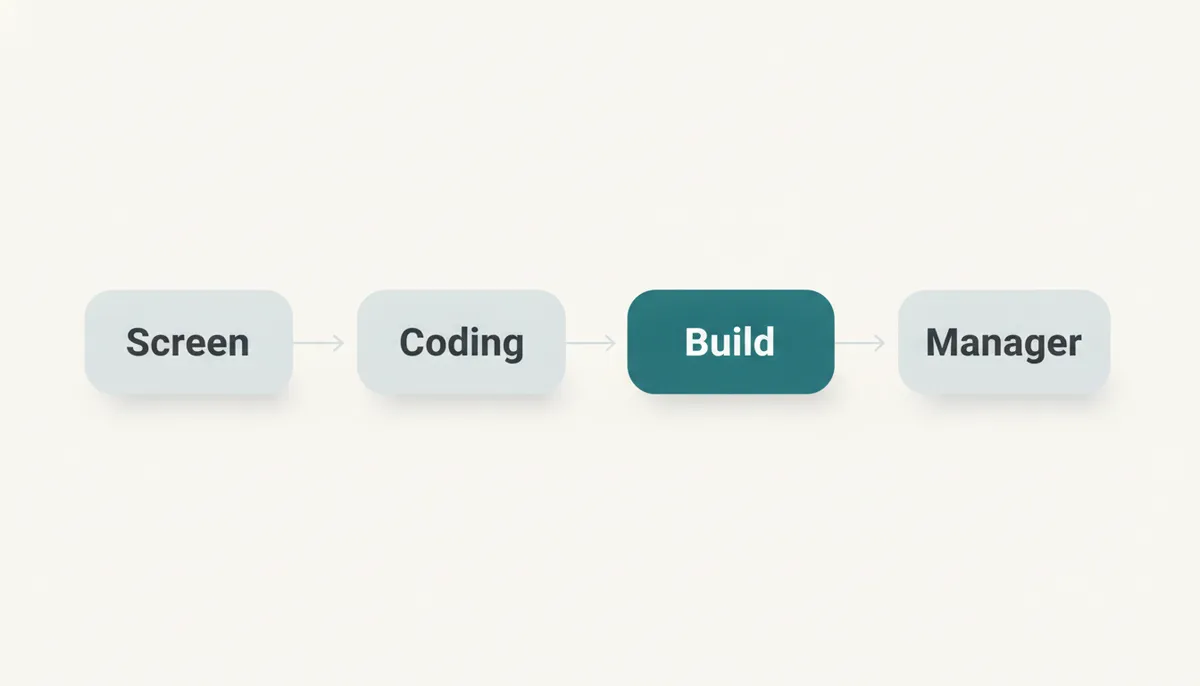
Because reported accounts do not provide a stable, detailed Gojek round-by-round consensus, treat this as a preparation checklist to validate with your recruiter rather than a promised interview sequence.
| Interview area | Likely format to clarify | What it screens for | Best preparation |
|---|---|---|---|
| Initial screen | Recruiter or engineering conversation | Role fit, communication, experience | Prepare a concise project narrative |
| Coding assessment | Timed or live problem solving | Fundamentals, correctness, complexity | Practise pattern recognition under time pressure |
| Technical coding | Collaborative coding with discussion | Reasoning, implementation, edge cases | Think aloud before and while coding |
| Low-level design | Discussion or implementation exercise | Modelling, abstraction, maintainability | Build a working design and explain trade-offs |
| Manager or team discussion | Project and collaboration conversation | Ownership, judgement, level fit | Prepare detailed examples from your work |
The shape may differ by role, seniority, location and team. A good recruiter question is simple: “Which areas will the technical interviews assess, and should I expect a coding, low-level design or system design exercise?” It is specific enough to get a useful answer without asking the recruiter to disclose questions.
Coding interviews — what they screen for
A coding interview is rarely a test of whether you have memorised a clever trick. It is a test of whether you can turn an unclear problem into a correct, maintainable solution while another engineer watches your process.
Start by restating the problem in your own words. Ask about input limits, invalid cases, duplicates and what should happen at the boundaries. Then describe a straightforward approach before reaching for an optimised one. This makes your reasoning visible and gives the interviewer a chance to redirect you early.
When you begin coding, use names that explain intent. Keep the main flow readable. Test examples aloud rather than announcing that the solution “should work”. If you change direction, explain why: perhaps a hash map removes repeated scanning, or a two-pointer approach avoids extra memory. That explanation is part of the assessment.
The DSA Patterns Sheet is free to browse and groups practice by reusable problem shape. For a deeper method, read how to identify the right DSA pattern in a coding interview. The goal is not to label every problem perfectly. It is to develop the habit of comparing a new prompt with familiar structures before you write code.
A reliable live-coding routine looks like this:
- clarify the constraints and expected output;
- state a simple baseline approach;
- explain the better approach and its complexity;
- code in small, testable pieces;
- walk through normal and awkward cases;
- summarise trade-offs at the end.
That rhythm is useful regardless of language. Choose the language in which you can write cleanly without stopping to remember syntax. An interview is not the moment to switch languages or introduce an unfamiliar framework.
For more on the communication side, what interviewers actually look for in live coding rounds is worth reading before your first mock.
Low-level design — what it screens for
Low-level design asks a different question from a coding puzzle: can you model a small system so that it works today and remains understandable when requirements change?
The kind of design problem evidenced at Gojek is useful practice for this skill because it forces you to make ordinary engineering choices under interview conditions. You need to identify the core objects, decide which object owns each behaviour, keep responsibilities narrow, and avoid building a framework for a requirement that does not exist.
Begin with a minimal version of the system. Write down the essential user actions and the state required to support them. From there, define the objects that hold that state and the methods that express those actions. Only introduce interfaces when behaviour may genuinely vary. A design with fewer moving parts is usually easier to explain, test and extend.
Interviewers commonly look for several signals:
Clear modelling. Your classes, functions or modules should reflect the domain rather than merely split code into arbitrary files.
Sensible ownership. A method should live where the data and responsibility naturally belong. Passing everything through one central manager often creates an object that knows too much.
Extensibility with restraint. You should be able to explain how the design would handle a likely change, but you should not pre-build every possible variation.
Working behaviour. If the format involves coding, a small end-to-end flow is more valuable than a large unfinished hierarchy.
Trade-off awareness. There is no single perfect design. Explain why you chose in-memory state, a simple data structure or a direct relationship first, and what would make you revisit that decision.
The Low Level Design Sheet is free to browse and gives you a structured way to practise these decisions. If you are unsure where low-level design ends and architecture-level discussion begins, low-level design vs high-level design explains the distinction.
System design and technical depth — what to clarify
Do not assume that every Gojek engineering interview uses the same design format. The supplied research does not establish whether a separate high-level system design stage is standard, role-specific or absent. Ask your recruiter directly, especially if you are interviewing for an experienced role.
If system design is part of your loop, prepare to move from requirements to a coherent architecture. Clarify scale, consistency needs, latency expectations and failure handling before drawing components. Then explain the request path, data storage, bottlenecks and the trade-offs behind your choices.
The System Design Sheet is free to browse if you need to refresh core concepts. A useful practice habit is to take a familiar product feature and explain it at two levels: first as a simple version that works, then as a version that handles more traffic, failures or competing writes. This prevents the common mistake of opening with a complicated architecture before you have established the actual requirements.
Technical depth can also appear through questions about your past work. Be ready to discuss decisions you made, incidents you helped resolve, performance constraints you encountered and what you would change with hindsight. Specificity matters. “We improved the service” is weak; “I changed the retry behaviour because duplicate requests were causing a particular failure mode” gives an interviewer something real to evaluate.
Manager and project discussion — what it screens for
A manager or team conversation often checks whether your technical claims match your actual experience. It can also assess collaboration, ownership and professional judgement.
Prepare several stories from projects you know deeply. For each one, be able to explain the context, your responsibility, the difficult decision, the outcome and what you learned. Use “I” accurately. Teamwork matters, but interviewers still need to understand your contribution.
Good examples include a disagreement you resolved with evidence, a project whose scope changed unexpectedly, a production problem you investigated, or a decision that did not work as intended. The strongest stories are not flawless success stories. They show that you can notice uncertainty, communicate clearly and improve the next decision.
Practise saying these stories aloud. An AI interview can help you rehearse technical and behavioural answers when you do not have a partner. Keep answers structured, but do not turn them into a speech. A follow-up question should reveal more detail, not expose a memorised script.
Named rituals to ask about
The research supplied for this guide does not identify a named Gojek interview ritual comparable to a formal cross-functional evaluation, a company-wide committee review or a distinctive practical exercise. That does not mean a team cannot use its own internal format; it means candidates should not treat an internet checklist as a fixed policy.
Ask your recruiter whether there are take-home tasks, pair-programming expectations, presentation requirements, architecture discussions or team-specific preparation materials. This is preparation, not an attempt to obtain protected interview content. It lets you choose the right practice format: timed coding, a whiteboard-style design discussion, a runnable exercise or a project deep-dive.
Is the Gojek interview hard?
It can be hard because technical interviews measure several skills at once: problem solving, code quality, communication, design judgement and the ability to stay composed while being observed. Difficulty is also relative to the role you are pursuing and the preparation you have already done.
How many rounds are there? The available research does not support a reliable standard count for Gojek. Confirm the stages for your role with the recruiter.
How long does it take? The available research does not establish a dependable end-to-end timeline. Hiring pace can vary by team, interview availability and the role’s urgency.
The practical takeaway is to prepare in layers instead of betting everything on one format. Build coding fluency first, then practise designing small systems, then rehearse explaining your work. Candidates often prepare the first layer and leave the other two to chance.
A 30-day preparation plan
Days 1–7 — rebuild coding fluency
Choose the language you will use in interviews and practise daily. Focus on arrays, strings, hash maps, recursion, trees, graphs and binary search. Do not race through random questions. After each solution, write down the clue that should have led you to the pattern sooner.
Use in-browser code practice for short sessions with feedback. Read how to explain your thought process clearly in coding interviews and start narrating your approach from the first day.
Days 8–14 — learn to design small systems
Practise modelling requirements before coding. For each exercise, identify entities, actions, state, validation and likely changes. Implement a modest first version. Then add one requirement and revise the design rather than restarting it.
The important habit is deliberate restraint. Ask, “What is the smallest design that meets the stated need?” before asking, “Which pattern can I use?”
Days 15–21 — rehearse the Gojek design focus
Work through Gojek's interview kit as a set of discussion and implementation rehearsals. First attempt each problem without looking at the editorial. Afterwards, compare your object boundaries, naming, tests and extension points with the proposed solution.
Say your reasoning aloud as you work. Explain assumptions, describe what you would defer, and identify the first change that would require a different abstraction. This builds the communication muscle that passive reading cannot.
Days 22–30 — simulate the real conversation
Alternate coding and design sessions. For coding, use a timer and finish with edge-case testing. For design, begin from an unclear prompt, ask questions, sketch the model and implement the central flow where appropriate.
Spend the final days on project stories and mock interviews. Prepare an opening summary for each project, then practise answering increasingly detailed follow-ups. Your aim is not to sound rehearsed. It is to make your thinking easy to inspect.
What is specific about Gojek preparation?
The most concrete company-specific preparation asset here is the design set evidenced at Gojek. Rather than treating low-level design as an abstract theory topic, use those problems to practise a repeatable interview routine: clarify the core flow, model only what you need, make the central path work, test it, and explain the next change your design can absorb.
That routine matters because it joins implementation with judgement. A candidate can know design-pattern terminology and still struggle to decide whether an interface is useful. Equally, a candidate can write working code and still lose credit if they cannot explain why responsibility belongs in one place rather than another.
Use the four problems as prompts for comparison. Solve one plainly, then revisit it with an added requirement. Notice what changes and what does not. That is closer to real engineering than decorating an initial solution with patterns.
Frequently asked questions
What should I study for Gojek interview questions?
Prepare coding fundamentals, live problem-solving communication, low-level design and detailed discussion of your past projects. Confirm the exact format with your recruiter.
Does Gojek ask low-level design questions?
Gojek's interview kit contains four low-level design problems evidenced at Gojek. Treat them as focused practice for modelling, extensibility and implementation judgement.
How many interview rounds does Gojek have?
The research available for this guide does not support a fixed, reliable count. Ask your recruiter for the current role-specific process.
How long does the Gojek interview process take?
A dependable timeline is not established in the available research. Confirm expected scheduling and next steps with the recruiter.
Should I prepare DSA for a Gojek interview?
Yes. Coding fundamentals remain valuable preparation for technical interviews, particularly problem clarification, complexity reasoning and edge-case handling.
How should I practise low-level design?
Start with a small working design, then add requirements gradually. Explain ownership, trade-offs and the reason for every abstraction you introduce.
What language should I use in a coding interview?
Use the language in which you can write correct, readable code and explain your choices confidently. Fluency matters more than novelty.
How do I prepare for project questions?
Choose projects you know deeply and prepare concrete examples of your role, decisions, constraints, outcomes and lessons learned.
Is an AI mock interview useful for preparation?
Yes. It is particularly useful for practising spoken reasoning, technical follow-ups and behavioural stories under pressure.
Where to start
Start with the technical habits that make your work visible: clarify before coding, explain trade-offs before committing to a design, and test the central path before polishing the edges.
Open Gojek's interview kit to practise the four low-level design problems evidenced at Gojek. Combine that work with the free-to-browse DSA Patterns Sheet, timed coding practice and an AI mock interview for explanation rehearsal.
Interview formats can change by team and role. Use this guide as your preparation foundation, then confirm the current Gojek process directly with your recruiter.
Topics
Related on Thita
Your next step
Practise with AI mock interviews
A spoken interview that asks follow-up questions, runs your code and ends with a written report.