
Interview
Google Coding Interview Questions: Patterns and Prep Guide (2026)
Prepare for Google coding interview questions with pattern families, round expectations, recognition drills, and a practical plan for technical rounds.
Google coding interview questions reward a particular kind of preparation: fast pattern recognition followed by careful, explainable execution. The coding rounds are not simply a test of whether you have seen a clever trick before. They test whether you can turn an ambiguous prompt into a precise model, identify the useful constraint, select an approach that fits it, and defend the complexity while writing reliable code.
That is why practising by pattern family is more useful than memorising a long question list. Google’s interview kit holds 188 mapped DSA questions, eleven low-level design problems and eight system design problems. The collection gives you a way to rehearse the technical shapes that matter while still learning how to recognise them under live-round pressure.
Reported accounts describe Google as DSA-heavy, especially for early-career engineering roles. But the loop is broader than coding alone: system design becomes relevant from L4 upwards, Googleyness is assessed in a dedicated discussion and across the loop, and a Hiring Committee reviews the final packet independently of the interviewers’ recommendation.
The practical takeaway is simple: build recognition speed first, then practise communicating your reasoning before the code is complete.
The pattern families that matter most
Google-style coding prompts often look broad at the beginning. The strongest candidates do not rush to name an algorithm. They first identify the structure hidden in the input, constraints and required output.
The following pattern families are the most useful way to organise preparation.
Arrays, strings and hash-based lookup
Many interview prompts begin with sequences, text, frequencies or relationships between values. The deciding observation is often whether fast membership checks, counting or prefix information removes a nested loop.
Hash maps and sets are not impressive because they are advanced; they are effective because they let you state and maintain an invariant. Ask yourself what information must be available immediately while you scan the input. It may be a count, a last-seen position, a complement, a running state or a mapping between related items.
The common failure here is coding before stating what the map represents. Name it explicitly: “This map tracks the most recent index of each value,” or “This set records states already visited.” That sentence makes both your approach and your edge-case reasoning easier to follow.
Two pointers and sliding windows
When the prompt involves a contiguous range, a pair of positions, a sorted sequence or a condition that expands and contracts, think about pointers before reaching for recursion or brute force.
Two pointers are usually driven by an ordering property: if moving one pointer changes the result predictably, you can narrow the search space. Sliding windows are driven by a validity condition: maintain a window while it is valid, then shrink it when the condition breaks.
Recognition speed means noticing words such as “subarray”, “substring”, “contiguous”, “at most”, “minimum length” or “longest range” and immediately testing whether a moving window can preserve the required state.
For a more detailed way to build this instinct, read how to identify the right DSA pattern in a coding interview.
Trees, recursion and traversal state
Tree prompts are rarely only about visiting nodes. The real task is usually deciding what information should travel down the recursion and what should return upwards.
A top-down traversal often carries context: depth, bounds, a partial path or an inherited state. A bottom-up traversal usually returns a result that a parent needs in order to combine its children. The distinction matters because it tells you where the logic belongs.
Before coding, say whether your recursive function answers a question about the current node or reports something to its caller. That one decision prevents many tangled implementations.
The same principle applies to graph traversal. A traversal is a framework, not a full solution. What makes the solution correct is the state you mark, the order you explore, and the condition that stops the search. Graph traversal patterns with DFS and BFS is useful when you want to practise choosing between depth-first and breadth-first search rather than treating them as interchangeable tools.
Binary search beyond sorted arrays
Binary search is a recognition problem disguised as an implementation problem. Candidates often remember it only for finding a value in sorted input. In interviews, its wider use is to search an ordered answer space.
If a candidate answer can be tested as feasible or infeasible, and that result changes monotonically as the answer grows, binary search may apply. The key is to define the predicate clearly: what does “works” mean, and why does it remain true or false in one direction?
Do not announce binary search merely because there is a number in the prompt. Establish the monotonic property first. Then decide whether you are searching for the first valid answer, the last valid answer, or any valid answer. This is where off-by-one errors tend to appear.
Our guide to binary search patterns breaks down the variants and the boundary decisions that make them reliable.
Dynamic programming and state design
Dynamic programming can be intimidating because it is often taught as a collection of unrelated formulae. In a live interview, a clearer approach is to define the state in plain English before writing any recurrence.
Ask three questions:
- What smaller decision does the current answer depend on?
- What information from the past must be remembered?
- Can multiple paths reach the same state?
If repeated subproblems exist, memoisation or tabulation may be appropriate. But do not introduce a table until you can explain each dimension. A state definition that cannot be said aloud is unlikely to remain correct in code.
Dynamic programming pattern practice is most helpful after you can already identify overlapping subproblems and want to improve the transition from recurrence to implementation.
Graph modelling, search and constraints
Some of the hardest-looking prompts become manageable once you model them as a graph. The nodes may not be labelled as nodes. They might be accounts, positions, words, dependencies, rooms, services or game states. The edges may represent a move, a transformation, a dependency or a relationship.
Recognition is about translating the domain into that structure early. Then ask whether you need reachability, shortest path, connected components, cycle detection, topological ordering or multi-source exploration.
The important habit is to justify the graph model before choosing BFS, DFS or another method. Interviewers can follow a solution that evolves from a clear model. They struggle to credit a memorised traversal that appears without explanation.
The reported Google round shape
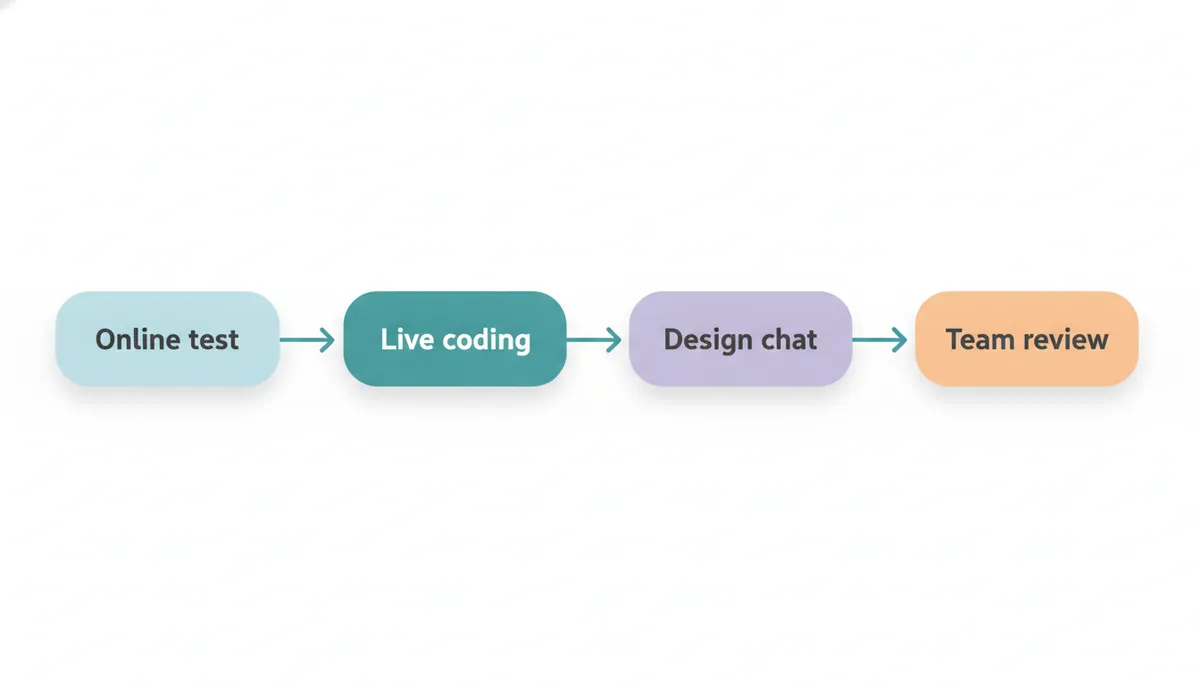
Reported accounts describe a resume screen followed by an online assessment for L3 and new-grad candidates; this assessment is commonly reported as skipped for L4 and above. A technical phone screen may follow, then an onsite loop of back-to-back interviews.
The onsite commonly includes several coding rounds, a system design discussion for experienced candidates, and a Googleyness discussion. The exact sequence varies by role and level, so treat this as a commonly reported shape rather than a fixed script.
The coding rounds are generally around forty-five minutes each. That constraint changes how you should practise. You need an approach that is good enough to implement, test and explain in the time available. An elegant solution that you cannot finish is weaker than a clean, correct approach with well-chosen trade-offs.
System design is reported as required from L4 upwards and consistently present from L5. For that preparation, the System Design Sheet and the Low Level Design Sheet are free to browse. The design material in Google’s interview kit covers the kind of design problem evidenced at Google, while your interview level should determine how deeply you prioritise it.
The final decision is notably separate from the conversation in the room. Reported accounts describe a Hiring Committee made up of senior engineers who did not interview the candidate. They review a recruiter-assembled packet containing interview feedback, the CV and related notes. That is why consistency matters: each interviewer’s evidence contributes to a larger picture of technical ability, leadership and Googleyness.
What recognition speed actually means
Recognition speed does not mean blurting out an answer in the first minute. It means reducing uncertainty quickly and visibly.
A strong opening often follows this sequence:
- Restate the goal and clarify one meaningful ambiguity.
- Identify the constraint that rules out the obvious brute-force route.
- Name the structural pattern you are testing.
- Walk through a small example before writing code.
- State complexity and the edge cases you will check.
That process may take a few minutes, but it saves time because it prevents rewrites. It also gives the interviewer evidence of your judgement before the implementation is complete.
Weak recognition looks different. It begins with silent coding, a vague claim that a solution is “probably linear”, or switching approaches repeatedly without explaining why. Those habits make it hard for an interviewer to distinguish productive exploration from confusion.
Practise narrating the transition from brute force to improvement. For example: “The direct comparison is quadratic. Because I only need the most recent occurrence, I can maintain it in a hash map and scan once.” The exact wording is not important. The causal reasoning is.
For more on making that reasoning visible, see how to explain your thought process clearly in coding interviews.
A practical preparation plan
Start with pattern fluency
Spend the first phase grouping practice by family rather than mixing everything randomly. Work through arrays and hashing, windows, trees, graphs, binary search and dynamic programming until you can identify the core signal before reading every detail.
The DSA Patterns Sheet is free to browse and helps you practise this grouping deliberately. Use it to learn the boundaries between patterns: when a window works but two pointers do not, when DFS is enough but BFS is necessary, or when a greedy choice needs a proof.
Do not measure progress by problems completed. Measure it by whether you can explain why a pattern fits before seeing the editorial.
Add timed live-coding rehearsal
Once the pattern is familiar, introduce time pressure. Use a timer and treat every session as a conversation, not a private coding exercise. Speak your assumptions, narrate your approach and test aloud.
Code practice with feedback is useful for rehearsing implementation, while AI mock interviews let you practise the interaction itself. The sheets are free to browse; the key is using them with a deliberate review loop.
After each session, write down the failure mode:
- Did you miss the pattern?
- Did you choose the pattern but implement it poorly?
- Did edge cases break the code?
- Did you fail to explain a sound approach?
- Did you spend too long deciding?
Those are different problems, and they need different fixes.
Build design confidence at the right level
If you are interviewing at a level where design is likely, separate low-level and system design preparation. Low-level design is about objects, responsibilities, interfaces and how a codebase accommodates change. System design is about components, data flow, reliability, scale and trade-offs.
Do not try to answer every design discussion with a memorised architecture. Start by clarifying requirements, identifying the main entities or services, and explaining what would change under a new constraint. The most useful design answers reveal a method of thinking, not a diagram you have seen before.
For a clear distinction between the two formats, read what low-level and high-level design interviews actually expect.
Rehearse Googleyness and project depth
Technical preparation alone is incomplete. Reported accounts describe Googleyness as a dedicated round and an evaluation that appears throughout the process. Prepare examples that show collaboration, influence, ambiguity management, learning and constructive disagreement.
For every project story, be ready to explain your individual contribution, the trade-off you made, what changed because of your decision, and what you would do differently now. Avoid rehearsed slogans. Specificity is more credible than polish.
Common mistakes in Google coding rounds
Solving the wrong problem efficiently. Candidates sometimes optimise before confirming the interpretation. Clarify the input rules, expected output and edge behaviour first.
Treating the first idea as the final answer. It is fine to begin with brute force. The important part is showing how the constraint motivates the improvement.
Using a pattern without an invariant. A sliding window, recursive traversal or dynamic-programming table is not self-justifying. Explain what remains true after each update.
Ignoring implementation quality. Variable names, clean helper functions and deliberate testing matter. Interview code does not need production-level abstraction, but it should be readable enough to inspect together.
Saving tests for the final minute. Test after the core loop, after boundary logic and after the final return condition. Small checks throughout are cheaper than a late rewrite.
Practising only alone. A Google coding round is a communication exercise as well as a coding exercise. If you never say your reasoning aloud, you are not rehearsing the full task.
Frequently asked questions
Are Google coding interview questions mostly LeetCode-style?
Reported accounts describe coding rounds built around data structures, algorithms, complexity reasoning and clear implementation. Pattern fluency is more valuable than memorising prompts.
What difficulty should I expect?
Candidates commonly report a demanding DSA bar. Focus on medium-to-hard pattern application, especially where the prompt requires modelling, careful edge cases and a strong explanation.
Does Google have an online assessment?
Reported accounts describe an online assessment for L3 and new-grad candidates, while L4 and above commonly skip it. Confirm the process for your role with your recruiter.
How many coding rounds are there?
Reported onsite loops commonly include several coding interviews, with the exact mix varying by level and team. Prepare for repeated live coding rather than a single technical conversation.
Is system design required at Google?
Reported accounts describe system design from L4 upwards, with it consistently present from L5. The expected depth depends on level and role.
What is Googleyness?
Googleyness is commonly reported as a dedicated interview dimension and something assessed across the loop. It concerns how you collaborate, navigate ambiguity, learn and work with others.
Does the Hiring Committee make the final decision?
Reported accounts describe a Hiring Committee reviewing the candidate packet independently of the interviewers. Strong, consistent evidence across rounds therefore matters.
Is Google using AI in coding interviews?
A code-comprehension format was reported as a pilot for L3 and L4 candidates on selected US teams. It reportedly uses Gemini, adds a round, and does not replace the traditional no-AI algorithm round.
How should I practise explaining my solution?
State the brute-force baseline, identify the constraint, name the pattern, describe the invariant and then code. A live coding interview guide can help you turn that structure into a repeatable habit.
Prepare for the technical bar
Google’s interview process rewards candidates who can recognise structure quickly, reason out loud and implement with discipline. Start with pattern families, add timed practice, then rehearse the design and communication parts of the loop as seriously as the code.
Open Google’s interview kit to practise the mapped DSA, low-level design and system design material in one focused collection. Use the free sheets to strengthen individual pattern families, and use an AI mock interview when you are ready to practise explaining your decisions under pressure.
Interview formats can change by level, team and location. Confirm the current structure with your recruiter before your interview.
Topics
Related on Thita
Your next step
Practise with AI mock interviews
A spoken interview that asks follow-up questions, runs your code and ends with a written report.