
Interview
Google Girl Hackathon 2026/27: Dates, Rounds & Results
Google Girl Hackathon 2026/27: registration status, every round (resume screen, DSA challenge, cohorts, grand finale), and a 90-day preparation plan.
The Google Girl Hackathon is one of the cleanest entry routes into Google's India engineering pipeline for women students — and unusually, it's an individual competition. No team to recruit, no teammate whose preparation gap ends your run. Your result is entirely your own.
That's an advantage and a warning at the same time. There's nobody to carry you through the first round, and the first round is a DSA challenge with resume screening attached.
This guide covers eligibility, every round, the patterns Google actually tests, and a 90-day plan to be ready when registration opens.
Start with the gate: the first round is medium-difficulty DSA. The DSA Patterns Sheet and the 90-Day Interview Roadmap are the fastest route through it.
Key Dates & Results (last checked 2026-09-07)
| Stage | Status |
|---|---|
| Eligible graduating batches | 2026–2029 (most recently published edition) |
| Registration window | not announced yet (last checked 2026-09-07) — has historically opened in the winter–spring period |
| Round 1 — resume screening + online DSA challenge | Dates not announced yet (last checked 2026-09-07) |
| Learning cohorts / problem-solving rounds | Dates not announced yet (last checked 2026-09-07) |
| Grand Finale | Dates not announced yet (last checked 2026-09-07) |
Google has not published a fixed 2026/27 schedule anywhere Thita could confirm — watch Google's India careers and student-programme pages and check back here for updates.
What Is the Google Girl Hackathon?
Google Girl Hackathon is Google India's programme for women students in engineering. It runs as a multi-stage competition combining a technical challenge, structured learning cohorts, and a final hackathon — with strong candidates routed toward Google's internship pipeline.
Eligibility
- Women students enrolled at engineering colleges in India
- Indian nationals
- Typically open across four graduating batches at a time (recent editions covered 2026–2029)
- You must be studying in the year of study you declare at registration
- Individual participation — team registrations are not permitted
Registration
Registration happens through a Google form-style application. You'll be asked for:
- Primary email, name, contact details
- College/university, graduation year, course, campus location
- Resume and LinkedIn profile
- A few short screening questions
⚠️ Important: The resume isn't decorative here. The first round combines online challenges with resume screening — meaning a strong coding performance and a weak resume can still end your run. Treat the resume as a graded artefact.
The Rounds
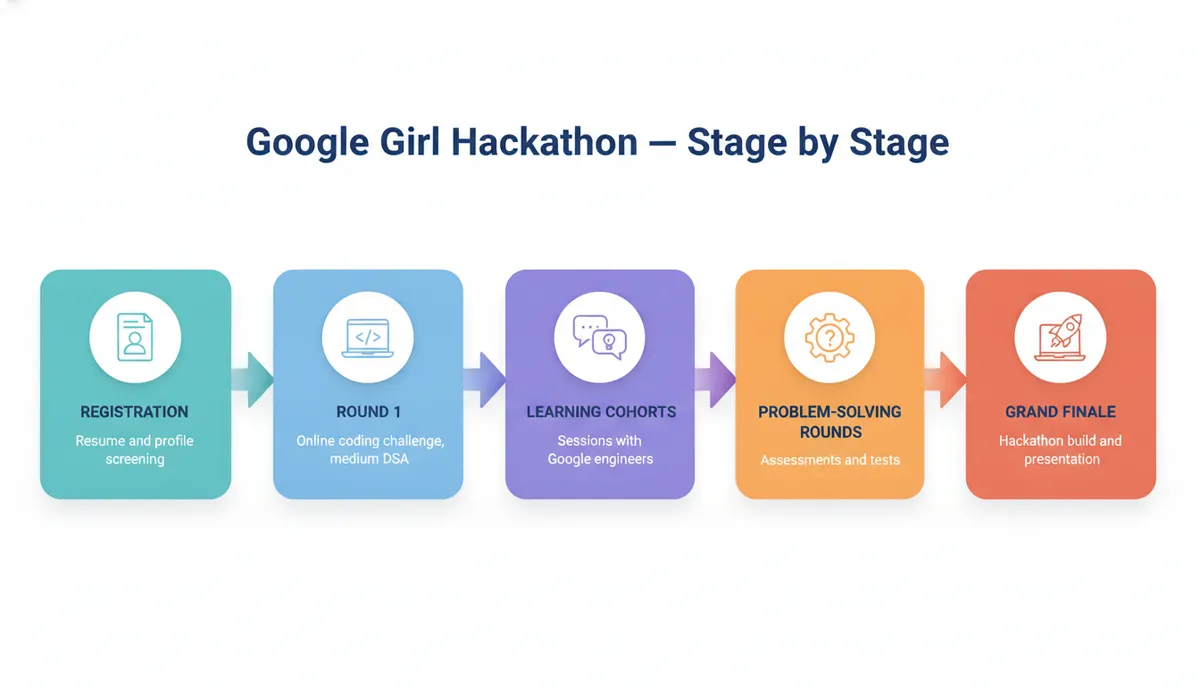
The competition is structured across multiple stages: an online challenge with resume screening, learning cohorts, problem-solving rounds and quizzes, and a grand finale hackathon.
| Stage | Format | What it filters |
|---|---|---|
| Registration + screening | Resume and profile review | Profile strength, eligibility |
| Round 1 | Online coding challenge — medium DSA | Algorithmic ability under time |
| Learning cohorts | Structured sessions with Google engineers | Engagement and follow-through |
| Problem-solving rounds / quizzes | Technical assessments | Depth across CS fundamentals |
| Grand Finale | Hackathon build + presentation | Building and communicating |
Round 1: The Online Coding Challenge
Based on past editions, expect medium-level DSA questions in a timed online round.
Google's question style leans conceptual — the problems are less about obscure algorithms and more about whether you can decompose a problem cleanly and reason about complexity. The patterns that recur most:
- Arrays & strings — manipulation, parsing, in-place transformation
- Hash maps — frequency, grouping, lookup optimisation
- Two pointers & sliding window — subarray and substring optimisation
- Binary search — including binary search on the answer
- Trees — traversals, recursion-heavy problems, path questions
- Graphs — BFS/DFS, connected components, grid problems
- Dynamic programming — 1D DP, grid DP, memoisation-first thinking
- Recursion & backtracking — Google leans harder on these than most companies
- Heaps — top-K and streaming problems
The DSA Patterns Sheet covers all of these across 94 sub-patterns and 404 curated problems, and the Google company kit narrows it to Google's actual frequency distribution.
💡 Pro Tip: Google rewards clean reasoning about complexity. For every problem you solve, state the time and space complexity out loud and justify it. In interviews and in later rounds, the ability to say "this is O(n log n) because of the sort, and I could get to O(n) with a heap if I only need the top K" is worth as much as the solution itself.
The Learning Cohorts
Selected participants go through structured learning sessions with Google engineers. These aren't passive — engagement is observed.
- Attend live rather than catching recordings
- Ask specific technical questions, not generic ones
- Complete every assigned exercise
- Connect with the engineers running the sessions
This stage is genuinely valuable independent of the outcome; it's direct exposure to how Google engineers approach problems.
Problem-Solving Rounds & Quizzes
Later rounds broaden beyond pure DSA into CS fundamentals — operating systems, DBMS, networks, OOP concepts.
- Operating Systems sheet — processes, threads, memory, scheduling
- DBMS sheet — indexing, transactions, normalisation
- Computer Networks sheet — TCP/IP, HTTP, DNS
These are fast marks and most candidates neglect them entirely.
The Grand Finale
The final stage is a hackathon: build something, present it, defend it.
What matters:
- A working demo on the happy path, 90 seconds, with realistic data
- A clear problem statement — one specific user with one specific pain
- Depth on your technical decisions — Google engineers will ask why, and then ask why again
- Honest limits — knowing what your system doesn't handle reads as maturity
The full build-and-demo playbook is in how to win a hackathon.
The 90-Day Preparation Plan
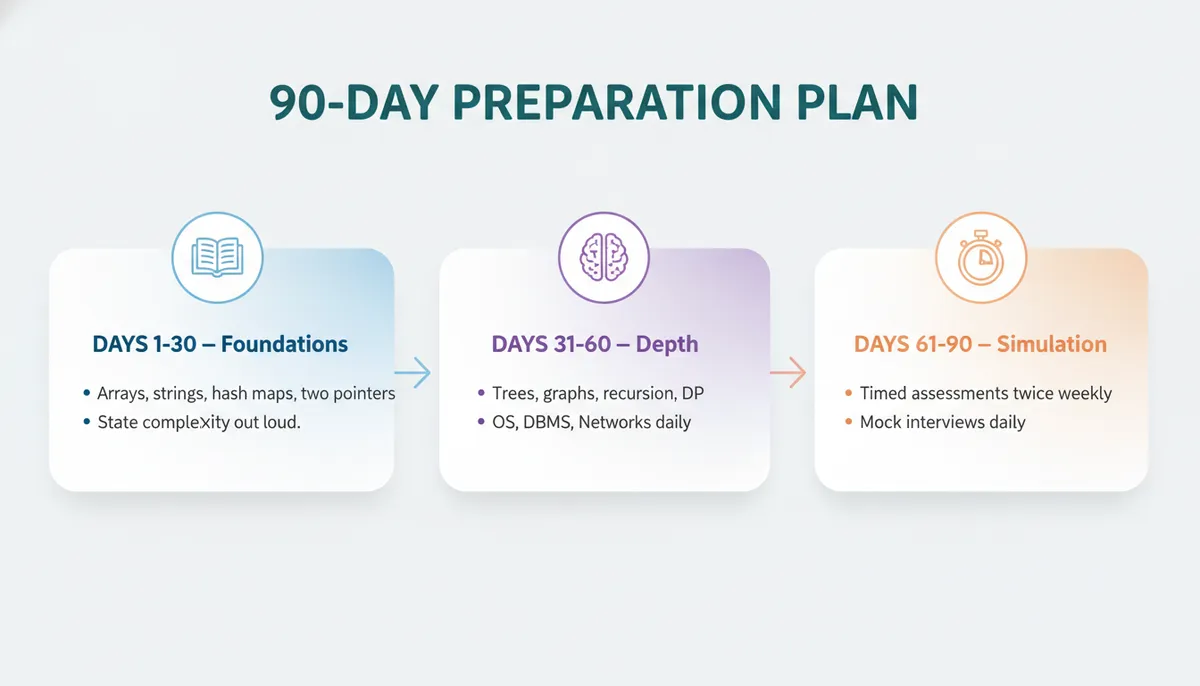
Days 1–30: Foundations
- Arrays, strings, hash maps, two pointers, sliding window from the DSA Patterns Sheet
- 3 problems daily; state complexity out loud for every single one
- Rebuild the resume properly and run it through the Resume Analyzer — remember, the resume is screened alongside Round 1
- One timed 90-minute mock per week
Days 31–60: Depth
- Trees, graphs, recursion and backtracking, dynamic programming, heaps
- Add 45 minutes daily on CS fundamentals via the OS, DBMS and Networks sheets
- Clear the Google company kit
- Build and deploy one full project end to end — you'll want the muscle memory for the finale
Days 61–90: Simulation
- Two full-length timed assessments per week
- Daily AI mock interviews — explaining your approach out loud is the skill Google grades hardest
- Prepare 5–6 STAR stories with the behavioural sheet
- Rehearse a 90-second demo of your project until it's automatic
The 90-Day Interview Roadmap sequences this whole plan — 316 DSA problems, 114 theory modules, 22 mock interviews, and AI coaching credits — if you'd rather follow a schedule than assemble one.
Beyond the Hackathon: Google's Interview Loop
If you convert into Google's internship pipeline, the interviews are their own preparation problem:
| Round | Content | Prepare with |
|---|---|---|
| Phone/online technical | 1–2 DSA problems, live, with heavy "explain your thinking" | DSA Patterns Sheet + AI mock interviews |
| Onsite technical (multiple) | DSA depth, complexity analysis, edge cases | Same, at higher difficulty |
| Googleyness & leadership | Collaboration, ambiguity, values | Behavioural sheet |
⚠️ Important: Google interviews weight communication of your thought process unusually heavily. Silent problem-solving, even if correct, scores poorly. Practise narrating: restate the problem, state a brute force, state its complexity, then optimise out loud.
Who actually decides
One detail surprises most first-time candidates: at Google, the people who interview you do not make the final call. Reported accounts describe a Hiring Committee of senior engineers who did not sit in your loop, reviewing a packet your recruiter assembles — the interviewers' written feedback, your CV and the recruiter's notes. Commonly reported evaluation dimensions are role-related knowledge, general cognitive ability, leadership and Googleyness.
That changes how you should answer. Your interviewer is effectively taking notes for a reader who will never meet you, so anything you leave unsaid simply does not exist in the packet. State your assumptions, name your complexity, and say why you rejected the approach you rejected. A committee cannot infer reasoning that was never written down.
One newer format to be aware of
Candidate accounts describe a pilot code-comprehension round introduced in May 2026 for L3 and L4 roles on selected US teams. Reports describe reading an unfamiliar codebase, finding bugs and discussing improvements with Gemini available as an assistant. Two caveats matter: it is reported as a pilot rather than a universal process, and it is reported to add a round rather than replace the traditional no-AI algorithm interview. Prepare conventional problem solving first; treat this as context, not a syllabus.
For frequency-weighted practice against Google's own pattern distribution, work through the Google company kit rather than a generic problem list.
Common Mistakes
❌ Ignoring the resume. Round 1 includes resume screening. A strong coder with a thin resume can be filtered before their code is read.
❌ Silent solving. Google grades reasoning. Practise talking through your approach from day one.
❌ Skipping complexity analysis. "It works" isn't the answer; "it's O(n log n) and here's why" is.
❌ Treating learning cohorts as optional. They're observed, and they're the best part of the programme regardless.
❌ Only preparing DSA. Later rounds bring in CS fundamentals.
❌ Missing the registration window. It opens and closes on Google's schedule; set alerts well in advance.
Frequently Asked Questions
Who is eligible for the Google Girl Hackathon?
Women students who are Indian nationals, enrolled at engineering colleges in India, typically across four graduating batches at a time. You must be in the year of study you declare at registration.
Is the Google Girl Hackathon individual or team-based?
Individual. Team registrations are not permitted.
How difficult is the first round?
Medium-level DSA, timed. The difficulty is less about exotic algorithms and more about clean decomposition and complexity reasoning under a clock.
Does the Google Girl Hackathon lead to an internship?
It's one of the recognised entry routes into Google India's internship pipeline for women students. Strong performers are routed toward interviews — which are then standard Google technical interviews.
When does registration open?
Registration windows have historically opened in the winter–spring period, but the schedule shifts. Watch Google's India careers and student programme pages, and set a reminder to check monthly.
What programming language should I use?
Whichever you're fastest in — Python, Java and C++ are all fine. Fluency matters far more than the language.
What if I'm in my first year?
Recent editions have covered four graduating batches simultaneously, which often includes first- and second-year students. Check the current eligibility, and if you're covered, apply — an early attempt is enormously valuable even if you don't convert.
Final Thoughts
The Google Girl Hackathon is individual, which means it rewards preparation with no dilution and no excuses. The first round is a DSA challenge with a resume attached — both are entirely within your control, starting today.
Three moves:
- Work the DSA Patterns Sheet in pattern order, narrating your complexity analysis every time
- Fix the resume now with the Resume Analyzer, because it's screened alongside your code
- Run the 90-Day Interview Roadmap so you're ready when the window opens rather than scrambling after
Related reading: Hackathon calendar 2026-27 · How to win a hackathon · Adobe University Hackathon guide