
Interview
Adobe University Hackathon 2026: Results, Dates & Prep
Adobe University Hackathon 2026 dates and results: Round 1 (Aug 9), Round 2 build (Aug 16–Sep 6), Round 3 (Sep 13–27) — plus a prep plan for each round.
The Adobe University Hackathon is one of the highest-leverage things an Indian engineering student can do with three weeks of their life. The 2025 edition drew roughly 260,000 registrations across 12,000 campuses and narrowed to a handful of finalists. The reward is not a certificate — it is a pre-placement interview and an Adobe internship paying ₹1,10,000 per month.
The 2026 theme, "Speak to Agents: The New Language of Brand Visibility", is about how intelligent assistants change the way brands get discovered. It is an AI-first problem statement, rewarding people who can build and explain what they built.
Preparing right now? Start with the 90-Day Interview Roadmap for a structured plan, and the Adobe company-wise DSA kit for the patterns Adobe actually asks.
Key Dates & Results (2026 cycle, last checked 2026-09-07)
| Stage | Date | Status |
|---|---|---|
| Registration | Closed 8 August 2026 | Closed |
| Round 1 — Online Assessment | 9 August 2026 (8-hour window, 2–10 PM IST) | Completed |
| Round 2 — Development Round | 16 August – 6 September 2026 | Completed |
| Round 2 results | not announced yet (last checked 2026-09-07) | Awaiting announcement |
| Round 3 — Prototype Showcase | 13–27 September 2026 | Upcoming |
| Grand Finale (Adobe Noida) | not announced yet (last checked 2026-09-07) | Awaiting announcement |
These dates are Adobe's published 2026-cycle windows; round-result announcement dates are not published anywhere Thita could confirm, so check back or watch the official listing rather than treat the "not announced" rows as fixed.
What Is the Adobe University Hackathon?
The Adobe University Hackathon (also called the Adobe India Hackathon) is Adobe's flagship campus programme. Unlike a weekend build-and-go-home event, it runs over several weeks as a full hiring funnel: an online assessment, a multi-week build round, a prototype showcase, and a grand finale at Adobe's Noida headquarters.
The 2025 edition — "Connecting the Dots" — asked teams to turn static PDFs into interactive knowledge experiences: first a pure engineering problem (extract a structured outline from raw PDFs with no manual intervention), then a working web app on Adobe's PDF Embed API.
The 2026 theme moves the target to AI agents: "Speak to Agents: The New Language of Brand Visibility." The through-line across both years is the same — Adobe wants working software, not slide decks.
Eligibility
- Full-time B.Tech / B.E. / M.Tech / M.E. / dual-degree or integrated STEM students
- Nationally recognised colleges and universities in India
- Graduating batches roughly 2026–2029 (all years of study are eligible)
- All branches — not restricted to CSE/IT
- Teams of 2–3 members from the same institution (cross-year teams are allowed)
💡 Pro Tip: The "all branches, all years" eligibility is the most underused fact about this hackathon. First- and second-years skip it thinking they are too junior. A first-year who reaches the development round has a two-year head start on their batch.
The Four Rounds: What Each One Actually Filters For
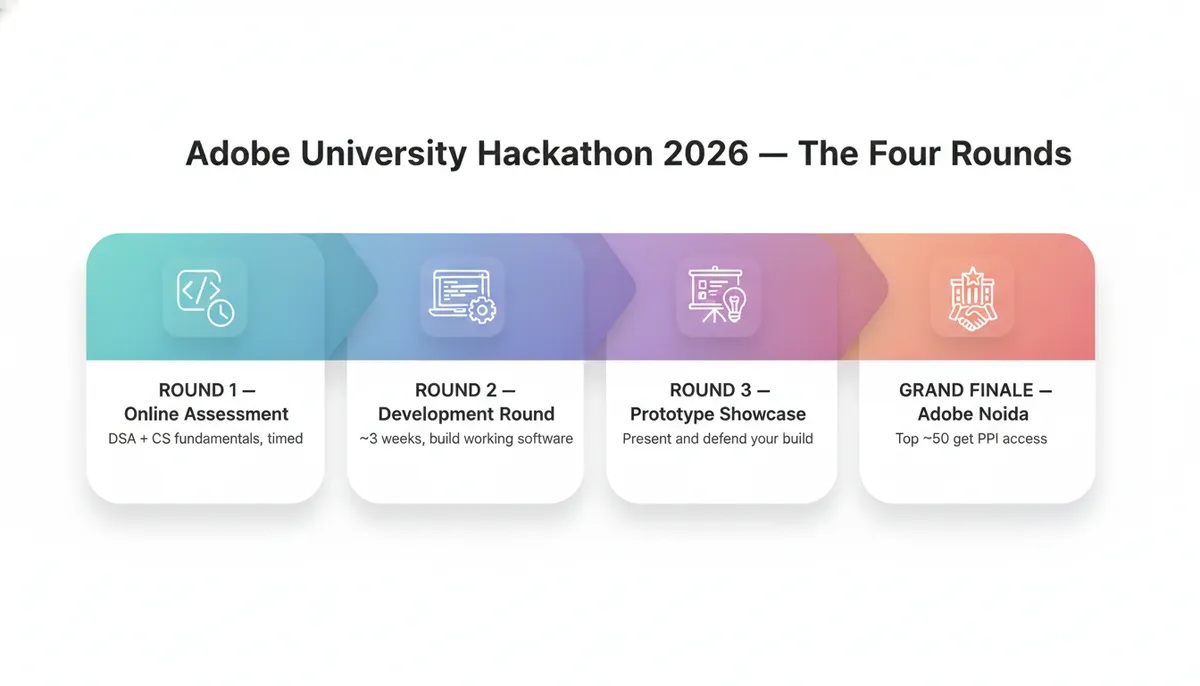
| Round | Format | What it filters | Where people fail |
|---|---|---|---|
| Round 1 | Online Assessment (timed, single window) | Raw DSA speed + CS fundamentals | Slow pattern recognition under a clock |
| Round 2 | Development Round (~3 weeks) | Can you ship working code? | Over-scoping; no working demo by deadline |
| Round 3 | Prototype Showcase | Can you explain and defend it? | Great code, terrible presentation |
| Grand Finale | On-site at Adobe Noida | Depth, ownership, hireability | Can't answer "why did you build it this way?" |
The funnel is shaped so each round tests a different skill — which is why most candidates are knocked out. They train for one of the four.
Round 1: The Online Assessment
Round 1 is a single-window timed assessment. In the 2026 cycle it ran on August 9 across an 8-hour window (2:00–10:00 PM IST): you pick your slot, but the test is strictly timed once you start.
What Shows Up
Based on Adobe's campus assessments and past hackathon rounds, expect a mix of:
- Coding problems — 2 to 3, usually medium difficulty by LeetCode standards
- Aptitude and logical reasoning — pattern recognition, quantitative, data interpretation
- CS fundamentals MCQs — OS, DBMS, computer networks, OOP
- Output-prediction / debugging questions — read code, predict behaviour
The DSA Patterns That Matter Most
Adobe's assessment questions cluster heavily around a handful of pattern families. Ranked by how often they appear:
- Arrays & matrix manipulation — prefix sums, in-place rearrangement, rotations
- Strings — parsing, frequency maps, sliding window on strings
- Hash maps — grouping, deduplication, two-sum-style lookups
- Two pointers & sliding window — subarray/substring optimisation
- Trees — traversal variants, level-order, path problems
- Dynamic programming — 1D DP, knapsack variants, grid DP
- Greedy & sorting — interval merging, custom comparators
- Stacks — monotonic stack, expression parsing
Work these in pattern order, not random order — you are optimising for recognition speed, not problem count. The DSA Patterns Sheet organises 404 problems into 94 sub-patterns across 15 families, and the Adobe company kit filters it to the patterns Adobe actually asks.
The CS Fundamentals Half Nobody Studies
This is where the Adobe OA differs from a pure coding contest: a meaningful chunk of marks sits in MCQs on operating systems, DBMS and networks, and most candidates prepare none of it.
- Operating Systems sheet — processes, threads, deadlock, paging, scheduling
- DBMS sheet — normalisation, indexing, transactions, ACID, joins
- Computer Networks sheet — TCP/IP, HTTP, DNS, the OSI layers
⚠️ Important: These MCQs are fast marks. A coding problem might take 25 minutes; ten fundamentals MCQs take eight and carry comparable weight. Never leave them unattempted.
Round 1 Timing Strategy
- First 5 minutes: read everything, ranking problems by how fast you recognise the pattern.
- Fundamentals MCQs first, if the platform allows navigation — highest marks per minute.
- Easier coding problem second — bank a complete solution before gambling.
- Hardest last — a brute force passing partial tests beats an empty submission.
Round 2: The Development Round
This is the heart of the hackathon. In 2026 it ran from August 16 to September 6 — roughly three weeks to build a real, working solution to Adobe's problem statement.
Three weeks sounds generous. It isn't — you build alongside classes, and winning submissions are genuinely engineered rather than demo-ware.
How Winning Teams Structure Three Weeks
| Days | Focus | Output |
|---|---|---|
| 1–2 | Understand the problem statement completely | A written one-page scope with explicit non-goals |
| 3–4 | Architecture + tech stack decisions | Repo scaffolded, CI running, deployment target chosen |
| 5–12 | Build the core engine | The hard technical piece — working, tested |
| 13–16 | Build the interface around it | A UI a stranger can operate without instructions |
| 17–19 | Polish, edge cases, README, demo video | Submission-ready package |
| 20–21 | Buffer | Because something will break |
💡 Pro Tip: Ship an end-to-end skeleton by day 5, even if every piece is a stub. Teams that build in isolation and integrate on day 18 are the teams that submit nothing.
What Adobe Evaluates in a Build Round
Looking at the 2025 "Connecting the Dots" scoring emphasis, Adobe cares about:
- Does it actually run? Reproducibility matters. If evaluators can't run it, it doesn't exist.
- Correctness on their test inputs — especially for engine-style problems like structured extraction
- Performance constraints — 2025's Round 1A had explicit runtime and model-size limits; treat published constraints as pass/fail gates, not suggestions
- Code quality — readable, modular, documented
- Genuine problem-solving — not an API wrapper with a nice landing page
✅ Do write a README assuming the evaluator has never seen your project — one-command setup, sample inputs, expected outputs — and record a 2–3 minute demo video even if it isn't required. It is the cheapest way to control the first impression.
❌ Don't build features nobody asked for, and don't skim the constraints document. Teams are disqualified on offline-execution and runtime limits far more often than on bad ideas.
The 2026 Theme: Building for Agents
"Speak to Agents: The New Language of Brand Visibility" asks a real question: when discovery moves from humans typing queries to agents retrieving and summarising on a user's behalf, how does a brand stay visible? Strong directions to think in:
- Structured, machine-readable content — schema, feeds, and APIs an agent can consume without scraping
- Agent-facing interfaces — endpoints designed for programmatic consumption, not just HTML pages
- Retrieval quality — making sure the right content surfaces for the right agent query
- Measurement — how do you even observe brand visibility inside an agent's answer?
- Trust and provenance — citation, attribution, and verifiable sourcing
⚠️ Important: Whatever direction you pick, the winning trait is a working, demonstrable mechanism — not a pitch about what your system would do at scale.
Round 3: The Prototype Showcase
Round 3 (September 13–27 in the 2026 cycle) is where shortlisted teams present. It eliminates strong engineers who cannot explain their own work.
The Presentation Structure That Works
- The problem in one sentence — no preamble, no company history
- The insight — what did you realise that other teams didn't?
- The demo — live, working, 90 seconds, on the happy path
- The engineering — the one hard technical decision and why you made it
- The honest limits — what doesn't work yet and what you'd do next
That fifth point consistently wins marks. Adobe engineers are evaluating you as a future colleague, and a candidate who knows their system's weaknesses is more hireable than one who claims there are none.
Questions You Will Be Asked
- "Why this architecture instead of the obvious alternative?"
- "What happens at 100x the data volume?"
- "Which part did you personally write?"
- "What broke during the build, and how did you debug it?"
- "If you had two more weeks, what would you fix first?"
💡 Pro Tip: Rehearse these aloud with someone who interrupts you. AI mock interviews let you practise defending technical decisions under questioning — the exact skill this round grades.
Grand Finale & the PPI Path
The finale is held at Adobe's Noida headquarters. This is also where the hackathon stops being a competition and becomes a hiring process.
The Rewards
- Winning team: Apple MacBook Pro per member
- Runners-up: Apple MacBook per member
- Top ~50 participants: pre-placement interview access and Adobe internship eligibility
- Internship stipend: ₹1,10,000 per month (batch-restricted in the 2026 cycle)
- Finalists: Adobe merchandise, Acrobat Pro licences, official certificates
The PPI Interviews
Reaching the PPI stage means facing real Adobe technical interviews. Those look like:
| Round | Content | How to prepare |
|---|---|---|
| Technical 1 | DSA — 1–2 medium/hard problems, live | DSA patterns sheet + AI mock interviews |
| Technical 2 | Project deep-dive + low-level design | LLD sheet |
| Technical 3 | System design (for senior/M.Tech profiles) | System design sheet |
| HR / Behavioural | Culture fit, ownership, teamwork | Behavioural sheet |
⚠️ Important: The PPI is not a formality. Candidates who coast on hackathon performance and walk into a DSA round cold get rejected. Treat it as a standard Adobe SDE loop, because that is what it is.
The 90-Day Preparation Plan
Here's the plan whether you're targeting the next cycle or converting a current one into a PPI. It maps directly onto the Thita.ai 90-Day Interview Roadmap, which bundles 316 DSA problems, 114 theory modules, 22 mock interviews, and AI coaching credits into a day-by-day schedule.
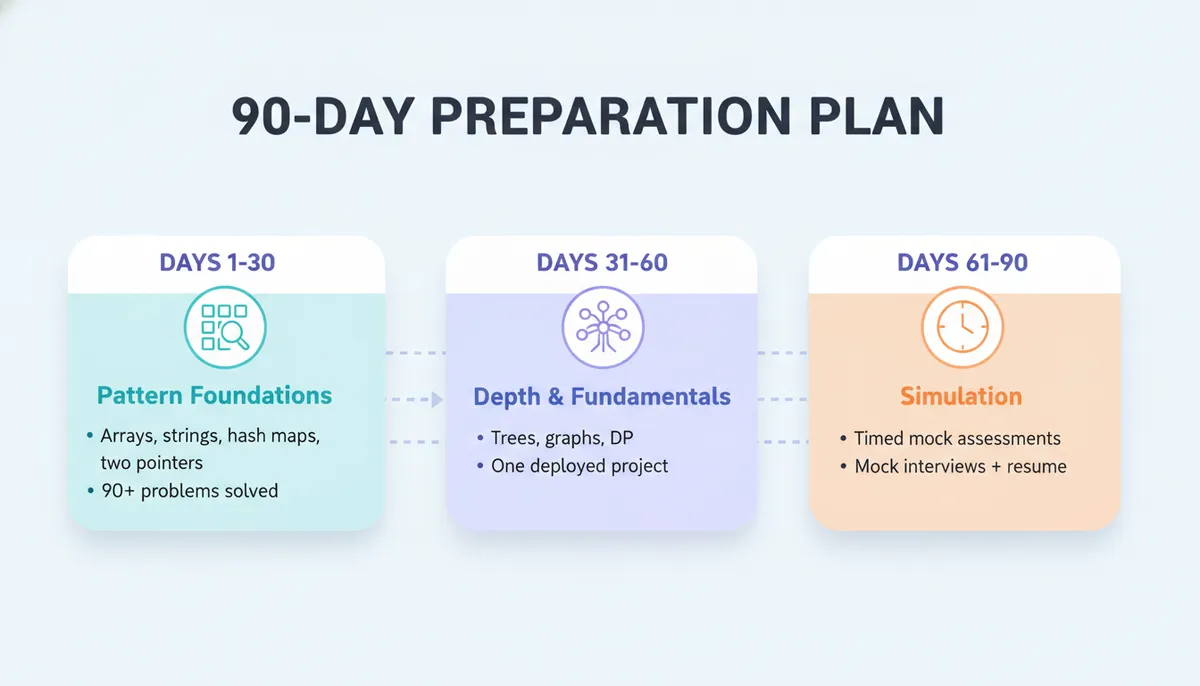
Days 1–30: Pattern Foundations
Goal: recognise the pattern within 60 seconds of reading a problem.
- Work through arrays, strings, hash maps, two pointers, and sliding window on the DSA Patterns Sheet
- 3 problems a day, minimum — quality over speed at this stage
- Keep a "pattern journal": for every problem, write one line on what signal told you which pattern to use
- Weekends: one timed 90-minute mock assessment
Milestone: 90+ problems solved, all core linear-structure patterns covered.
Days 31–60: Depth, Fundamentals & Build Skills
Goal: cover the hard patterns and the CS fundamentals half of the OA.
- Trees, graphs, dynamic programming, backtracking, heaps
- 45 minutes daily on OS / DBMS / Networks via the OS, DBMS, and Networks sheets
- Filter to the Adobe company kit and clear every problem in it
- Build one full-stack project end to end — scaffold, build, deploy. Speed matters more than novelty; you're training the muscle for a three-week build round.
Milestone: 200+ problems, one deployed project, fundamentals covered.
Days 61–90: Simulation & Interview Skills
Goal: perform under pressure and defend your work.
- Two timed full-length mock assessments per week
- Daily AI mock interviews — alternate DSA and project-defence sessions
- Prepare 5–6 STAR stories using the behavioural sheet
- Run your resume through the Resume Analyzer — the PPI shortlist starts from your profile
- Practise your project pitch until the 90-second demo is automatic
Milestone: 300+ problems, 10+ mock interviews, a rehearsed project story.
Common Mistakes That Cost People the PPI
❌ Registering late. The 2026 registration window closed August 8 with the assessment on August 9. There is no grace period.
❌ Preparing only DSA. The OA has a fundamentals half, and the build round has nothing to do with LeetCode.
❌ Forming a team on deadline day. You need 2–3 people from your institution who will show up for three weeks. Recruit early, and pick on reliability rather than popularity.
❌ Building the wrong thing beautifully. Re-read the problem statement on day 10. Teams drift.
❌ No working demo. A partly working system that runs beats a perfect architecture diagram every time.
❌ Treating the PPI as a victory lap. It's a full Adobe interview loop with real rejections.
Frequently Asked Questions
Who is eligible for the Adobe University Hackathon 2026?
Full-time B.Tech, B.E., M.Tech, M.E., dual-degree, and integrated STEM students at recognised Indian institutions, across all branches and all years of study, in roughly the 2026–2029 graduating batches. Teams are 2–3 members from the same college.
Do I need to be a CSE student?
No. All engineering branches are eligible. You do need to be able to write working code — but ECE, mechanical, and civil students have reached the later rounds.
What is the Adobe University Hackathon 2026 theme?
"Speak to Agents: The New Language of Brand Visibility" — building for a world where AI agents, not humans, are increasingly the ones discovering and surfacing brand content.
How hard is the Adobe online assessment?
Medium difficulty by LeetCode standards for the coding section, plus aptitude and CS fundamentals MCQs. The difficulty is less about individual problems and more about the clock — you need pattern recognition to be automatic.
Does the Adobe hackathon guarantee an internship?
No. Top ~50 participants get access to pre-placement interviews and internship eligibility. The interviews themselves are standard Adobe technical rounds.
What's the Adobe internship stipend?
₹1,10,000 per month for the India internship, with batch eligibility restrictions that vary by cycle.
Can first-year students participate?
Yes. All years of study are eligible, and cross-year teams are permitted. First-years who make it deep into the process build a substantial advantage for later campus cycles.
How do I prepare if the registration window has already closed?
Prepare for the next cycle and for Adobe's regular campus process — they test the same things. Start the 90-Day Roadmap now, and use the intervening months to clear the Adobe company kit and ship two real projects.
Final Thoughts
The Adobe University Hackathon rewards a combination most students never train together: fast pattern recognition under a clock, the discipline to ship working software in three weeks, and the ability to defend a technical decision to a sceptical engineer.
You can build all three, and the order matters:
- Start the 90-Day Interview Roadmap so you aren't guessing what to do each day
- Clear the DSA Patterns Sheet, then filter to the Adobe company kit
- Ship one deployed project, so a three-week build round isn't your first time
- Run AI mock interviews until defending your work feels routine
The students who reached Noida weren't more talented. They prepared for all four rounds instead of just the first.
Related reading: JP Morgan Code for Good · How to win a hackathon · Hackathon calendar 2026-27