
Interview
How to Win a Hackathon: The Complete 24-48 Hour Strategy Guide
The hour-by-hour playbook for winning hackathons — team roles, scoping, tech stack, demo strategy, and judge psychology. Turn your build into a job offer.
Most hackathon teams lose in the first two hours, long before any code gets written. They lose by picking an idea that can't be demoed, by splitting work before agreeing on an architecture, or by building something impressive to engineers when the judging panel is half product people.
Winning teams look almost boring from the outside. They scope brutally, they have something running by hour six, and they spend the last three hours rehearsing a demo instead of adding features.
This is the playbook. It works for a 24-hour campus hackathon, a 48-hour company event like HackOn with Amazon, a 36-hour Smart India Hackathon finale, and a multi-week build round like Adobe's. The clock changes; the principles don't.
One thing before you start: nearly every hackathon with a hiring outcome gates you behind a timed coding round first. If that's your target, the DSA Patterns Sheet and the 90-Day Interview Roadmap are where that preparation lives.
Part 1: Before the Hackathon Starts
Build the Right Team, Not the Best Individuals
The optimal hackathon team isn't four excellent backend engineers. It's a spread of roles with no gaps:
| Role | What they own | Why it matters |
|---|---|---|
| Builder (core) | The hard technical piece — the thing that makes the project non-trivial | This is what gets scored as "technical depth" |
| Builder (surface) | The interface a judge will click through | Judges experience your project through this |
| Integrator | Glue, deployment, environments, data | Every team that fails, fails at integration |
| Storyteller | Problem framing, slides, demo script, Q&A | The difference between built and communicated |
On a three-person team, one person doubles up. The role that gets cut most often is storyteller — and that's exactly why so many technically strong teams lose.
💡 Pro Tip: Pick teammates on reliability over raw skill. In a 36-hour event, the person who shows up, stays awake, and finishes their piece is worth more than the person who's brilliant for six hours and then disappears.
Prepare Your Stack in Advance
You should never be reading documentation for a framework's setup during the event. Before the hackathon:
- Pick a stack you can scaffold in 15 minutes. Familiar beats fashionable, always.
- Build a boilerplate repo: auth stubbed, database connected, one CRUD route working, deployed to a live URL.
- Know your deploy path cold — Vercel, Railway, Render, whatever. Practise it once.
- Pre-download heavy dependencies, model weights, and datasets. Venue Wi-Fi will fail. Assume it.
✅ Do rehearse the whole scaffold-to-deploy path once as a team before the event. That dry run reliably saves four hours.
❌ Don't learn a new framework at a hackathon. The learning is real but the deliverable dies.
Do the Homework on Judging
Every hackathon publishes judging criteria. Almost nobody reads them.
Typical weightings look like: technical complexity, innovation, impact/usefulness, completeness, presentation. If "impact" is weighted 30%, a technically simpler project aimed at a real problem beats a clever one aimed at nothing.
Also find out who the judges are. Engineers ask "how did you build it." Product managers ask "who is this for." Sponsors ask "did you use our platform." Build the demo for the room you'll actually be in.
Part 2: The First Three Hours (This Decides the Outcome)
Hour 0–1: Idea Selection
Generate five ideas fast, then kill four of them against three questions:
- Can we demo this in 90 seconds? If the value only appears after ten minutes of setup, it's the wrong project.
- What's the hardest technical piece, and can we build it? Be honest. If the answer is "we'd need to train a model from scratch," pick differently.
- Who specifically has this problem? "Students" is not an answer. "Second-year students who miss internal deadlines because notices live in five WhatsApp groups" is.
⚠️ Important: The most common losing idea is a project that's ambitious in description and empty in demo. Judges score what they can see running.
Hour 1–2: Scope Ruthlessly
Write two lists on a whiteboard or a shared doc:
- In scope: the three things that must work
- Explicitly NOT in scope: everything else
That second list is the important one. It's what you point at when someone says "what if we also added…" at hour 20.
Define your MVP as the single flow a judge will walk through. Everything else is optional. Then define one stretch feature — and don't touch it until the MVP is complete and deployed.
Hour 2–3: Architecture and Task Split
- Draw the system on one page: components, data flow, external services
- Assign ownership per component with clear interfaces between them
- Agree the data model now — mid-build schema changes are the leading cause of integration hell
- Get every member's environment running and committing to the repo before anyone writes real logic
💡 Pro Tip: Have a deployed "hello world" live at a public URL by hour 3. Deployment problems discovered at hour 30 have killed more good projects than bad ideas have.
Part 3: The Build
The Golden Rule: End-to-End Before Deep
Build a thin, ugly, complete path through your product first — even if every piece is stubbed and hardcoded. Then thicken each layer.
Teams that build components in isolation and integrate at the end are gambling everything on the last four hours. Teams that integrate on hour six spend the rest of the event improving something that already works.
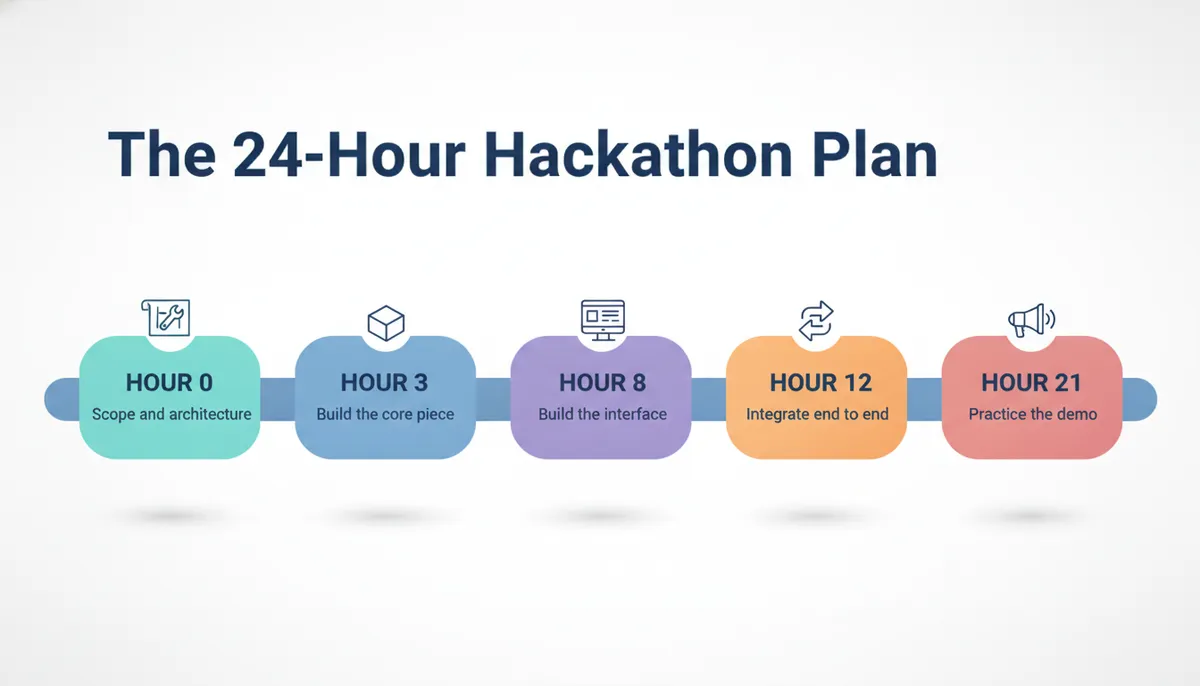
Hour-by-Hour: The 24-Hour Version
| Hours | Focus | Gate |
|---|---|---|
| 0–3 | Idea, scope, architecture, environments | Deployed hello-world live |
| 3–8 | Core technical piece | The hard part works on one input |
| 8–12 | The interface around it | A stranger can click through the main flow |
| 12–15 | Integration + realistic data | Full path works end to end |
| 15–18 | Second feature or depth on the first | Only if the gate above passed |
| 18–21 | Bug fixing, edge cases, demo data seeding | Nothing crashes on the happy path |
| 21–23 | Demo rehearsal, slides, README | Demo runs three times without failing |
| 23–24 | Buffer | Because something always breaks |
The 48-Hour Version
Same shape, stretched — but with one addition: a hard checkpoint at the halfway mark. At hour 24, ask out loud: "if we stopped building right now, do we have something demoable?" If the answer is no, cut scope immediately rather than hoping.
Rules That Save Teams
- Commit and push constantly. Local-only work that dies with a laptop is a real and recurring tragedy.
- One person owns the main branch. Merge conflicts at hour 20 with four people force-pushing is a losing position.
- Timebox every bug. 45 minutes stuck means you switch tasks and come back, or you route around it.
- Sleep in shifts for anything over 24 hours. Code written at hour 26 with no sleep gets deleted at hour 30.
- Fake what isn't scored. Hardcode the login. Seed the database. Stub the third-party integration. Spend your hours on what gets graded.
❌ Don't rewrite anything after the halfway mark. Ever. "It'd be cleaner if…" has ended more hackathon runs than any bug.
Part 4: The Demo (Where Most Points Are Won and Lost)
You will get three to five minutes. Judges will have seen twenty projects before yours and will see twenty after. Your job is to be unmistakable in the first thirty seconds.
The Structure That Works
- The problem — 20 seconds. One concrete person with one concrete pain. No market-size statistics, no "in today's world."
- The demo — 90 seconds. Live, on the happy path, with realistic seeded data. Narrate what you're doing and why it matters.
- The technical bit — 45 seconds. The one hard thing you built and one sentence on why it was hard.
- What's next and what doesn't work yet — 20 seconds. Honesty reads as competence.
- Q&A. This is graded too. Answer directly; don't bluff.
Demo Rules
- Record a backup video. Wi-Fi dies, laptops sleep, APIs rate-limit. A 90-second recording has saved countless teams.
- Seed realistic data. "Test User 1" and "asdasd" signal an unfinished project even when the code is excellent.
- Never live-code during the demo. Never say "let me just refresh."
- Rehearse three full run-throughs. Out loud, timed, with someone playing the judge.
- Decide who speaks before you walk up. Silent teammates should still be able to answer questions.
💡 Pro Tip: Practise being interrupted. Judges cut in with hard questions, and losing your thread mid-demo is costly. AI mock interviews are surprisingly good practice for this — defending a technical decision under questioning is the same skill in both settings.
Answering the Questions Judges Actually Ask
| Question | What they're really testing | How to answer |
|---|---|---|
| "Why this approach over X?" | Did you make a decision or a default? | Name the alternative, name the trade-off, name why |
| "What happens at scale?" | Do you understand your own system? | Identify the real bottleneck honestly |
| "What did you personally build?" | Is this a team or one person? | Everyone should have a specific answer |
| "What broke?" | Engineering maturity | Tell the actual debugging story |
| "Two more weeks — what next?" | Product judgement | One prioritised thing, not a wishlist |
Part 5: Turning a Hackathon Into a Job Offer
The prize is nice. The career outcome is the real return — and it's mostly won after the event.
At the Event
- Talk to sponsor engineers and mentors. They are frequently the ones who recommend candidates internally.
- Ask them a real technical question about their platform. That conversation is remembered; "are you hiring?" is not.
- Get names. Connect the same evening while you're memorable.
After the Event
- Clean up the repo within a week: a real README, setup instructions, screenshots, a demo link. An abandoned messy repo is worse than no repo.
- Write the resume bullet properly: not "participated in X hackathon" but "Built a low-bandwidth crop advisory tool for a 36-hour national hackathon; placed top 10 of 400 teams." Run it through the Resume Analyzer to check the impact language lands.
- Turn it into an interview story. This project will come up in every interview for two years. Rehearse the constraint you found, the decision you made, the trade-off you accepted, and the result — the behavioural sheet covers the STAR structure.
The Preparation That Actually Unlocks Offers
Here's the uncomfortable truth: a hackathon win gets you an interview, not a job. What gets you the job is clearing the technical rounds behind it.
For hackathons that are explicit hiring funnels — Adobe, Flipkart GRiD, HackOn with Amazon, Code for Good — there's a timed coding round before you ever build anything, and a full interview loop after you win.
- 90-Day Interview Roadmap — 316 DSA problems, 114 theory modules, 22 mock interviews, sequenced day by day
- DSA Patterns Sheet — 404 problems across 94 sub-patterns and 15 families; pattern recognition is what timed rounds actually test
- Company-wise kits — filter to what Adobe, Amazon, Google, Microsoft or Flipkart actually ask
- AI mock interviews — for both the PPI loop and demo-day Q&A
The Mistakes That Lose Hackathons
❌ Choosing an idea you can't demo. If the value is invisible on screen, it's invisible to judges.
❌ Skipping the scoping conversation. "We'll figure it out as we go" is how teams arrive at hour 20 with four half-features.
❌ Building in isolation, integrating at the end. The most common cause of a team with no submission.
❌ Adding features after the halfway point. Polish beats scope, every time.
❌ Zero demo rehearsal. You built for 24 hours and improvised the four minutes that determine your score.
❌ Ignoring the published judging criteria. They tell you exactly where the points are.
❌ No sleep plan. Hour-30 code is a liability, not an asset.
❌ Letting the repo rot afterwards. The project's career value depends on someone being able to look at it in March.
Frequently Asked Questions
How do I win my first hackathon?
Don't try to. For your first event, aim to finish and demo something working — that alone puts you ahead of a large fraction of teams. Learn the format, then compete seriously at the second one.
What should I build at a hackathon?
Something with one clearly visible flow, one genuinely hard technical component, and a specific user. Avoid ideas whose value only appears at scale or after long setup.
How important is the presentation?
Enormously. Presentation is a scored criterion at most events, and it's the lens through which everything else is judged. Budget the last 10% of your time for it, minimum.
Should I use AI tools during a hackathon?
Yes, unless the rules forbid it — and read the rules, because some hiring hackathons restrict them. Use AI for boilerplate, scaffolding and debugging speed. Don't use it for the core technical piece you'll be asked to explain, because you will be asked to explain it.
How many people should be on a team?
Three to four is the sweet spot for a 24-hour event. Some competitions mandate sizes — Smart India Hackathon requires six, Adobe requires 2–3, HackOn with Amazon requires 2–3. Check before recruiting.
Do hackathons help you get hired?
Company-run hackathons with PPI paths absolutely do — see the hackathon calendar for which ones are real hiring funnels. Generic hackathons help indirectly by giving you projects, stories, and network.
What if my team's project doesn't work by demo time?
Demo what does work, honestly, and explain the gap. Judges have seen many broken demos; they respond well to a team that says "the extraction pipeline works, the UI integration isn't done, here's the pipeline running on real input." Never pretend a broken thing works — they will ask you to click the thing.
Final Thoughts
Winning a hackathon is mostly a scoping and communication problem wearing an engineering costume. The technical work matters, but it's the third-most-important variable behind choosing something demoable and explaining it well.
Your checklist for the next one:
- Recruit for role coverage, especially a storyteller
- Have a boilerplate repo that deploys in 15 minutes
- Read the judging criteria before you pick the idea
- End-to-end skeleton by the one-quarter mark
- Stop building at the 90% mark and rehearse the demo three times
- Clean the repo and write the resume bullet within a week
And for the hackathons that lead somewhere: the coding round comes first. Start the 90-Day Interview Roadmap or the DSA Patterns Sheet now so the gate isn't what stops you.
Related reading: Hackathon calendar 2026-27 · Adobe University Hackathon guide · Smart India Hackathon 2026 guide