
Interview
Google Solution Challenge 2027: Dates, Registration & How to Win
Solution Challenge 2027 dates are not announced. Last edition's timeline, how to register via GDG on Campus, problem statements, and how to win.
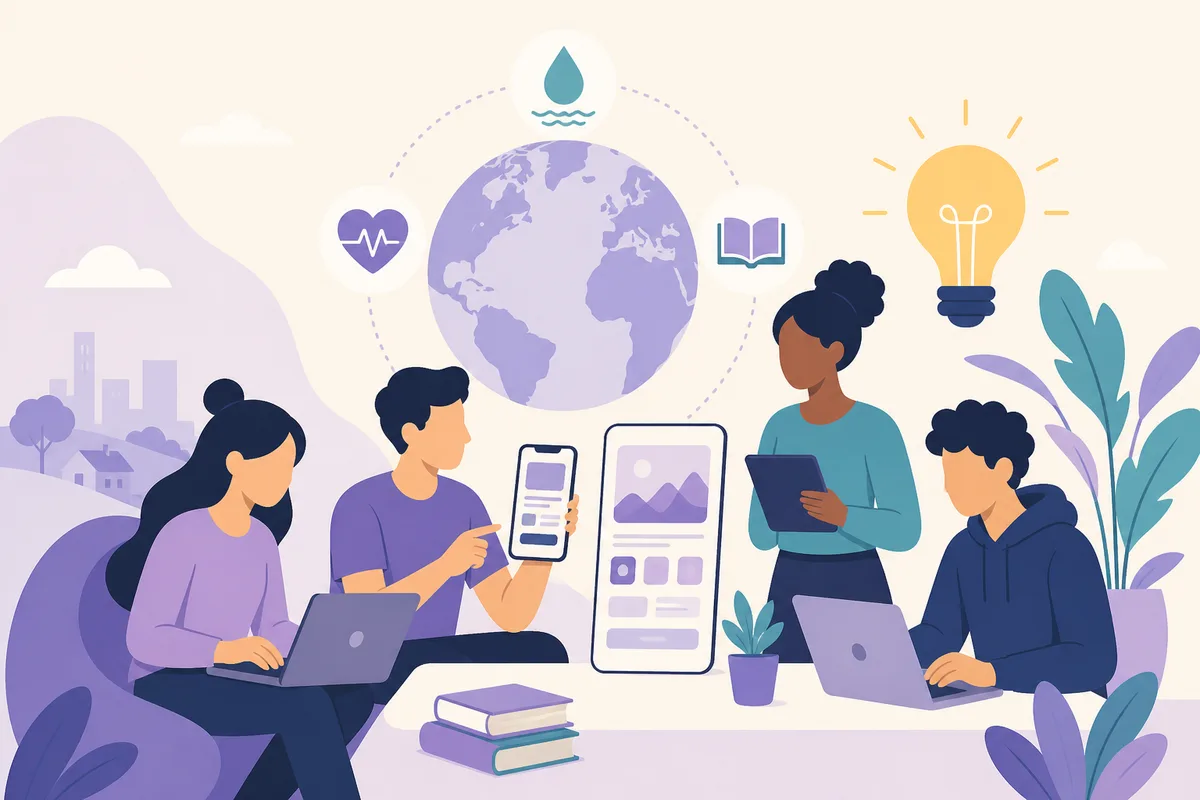
Practise the rounds for the Google Solution Challenge
Short answer: Solution Challenge 2027 has not been announced. The challenge did run in 2026, so a 2027 edition is plausible, but no official 2027 dates exist yet. The 2026 edition started on 6 March and ran to late June according to a third-party listing; Google's own community pages we checked did not carry dates. If 2027 follows 2026 (an inference), expect registration to open around February or March 2027 through your campus GDG on Campus chapter.
The Solution Challenge is a student team contest where you pick a real-world problem, build a working prototype with Google technology, and submit it with a short demo video. It is not a coding test and it is not the Google Girl Hackathon. Read the comparison below before you plan.
For where this fits among other events, see the hackathon calendar 2026-27.
Does the Solution Challenge Still Run? (Checked 29 Oct 2026)
Yes, as far as we can verify. The programme has changed names and format across years (it was run under Google Developer Student Clubs, later renamed GDG on Campus), so treat any older guide with caution.
What we found:
- A third-party listing on Internshala describes Solution Challenge 2026 under the "Build with AI" theme, now marked closed
- Dozens of GDG on Campus chapter pages on gdg.community.dev advertise 2026 kickoff, info and referral-code sessions, which is how most students register
- Google's own community overview page that we fetched lists Build With AI and DevFest as featured events and does not mention the Solution Challenge. So we cannot cite an official Google page for 2026 dates or rules
Take-away: the event exists and chapters run it, but the authoritative details come via your GDG on Campus lead and the registration page they point you to. Where this guide quotes dates and prizes, they are third-party unless stated.
Solution Challenge: Key Dates (last checked 29 Oct 2026)
| Detail | Status |
|---|---|
| 2027 edition | Not announced |
| 2026 start | 6 March 2026 (Internshala, third-party) |
| 2026 registration and prototype deadline | Sources conflict. Listings show mid-to-late April 2026 (15 April on one source, 28 April on a chapter page). Confirm on the official page |
| 2026 Top 100 announcement | 29 May 2026 (one chapter roadmap, third-party) |
| 2026 Top 10 | 20 June 2026 (chapter page, third-party), with a virtual finale in the last week of June |
| 2026 results | Listing says August 2026 |
| Expected 2027 window (inferred) | Registration opens roughly February to March 2027; submission about April 2027; finalists around May to June 2027 |
The last row is our guess from one prior year, not an announcement. Do not plan flights or exams around it.
Who Can Participate
From the 2026 third-party listing:
- University students, specifically GDG on Campus members. The listing describes it as open globally including India
- Teams of 1 to 4
- Each member may need a public Google Developer Profile (one chapter noted that its link is required at registration)
Check your own college has a GDG on Campus chapter. If it does not, ask on the GDG community site how to join one or find another chapter, because registration has gone through chapter referral codes. This eligibility is not confirmed by an official Google page we could load, so verify when 2027 opens.
Solution Challenge vs Google Girl Hackathon
These are different events with different goals:
| Solution Challenge | Google Girl Hackathon | |
|---|---|---|
| Format | Build a prototype and demo video | Resume screening, online coding challenge, learning cohorts, finale |
| Who runs it | Google Developer Groups, via campus chapters | Google India hiring and university outreach |
| What is judged | Impact, idea, technical execution | Algorithmic and problem-solving skill |
| Team | 1 to 4 students | Individual |
| Skill that wins | Product thinking plus a working app | DSA and coding speed |
| Eligibility | University students in a GDG on Campus chapter | Women in engineering programmes, see the guide |
If you want the DSA and coding-challenge route, read our Google Girl Hackathon guide. If you want a prototype and a story, you are in the right place. And if you want a mentored coding project over a summer, see Google Summer of Code 2027.
Registration: How It Worked in 2026
- Join your campus GDG on Campus chapter and attend the kickoff or info session
- Create a public Google Developer Profile for every team member
- Form a team of up to 4
- Register with your chapter's referral code on the official registration page the chapter shares
- Build and submit a prototype and a short demo video before the deadline
Because 2026 used chapter referral codes, you may not be able to register without your chapter lead. Ask them in January.
Problem Statements: There Is No Single List
"Solution Challenge problem statements" is a common search, but the design is open: according to the third-party listing, teams choose one of the 17 UN Sustainable Development Goals and build a solution with at least one Google technology. The 2026 theme was "Build with AI".
So the problem statement is yours to define. The 17 UN goals cover areas such as no poverty, zero hunger, good health, quality education, gender equality, clean water, clean energy, decent work, industry and infrastructure, reduced inequalities, sustainable cities, responsible consumption, climate action, life below water, life on land, peace and justice, and partnerships.
How to choose a problem that scores
- Pick a narrow user, not "everyone". "Smallholder farmers in one district who get crop advice by voice message in their language" beats "an app for farmers"
- Choose a problem you can verify. Talk to 3 to 5 real people in the affected group and quote what they said
- Check that AI is actually needed. If a form and a database solve it, say so and use AI only where it adds something
- Make sure the prototype works end to end for one honest use case
Original sample directions (do not copy; adapt)
- A multilingual helper that explains prescriptions and dosage instructions to patients with low literacy
- A tool that turns a school's handwritten attendance sheets into structured data for dropout risk alerts
- A flood-alert summariser that converts official bulletins into plain-language local messages
- A food-waste matcher linking canteens with nearby shelters
How to Win the Google Solution Challenge
No official rubric for 2026 was available to us. Older editions (2023 and 2024) used criteria roughly in these groups, with Impact weighted heavily, according to third-party info-session slides and a community search result. We cannot confirm that 2027 will use the same weights. Treat the following as good practice rather than official scoring.
1. Impact first
Judges want to see who benefits, how many, and how you would know it worked. Include one metric you could measure (for example, time saved per patient visit) and a plausible path to scale.
2. A real working prototype
A clickable mock-up is not enough. Build the one core flow so the judge can see data go in and a useful result come out. A 2-minute demo that works beats a 10-minute one that crashes.
3. Use Google technology meaningfully
The listing says at least one Google technology is required. Choose tools that matter for your design, such as Gemini for language understanding, Firebase for auth and storage, Flutter for a cross-platform app, or Cloud services for deployment. Explain why you picked each, not just that you did.
4. A clear, short demo video
Structure the roughly two-minute video this way:
- 15 seconds: the person and their problem
- 60 seconds: live walkthrough of the working prototype
- 25 seconds: how it uses Google tools and what is under the hood
- 20 seconds: impact, next steps and how it scales
5. A tight team
Split roles early: one person owns product and story, one the backend, one the front end, and the fourth testing, docs and video. Our hackathon strategy guide covers team structure and demo discipline in more depth.
6. Responsible AI
Because the 2026 theme was building with AI, expect questions on bias, privacy and failure modes. Write down what your system does when it is wrong, and what data it never stores.
7. Show future steps
Briefly state scalability: what changes at 100 times the users, who you would partner with, and what a sustainable model looks like.
Prizes
The Internshala listing for 2026 states US$3,000 for global finalists and US$12,000 for top winners, plus mentorship, swag, certificates and cloud credits. We could not confirm these figures on an official Google page, and older editions used a different structure (top 100 got mentorship and certificates; top 10 got cash prizes). Confirm on the official page once 2027 is announced.
A 12-Week Prep Plan for Registration Time
Assuming registration around February to March (inferred):
| Weeks | Focus |
|---|---|
| Now to mid-Dec | Join your GDG on Campus chapter. Attend events. Build a Google Developer Profile |
| Dec to Jan | Learn one stack end to end (for example Flutter plus Firebase, or a web app with a Gemini API call) |
| Jan | Form a team of up to 4. Interview 3 to 5 people about a problem you care about |
| Feb | Pick your SDG and problem. Draft a one-page brief with metrics |
| On announcement | Register with your chapter code and build the core flow in week one |
| Last week | Record the video, polish the write-up and submit early |
Interview-style questioning helps too. Explaining your design under pressure is a skill; rehearse with an AI mock interview before demo day.
FAQs
Is Google Solution Challenge 2027 happening?
Not announced. The 2026 edition ran, and GDG on Campus chapters hosted it, so a 2027 edition is plausible. No official dates exist yet.
What is the Solution Challenge 2027 registration date?
Unknown. For 2026, one listing shows a 6 March start. If 2027 mirrors that, expect February to March 2027 (inferred).
How do I register for the Solution Challenge?
Through a GDG on Campus chapter at your university, using the registration link and referral code the chapter provides, with a Google Developer Profile for each team member. This is how 2026 worked per chapter pages.
What are the Solution Challenge problem statements?
There is no fixed list. Teams choose one of the 17 UN Sustainable Development Goals and define their own problem within it.
How many people can be in a team?
One to four per the third-party 2026 listing.
Is it the same as the Google Girl Hackathon?
No. See the comparison table above and our Google Girl Hackathon guide.
Do I need to know AI to take part?
2026 used a "Build with AI" theme, so using something like Gemini helps, but a sensible use of an API is enough. Impact and a working prototype matter more than model novelty.
Can I take part if I am not a student?
The 2026 listing describes university students who are GDG on Campus members. Check the 2027 rules when published.
Final Thoughts
The best preparation is early: join a GDG on Campus chapter, learn one stack well, and talk to real users before the announcement. Then, when 2027 dates appear on your chapter's page, you will already have a team and a problem.
Check the official GDG community pages for the real dates once announced.
Related reading: Hackathon calendar 2026-27 · How to win a hackathon · Google Girl Hackathon · Google Summer of Code 2027
Topics
Related on Thita
Your next step
Practise the rounds for the Google Solution Challenge
Most selection rounds open with a timed coding test. Work through the DSA patterns they draw on, run your code in the browser, then rehearse the interview out loud with an AI interviewer.