
Interview
HackerRank AI Interviewer (Chakra): What the Interview Is Like and How to Prepare
HackerRank's AI interviewer Chakra went generally available on 5 Oct 2026. What candidates face, what it scores, how it differs from an OA, and prep tips.
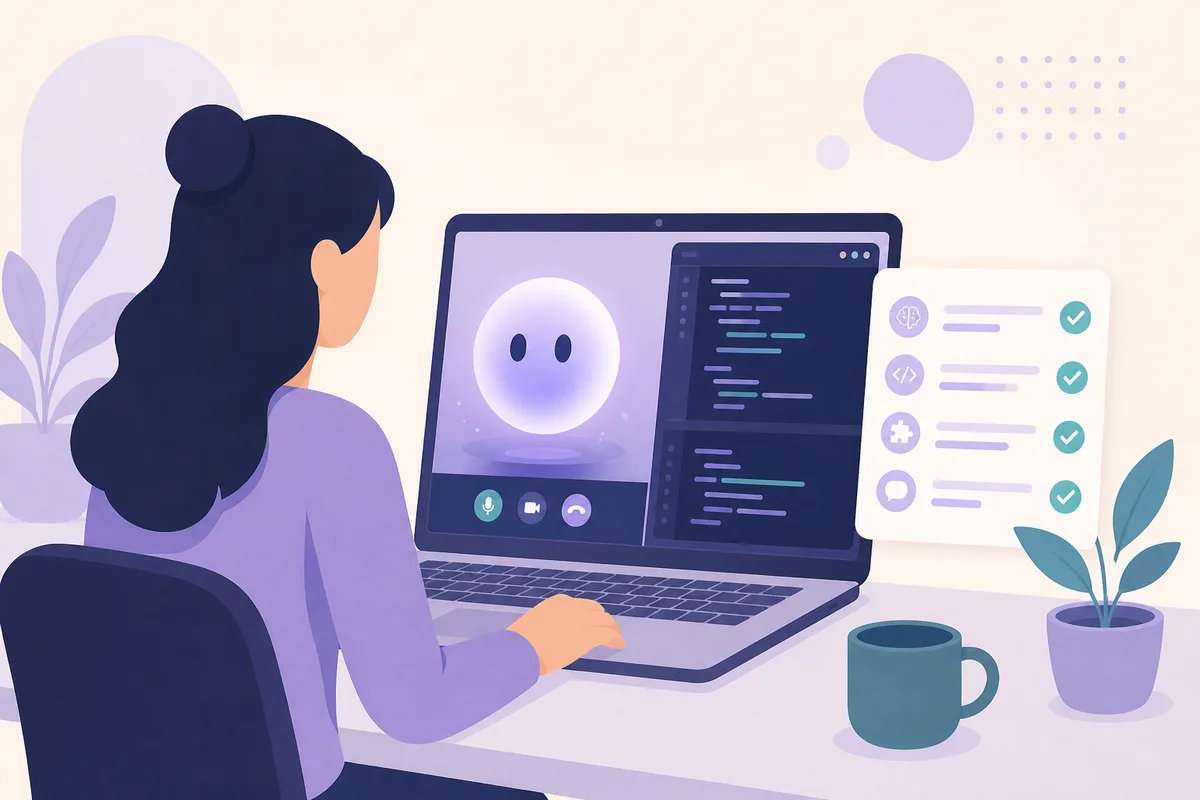
Got an OA link? Take a timed practice set now
Short answer: Chakra is HackerRank's AI interviewer. TechCrunch reported that it became generally available on 5 October 2026 after about six months in beta. Companies use it to run a structured interview without a human interviewer, and it produces a scored, evidence-linked report for the hiring team. Where we could verify details we say so; where we could not, we say that too. Last checked 29 Oct 2026.
If you have been invited to one, treat it as a conversation about your reasoning, not a quiz. This guide covers what we could verify about the experience, what it evaluates, how it differs from a normal HackerRank test, and how to prepare. Our AI mock interview lets you rehearse the same style.
What is verified (and from where)
| Claim | Source | Status |
|---|---|---|
| Name is "Chakra"; HackerRank's AI interviewer | HackerRank's own pages and release notes | Confirmed |
| Generally available 5 Oct 2026 after ~6 months beta | TechCrunch | Confirmed by press; no standalone HackerRank press release found |
| More than 500,000 beta interviews; early testers included Snowflake, Snorkel, Capgemini | TechCrunch, citing HackerRank | Company figure, not independently verified |
| Replaces recruiter screen, take-home and engineer follow-up with one session | TechCrunch, citing HackerRank | Company claim |
| Pricing | Not published | Unknown |
| Session length and exact format (voice vs text) for every deployment | Not specified in what we found | Unconfirmed |
HackerRank's own release notes say the Chakra product existed earlier in 2026 (April and July notes list features), so "generally available on 5 Oct" is about the general release, not the first time candidates saw it.
What the candidate experiences
From HackerRank's release notes and press coverage:
- An AI, not a person. The interview is run by an AI agent. The recruiter supplies a job description, Chakra proposes topics and questions, and the recruiter edits them. Each company configures its own interview, so yours may differ from a friend's.
- Adaptive questions. HackerRank describes it as probing for depth and following up on what you say, rather than reading a fixed script.
- Real-work tasks. The October 2026 release notes describe Code Repository questions in an Agentic Development Environment: you explore an existing codebase, work out requirements, plan, build with an AI assistant, and then explain your solution to Chakra. Coding questions with an in-line editor were added in July.
- Follow-ups on your choices. TechCrunch reports Chakra can ask why you chose an approach or how it would change under a new constraint.
- A demo you can try. HackerRank's guide points to live demo interviews at chakra.sh with no sign-up.
Whether your session is voice, video or text depends on the configuration; HackerRank's pages describe AI interviewers in general as voice or video but did not specify it for Chakra, so check your invitation.
What it evaluates
- Your answers and your reasoning. Scores are tied to a rubric the hiring team sets, with evidence linked to moments in the transcript. Expectations with no relevant evidence are marked "Not Assessed".
- AI fluency. For Code Repository questions, the October release notes list three dimensions: Framing (defining the problem and giving the AI useful context), Judging (reviewing and validating its output), and Steering (guiding and redirecting it toward a solution).
- Integrity signals. HackerRank says Chakra can pause the interview if you add a monitor, share your screen or leave full screen, flags tab switching, and from October analyses responses for language patterns that may be LLM-generated. HackerRank states this last signal does not by itself decide whether someone cheated. See does HackerRank record your screen.
- Humans decide. TechCrunch reports HackerRank saying Chakra scores candidates while humans make the final hiring call.
How it differs from a HackerRank online assessment
| Classic HackerRank OA | Chakra interview | |
|---|---|---|
| Format | Fixed questions, timed, auto-graded on test cases | Adaptive conversation plus tasks |
| What is scored | Correctness and sometimes speed | Reasoning, communication, judgment, AI use |
| Follow-up | None | Questions about your choices |
| AI tools | Often banned, sometimes an assistant (see here) | Can be part of the task and evaluated |
| Output to company | Score and code | Rubric report with transcript evidence |
For the OA style, see HackerRank at Goldman Sachs. The skills overlap, but passing tests is no longer enough: you must explain what you did.
How to prepare
- Narrate while you work. Say what you are checking and why. Silence leaves the evaluator nothing to score.
- Ask clarifying questions first, then restate the requirements before building.
- Practise working with an AI assistant. Give it context (Framing), read its output critically and test it (Judging), and correct it when it drifts (Steering). Do not paste its answer without explaining it.
- Prepare to defend trade-offs. Expect "what if the input is ten times larger" style follow-ups.
- Read an unfamiliar repo quickly. Practise opening a project, finding the entry point and tests, and making a small change.
- Test your setup. Single monitor, full screen, stable connection, no extra tabs.
- Rehearse out loud. Our guide on how to pass an AI interview and the AI interview questions and answers list common prompts.
A realistic walk-through of a session
HackerRank has not published a transcript, so this is an illustration built from the features above, not a recording. Suppose an employer configures a backend-engineer interview with a Code Repository task.
- Setup. You get a link, check your environment and are told you are speaking with an AI. Integrity rules (full screen, one monitor) apply from the start.
- Orientation. You open a small existing project. A good opening move is to read the README, run the tests and say aloud what you think the task is.
- Requirements. You ask what behaviour is expected on edge cases. Chakra can answer or push back; either way you are showing how you reduce ambiguity.
- Build with an assistant. You prompt the AI with real context, read its diff line by line, run the tests and fix what is wrong. This is where Framing, Judging and Steering are observable.
- Explain. You walk Chakra through the solution and defend choices. Expect a "what if" follow-up.
- Report. The hiring team receives a rubric-based report with evidence tied to moments in the transcript, and decides.
Common mistakes candidates are likely to make
- Treating it like a trivia round. The system is built to probe, so one-line answers leave little evidence to score.
- Over-trusting the assistant. Accepting generated code without running it is exactly what the Judging dimension looks for.
- Going silent while thinking. Say "I am checking the failing test" rather than staring at the screen.
- Ignoring the setup rules. An extra monitor or leaving full screen can pause the session.
- Memorising scripts. Adaptive questions follow your answers, so rehearsed monologues fall apart at the first follow-up.
What employers get, and why that shapes your answers
Understanding the recruiter's side explains why the interview feels the way it does. According to HackerRank's release notes, the hiring team receives a report on a 5-point scoring scale with evidence linked to the transcript, can export it as PDF or CSV, and can watch full session video playback. Interviews can be cloned across roles, and integrations with applicant tracking systems such as Greenhouse, Ashby and Workday are listed.
Two consequences follow. First, your answers are read against a written rubric, so concrete, specific statements ("I would add an index on the lookup column because the query filters on it") are easier to credit than general ones. Second, a human reviews the report, so clear structure helps: state the problem, your approach, the trade-off, and what you would test.
Treat each answer as evidence. If you did something well but never said so, there is nothing for the report to cite.
Who is likely to meet it
HackerRank lists more than 3,000 business customers, per TechCrunch, and named Snowflake, Snorkel and Capgemini as early Chakra testers. That does not mean every one of them uses it, and we could not verify a list of current Chakra customers. See companies using AI interviewers in 2026 for the wider picture.
Fairness and caveats
HackerRank's integrity and usage numbers are its own. TechCrunch notes that consistent criteria do not guarantee freedom from bias, and that regulators scrutinise AI hiring tools. We found no independent evidence yet on how well Chakra scores predict job performance. For more, read AI interview bias and fairness.
FAQ
What is the HackerRank AI interviewer?
Chakra, HackerRank's AI agent that interviews candidates on behalf of an employer and produces a scored report.
When did Chakra launch?
Generally available on 5 October 2026 per TechCrunch, after about six months in beta. HackerRank release notes show features shipping from April 2026.
Is a HackerRank AI interview the same as a HackerRank test?
No. A test is fixed and auto-graded; Chakra is adaptive and scores reasoning against a rubric.
Can I use AI during it?
In Code Repository questions the AI assistant is part of the task, and your use of it is evaluated. Follow the rules in your own invitation.
Is a human involved?
HackerRank says humans make the final decision; the AI scores and reports.
How long is it?
We could not verify a standard length. It is configured by each employer; check your invite.
How do I practise?
Rehearse explaining your reasoning aloud, and use an AI mock interview to get used to answering an AI.
Topics
Related on Thita
Your next step
Got an OA link? Take a timed practice set now
A timed set on Thita keeps the clock running, hides most test cases and ends with a score report on what to fix. It is practice in the format, not the employer's own test. Three sets are free with a signup; Pro adds the rest.