
Interview
HackOn with Amazon 2027: Complete Preparation Guide for the Coding Round & 48-Hour Hackathon
HackOn with Amazon explained — qualifying coding challenge, 48-hour hackathon, prototype submission, PPI path, and the DSA plan every team member needs.
HackOn with Amazon has one structural feature that decides the outcome for most teams, and almost nobody plans around it:
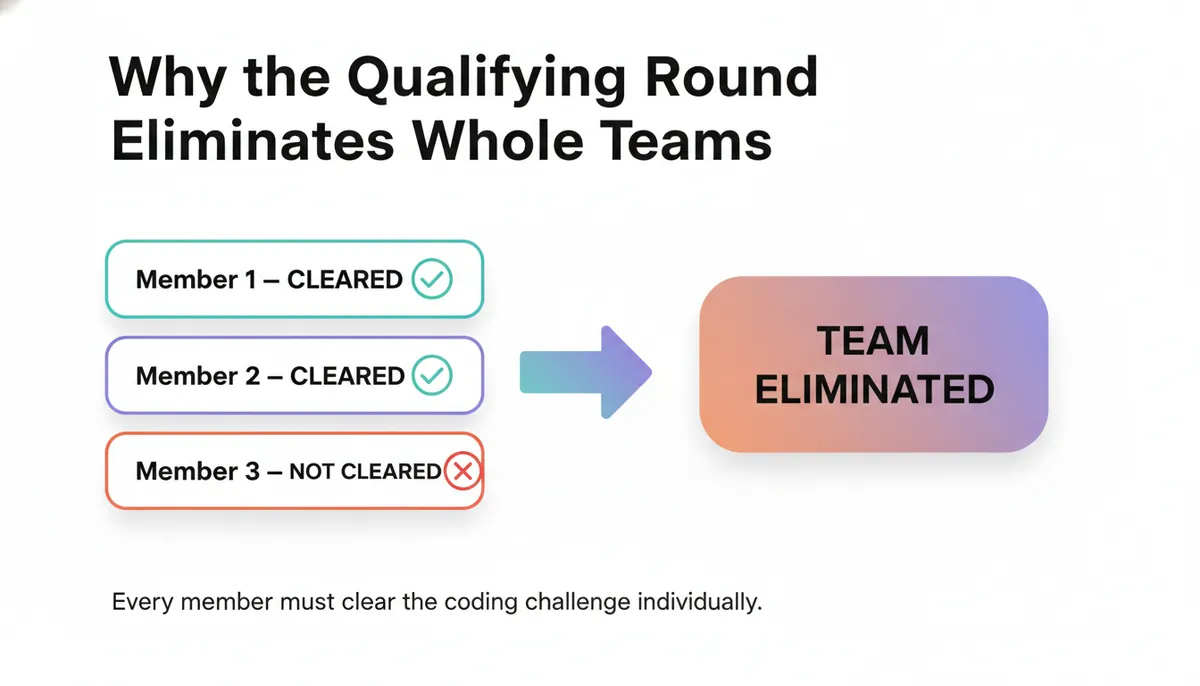
Every team member must individually clear the qualifying coding challenge for the team to advance.
Not the team average. Not the best two of three. Every single person. Which means the strongest developer in your college can build a brilliant prototype and never get to, because a teammate didn't clear a timed DSA round.
This guide covers the format, the timeline, what the coding challenge tests, how to run the 48-hour build, and the pre-placement interview path at the other end.
The one thing that matters most: make sure all 2–3 members clear Round 1. Point your whole team at the DSA Patterns Sheet and the 90-Day Interview Roadmap together — this is a team preparation problem, not an individual one.
What Is HackOn with Amazon?
HackOn with Amazon is Amazon India's flagship student coding competition, run in annual seasons — Season 6 was the 2026 edition. It combines a competitive-programming filter with a compressed 48-hour build, and it carries a genuine pre-placement interview path.
The Format
| Stage | What happens |
|---|---|
| Registration | Teams of 2–3, each member registering individually on Unstop and joining the same team |
| Coding Challenge | Timed qualifying round — every member must clear it individually |
| Kick-off webinar | Problem statement / theme reveal, rules, judging criteria |
| 48-hour hackathon | The build |
| Prototype submission | Final deliverable, usually the day after the build window closes |
For the Season 6 cycle, the sequence ran: registration closing May 28, coding challenge May 30, kick-off webinar June 12, the 48-hour hackathon June 13–14, and prototype submission June 15.
Eligibility
- Team size: 2–3 members
- Branches: CSE, IT, AI, Data Science, Cyber Security, ECE, Electrical and other circuital branches
- Cost: free
- Batch eligibility varies by season — check the official Unstop listing
The Rewards
- Prizes up to ₹2.25 lakh
- Pre-placement interview opportunities at Amazon — the actual reason to do this
- Certificates and Amazon visibility
Round 1: The Qualifying Coding Challenge
This is a standard timed algorithmic assessment, and it functions as an Amazon coding screen — because that's effectively what it is.
What Amazon Actually Tests
Amazon's coding questions cluster tightly around a recognisable set of patterns. Ranked by frequency:
- Hash maps & frequency counting — the single most common Amazon pattern family
- Arrays and prefix sums — subarray sums, running aggregates, in-place manipulation
- Two pointers & sliding window — longest/shortest subarray and substring problems
- Heaps / priority queues — top-K elements, K-closest, merge-K-lists variants
- Graphs (BFS/DFS) — grid traversal, island counting, shortest path in unweighted graphs
- Trees — level-order, path sums, lowest common ancestor
- Dynamic programming — 1D DP, knapsack, grid paths
- Binary search — including binary search on the answer
- Stacks — monotonic stack, next-greater-element, parenthesis problems
- Intervals & greedy — merging, meeting rooms, scheduling
The DSA Patterns Sheet covers all of these — 404 problems across 94 sub-patterns in 15 families — and the Amazon company kit filters it to Amazon's actual frequency distribution.
Preparing as a Team (Not as Individuals)
This is the strategic insight most teams miss. Because every member must clear the round, your team's probability of advancing is the product of three individual probabilities. Two strong members and one unprepared member is a losing configuration no matter how good the two are.
Run a team preparation protocol:
- Assess honestly at the start. Everyone solves the same three medium problems, timed. Find out where each person really is.
- Sync on the same sheet. Everyone works the same patterns in the same order so you can help each other.
- Weekly timed mock, together. Same problems, same clock, then a 30-minute review comparing approaches.
- Pair on weak areas. The strongest member's highest-leverage contribution before the hackathon isn't building anything — it's getting the weakest member across the line.
💡 Pro Tip: Choose teammates on preparation willingness, not on friendship or reputation. A teammate who won't do timed practice is a teammate who ends your run in Round 1.
The 8-Week Coding-Round Plan
| Weeks | Focus |
|---|---|
| 1–2 | Arrays, strings, hash maps — the highest-frequency Amazon families |
| 3–4 | Two pointers, sliding window, stacks, sorting/greedy |
| 5–6 | Trees, graphs, heaps |
| 7 | Dynamic programming and binary search on the answer |
| 8 | Timed simulation only — two full-length mocks per week, whole team |
The 90-Day Interview Roadmap runs this same progression with 316 problems and 22 mock interviews built in, which is the cleanest option if your team wants a shared schedule to follow.
The 48-Hour Hackathon
Once the whole team clears, you get a theme at the kick-off webinar and 48 hours to build.
Amazon themes typically orbit e-commerce, customer experience, logistics, sustainability and — increasingly — applied AI. Expect a broad theme rather than a narrow spec, which means scoping is your first real technical decision.
The 48-Hour Plan
| Hours | Focus | Gate |
|---|---|---|
| 0–3 | Idea selection, ruthless scoping, architecture, repo + deploy setup | A deployed hello-world is live |
| 3–12 | The core technical piece | The hard part works on one real input |
| 12–20 | The interface around it | A stranger can complete the main flow |
| 20–24 | Halfway checkpoint — integrate everything end to end | If nothing is demoable, cut scope now |
| 24–34 | Depth: second feature, edge cases, realistic data | — |
| 34–40 | Bug fixing, performance, deployment hardening | Nothing crashes on the happy path |
| 40–45 | Demo video, README, submission package | Demo runs three times clean |
| 45–48 | Buffer | Because something always breaks |
⚠️ Important: Submission is a separate deadline after the build window. Package early — a working project that misses the submission format is a self-inflicted zero. Read the submission requirements on day one, not hour 47.
What Amazon Evaluates
Amazon's engineering culture shows up in the judging. They reward:
- Customer obsession — is there a real user with a real problem, described concretely?
- Working software — a running demo, not an architecture diagram
- Scale thinking — what breaks at 10 million users, and do you know?
- Ownership — can each member explain their own contribution in depth?
- Bias for action — did you ship something complete, or over-plan something incomplete?
✅ Do seed your demo with realistic data. "Test User 1" reads as unfinished.
✅ Do record a backup demo video. Venue and home internet both fail.
❌ Don't build a wrapper around an API and call it the project. The hard technical piece is what gets scored.
❌ Don't add features after hour 34. Polish beats scope.
For the full build-and-demo playbook, see how to win a hackathon.
The PPI Path
Strong performers get pre-placement interview opportunities — and Amazon's interviews are a well-defined loop that you should prepare for separately.
| Round | Content | Prepare with |
|---|---|---|
| Technical 1–2 | DSA, 1–2 problems per round, live coding | DSA Patterns Sheet + AI mock interviews |
| Technical 3 | Low-level design / OOD | LLD sheet |
| Bar Raiser | Leadership Principles, deep behavioural probing | Behavioural sheet |
| System design | For experienced/senior profiles | System design sheet |
⚠️ Important: Amazon's Leadership Principles round is not a soft round. Prepare 8–10 STAR stories mapped to principles like Customer Obsession, Ownership, Dive Deep, Bias for Action, and Invent and Simplify. Your hackathon project is excellent raw material for several of them — but only if you've rehearsed it as a story with a decision, a trade-off and a result.
Common Mistakes
❌ Only the "coder" preparing. Every member must clear Round 1 individually. This is the number one cause of team elimination.
❌ Forming a team on the deadline. Recruit 8+ weeks out so you can prepare together.
❌ Untimed DSA practice. The qualifying round is a speed test.
❌ Reading the submission format at hour 47. Read it at hour zero.
❌ Over-scoping the 48 hours. Two working features beat five half-features, every time.
❌ Treating the PPI as a reward rather than an interview. It's a full Amazon loop, Bar Raiser included.
Frequently Asked Questions
What is the team size for HackOn with Amazon?
Teams of 2–3 members. Every member registers individually on Unstop and joins the same team before the registration deadline.
Does everyone on the team need to clear the coding round?
Yes. Every member must individually clear the qualifying coding challenge for the team to advance. This is the single most important rule of the competition.
Which branches are eligible?
CSE, IT, AI, Data Science, Cyber Security, ECE, Electrical and other circuital branches. Graduating-batch eligibility varies by season.
How hard is the HackOn coding challenge?
It functions as an Amazon coding screen — medium-difficulty algorithmic problems, tightly timed. Hash maps, arrays, heaps, graphs and sliding window dominate.
What are the prizes?
Up to ₹2.25 lakh in prizes, plus pre-placement interview opportunities at Amazon — which is the more valuable outcome.
When does registration open?
Historically in the April–May window; Season 6 registration closed on May 28, 2026 with the coding challenge on May 30. Watch Amazon's Unstop listings from around March.
What if registration has closed for this season?
Prepare for the next season and for Amazon's regular campus process — the technical bar is identical. Start the 90-Day Roadmap, and check the hackathon calendar for events with open windows right now.
Final Thoughts
HackOn with Amazon is a team competition with an individual gate. The teams that get to build are the ones where all three members did timed DSA practice for two months — not the ones with the best idea.
Do these three things:
- Recruit your team 8+ weeks early, on willingness to prepare
- Put the whole team on the DSA Patterns Sheet and run weekly timed mocks together
- Follow the 90-Day Interview Roadmap so the qualifying round and the eventual PPI loop are both covered
Related reading: Hackathon calendar 2026-27 · Flipkart GRiD guide · How to win a hackathon