
Interview
Flipkart GRiD 9.0 (2027): Dates, Rounds & Results
Flipkart GRiD 9.0 (2027 cycle): registration status, eligibility, all 4 rounds, and the DSA plan that clears the coding assessment (Round 2).
Flipkart GRiD is the largest engineering challenge in India, and unlike most campus competitions it is unambiguously a hiring funnel. Clear the rounds and you're in conversation for Flipkart internships and SDE roles — not a certificate.
It's also the most DSA-heavy event on the Indian hackathon circuit. GRiD does not eliminate you on your idea; it eliminates you on a timed coding assessment, and it does so early. That means preparation for GRiD looks much more like interview preparation than hackathon preparation.
This guide covers the four rounds, the three tracks, eligibility, and exactly what to work on to clear the round that filters most people out.
Start here if the coding round is what worries you: the DSA Patterns Sheet covers 404 problems across 94 sub-patterns, and the 90-Day Interview Roadmap sequences it day by day.
Key Dates & Results (last checked 2026-09-07)
| Stage | Status |
|---|---|
| Most recent confirmed edition | GRiD 8.0 — the 2026 cycle |
| GRiD 9.0 (2027 cycle) registration | not announced yet (last checked 2026-09-07) |
| Round 1 — Profile screening | Dates not announced yet (last checked 2026-09-07) |
| Round 2 — Coding assessment | Dates not announced yet (last checked 2026-09-07) |
| Round 3 — Case study round | Dates not announced yet (last checked 2026-09-07) |
| Round 4 — National Grand Finale | Dates not announced yet (last checked 2026-09-07) |
Flipkart runs GRiD in numbered annual editions and has not published GRiD 9.0 dates anywhere Thita could confirm — watch the official Flipkart GRiD page for the registration window to open.
What Is Flipkart GRiD?
GRiD is Flipkart's annual national engineering challenge, run in editions — GRiD 8.0 was the 2026 cycle. It's free to enter, conducted online except for the Grand Finale, and open to engineering students across India.
The most important structural fact: registration is individual, not by team. Teams are formed by Flipkart for the Grand Finale. So unlike Adobe's hackathon or Smart India Hackathon, you don't need to recruit anyone — you advance on your own performance.
Eligibility
For the GRiD 8.0 cycle:
- Programmes: B.E., B.Tech., M.E., M.Tech., M.S., PhD, dual and integrated degrees
- Graduating batches: roughly 2027 through 2031, varying by programme length
- Institutions: colleges across India
- Cost: free
⚠️ Important: Batch eligibility is the most common disqualifier. Check the exact eligible years for your specific programme on the official listing before you build a plan around it — the rules differ between a four-year B.Tech and a five-year integrated degree.
The Tracks
You apply to one or more of:
| Track | Who it's for | What it tests |
|---|---|---|
| Software Development | Core SDE aspirants | DSA, system thinking, clean implementation |
| AI Engineering | ML/AI-focused students | Modelling, applied ML, plus coding fundamentals |
| Data Science | Analytics and DS students | Statistics, SQL, feature engineering, ML |
💡 Pro Tip: Applying to multiple tracks is allowed and usually worth it — but only if you can prepare for both. A half-prepared second track costs you time you should have spent on your primary.
The Four Rounds
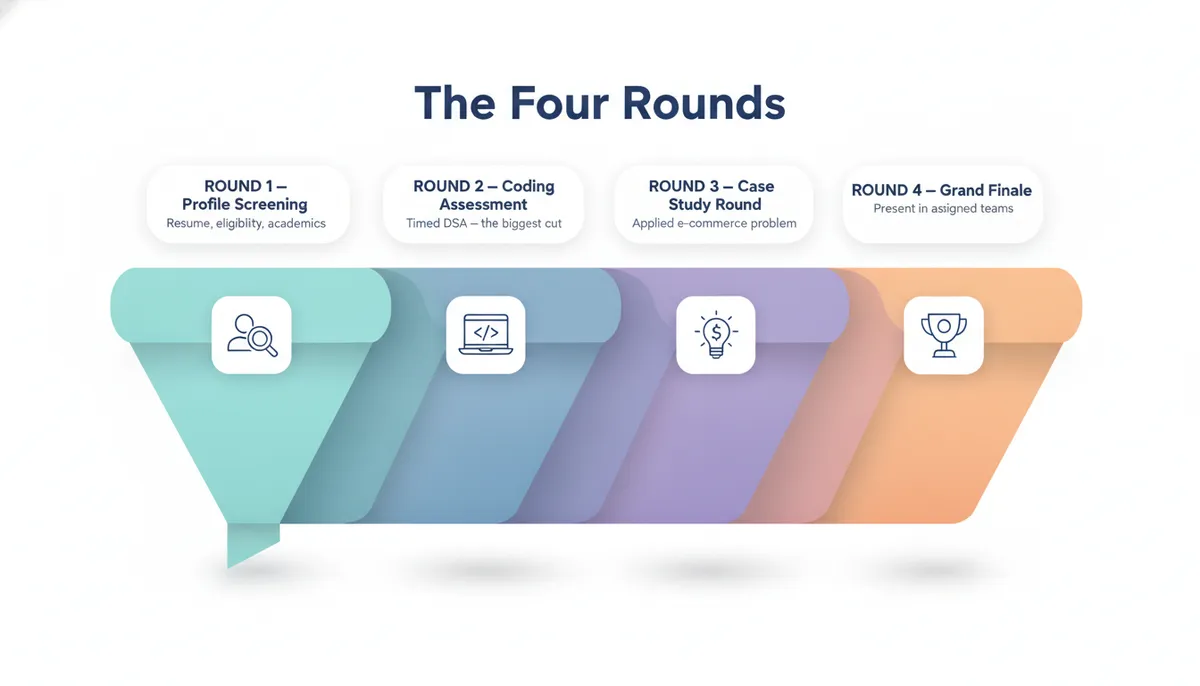
| Round | Format | What it filters |
|---|---|---|
| Round 1 | Profile screening | Resume quality, eligibility, academics |
| Round 2 | Coding assessment (timed, online) | Raw DSA under a clock — the biggest cut |
| Round 3 | Case study / applied coding round | Problem-solving on a realistic e-commerce problem |
| Round 4 | National Grand Finale | Presentation and depth, in Flipkart-assigned teams |
Round 1: Profile Screening
Your registration profile and resume are screened. This is low-effort to prepare for and high-cost to ignore.
- Keep the resume to one page, cleanly structured: Education → Projects → Skills → Achievements
- Quantify every project bullet — "reduced query latency 40%," not "worked on optimisation"
- List real, working links: GitHub, deployed demos
- Make sure your coding-platform profiles (LeetCode, Codeforces) are visible if they're strong
Run the draft through the Resume Analyzer before you submit — weak verbs and missing metrics are the two things that quietly sink screening-stage profiles.
Round 2: The Coding Assessment (The Real Filter)
This is where GRiD is won or lost. A timed online assessment, typically medium-difficulty algorithmic problems, with a clock that punishes hesitation.
What "medium difficulty" actually demands: you need to recognise the pattern within about a minute and produce a working, correct solution in 20–25 minutes. That's not a knowledge problem — it's a recognition-speed problem, and recognition speed comes from covering patterns systematically rather than solving problems randomly.
The patterns that dominate e-commerce-flavoured assessments:
- Arrays & prefix sums — inventory, pricing windows, cumulative aggregates
- Hash maps — deduplication, frequency, order-lookup problems
- Sorting with custom comparators — ranking, priority ordering
- Two pointers & sliding window — subarray optimisation
- Heaps / priority queues — top-K problems, scheduling, delivery slotting
- Graphs — shortest path, dependency resolution, supply-chain flavoured problems
- Dynamic programming — knapsack variants (packing, bundling, discounts)
- Binary search — including binary search on the answer, which shows up constantly
- Intervals & greedy — merging, scheduling, resource allocation
The DSA Patterns Sheet organises exactly these into 94 sub-patterns across 15 families with 404 curated problems. For frequency weighting specific to Flipkart, use the company-wise kits.
💡 Pro Tip: Practise timed. Solving a medium problem in 45 unhurried minutes builds false confidence. Run 90-minute two-problem sessions weekly until finishing inside the clock is normal.
Round 3: The Case Study / Applied Round
Shortlisted candidates get a more realistic problem — usually framed around actual e-commerce mechanics: recommendation, logistics routing, catalogue search, pricing, fraud detection, warehouse allocation.
This round rewards a different skill: turning an ambiguous business problem into a tractable technical one.
How to approach it:
- Restate the problem in terms of inputs, outputs and constraints before writing any code
- State your assumptions explicitly — evaluators grade the reasoning, not just the output
- Start with a correct baseline, then optimise. A working simple solution beats a broken sophisticated one.
- Address scale — Flipkart problems always have a "what if this is 100 million rows" dimension
- Document trade-offs — what you chose, what you rejected, and why
For track-specific depth: Software Development candidates should be comfortable with low-level design and system design basics; Data Science candidates should be fluent in SQL and feature engineering — see the Data Science & AI sheet.
Round 4: The Grand Finale
The finale is on-site, and Flipkart forms the teams. You'll present to Flipkart engineers and leadership.
What matters here:
- Clarity of the demo — 90 seconds, live, on the happy path
- Depth on your own contribution — "which part did you write?" is guaranteed
- Trade-off reasoning — every architectural choice will be questioned
- Collaboration — you're being evaluated as a future colleague on a team you didn't pick
Practise defending technical decisions under interruption. AI mock interviews are the closest simulation of that pressure you can get on demand.
The Preparation Plan
Work backwards from the registration date. Registration for GRiD 8.0 closed on July 7, so a typical cycle gives you the whole academic year if you start early.
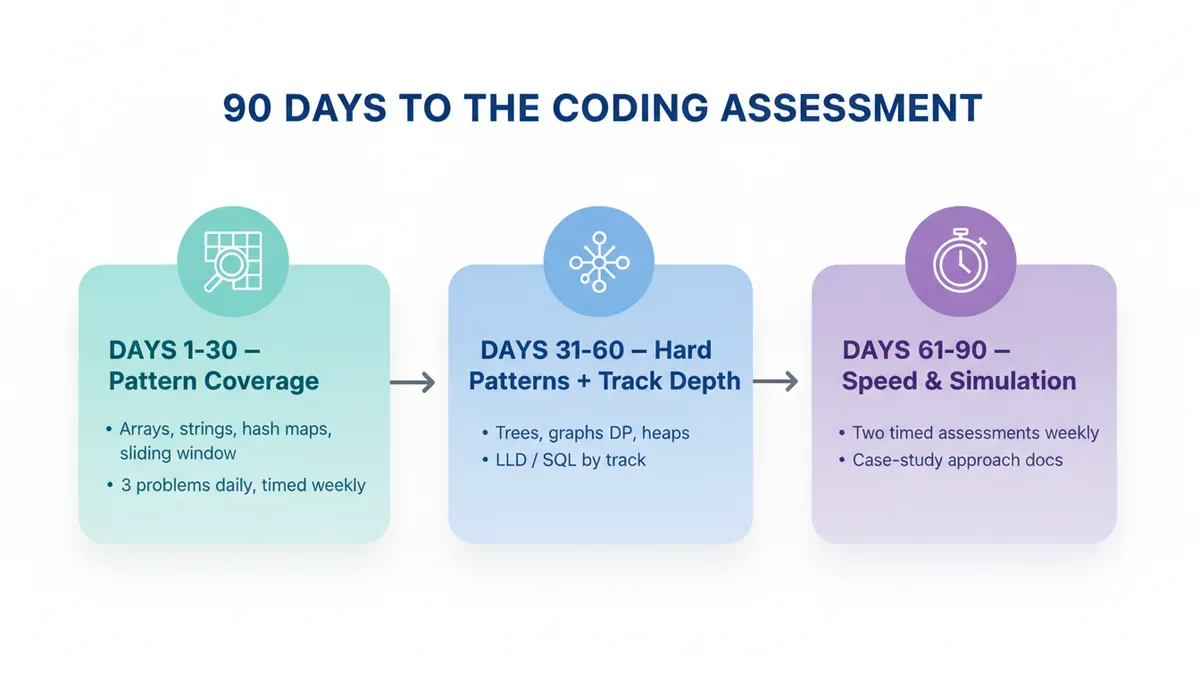
Days 1–30: Pattern Coverage
- Arrays, strings, hash maps, two pointers, sliding window, sorting
- 3 problems daily from the DSA Patterns Sheet
- Keep a one-line note per problem on what signalled the pattern
- One 90-minute timed mock per week
Days 31–60: Hard Patterns + Track Depth
- Trees, graphs, dynamic programming, heaps, binary search on the answer
- Add track-specific work: LLD/system design for SWE, SQL and ML fundamentals for DS/AI
- Clear the Flipkart-relevant company kit
- Two timed mocks per week
Days 61–90: Speed and Simulation
- Full-length timed assessments twice a week
- Case-study practice: take a real e-commerce problem and write a one-page approach doc, weekly
- Daily AI mock interviews alternating DSA and project defence
- Polish the resume with the Resume Analyzer
The 90-Day Interview Roadmap packages this exact sequence — 316 DSA problems, 114 theory modules, 22 mock interviews — if you'd rather follow a plan than build one.
Common Mistakes
❌ Registering and then starting preparation. The assessment often follows registration closely. Prepare first, register second.
❌ Untimed practice. GRiD's coding round is a speed test disguised as a correctness test.
❌ Ignoring the resume round. People who could clear Round 2 never get there because of a weak profile.
❌ Applying to all three tracks unprepared. Depth in one beats presence in three.
❌ Skipping the scale question in Round 3. Every Flipkart problem has a "what if it's 100x bigger" dimension, and ignoring it is a visible gap.
❌ Treating the finale as a formality. It's an evaluation of you as a hire, in a team of strangers.
Frequently Asked Questions
Who is eligible for Flipkart GRiD?
B.E./B.Tech, M.E./M.Tech, M.S., PhD, and dual/integrated degree students, with eligible graduating batches spanning roughly 2027–2031 depending on programme. Check the official listing for your exact programme.
Is Flipkart GRiD a team competition?
No — registration is individual and all early rounds are solo. Flipkart forms teams for the Grand Finale.
How hard is the Flipkart GRiD coding round?
Medium difficulty by LeetCode standards, but timed tightly. The bar is recognising the pattern quickly and implementing cleanly, not solving exotic problems.
Can I apply to more than one track?
Yes, multiple tracks are permitted. Only do it if you can genuinely prepare for both.
Does Flipkart GRiD lead to a job?
Yes — it feeds directly into Flipkart internships and SDE roles. It's one of the most direct hiring funnels on the Indian hackathon circuit.
When does registration open?
Historically mid-year — GRiD 8.0 registration closed on July 7, 2026. Watch the official Flipkart careers and Unstop listings from roughly May onwards for the next edition.
What should I do if registration has already closed?
Prepare for the next edition and for Flipkart's regular campus process — the technical bar is the same. Start the 90-Day Roadmap now and check the hackathon calendar for events with open windows.
Final Thoughts
GRiD rewards one thing above all others: DSA fluency under a clock. Everything else — the case study, the finale — is downstream of clearing Round 2, and Round 2 is a pure function of how systematically you've covered patterns.
Your next three steps:
- Work the DSA Patterns Sheet in pattern order, timed
- Filter to your target company with the company-wise kits
- Run the 90-Day Interview Roadmap so you're ready when registration opens, not scrambling after
Related reading: Hackathon calendar 2026-27 · HackOn with Amazon guide · How to win a hackathon