
Interview
How Many Hours Should You Study Daily for Coding Interviews?
Most candidates don’t fail coding interviews because they’re “bad at algorithms.” They fail because they mismanage time: too many random LeetCode problems, n...

Most candidates don’t fail coding interviews because they’re “bad at algorithms.” They fail because they mismanage time: too many random LeetCode problems, not enough structure, and no realistic plan for daily interview prep time.
So how many hours should you actually study daily for coding interviews?
The honest answer: it depends on your background, timeline, and goals—but there are concrete ranges and patterns that work reliably. In this guide, we’ll walk through how to decide your own daily study hours for coding interviews, how to build a sustainable coding interview study schedule, and how to adjust over time without burning out.
1. The Real Question: Hours Per Day vs. Total Hours
When people ask “How many hours should I study daily for coding interviews?”, they’re usually mixing two different questions:
- How many total hours does solid prep require?
- How do I distribute those hours per day given my schedule?
You can think of interview prep like a project:
- There’s a total effort required (e.g., 150–250 hours for a strong DSA + system design foundation).
- There’s a deadline (e.g., interviews in 8 weeks).
- Your daily study hours come from dividing total effort by time available, then adjusting for sustainability.
A rough rule of thumb:
- Light prep / long runway (4–6 months): 1–2 hours per day, 5–6 days/week
- Moderate prep / medium runway (2–3 months): 2–3 hours per day, 5–6 days/week
- Intensive prep / short runway (4–8 weeks): 3–5 hours per day, 6 days/week
Those are starting points. The rest of this article explains how to select the right band for you and how to turn it into a concrete, realistic plan.
2. Key Factors That Determine Your Daily Study Hours
Before picking a number, you need to evaluate four variables.
2.1 Your Current Level
Roughly categorize yourself:
-
Beginner in DSA
- Rarely solved LeetCode-style problems
- Weak on time/space complexity
- Not comfortable with recursion, pointers, or basic data structures
- You’ll need more total hours and slower pacing.
-
Intermediate
- Have solved 50–150 LeetCode problems
- Know arrays, hash maps, trees, recursion, basic DP
- Struggle with consistency and pattern recognition
- You can ramp faster with a structured pattern-based plan like the Beginner to Advanced DSA Roadmap for Software Engineers in 2026.
-
Advanced
- 200+ LeetCode problems
- Comfortable with most common DSA patterns
- Main gaps: speed, communication, edge cases
- You need focused practice and mock interviews more than raw problem volume.
The less experience you have, the more time you need—but that doesn’t necessarily mean more daily hours. It might mean starting earlier with lower daily intensity.
2.2 Time Until Interviews
Your runway strongly affects your daily interview prep time:
- > 4 months: You can afford 1–2 hours/day, focus on fundamentals and breadth.
- 2–4 months: 2–3 hours/day is ideal to cover patterns and do multiple passes.
- < 2 months: 3–5 hours/day is often required to see enough problems and patterns.
If your runway is very short (e.g., 2–3 weeks), your goal should shift from “master everything” to “maximize impact on the highest-yield patterns and mock interview practice,” including using tools like AI Mock Interviews vs Real Interviews: Do They Actually Help?.
2.3 Other Commitments (Job, School, Life)
Be realistic. A full-time engineer with a family will not sustainably do 5 hours/day for 8 weeks.
- Full-time job: 1–3 hours on weekdays, 3–5 hours on weekends is already strong.
- Student with classes: 2–4 hours/day is often achievable with good scheduling.
- Between jobs: 4–6 hours/day is possible, but should be structured with breaks to avoid burnout.
Consistency beats heroics. A sustainable 2 hours/day for 12 weeks is better than 6 hours/day for 7 days followed by burnout.
2.4 Target Companies and Roles
-
Top-tier companies (FAANG, top startups):
- Expect deeper coverage of DSA patterns, system design (for experienced roles), and behavioral.
- You’ll likely be aiming toward the higher end of the daily study range.
-
Mid-sized / smaller companies:
- Still need solid fundamentals, but often less breadth.
- You may get away with fewer total hours if you focus on the right patterns.
3. Recommended Daily Study Hours by Profile
Here’s a simple table that maps common profiles to suggested daily hours.
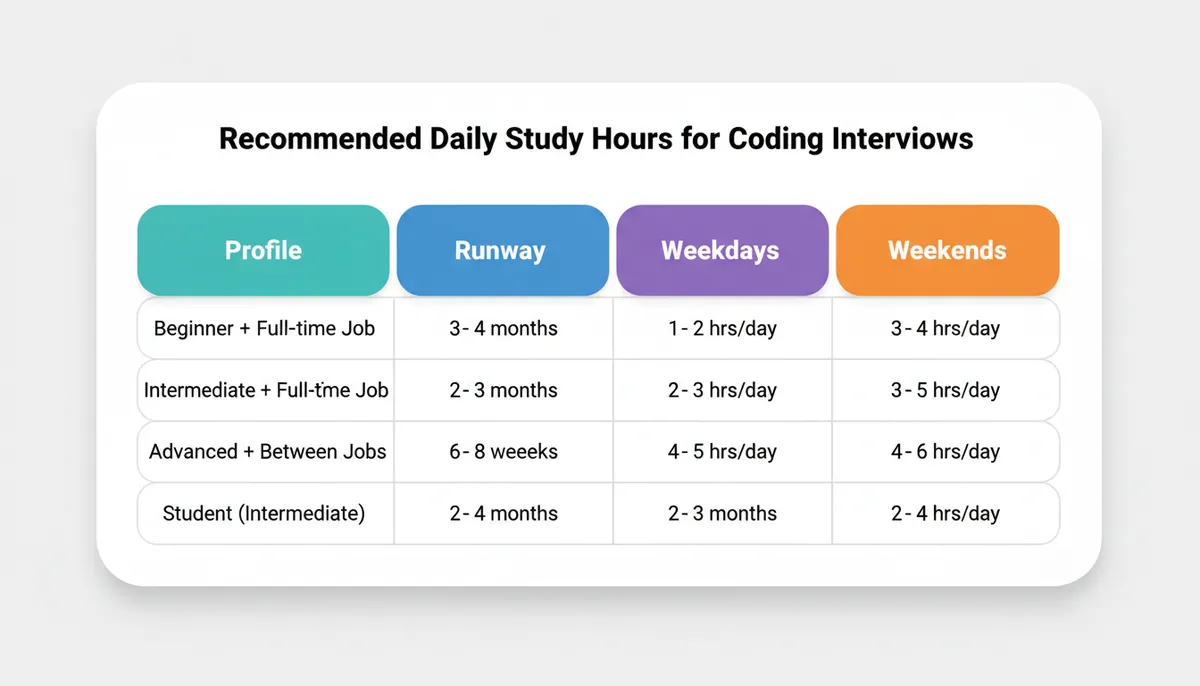
Use this as a starting point, then adjust based on your energy and progress after 1–2 weeks.
4. Why “More Hours” Isn’t Always Better
The naive approach is: “I’ll just do 8 hours of LeetCode every day until I get good.” That fails for three reasons:
- Diminishing returns: After 2–4 hours of focused problem-solving, your ability to reason clearly drops.
- Shallow learning: Grinding random problems without reflection or pattern extraction leads to memorization, not understanding.
- Burnout: Interview prep is a marathon. Unsustainable intensity usually leads to quitting.
Effective prep is not just about raw hours. It’s about how you allocate those hours:
- Concept review
- Pattern-based problem solving
- Deliberate review of mistakes
- Timed practice
- Mock interviews
- System design and behavioral (for experienced candidates)
5. A Pattern-Based Daily Coding Interview Study Schedule
Instead of asking “How many hours?”, think in terms of blocks of work. Here’s a template schedule for 2.5 hours per day, which you can scale up or down.
5.1 Example: 2.5-Hour Daily Interview Prep Time (Weekday)
Block 1 – 30 minutes: Concept & Pattern Review
- Review 1–2 DSA patterns (e.g., Sliding Window, Two Pointers, Binary Search).
- Skim 1–2 example problems per pattern.
- Write down:
- When to use this pattern
- Typical time/space complexities
- Common pitfalls
Block 2 – 75 minutes: Focused Problem Solving (2–3 problems)
- Choose 2–3 problems that share the same pattern.
- For each:
- Spend up to 15–20 minutes thinking without looking at the solution.
- If stuck, reveal a hint or partial solution, then continue.
- After solving, write a brief summary:
- Core idea
- Time/space complexity
- Edge cases
- Optionally, re-implement once from scratch without looking.
Block 3 – 30 minutes: Review & Spaced Repetition
- Revisit 1–2 problems from previous days that you found hard.
- Try to solve from memory. If you can’t, that’s normal:
- Re-learn the solution.
- Add notes on what you forgot (indexing detail, base case, etc.).
Block 4 – 15 minutes: Communication Practice
- Pick one problem from today.
- Explain your solution out loud as if in an interview:
- Problem restatement
- Constraints
- High-level idea
- Complexity
- Edge cases
- Optionally, record yourself or use an AI mock interview tool like Thita’s AI Interview Practice: Free Mock Interview Simulator with Real-Time Feedback for Technical Interviews to simulate the experience.
You can compress this to ~1.5 hours/day (1 problem instead of 3) or expand to ~4 hours/day (more problems and longer mock interviews).
6. Example Weekly Coding Interview Study Schedules
To make this concrete, here are two sample schedules with realistic daily interview prep time.
6.1 Schedule A: Full-Time Job, 2–3 Months Until Interviews
Goal: 15–18 hours/week
- Mon–Thu: 2 hours each (8 hours total)
- Fri: 1–1.5 hours (light review)
- Sat: 4–5 hours
- Sun: 2–3 hours (including mocks and recap)
Weekly structure:
- Mon–Tue: Arrays, Strings, Hash Maps (core patterns)
- Wed–Thu: Trees, Graphs, BFS/DFS
- Fri: Light review, revisit 3–4 tricky problems
- Sat:
- 2–3 hours: New problems (e.g., DP, Backtracking)
- 1–2 hours: Timed sets (2 problems in 60–75 minutes)
- Sun:
- 1–1.5 hours: Mock interview (live or AI)
- 1–1.5 hours: Review mock, identify weaknesses, plan next week
6.2 Schedule B: Between Jobs, 6–8 Weeks Until Interviews
Goal: 30–35 hours/week
- Mon–Sat: 4–5 hours/day
- Sun: 3–4 hours (lighter, retrospective)
Daily structure (Mon–Sat):
- 45 min: Pattern review + 1 warm-up easy problem
- 2 hours: 3–4 medium problems in a single pattern
- 45 min: Review + spaced repetition
- 45–60 min: Alternate between:
- Mock interviews
- System design practice (if applicable)
- Behavioral prep
Sunday:
- 1–2 hours: Mock interviews (2 sessions)
- 1–2 hours: Review, update notes, adjust plan for next week
7. How Many LeetCode Problems per Day Is Enough?
A common variant of the main question: “How many LeetCode questions should I do per day?”
The answer depends on difficulty and depth:
- Beginner / 1.5–2 hours/day:
- 1–2 easy + 1 medium
- Intermediate / 2–3 hours/day:
- 2–3 medium (plus occasional easy/hard as needed)
- Intensive / 4–5 hours/day:
- 3–4 medium + 1 hard or 4–5 medium
But the more important metric is patterns mastered, not raw problem count.
If you’re using a pattern-based learning system (e.g., Thita’s What Are DSA Patterns? A Complete Guide for Beginners), aim to:
- Cover 2–3 new patterns per week.
- Solve 5–10 representative problems per pattern over time.
- Revisit difficult problems 2–3 times across weeks.
8. Sample 6-Week LeetCode Study Plan (Pattern-Based)
Here’s a compact view of how to map your hours into a pattern-based leetcode study plan.
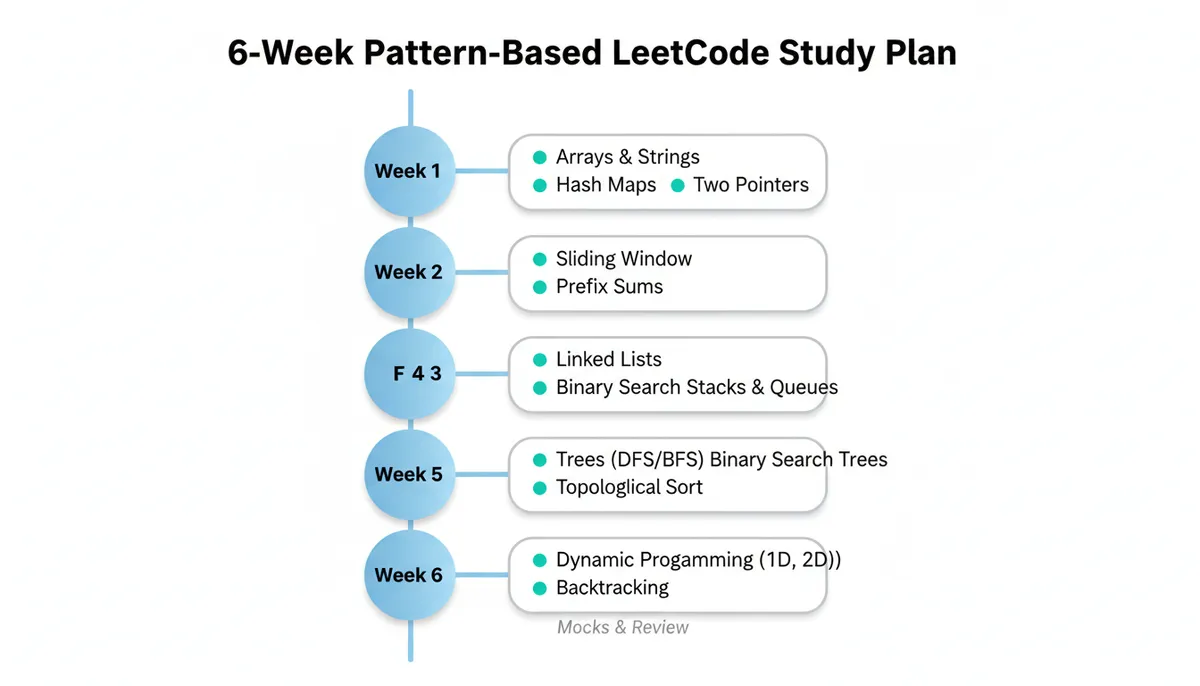
Assuming ~2–3 hours/day, 5–6 days/week:
- Weeks 1–2: Core data structures + fundamental search patterns
- Weeks 3–4: Linked structures, trees, and traversal patterns
- Weeks 5–6: Graphs, DP, and intensive mocks/review
For each week:
- Spend ~60–90 minutes/day on new problems in the current patterns.
- Spend ~30–45 minutes/day revisiting older patterns.
- Reserve 1–2 mock interviews per week from Week 3 onward.
9. Balancing DSA, System Design, and Behavioral Prep
If you’re an experienced engineer, your daily coding interview study schedule shouldn’t be 100% LeetCode.
A typical split for 3 hours/day might look like:
- 1.5–2 hours: DSA / coding problems
- 30–45 minutes: System design (for mid/senior roles)
- 15–30 minutes: Behavioral prep
Over a week:
- 4–5 days focused on DSA
- 2–3 days with system design blocks
- 2–3 days with behavioral practice (stories, STAR format, etc.)
You can simulate full interview rounds using tools like Thita’s /ai-interview and then feed the feedback into your next week’s plan.
10. Common Mistakes in Planning Study Hours for Coding Interviews
10.1 Overestimating Sustainable Daily Hours
- Planning for 5 hours/day after a full-time job is rarely sustainable.
- Result: you do it for 2 days, then skip 3 days, then feel behind and demotivated.
Fix: Start with a realistic baseline (e.g., 1.5–2 hours/day), maintain it for 2 weeks, then add 30–60 minutes if you can.
10.2 Underestimating Review Time
Many candidates spend 100% of their daily interview prep time on new problems.
- That leads to shallow familiarity, not mastery.
- You forget older problems and repeatedly make the same mistakes.
Fix: Allocate at least 25–35% of your daily time to:
- Reviewing previous problems
- Re-implementing tricky solutions
- Summarizing patterns and pitfalls
10.3 Ignoring Communication and Mock Interviews
You can solve problems alone but freeze in real interviews because:
- You’ve never practiced thinking out loud.
- You’re not used to time pressure and interruptions.
Fix:
- Start mock interviews early (Week 2 or 3), not just at the end.
- Use AI or peers for practice, even if it’s just 1 mock/week initially.
- Reserve at least 1 hour/week for mock interviews once you’re past the basics.
10.4 Focusing on Problem Count Over Understanding
“300+ LeetCode problems” is a vanity metric if:
- You can’t explain why a solution is O(n log n) instead of O(n²).
- You can’t derive the solution under pressure without memorization.
Fix:
For each problem, ensure you can answer:
- What pattern does this problem use?
- Why is that pattern appropriate?
- What’s the time and space complexity?
- What are the tricky edge cases?
If you can’t, you haven’t finished that problem, regardless of the time spent.
11. How to Adjust Your Daily Interview Prep Time Over Time
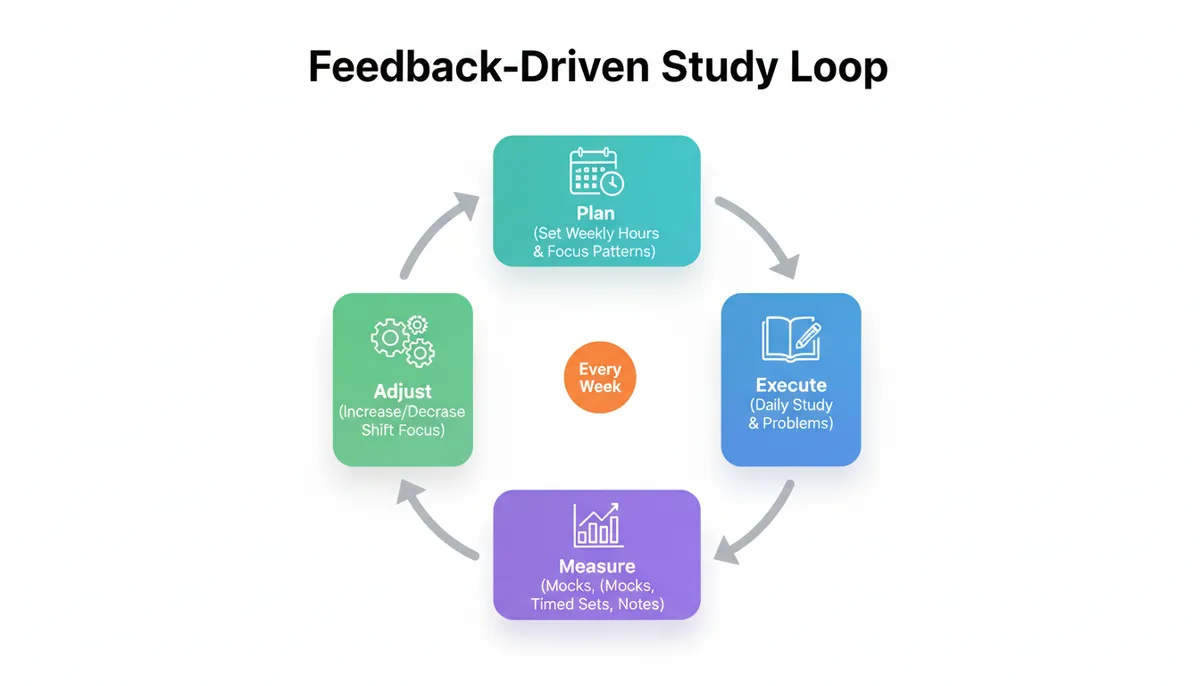
Your daily study hours are not static. You should adapt based on feedback:
11.1 Weekly Retrospective
Once per week, ask:
- How many hours did I plan vs. actually complete?
- Which patterns still feel weak?
- Did I feel burned out or energized?
Based on this:
- If you’re consistently missing your target hours → reduce by 30–60 minutes/day and tighten focus.
- If you’re consistently hitting your target and feel fine → consider increasing by 30 minutes/day or adding more mocks.
11.2 Performance-Based Adjustment
Use your performance to drive changes:
-
If you’re:
- Solving easy problems in <10 minutes
- Solving most medium problems in 20–30 minutes
- Explaining solutions clearly
→ You might reduce raw problem volume and increase mocks/system design.
-
If you’re:
- Taking 45+ minutes on easy problems
- Frequently stuck on implementation details
→ Spend more time on fundamentals and fewer new problems per day.
12. Best Practices for Effective Daily Coding Interview Study
12.1 Timebox Your Practice
- Use a timer for each problem (e.g., 20–25 minutes).
- If you’re completely stuck, move to hints or solutions rather than grinding for an hour with no progress.
12.2 Use Active Recall and Spaced Repetition
- After solving a problem, close the tab and re-implement from memory.
- Revisit difficult problems 2–3 times over 1–3 weeks.
- Maintain a lightweight “error log” of:
- Problem name
- Pattern
- What went wrong
- What to watch out for next time
12.3 Mix Easy, Medium, and Hard
- Start each session with 1 easy problem as a warm-up.
- Spend most of your time on mediums—they’re closest to real interviews.
- Use hard problems sparingly to stretch yourself, not as a daily requirement.
12.4 Protect Deep Work Time
- Turn off notifications during your 60–90-minute problem-solving blocks.
- Avoid context switching (e.g., checking email, Slack) mid-problem.
- Treat your daily interview prep time like a meeting with your future self: non-negotiable.
12.5 Simulate Real Interview Conditions Regularly
Every week or two:
- Do a 45–60 minute timed session:
- 1–2 medium problems
- No pausing the timer
- Explain out loud as you go
- Review:
- Did you clarify requirements?
- Did you consider edge cases early?
- Did you analyze complexity?
Over time, integrate AI-based mock interviews or peer interviews to approximate real conditions more closely, as discussed in Best Ways to Use AI for DSA and Coding Interview Preparation.
13. Putting It All Together: A Simple Decision Framework
To decide how many hours you should study daily for coding interviews:
-
Assess your profile:
- Beginner / intermediate / advanced?
- Full-time job / student / between jobs?
- Time until interviews?
-
Pick an initial daily range:
- Full-time + 3–4 months: 1.5–2.5 hours/day
- Full-time + 2–3 months: 2–3.5 hours/day
- Between jobs + 6–8 weeks: 4–5 hours/day
- Student + 2–4 months: 2–3 hours/day
-
Design a weekly structure:
- 60–75%: DSA / pattern-based problems
- 20–30%: Review, re-implementation, notes
- 10–20%: Mocks, system design, behavioral
-
Run the plan for 2 weeks.
-
Adjust based on:
- Actual hours vs. planned hours
- Problem-solving speed and accuracy
- Energy levels and signs of burnout
Key Takeaways
- There is no single magic number of study hours for coding interviews; effective ranges are:
- 1–2 hours/day for long runways
- 2–3 hours/day for moderate timelines
- 3–5 hours/day for intensive short-runway prep
- Focus on patterns mastered, not just LeetCode problem counts.
- Allocate time across:
- New problems
- Review and pattern consolidation
- Mock interviews and communication
- Start with a realistic daily interview prep time, then adjust using weekly feedback.
- Consistency and deliberate practice over weeks matter more than sporadic high-intensity bursts.
If you structure your coding interview study schedule around patterns, feedback, and sustainable daily hours, you’ll walk into interviews not just “LeetCode ready,” but genuinely confident in your problem-solving process.