
Interview
How to Prepare for Coding Interviews from Scratch in 2026: A Complete Beginner Guide
Most people start coding interview preparation the wrong way: they open LeetCode, filter by “Easy,” and start grinding problems until burnout. Weeks later, t...
Most people start coding interview preparation the wrong way: they open LeetCode, filter by “Easy,” and start grinding problems until burnout. Weeks later, they’ve solved 100 questions but still can’t explain time complexity clearly or design a simple cache.
This guide is for the complete beginner who wants a systematic, realistic path to prepare for coding interviews from scratch in 2026—without wasting hundreds of hours.
We’ll cover how to prepare for coding interviews step by step: what to learn first, how to practice, how to use patterns instead of memorizing problems, and how to build interview-ready communication skills even if you’ve never done a technical interview before.
1. Understand What Coding Interviews Actually Test
Before writing a single line of code, you need a mental model of what you’re preparing for.
Most software engineer interview prep focuses on these pillars:
- Core coding ability
- Implement algorithms and data structures
- Write correct, readable, bug-resistant code
- Problem solving
- Break down unfamiliar problems
- Recognize underlying patterns
- Choose appropriate data structures
- Computer science fundamentals
- Time and space complexity
- Memory usage and trade-offs
- Basic systems knowledge (for more senior roles)
- Communication
- Think aloud
- Clarify requirements
- Justify trade-offs and choices
- Behavioral and collaboration
- Past experiences
- How you debug, learn, and work with others
Your goal is not to memorize 500 problems. Your goal is to build a toolbox of patterns and the ability to apply them under time pressure, while communicating clearly.
2. Set Up a Realistic Roadmap (0 → Interview-Ready)
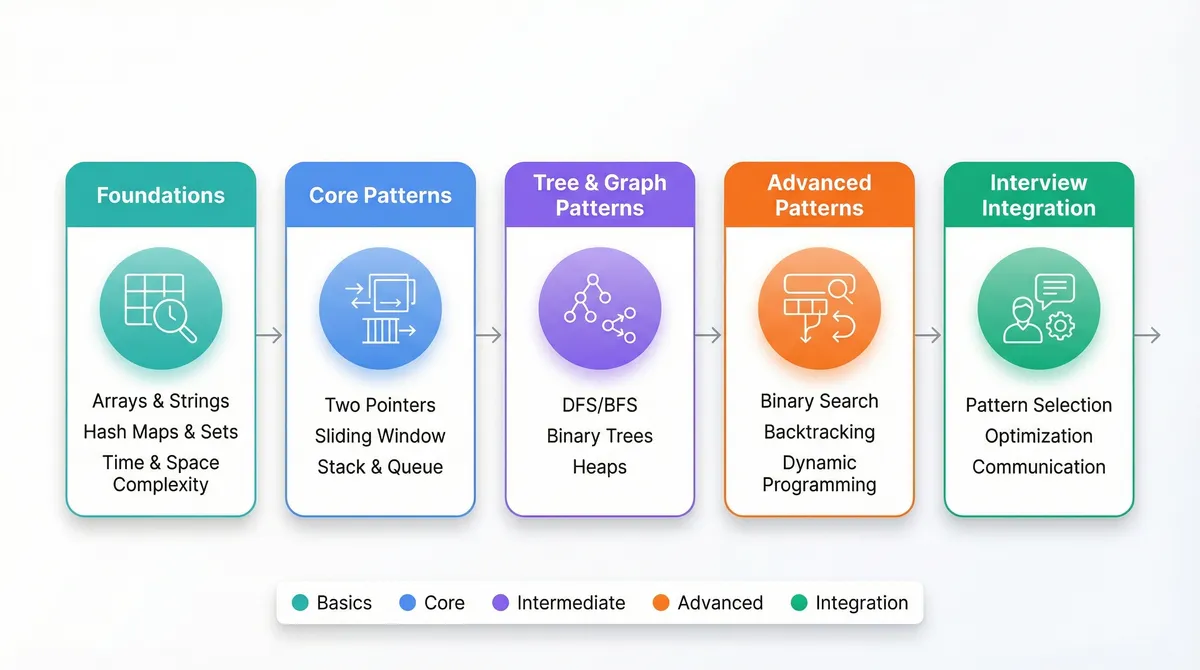
Here’s a high-level roadmap for a complete beginner, assuming ~10–15 hours/week. Adjust pacing based on your background.
Phase 0 (1–2 weeks): Foundations & Environment
- Choose a primary language: Python, Java, C++, or JavaScript/TypeScript are most common.
- Set up:
- Local dev environment (VS Code or similar)
- Online judge accounts (LeetCode, HackerRank, Codeforces if you like contests)
- Review language basics:
- Variables, conditionals, loops
- Functions, basic I/O
- Arrays/lists, dictionaries/maps, sets
- Learn how to:
- Run code locally
- Read stack traces
- Use a debugger or print debugging
Phase 1 (4–6 weeks): Core DSA Patterns & Complexity
- Focus on breadth over depth:
- Arrays & strings
- Hash maps & sets
- Two pointers, sliding window
- Stacks & queues
- Basic recursion
- Learn Big-O analysis and apply it to every solution.
- Start pattern-based learning instead of random problems. For a structured approach, consider following a beginner to advanced DSA roadmap for software engineers in 2026 to cover essential data structures and algorithms systematically.
Phase 2 (4–8 weeks): Intermediate Topics & Systematic Practice
- Trees (binary trees, BSTs)
- Heaps / priority queues
- Graph basics (BFS, DFS)
- Advanced patterns:
- Binary search
- Backtracking
- Dynamic programming (1D, 2D basics)
- Start full-length timed mock interviews (45–60 min).
Phase 3 (2–4 weeks): Interview Simulation & Gaps
- Mix:
- Timed problem solving
- Behavioral questions
- System design basics (for mid/senior)
- Review weak patterns and re-implement from scratch.
- Practice explaining solutions out loud.
3. Learn the Minimum Coding Fundamentals (Efficiently)
If you’re a true beginner, spend focused time getting “interview-capable” in one language.
3.1 Choose the Right Language for Interviews
Use a language that:
- Has strong standard library support for:
- Dynamic arrays/lists
- Hash maps
- Sets
- Priority queues/heaps
- Has concise syntax (Python is often easiest for beginners).
- Is accepted by your target companies.
You do not need framework knowledge (React, Spring, etc.) for coding interviews.
3.2 Language Features You Actually Need
Focus on:
- Primitive types and strings
- Arrays/lists and indexing
- Dictionaries/maps and sets
- Functions:
- Parameters and return values
- Pass by value vs reference (especially in C++/Java)
- Loops and conditionals
- Basic class/struct syntax (for tree/graph nodes)
4. Master Complexity: Your First Interview Superpower
Every coding interview will implicitly test your understanding of time and space complexity.
4.1 Time Complexity: Big-O Essentials
You should be able to:
- Identify:
- O(1), O(log n), O(n), O(n log n), O(n²)
- Recognize patterns:
- Single loop → O(n)
- Nested loops → O(n²)
- Divide-and-conquer (binary search, mergesort) → O(log n) or O(n log n)
4.2 Space Complexity
Always ask:
- What extra data structures am I using?
- How does their size scale with input?
Examples:
- Using a hash set to track seen elements → O(n) extra space
- In-place array manipulation → O(1) extra space
- Recursion depth → contributes to space complexity via call stack
5. Pattern-Based Coding Interview Preparation
Random problem grinding is inefficient. Instead, learn patterns that generalize across many questions.
Thita.ai, for example, organizes 94 DSA patterns across 15 categories; you don’t need all of them to start, but you should cover the core ones.
5.1 Why Patterns Beat Memorization
Consider these problems:
- “Given a sorted array and a target sum, find two numbers that add up to the target.”
- “Given a sorted array, remove duplicates in-place.”
- “Given a sorted array, find the pair with sum closest to zero.”
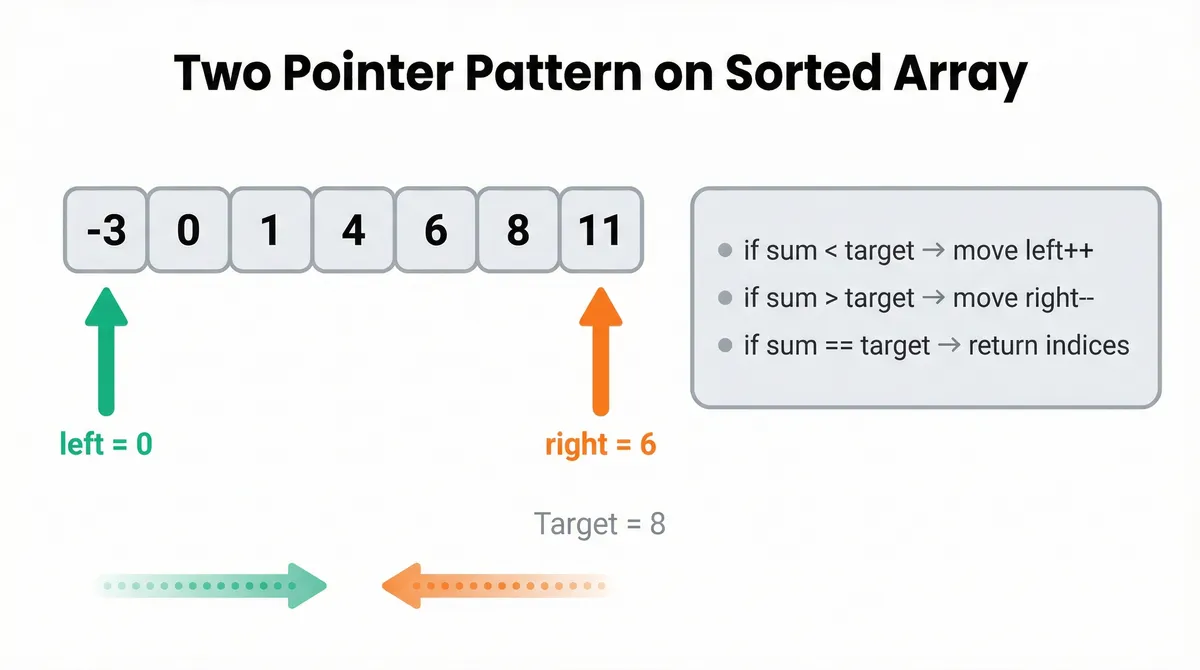
These all share the two-pointer pattern on a sorted array. Once you internalize the pattern, new problems become variations, not mysteries. To deepen your understanding, explore resources like What Are DSA Patterns? A Complete Guide for Beginners that explain these patterns in detail.
5.2 Core Beginner Patterns to Learn First
Focus on these high-yield patterns early:
-
Two Pointers
- Use on arrays/strings when you need to compare or move from both ends or maintain a window.
- Common tasks: remove duplicates, reverse words, palindrome checks.
-
Sliding Window
- For subarrays/substrings with constraints (fixed or variable length).
- Examples: longest substring without repeating characters, max sum subarray of size k.
-
Hash Map / Hash Set
- For constant-time lookups.
- Examples: two-sum, anagram checks, frequency counting.
-
Stack
- For problems with nested structure or “last unmatched” logic.
- Examples: valid parentheses, next greater element.
-
Basic Recursion & DFS
- For tree traversals and simple backtracking.
- Examples: binary tree depth, path sums.
As you progress, add:
- Binary Search
- Heap / Priority Queue
- Dynamic Programming (DP) basics
6. Example: From Problem Statement to Pattern
Let’s walk through a simple problem and map it to a pattern.
Problem:
Given a sorted array of integers nums and an integer target, return indices of the two numbers such that they add up to target. Assume exactly one solution exists.
6.1 Brute Force Approach
Check all pairs.
PYTHON
- Time: O(n²)
- Space: O(1)
This works but doesn’t scale.
6.2 Hash Map Pattern
Use a hash map to store value → index while iterating.
PYTHON
- Time: O(n)
- Space: O(n)
Pattern: “Use a hash map to remember what you’ve seen and find complements in O(1) time.”
6.3 Two-Pointer Pattern (Because Array is Sorted)
Since the array is sorted, we can do better in space.
PYTHON
- Time: O(n)
- Space: O(1)
- Pattern: Two pointers on a sorted array.
In an interview, you’d:
- Start with brute force.
- Recognize time complexity is too high.
- Propose hash map.
- Notice sorted property → propose two-pointer optimization.
- Implement, then analyze complexity.
7. How to Practice Problems Effectively (Not Randomly)
7.1 A Simple Daily Practice Loop
For each session (60–90 minutes):
-
Warm-up (5–10 min)
- Re-implement a known pattern from memory (e.g., BFS on a tree).
-
New Problem (30–45 min)
- Read carefully.
- Restate the problem in your own words.
- Identify constraints and edge cases.
- Ask: “Which pattern(s) might apply here?”
- Solve on paper or a whiteboard first, then code.
-
Review & Reflection (15–20 min)
- Compare with editorial/other solutions.
- Ask:
- Did I pick the right pattern?
- Could I optimize time/space?
- How would I explain this to an interviewer?
-
Spaced Repetition (10–15 min)
- Revisit 1–2 previous problems you struggled with.
- Implement the core idea again without looking.
7.2 Track by Pattern, Not Just Problem Count
Maintain a simple table (spreadsheet or notebook):
| Pattern | Problems Done | Confidence (1–5) | Notes |
|---|---|---|---|
| Two Pointers | 12 | 4 | Comfortable with sorted arrays |
| Sliding Window | 8 | 3 | Still confuse variable windows |
| Hash Map | 15 | 5 | Solid |
This surfaces weak areas and guides your next week’s focus.
8. Build Interview Communication Skills from Day 1
Many strong coders fail interviews because they “go silent” or code without explaining.
Treat communication as a first-class skill, not an afterthought.
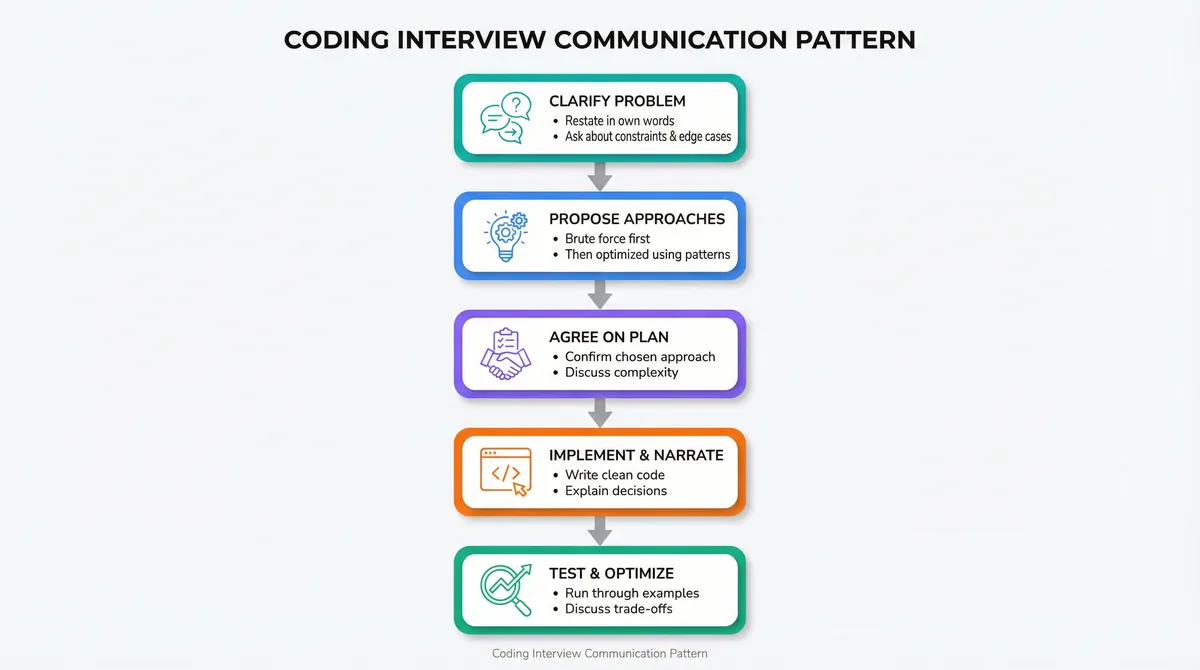
8.1 A Simple Communication Template
When solving any problem (even alone), practice this structure out loud:
-
Clarify
- “Let me restate the problem to ensure I understand…”
- Ask about:
- Input constraints
- Edge cases (empty input, negative numbers, duplicates)
- Output format
-
Outline Approaches
- “Naively, we could try X with O(n²) time…”
- “We can optimize using Y pattern to get O(n log n)…”
-
Choose and Justify
- “Given the constraints (n up to 10⁵), O(n²) is too slow, so I’ll use a hash map to achieve O(n).”
-
Implement While Narrating
- “I’ll create a dictionary to map values to indices…”
- “Now I’ll iterate through the array and check for complements…”
-
Test and Analyze
- “Let’s test with this example…”
- “Time complexity is O(n) because we traverse the array once…”
Even if you’re just writing on paper, narrate in your head or out loud. This makes real interviews feel like a repetition of what you already do daily.
9. Common Beginner Mistakes in Coding Interview Preparation
Avoiding these will save you months.
9.1 Grinding Without Feedback
- Solving 200 problems but never:
- Timing yourself
- Explaining aloud
- Getting corrections on code style or reasoning
Fix: Incorporate mock interviews (with peers, mentors, or AI-driven tools like Thita’s AI Interview Practice: Free Mock Interview Simulator with Real-Time Feedback for Technical Interviews) every 1–2 weeks once you know the basics.
9.2 Ignoring Patterns and Fundamentals
- Jumping into hard problems before:
- Understanding arrays, maps, and basic recursion
- Being comfortable with Big-O
Fix: Spend dedicated weeks on foundational patterns before touching “Hard” problems.
9.3 Over-Focusing on Rare Topics
- Spending weeks on:
- Segment trees
- Fenwick trees
- Advanced graph algorithms
- While still weak on:
- Sliding window
- Hash maps
- Basic DP
Fix: Prioritize high-frequency patterns first. Only add advanced topics if your target companies explicitly require them or you’re aiming for competitive programming.
9.4 Memorizing Solutions Instead of Ideas
- Recognizing a problem as “that LeetCode #xyz” but unable to adapt when constraints change.
Fix: After solving, close the editor and:
- Re-derive the solution idea.
- Explain the core pattern in 2–3 sentences.
- Implement from scratch a day later.
10. Beginner-Friendly Study Plan (8–12 Weeks)
Here’s a more concrete weekly breakdown for your software engineer interview prep.
Weeks 1–2: Language & Complexity Basics
- Pick a language and learn:
- Arrays/lists, maps, sets
- Loops, functions
- Practice:
- Implementing simple functions (reverse array, count frequency)
- Calculating time complexity of simple loops
Target:
- 10–15 easy problems (arrays, strings)
- Comfort explaining O(n) vs O(n²)
Weeks 3–4: Arrays, Strings, Hash Maps, Two Pointers
- Learn and practice:
- Two pointers on sorted arrays and strings
- Hash map for complements and frequency
- Sliding window (fixed-size)
Target:
- 20–30 problems across these patterns
- Able to choose between brute force, hash map, and two pointers
Weeks 5–6: Stacks, Queues, Recursion, Basic Trees
- Learn:
- Stack-based problems (valid parentheses, min stack)
- Queue / BFS intuition
- Recursive tree traversals (preorder, inorder, postorder)
Target:
- Implement binary tree node class
- Solve 10+ tree/stack problems
Weeks 7–8: Binary Search, Heaps, Graph Basics
- Practice:
- Binary search variations (first/last occurrence, search insert position)
- Priority queue usage (top-k elements, merge k sorted lists)
- BFS/DFS on simple graphs (grids, adjacency lists)
Target:
- Confident with standard binary search template
- 10–15 problems using heaps/graphs
Weeks 9–12: Intro to Dynamic Programming & Mock Interviews
- Learn:
- 1D DP (climbing stairs, house robber)
- 2D DP basics (grid paths)
- Start weekly mock interviews:
- 45–60 minutes each
- Focus on communication and time management
Target:
- 10–15 basic DP problems
- 4–6 mock interviews (with peers or AI)
11. Using Tools and Resources Wisely (Without Getting Overwhelmed)
There are many resources; the key is how you use them.
11.1 Problem Platforms
- LeetCode, HackerRank, Codeforces, AtCoder
- Use filters:
- Topic (arrays, hash map, etc.)
- Difficulty (start with Easy, then mix Easy/Medium)
11.2 Pattern Guides and Sheets
A curated pattern sheet can prevent you from getting lost in random problems. For example, Thita’s /dsa-patterns-sheet organizes problems by 94 patterns across 15 categories, which you can approximate with your own checklist if you prefer.
11.3 Mock Interviews and Coaching
- Practice with:
- Friends/classmates
- Online communities
- AI mock interview tools (e.g., Thita’s
/ai-interviewor/ai-coachfor real-time feedback)
- Focus mocks on:
- Structure (clarification → approach → code → test)
- Communication clarity
- Handling hints gracefully
For insights on how AI is changing the interview landscape and how to best leverage AI tools without dependency, see How AI Is Changing Technical Interviews in 2026 and How to Use AI Tools Like ChatGPT for Interview Preparation (Without Becoming Dependent).
12. How to Prepare for Coding Interviews in 2026 Specifically
The fundamentals haven’t changed much, but a few 2026-specific realities matter:
12.1 AI Assistance Is Ubiquitous—Use It Strategically
-
Use AI to:
- Get hints, not full solutions.
- Analyze your code for edge cases and complexity.
- Simulate interviewer questions (“Why is this O(n²)?”).
-
Avoid:
- Letting AI write full solutions you don’t understand.
- Copy-pasting code into interviews without comprehension.
Interviewers can tell when understanding is shallow.
12.2 Remote and Hybrid Interviews
- Be comfortable:
- Sharing your screen
- Using collaborative editors (CoderPad, CodeSignal, Google Docs)
- Practice:
- Typing and narrating simultaneously
- Managing silence (“I’m thinking about two possible approaches…”)
12.3 Broader Evaluation Beyond Just DSA
Especially for experienced roles, expect:
- Some system design (caching, APIs, scalability basics)
- Questions about past projects and trade-offs
- Collaboration scenarios (“How would you work with a PM who…”)
But even then, strong DSA fundamentals remain a key filter.
13. Best Practices for Sustainable Progress
To avoid burnout and maximize learning:
- Consistency over intensity
- 1–2 hours daily beats 10 hours once a week.
- Mix old and new
- 70% new problems, 30% revisiting and solidifying patterns.
- Deliberate difficulty
- If everything feels easy, you’re not growing.
- If everything feels impossible, step back to simpler patterns.
- Document your journey
- Keep a log of:
- Problems solved
- Patterns used
- Mistakes made and lessons learned
- Keep a log of:
14. Key Takeaways
- Coding interview preparation is not about memorizing hundreds of problems; it’s about mastering patterns, complexity, and communication.
- Start with:
- Language basics
- Arrays, strings, hash maps
- Two pointers and sliding window
- Progress to:
- Trees, graphs, heaps
- Binary search and basic DP
- Practice like you interview:
- Clarify → propose → choose → implement → test
- Speak your thoughts out loud from day one
- Use tools (platforms, pattern sheets, AI mock interviews) to accelerate feedback, not to replace understanding.
If you’re starting from scratch in 2026, a focused 8–12 week plan following these principles is enough to become genuinely interview-ready for many junior and entry-level software engineering roles. The hardest part is not the algorithms—it’s building a disciplined, pattern-driven approach and sticking with it.