
Interview
Smart India Hackathon 2026: Registration, Problem Statements & How to Actually Win
SIH 2026 explained — registration deadline, problem statement strategy, team rules, internal hackathon, and the 36-hour Grand Finale playbook. Prepare properly.
The Smart India Hackathon is the largest hackathon in the country by participation, and it's the only one where your "client" is a government ministry, a PSU, or a national agency with an actual unsolved problem. That combination — enormous scale, real stakeholders — makes SIH unlike anything else on the student circuit.
It also makes it winnable in a very specific way. SIH is not primarily an engineering contest. Teams that win are the ones who chose the right problem statement, understood the sponsoring organisation's real constraint, and built something a bureaucracy could actually deploy.
This guide covers the 2026 timeline, the team rules that disqualify people every year, how to pick a problem statement strategically, and what the 36-hour Grand Finale actually demands.
Building your technical foundation alongside SIH? The 90-Day Interview Roadmap turns the same months into placement readiness, and the DSA Patterns Sheet covers the coding rounds every company hackathon gates you behind.
SIH 2026: The Timeline You Need
| Milestone | Date (2026 cycle) |
|---|---|
| SPOC registration deadline | July 31, 2026 |
| Problem statements released | August 25, 2026 |
| Team registration deadline | September 6, 2026 |
| Internal college hackathons | September – October 2026 |
| Institute nominations to national portal | Following internal rounds |
| Grand Finale | December 2026 |
⚠️ Important: The whole process runs through your college's SPOC (Single Point of Contact) — a nominated faculty member. If your institution never registered a SPOC by July 31, your college cannot nominate teams this cycle. Find out who your SPOC is today; that one question resolves 80% of the confusion around SIH.
Always confirm dates at sih.gov.in — the official portal is the only source that matters, and problem statement documents are revised.
Eligibility and Team Rules
These rules eliminate teams every single year on technicalities. Read them carefully.
- Team size: exactly 6 members, including the team leader
- Female representation: at least one female member is mandatory; all-female teams are permitted
- Same institution only: all six must be from the same college or school — inter-college teams are not allowed
- Cross-branch is fine: members from different branches and disciplines within the same institution can team up
- Institution type: AICTE-approved colleges and universities
- Mentors: teams can nominate up to two mentors — senior faculty or domain experts
Software vs Hardware Edition
SIH runs two parallel editions:
| Software Edition | Hardware Edition | |
|---|---|---|
| Deliverable | Working application / platform | Working physical prototype |
| Ideal team | Full-stack devs, ML, UI/UX, one presenter | Mechanical + electronics + firmware + programmer + designer |
| Finale format | 36-hour build at a nodal centre | Extended build with hardware access |
| Common failure | Beautiful UI, no real functionality | Prototype doesn't work on demo day |
💡 Pro Tip: The Hardware edition explicitly encourages multi-disciplinary teams. If you're in mechanical or electronics and have been told hackathons aren't for you, the hardware edition is where your branch is an advantage rather than an apology.
Prize Money
- Winner: ₹1,00,000 per problem statement
- Runner-up: ₹75,000
- Second runner-up: ₹50,000
The prize money is genuinely secondary. The real prize is a direct line to the ministry or company that posted the problem — several SIH teams have converted their solution into a pilot deployment, a startup, or a job.
Step 1: Problem Statement Selection (This Decides Everything)
Problem statements drop on August 25. Most teams pick one in an afternoon. That's the single biggest mistake in the entire process.
SIH publishes hundreds of problem statements across 17+ themes — agriculture, health, smart cities, transport, disaster management, clean tech, robotics, blockchain, MedTech, heritage and more. Each one comes from a real ministry, PSU, or industry partner.
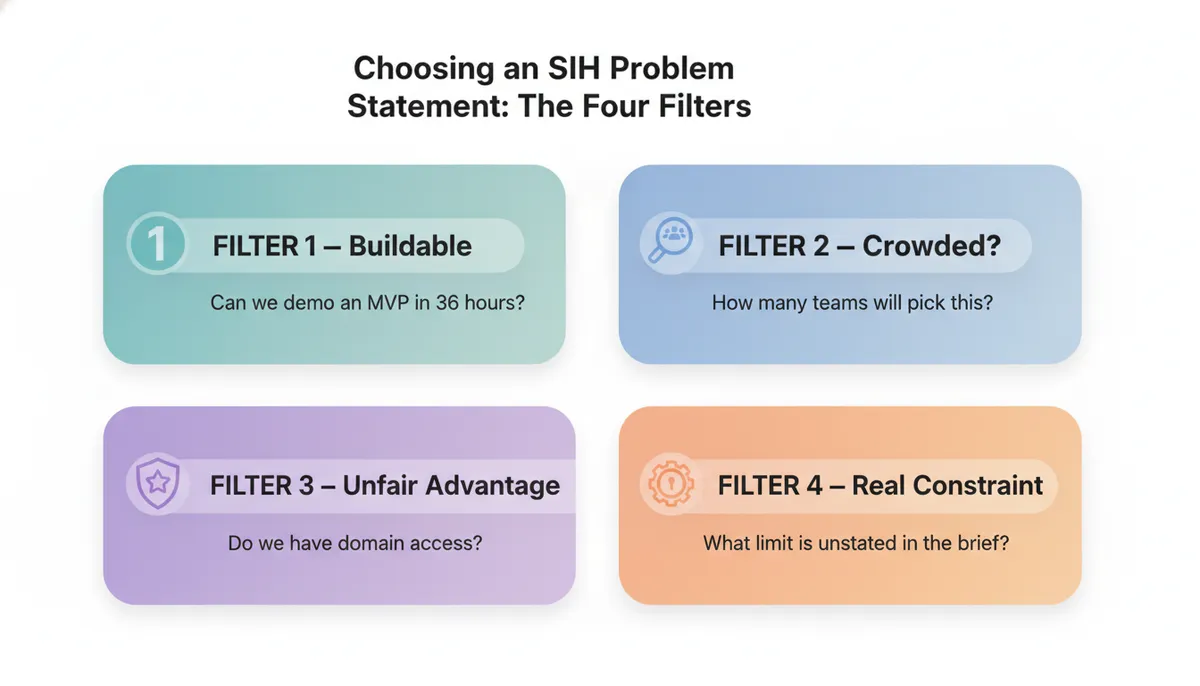
The Four-Filter Method
Filter 1: Can your team actually build this in 36 hours?
Read the statement and ask: what is the minimum demonstrable version? If you can't describe a working MVP in two sentences, the scope is wrong for your team.
Filter 2: How crowded is it?
Popular themes — generic "AI chatbot for X" statements — attract hundreds of teams. Obscure statements from smaller ministries attract a handful. Your odds are structurally better on the less glamorous problem. Look at statements involving domain-specific data, regional languages, legacy system integration, or field constraints — they scare teams off and reward the ones who stay.
Filter 3: Do you have unfair advantage?
Does someone on your team have a family connection to agriculture, a semester of GIS coursework, a parent in the railways? Domain insight is worth more than an extra developer. It shows up in the questions you ask and the details you get right.
Filter 4: Is the sponsoring organisation's real constraint clear?
Every problem statement has an unstated constraint — no internet in the field, users who aren't literate in English, data that can't leave a government network, existing software that must be integrated with. Find it. Solutions that ignore the constraint lose to solutions that build around it.
The Research You Should Do Before Committing
- Read the full problem statement PDF, not the one-line title on the portal
- Look up the sponsoring organisation — what do they already run? What have they procured before?
- Find past SIH winners on the same theme; understand what "good" looked like
- Search for existing government schemes and portals in that domain — your solution should complement them, not pretend they don't exist
⚠️ Important: Download problem statements only from the official SIH portal. They get revised, and building against an outdated version is a preventable disaster.
Step 2: The Internal Hackathon (September–October)
Before your team reaches the national stage, you must win your college's internal hackathon. Institutions nominate a limited number of teams per problem statement.
The internal round is judged by your own faculty, usually on a presentation rather than working code. That means it rewards a different skill set than the finale.
What the Internal Round Actually Grades
- Idea clarity — can a non-specialist faculty member understand what you're building in 60 seconds?
- Feasibility — is there a credible path from your slides to a working prototype?
- Technical depth — is there real engineering here, or an API call and a UI?
- Team readiness — do all six members know the project, or just the leader?
The SIH Presentation Format
SIH publishes an idea-submission PPT template. Use it exactly as given — deviating from the format is an easy reason to be marked down. Typically:
- Slide 1: Proposed solution and idea
- Slide 2: Technical approach — stack, architecture, methodology
- Slide 3: Feasibility and viability — challenges and how you address them
- Slide 4: Impact and benefits
- Slide 5: Research and references
💡 Pro Tip: Put an actual architecture diagram on the technical slide. A block diagram with named components and data flow instantly separates you from teams presenting bullet lists of buzzwords.
✅ Do build a rough working demo before the internal round even if it's not required. A 30-second screen recording of something functioning beats every deck in the room.
❌ Don't let the team leader present alone. Judges ask "who wrote which part" and teams that can't answer look assembled rather than real.
Step 3: The Grand Finale (December, 36 Hours)
If your team is nominated and selected nationally, you'll be at a nodal centre building for 36 continuous hours in front of rotating panels of judges.
How Judging Works
You are evaluated multiple times across the 36 hours, not once at the end. Judges visit in rounds, and each round they're checking progress against what you told them last time. This has one enormous implication:
Your build sequence matters as much as your final output. A team with a working core at hour 12 that improves steadily beats a team that has nothing until hour 30 and then produces something better.
The 36-Hour Plan
| Hours | Focus |
|---|---|
| 0–2 | Re-read the problem statement as a team. Lock scope. Write down explicit non-goals. |
| 2–4 | Architecture, task split, repo and environment setup for all six members |
| 4–12 | Core functionality only. Nothing cosmetic. |
| 12–14 | First judge round — have something running. Sleep rotation begins. |
| 14–24 | Second layer of features + the parts judges asked about |
| 24–30 | Integration, bug fixing, edge cases, data seeding for the demo |
| 30–34 | Demo rehearsal, presentation build, README and documentation |
| 34–36 | Buffer, final judge round, final polish |
What Judges Reward
- A working demo on real-ish data — seed your database with realistic records, not "test1 / test2"
- Awareness of deployment reality — who runs this, on what infrastructure, at what cost?
- Handling the domain constraint — offline capability, regional language support, low-bandwidth mode
- Honest scoping — "here's what works, here's what's stubbed, here's what's next" reads as professional, not weak
- Whole-team fluency — every member should be able to explain the whole system, not just their file
Survival Logistics
- Sleep in shifts. Two people down for three hours at a time. Teams that go 36 hours awake ship broken code from hour 24 onwards.
- Bring your own hardware and cables. Extension boards, adapters, a mobile hotspot.
- Pre-download dependencies. Venue Wi-Fi will fail. Have your node_modules, model weights, and datasets local before you arrive.
- Assign one person as the presenter from hour zero so someone is always thinking about the story.
The Technical Preparation That Pays Off Beyond SIH
Here's something worth saying plainly: SIH is excellent for your resume and terrible as your only preparation. It doesn't test DSA, and the companies you'll interview with in placement season do.
Run both tracks in parallel. The months between problem statement release and the Grand Finale are exactly the window where the 90-Day Interview Roadmap fits — 316 DSA problems, 114 theory modules, 22 mock interviews, sequenced day by day, so December leaves you with a hackathon result and placement readiness.
Specifically:
- DSA Patterns Sheet — 404 problems across 94 sub-patterns; this is the gate for every company hackathon and campus OA
- Company-wise kits — filter to the patterns your target companies actually ask
- System design sheet — directly useful for SIH architecture slides and interviews
- AI mock interviews — rehearse defending your SIH project, which will be the centrepiece of every interview you sit for the next two years
- Resume Analyzer — get the SIH line on your resume written properly, with impact quantified
💡 Pro Tip: Whatever happens at the finale, your SIH project becomes your best interview story. Prepare it as one: the constraint you discovered, the decision you made, the trade-off you accepted, the result.
Common Mistakes That Kill SIH Teams
❌ Missing the SPOC deadline. No SPOC, no nomination, no SIH. This is entirely administrative and entirely avoidable.
❌ Picking a problem statement on vibes. The crowded, glamorous statements have the worst odds. Do the four-filter analysis.
❌ A team of six that's really a team of two. Six committed members beats two brilliant ones with four passengers — judges test the whole team.
❌ Forgetting the mandatory female member. It's a hard requirement, not a preference.
❌ Building for a demo instead of for deployment. The ministry judging you wants to know if it could run in a district office with patchy internet.
❌ Ignoring the official templates. Use the SIH PPT format exactly.
❌ No sleep plan. 36 hours awake produces worse software than 30 hours with rotation.
Frequently Asked Questions
When is the SIH 2026 registration deadline?
Team registration closes September 6, 2026. The SPOC registration deadline was July 31, 2026, and problem statements are released August 25, 2026.
How many members are in an SIH team?
Exactly six, including the team leader, with at least one mandatory female member. All six must be from the same institution.
Can students from different colleges form a team?
No. Inter-college and inter-school teams are not permitted. Members from different branches within the same institution are fine.
What is the SIH prize money?
₹1,00,000 for the winning team per problem statement, ₹75,000 for the runner-up, ₹50,000 for the second runner-up, in both the software and hardware editions.
Do I need to be a CSE student to participate?
No — and for the hardware edition, mechanical, electronics and design students are actively encouraged. Multi-disciplinary teams are a stated advantage.
What happens after the internal hackathon?
Your institution nominates selected teams to the national portal. Those nominations are screened, and shortlisted teams are invited to the Grand Finale in December at an assigned nodal centre.
Does SIH help with placements?
Indirectly but substantially. It's not a hiring funnel like Adobe's or Flipkart's hackathons, but a strong SIH project is one of the best interview stories a student can carry — provided you can explain the engineering behind it. See the full hackathon calendar for the events that are direct hiring funnels.
Can I participate in SIH more than once?
Yes. Many finalists are repeat participants, and the second attempt is materially easier because you already know how judging and scoping work.
Final Thoughts
SIH is won in August, not December. The teams that reach the Grand Finale are the ones who spent a week on problem statement selection while everyone else spent an afternoon, and who understood that a government ministry judging a prototype cares about deployment reality far more than about your framework choice.
Your next four moves:
- Find your college SPOC this week
- Block time on August 25 to read problem statements properly, and run the four filters
- Lock a team of six — cross-branch, with the mandatory female member, all committed
- Run the 90-Day Interview Roadmap in parallel so December leaves you placement-ready as well as hackathon-ready
Related reading: Hackathon calendar 2026-27 · How to win a hackathon · Adobe University Hackathon guide