
Interview
IBM Interview Questions and Process: The Complete Guide (2026)
Prepare for IBM interview questions with a round-by-round guide to the online test, recorded competency interview, live technical rounds, and a 30-day plan.
IBM interview questions commonly appear across an online coding assessment, an unusual recorded competency interview, and live technical discussions. Reported accounts describe an initial HackerRank assessment with coding problems, followed by an AI-led recorded video stage and one or two technical rounds. The practical preparation strategy is to practise coding patterns under time pressure, prepare concise examples from your experience, and rehearse explaining decisions aloud rather than relying on silent problem solving.
For company-tagged coding practice, IBM's interview kit contains seven mapped DSA questions. Use it alongside mock practice and your own project stories: IBM's recorded competency stage means communication preparation matters before a live interviewer ever joins the process.
The IBM interview process at a glance
| Stage | Format commonly reported | What it screens for | Best preparation focus |
|---|---|---|---|
| Online assessment | HackerRank coding test | Core coding ability, correctness, time management | DSA patterns and edge cases |
| Recorded competency interview | AI-led recorded video responses | Communication, motivation, structured examples | Clear project and behavioural stories |
| Live technical round | Technical discussion and coding | Problem solving, technical depth, reasoning aloud | Explain approach, trade-offs and complexity |
| Further technical round | Team- and role-dependent technical discussion | Role fit, fundamentals and practical judgement | Projects, core CS knowledge and questions |
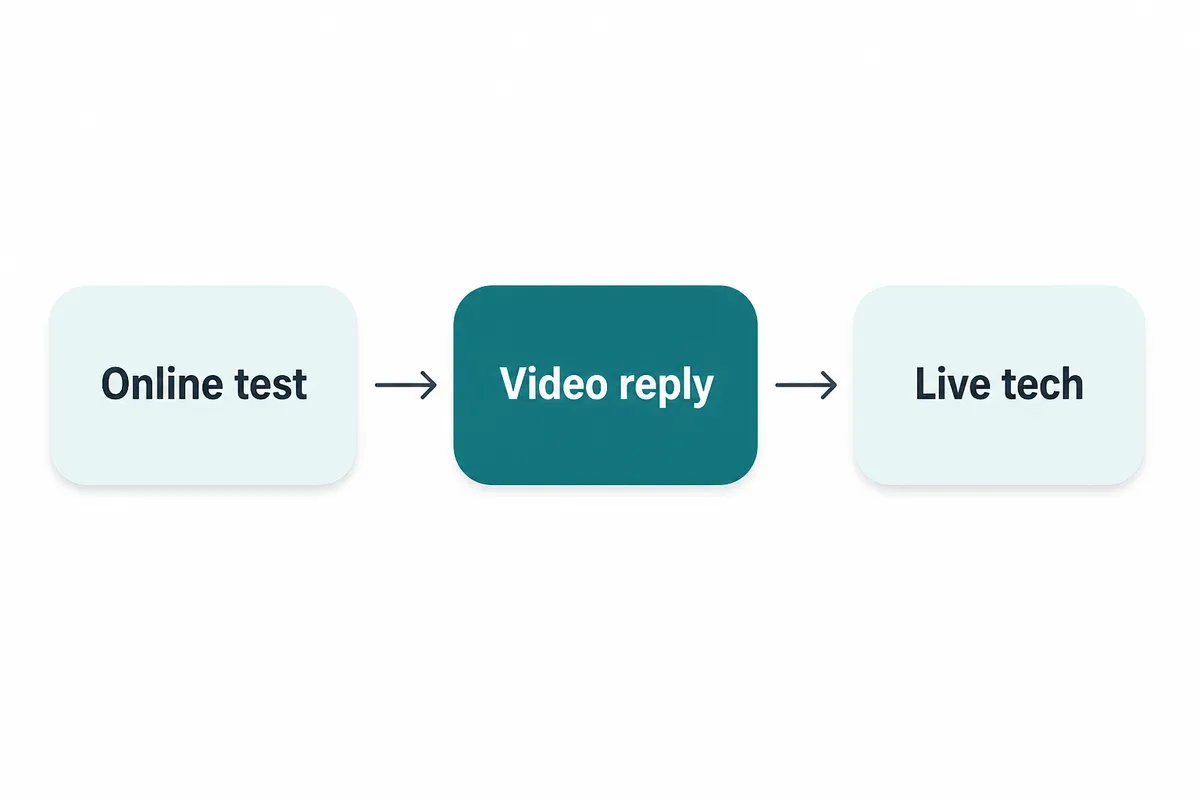
Reported accounts are useful for planning, but they are not an IBM-published specification. Team, location, level and role can all affect the order and content of later conversations. Confirm the current format with your recruiter when you enter the process.
Round one — online coding assessment
Reported accounts describe an online HackerRank assessment with one or two coding problems and a timed window of roughly an hour to an hour and a half. This is the initial technical filter: can you turn a sensible approach into correct, readable code under ordinary interview constraints?
Expect the foundations rather than niche trick questions. Arrays, strings, hash maps, sorting, recursion, trees, graphs and complexity analysis are all useful areas to revise. The important habit is recognising the shape of a problem early enough to leave time for testing.
A good assessment workflow is straightforward:
- Read every prompt before committing to one.
- Clarify inputs, outputs and constraints from the text.
- State the simplest correct approach to yourself before coding.
- Test boundary cases deliberately.
- Check time and space complexity before submission.
The DSA Patterns Sheet is free to browse and helps organise preparation around reusable problem shapes rather than a long unstructured list. For the skill that makes timed assessments more manageable, read how to identify the right DSA pattern in a coding interview.
The most common failure is not a total lack of knowledge. It is spending too long searching for a perfect solution, then submitting code that has not been tested against empty inputs, duplicates, large values or awkward ordering. Start with a clear baseline, then improve it if the constraints demand it.
Preparation rule: write down the complexity before you write the implementation. It creates a quick check on whether your intended solution can realistically pass.
Round two — IBM’s recorded competency interview
This is the IBM-specific stage that deserves separate preparation. Candidate reports describe an AI-led recorded video interview with no live interviewer present. You receive pre-recorded competency or behavioural prompts, then record your response within a short response window.
Reported accounts commonly describe around five prompts, with a few minutes available for each recorded answer. Treat those details as indicative rather than fixed: the defining feature is the format, not a guaranteed script.
This round screens for something different from the coding assessment. It looks for whether you can communicate clearly, connect your experience to the question, and make a credible case for how you work with others. Because there is no live person to rescue a vague answer with follow-up questions, structure matters more than usual.
Use a simple story framework:
- Situation: Give only the context needed to understand the problem.
- Task: Explain what you were responsible for.
- Action: Focus on decisions you made, not what “we” did in general.
- Result: State the outcome, what changed and what you learned.
Prepare examples involving ownership, collaboration, a difficult technical decision, an error or setback, learning something quickly, and handling competing priorities. You do not need a dramatic story. You need a specific one with a visible personal contribution.
The video format changes the rehearsal method. Record yourself answering on your laptop or phone. Watch it back with the sound on and ask: did I answer the actual question? Did I explain my role? Did I finish with a result? Do I sound like I am reading from a script?
An AI mock interview can help you practise behavioural answers under pressure before recording them. Aim for direct, natural responses rather than polished monologues. A brief pause to think is better than filling the answer with vague language.
Round three — live technical interview
After the recorded stage, reported accounts describe one or two live technical rounds. The exact format varies, but this is where coding ability, technical judgement and communication start to come together.
A live coding discussion does not reward the same behaviour as an online assessment. You are no longer simply producing an accepted answer. The interviewer can see how you handle an ambiguous requirement, whether you choose sensible data structures, whether you notice flaws in your own approach, and how you respond when challenged.
A strong sequence sounds like this:
- Restate the problem and ask a clarifying question.
- Describe a straightforward solution first.
- Explain why it may or may not meet the constraints.
- Select a better approach and name its complexity.
- Code in small, testable pieces.
- Walk through an example before declaring completion.
The guide to what interviewers actually look for in live coding interviews is useful here. The headline is simple: visible reasoning is evidence. If you silently arrive at a good solution, the interviewer has less evidence of how you got there and how you would work with colleagues.
Use in-browser code practice to rehearse implementation without the friction of setting up a local project. Then repeat questions aloud. Explaining why a hash map helps, why a traversal is safe, or why a solution is linear is part of the skill being tested.
Midway through your preparation, return to IBM's interview kit. The seven mapped DSA questions are a focused way to practise patterns associated with IBM while building the broader reasoning habits that transfer across technical rounds.
Further technical conversations — fundamentals, projects and role fit
Later technical conversations can move beyond a standalone coding prompt. Candidate reports are thin on a single universal IBM format, so do not assume every team uses the same sequence. A cloud, data, infrastructure or enterprise software role may place different weight on your projects and underlying fundamentals.
Prepare to discuss your work at multiple levels:
- What problem did the system solve?
- What did you personally own?
- Which trade-off did you make, and why?
- What failed or became difficult?
- How would you improve the design now?
Refresh the fundamentals that support those conversations. Operating systems, databases and networking often give you the vocabulary to explain practical engineering choices. The Operating Systems Sheet, DBMS Sheet and Computer Networks Sheet are free to browse when you need a targeted revision pass.
For experienced candidates, prepare an architecture-level discussion as well. You do not need to memorise a diagram. You do need to articulate requirements, interfaces, data flow, failure modes and trade-offs. If that distinction feels unclear, how much system design is enough for SDE-1 versus SDE-2 interviews gives a practical level-based framework.
Is the IBM interview hard?
IBM’s interview process is challenging because it tests two separate abilities: solving technical problems and communicating professional judgement clearly. Neither is unusual on its own, but the recorded competency stage means candidates need to perform well in both modes early in the process.
How many rounds are there? Reported accounts describe an online assessment, a recorded competency interview and one or two live technical rounds. Exact counts vary by team, level and role, so treat that as a common shape rather than a fixed promise.
How long does the process take? Reliable company-wide timing is not established in the available reports. Scheduling, team needs and hiring location can change the pace substantially. Ask your recruiter when each stage is likely to happen and whether there are any role-specific preparation expectations.
What makes it difficult? The coding bar is only part of the picture. A candidate can be technically capable yet underperform if they give generic recorded answers, cannot explain their own project decisions, or code without narrating their reasoning. The preparation advantage comes from practising the transitions between these formats.
A 30-day IBM interview preparation plan
Days one to seven — build coding fluency
Start with the core patterns: arrays, strings, hash maps, two pointers, sliding windows, recursion and tree traversal. Work in short timed sessions. After every problem, explain the brute-force approach, the improved approach and the complexity aloud.
Read binary search patterns for coding interviews if binary search still feels like a memorised template rather than a decision tool. The aim is recognition, not rote recall.
Days eight to fourteen — practise assessment conditions
Simulate the online assessment. Choose one or two problems, set a timer, work without hints and reserve the final portion for testing. Keep a mistake log: off-by-one errors, missed null cases, incorrect assumptions and complexity slips tend to repeat.
Review IBM's interview kit during this phase. Re-solve questions after a gap rather than immediately rereading the answer. Retrieval is more valuable than familiarity.
Days fifteen to twenty-one — prepare recorded answers
Create a story bank of six to eight experiences from work, internships, university projects or independent builds. Record answers to likely competency prompts. Keep each response focused on one decision or outcome.
Practise looking at the camera, pausing before difficult questions and ending decisively. Do not try to sound flawless. Try to sound specific, calm and accountable.
Days twenty-two to thirty — integrate live technical practice
Run full mock sessions: clarify, plan, code, test and explain. Add a project deep-dive after each coding exercise. This trains the switch from abstract problem solving to practical engineering discussion.
Use the System Design Sheet, which is free to browse, if your role is likely to include broader design discussion. Finish the month by reviewing your mistake log and story bank, not by attempting an exhausting last-minute problem marathon.
The IBM-specific advantage: prepare for the camera, not just the whiteboard
Many interview processes have a behavioural conversation. IBM’s reported recorded competency interview changes the conditions: you may need to communicate a strong answer to a camera without live feedback, follow-up prompts or an interviewer’s cues.
That rewards deliberate preparation. In a live conversation, an interviewer may redirect an answer that is too broad. In a recorded response, you must do that editing yourself. The best candidates are not those with the most dramatic stories; they are the ones who can make their contribution easy to understand.
Before the interview, rehearse three habits:
- Answer the question in your opening sentence.
- Name your personal action clearly.
- End with the result or lesson.
This is not a reason to memorise scripts word for word. Over-rehearsed answers can sound detached. Instead, memorise the structure, key facts and outcome. Leave room for natural speech.
Frequently asked questions
Does IBM use HackerRank for software engineering interviews?
Reported accounts describe a HackerRank online assessment early in the process. The exact platform and format can vary, so confirm the invitation details you receive.
What kinds of IBM interview questions should I practise?
Practise coding questions involving common DSA patterns, then prepare competency stories and project deep-dives. The process reported by candidates tests both technical reasoning and communication.
Is the IBM recorded interview live?
Reported accounts describe an AI-led recorded video stage without a live interviewer. You respond to pre-recorded prompts within a limited recording window.
How should I prepare for IBM’s recorded competency interview?
Prepare concise examples using a situation, task, action and result structure. Record yourself practising and review whether your personal contribution and outcome are clear.
How many technical rounds does IBM have?
Candidate reports commonly describe one or two live technical rounds after the online assessment and recorded competency stage. The number can vary by role and team.
Does IBM ask system design questions?
Later technical discussions can vary by role and seniority. Candidates should prepare to discuss the design decisions in their own projects and confirm role-specific expectations with their recruiter.
What should I say during a live coding round?
Clarify the prompt, explain your approach before coding, state complexity, test edge cases and narrate trade-offs. Silence makes it harder for an interviewer to assess your reasoning.
Are computer science fundamentals important for IBM interviews?
They can be especially useful in project and technical discussions. Revise the fundamentals most relevant to the role, including operating systems, databases and networking.
How long does IBM’s interview process take?
A reliable company-wide timeline is not established in the available candidate reports. Ask your recruiter about scheduling and expected next steps for your particular role.
Where to start
Start with the technical foundation, then give the recorded competency stage equal attention. IBM’s reported process is not simply a coding test followed by a formality: each stage provides a different signal about how you think and communicate.
Open IBM's interview kit to practise the seven mapped DSA questions, use the free sheets to reinforce fundamentals, and rehearse your explanations in an AI mock interview. Confirm the current sequence and expectations with your recruiter before the process begins.