
Interview
Intel Interview Questions and Process: The Complete Guide (2026)
Intel interview questions, rounds and preparation: a practical guide to the reported software engineering loop, coding, design, depth and a 30-day plan.
Intel interview questions commonly span an entry-level online test, coding, design, technical depth and behavioural discussion across roughly four to six stages. Reported accounts describe meaningful variation by business unit, so the useful preparation strategy is to build strong transferable coding and communication habits, then use recruiter conversations to clarify the team-specific emphasis. For targeted coding practice, Intel's interview kit holds four mapped DSA questions with worked guidance and practice support.
This guide breaks down the reported Intel software engineering interview process round by round: what each stage is likely to screen for, how difficult the process feels in practice, how long it may take, and how to prepare over thirty days without treating a variable process as a fixed script.
The Intel interview process at a glance
Reported accounts describe an online assessment for entry-level candidates, followed by a sequence of technical and behavioural stages. The exact order, format and number of conversations can vary by business unit and role.
| Stage | Common format | What it screens for | How to prepare |
|---|---|---|---|
| Online test | Timed coding for entry-level roles | Core problem solving and correctness | Practise recognising standard patterns quickly |
| Coding | Live problem solving | Clarity, complexity reasoning and implementation | Narrate decisions before writing code |
| Design | Discussion-led technical design | Structure, trade-offs and engineering judgement | Explain components and boundaries clearly |
| Technical depth | Role and project discussion | Fundamentals, depth and practical experience | Revisit projects and core CS concepts |
| Behavioural | Conversation with interviewers or manager | Collaboration, ownership and fit | Prepare specific evidence-based stories |
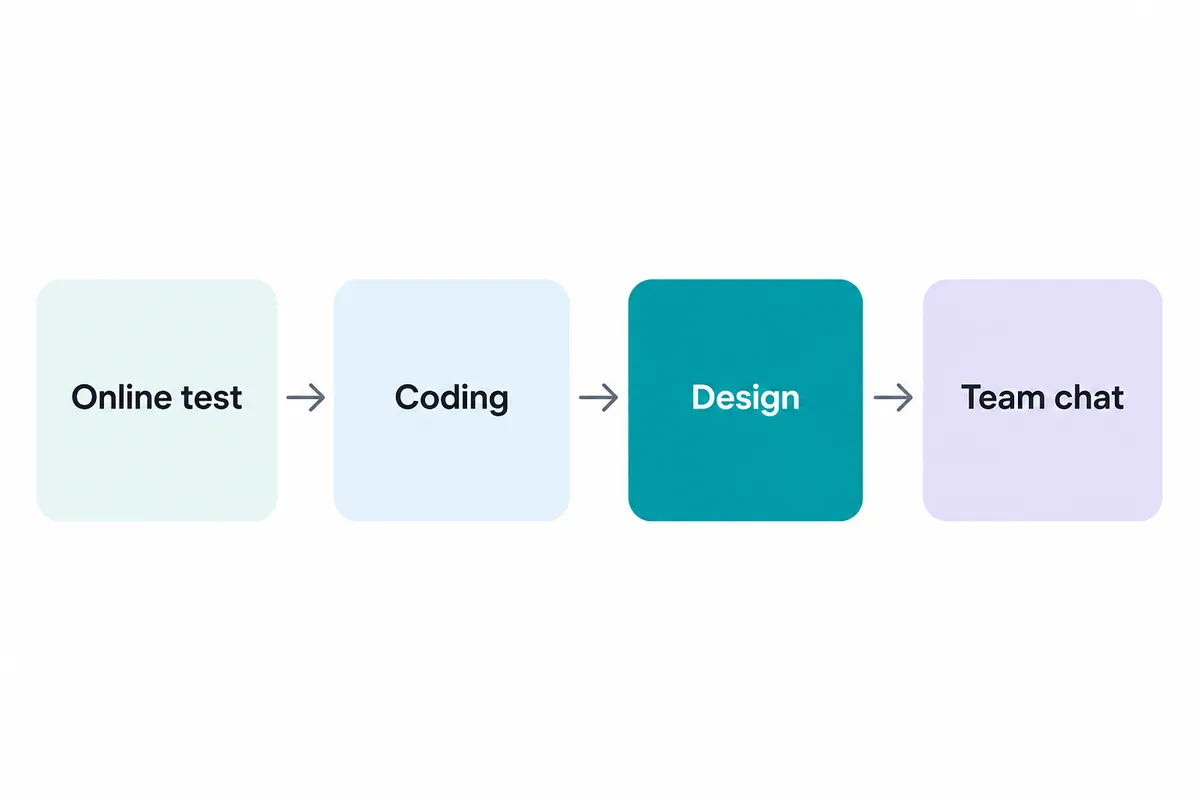
Treat this as a preparation map rather than a promise of a universal sequence. Candidate reports are thin compared with companies that run highly standardised loops, and Intel’s business-unit variation is the central fact to plan around. Confirm the current format, expected language and any role-specific technical focus with your recruiter.
Round one — the entry-level online test
For entry-level roles, reported accounts describe an online assessment with two easy-to-medium coding problems in a sixty-to-ninety-minute window. This stage is principally a volume filter: it checks whether you can translate a sensible approach into correct code under a time limit.
The likely topics are the transferable foundations of coding interviews: arrays, strings, hash maps, sorting, recursion, trees and graph traversal. The most valuable skill is not memorising a long catalogue of solutions. It is recognising the shape of a new prompt quickly enough to reserve time for testing.
Start with the DSA Patterns Sheet, which is free to browse and organises questions around reusable approaches. Pair that with Intel's interview kit when you want to practise problems mapped to Intel.
A reliable online-test routine looks like this:
- Read the examples and constraints before deciding on an approach.
- State the brute-force solution privately, then improve it deliberately.
- Write down the target time and space complexity before coding.
- Test empty input, a minimal input, duplicates and boundary cases.
- Leave a final buffer for compilation mistakes and input assumptions.
💡 Pro Tip: Do not spend the opening minutes trying to find the cleverest possible solution. A correct, well-tested solution with appropriate complexity is more useful than an unfinished optimisation.
For a clearer way to choose approaches under pressure, read how to identify the right DSA pattern in a coding interview.
Round two — live coding and problem solving
The live coding stage moves beyond whether your code works. Interviewers can now observe how you handle ambiguity, respond to hints and communicate trade-offs.
Reported Intel processes include coding among their technical stages, but the particular problem style may vary by business unit. That makes a rigid list of supposed Intel questions less useful than a disciplined method. Begin by clarifying inputs, expected outputs and constraints. Describe a straightforward approach. Explain why it may be too slow or too memory-intensive. Then present the improved approach before you begin implementation.
The interviewer is evaluating both the code and the path you took to get there. Strong candidates make their reasoning visible:
- They ask a small number of useful questions rather than guessing.
- They identify the data structure that supports the operation they need.
- They mention complexity in plain language.
- They test their code aloud instead of announcing that it “should work”.
- They recover calmly when an edge case exposes a flaw.
The practical mechanics matter. What interviewers actually look for in live coding rounds explains why clear communication changes the evaluation, even when two candidates reach similar answers.
Use in-browser code practice to rehearse the complete cycle: understand, plan, implement, test and explain. It is more representative than repeatedly reading editorials without writing anything from scratch.
✅ Do: Say what you are optimising for before changing a brute-force solution.
❌ Don’t: Type silently for ten minutes and wait for the interviewer to infer your plan.
Round three — design discussion
Reported accounts describe design as one of the technical components in Intel’s broader loop. The depth can differ by role and business unit, so candidates should avoid assuming that every position will use the same design prompt or expect the same level of detail.
At its core, a design discussion screens for engineering judgement. Can you break a vague system into understandable parts? Can you explain why a component exists? Can you identify a trade-off without pretending there is one universally correct answer?
For an early-career role, preparation should include class design, object responsibilities, interfaces, state and error handling. More experienced candidates should also be ready to discuss service boundaries, data movement, reliability and how a design changes as usage grows.
The useful distinction is between low-level and high-level design. Low-level design concerns how code-level parts work together: objects, methods, responsibilities and interactions. High-level design concerns larger system boundaries and operational trade-offs. Low-level design vs high-level design provides a practical comparison.
The Low Level Design Sheet and System Design Sheet are free to browse. Use them to build vocabulary, then practise explaining your choices aloud. The important habit is not drawing more boxes; it is connecting each box to a requirement.
When discussing the kind of design problem evidenced at Intel, aim to structure your answer around:
- the core user or system flow;
- the main entities and responsibilities;
- assumptions you need to make explicit;
- failure cases and changing requirements;
- the trade-off behind your chosen design.
A concise answer with a defensible rationale is stronger than an elaborate diagram you cannot explain.
Round four — technical depth and engineering fundamentals
“Technical depth” is the part of an Intel process that is easiest to underestimate because it may not arrive as a neat standalone puzzle. Reported accounts describe coding, design and depth across the broader set of stages. In practice, that can mean questions about your prior projects, implementation choices and the computer science concepts relevant to the role.
Prepare for this round by revisiting the work on your résumé. For each meaningful project, be able to explain the problem, your individual contribution, the architecture, a difficult decision, a failure or limitation, and what you would change now.
Then refresh the fundamentals that make those explanations credible. Depending on the role, that may include operating systems, databases, networking, language runtime behaviour or performance reasoning. The Operating Systems Sheet, DBMS Sheet and Computer Networks Sheet are free to browse and useful for structured revision.
Do not turn revision into passive reading. Ask yourself questions such as:
- Why did this component become slow?
- What resource was constrained?
- What did the system do when a dependency failed?
- Which choice did you make, and what did it cost?
- What evidence told you the change helped?
That is the bridge between textbook knowledge and interview-ready technical depth.
Round five — behavioural and project discussion
Behavioural discussion is not an administrative finish line. It is where an interviewer can assess how you work with others, how honestly you describe ownership and whether your decision-making sounds dependable.
Prepare a small set of stories that show different dimensions of your work: a disagreement, a difficult delivery, an error you corrected, a decision made with incomplete information, a time you helped someone else succeed, and a project where you owned a meaningful outcome.
Use a simple structure: situation, action, result and reflection. The reflection matters. A candidate who can explain what they would do differently demonstrates judgement rather than rehearsed perfection.
Avoid vague collective language. “We built” is often true, but it invites follow-up questions about your specific role. Be ready to distinguish the team outcome from the part you personally owned.
Practising aloud is the fastest improvement available here. An AI mock interview can help you rehearse behavioural answers, technical explanations and follow-up questions before you speak with an interviewer.
Are Intel interviews hard?
Intel interviews are challenging because they test range rather than relying on one predictable ritual. Reported accounts describe four to six stages across coding, design, technical depth and behavioural discussion, with an entry-level online assessment in some processes. The difficult part is preparing broadly while still adapting to the needs of a specific business unit.
The coding bar is likely to feel manageable for candidates who can solve standard easy-to-medium problems accurately and explain their reasoning. The design and depth stages can feel harder because they expose gaps that problem-solving practice alone does not cover: unclear communication, shallow project ownership, weak fundamentals or an inability to reason through trade-offs.
How many rounds are there? Reported accounts describe roughly four to six stages after the initial process begins. The number can vary by role and business unit.
How long does the process take? Public candidate accounts do not establish a reliable single timeline for Intel. Ask your recruiter about scheduling, decision timing and whether additional discussions are likely for your team.
The right conclusion is neither “easy” nor “impossible”. It is a mixed technical process where balanced preparation is more reliable than over-specialising in a single question type.
A 30-day Intel interview preparation plan
Days one to seven — rebuild coding fluency
Focus on arrays, strings, hash maps, two pointers, sorting, recursion, trees and graph basics. Solve fewer problems, but review each one deeply: what clue indicated the pattern, what alternative approach existed and which edge case almost caused a mistake?
Use Intel's interview kit for company-mapped practice, then widen out through the free DSA sheet. Spend part of every session explaining your approach aloud.
Days eight to fourteen — make communication deliberate
Continue coding, but introduce a stricter routine: clarify, plan, state complexity, code, test and summarise. Record yourself if possible. You are listening for long silences, unexplained jumps and phrases that conceal uncertainty.
The guide to explaining your thought process clearly in coding interviews is useful when your solutions are sound but your delivery is hesitant.
Days fifteen to twenty-one — cover design and technical depth
Work through low-level design fundamentals first, then practise a few high-level design discussions appropriate to your experience. Choose one project from your background each day and explain it from a different angle: performance, reliability, data, trade-offs or ownership.
Refresh operating systems, databases and networking in the areas most relevant to your target role. Use the recruiter conversation to prioritise rather than attempting to revise every topic equally.
Days twenty-two to thirty — simulate the loop
Alternate between timed coding, design explanation, project depth and behavioural rehearsal. Run at least two full mock sessions where you must speak continuously through your reasoning.
At the end of each mock, review process rather than merely correctness. Did you clarify the prompt? Did you test edge cases? Did you explain a trade-off? Did you show what you personally owned? These are repeatable behaviours, and they often separate an adequate answer from a convincing one.
Intel-specific preparation: plan for business-unit variation
The defining feature of reported Intel interview processes is not a named ritual or a single standardised exercise. It is variation by business unit. That changes how you should prepare.
Do not ask a recruiter only, “What should I study?” Ask focused questions that produce usable information:
- Will the technical discussion be more coding, design or project depth?
- Is the online test part of this role’s process?
- Which programming languages are practical for the team?
- Should I expect a systems or domain-fundamentals discussion?
- How should I prepare for the final conversation?
These questions are not attempts to obtain interview answers. They show that you want to prepare for the role responsibly, and they help you allocate your limited time intelligently.
Once you know the emphasis, adjust the final week. A coding-heavy process needs timed implementation. A design-heavy process needs spoken trade-offs. A depth-heavy process needs clear project stories and fundamentals. The preparation baseline remains the same; the weighting changes.
Frequently asked questions
What are the most common Intel interview questions?
Reported Intel processes include coding, design, technical-depth and behavioural questions. The exact prompts vary by business unit, so prepare transferable patterns and confirm role-specific emphasis with your recruiter.
Does Intel have an online assessment?
Reported accounts describe an online assessment for entry-level roles, with two easy-to-medium coding problems in a timed window.
How many interview rounds does Intel have?
Reported accounts describe roughly four to six stages spanning coding, design, technical depth and behavioural discussion. Team and role variation is significant.
Are Intel coding interviews difficult?
They can be demanding under time pressure, but the reported entry-level assessment is oriented around easy-to-medium coding problems. Clear reasoning and careful testing matter alongside speed.
Does Intel ask system design questions?
Reported accounts describe design as part of the broader process. The expected depth may vary by role and business unit, particularly with experience level.
What should I revise for Intel technical depth rounds?
Start with your own projects, then revise the relevant foundations: operating systems, databases, networking, performance and the concepts most connected to the role.
How should I prepare for the behavioural round?
Prepare specific stories about ownership, collaboration, mistakes, conflict and decisions. Focus on what you personally did and what you learned.
What programming language should I use?
Use the language in which you can write correct, readable code and explain trade-offs confidently. Confirm practical expectations with your recruiter where possible.
How long does Intel’s process take?
Candidate reports do not establish one reliable timeline. Ask your recruiter about expected scheduling and decision timing for the business unit you are interviewing with.
Start with the skills that transfer
Intel’s reported process rewards candidates who can do more than solve an isolated coding problem. You need to communicate a solution, discuss design choices, show technical depth and describe your work with credible ownership.
Open Intel's interview kit to practise the four mapped DSA questions, then use the free sheets and an AI mock interview to rehearse the coding, design and discussion stages as a complete loop.
Interview processes change, particularly across business units. Confirm the current structure with your recruiter and use that information to focus your final preparation.
Topics
Related on Thita
Your next step
Practise with AI mock interviews
A spoken interview that asks follow-up questions, runs your code and ends with a written report.