
Interview
Is LeetCode Enough to Crack FAANG Interviews in 2026?
Most candidates preparing for FAANG interviews eventually ask the same question: *is LeetCode enough*? In 2026, with AI tools everywhere, evolving interview ...

Most candidates preparing for FAANG interviews eventually ask the same question: is LeetCode enough? In 2026, with AI tools everywhere, evolving interview formats, and more competition than ever, this question matters even more.
The short answer: LeetCode is necessary but not sufficient for FAANG interview preparation.
Used well, LeetCode is one of the best tools to build your coding interview muscles. Used poorly, it creates a dangerous illusion of readiness: you “pass” hundreds of problems online, then stumble when a real interviewer asks a slightly different variant and starts asking “why?” instead of “what’s the answer?”
This article breaks down what LeetCode is good for, where it falls short, and how to build a coding interview strategy for FAANG-level roles in 2026 that goes beyond grinding problems.
How FAANG Interviews Look in 2026
Before we can answer “is LeetCode enough?”, we need a realistic picture of what FAANG-style interviews actually test today.
Common FAANG Interview Rounds
Most large tech companies still use a variation of these rounds:
- Online assessment / coding screen
- Technical phone screen(s)
- Onsite (or virtual onsite):
- 2–4 data structures & algorithms (DSA) / coding rounds
- 1–2 system design rounds (for mid/senior)
- 1+ behavioral / leadership / culture-fit round
What They’re Really Evaluating
Across these rounds, interviewers are looking for:
-
Problem solving ability
Can you reason from first principles, break down a problem, and explore tradeoffs? -
Data structures and algorithms fluency
Not just “I’ve seen this exact problem,” but “I recognize the pattern and can adapt it.” This is why mastering DSA patterns is crucial for interview success. -
Code quality
Readable, maintainable, correct code under time pressure. -
Communication
Clear explanation of approach, tradeoffs, and debugging thought process. -
System thinking (for seniors)
Ability to design scalable, reliable systems and reason about constraints.
LeetCode primarily trains DSA fluency and syntax speed. The rest—problem framing, communication, design, behavioral—requires different practice.
What LeetCode Actually Teaches You (When Used Well)
LeetCode is extremely good at a few things that are still central to FAANG interviews in 2026.
1. Pattern Recognition in DSA Problems
After ~100–200 well-chosen problems, you begin to see recurring patterns:
- Sliding window
- Two pointers
- Fast/slow pointers
- Binary search on answer
- Monotonic stack / queue
- Topological sort
- DFS/BFS on trees and graphs
- Dynamic programming (1D, 2D, subsequences, knapsack, etc.)
- Union-Find / DSU
- Greedy with sorting / priority queues
If you deliberately focus on patterns instead of problem counts, LeetCode becomes a powerful pattern-learning environment. For a structured approach, consider the Beginner to Advanced DSA Roadmap for Software Engineers in 2026 which emphasizes mastering these essential patterns.
2. Implementation Speed Under Time Constraints
FAANG interviews still expect you to:
- Write correct code in ~20–30 minutes
- Handle edge cases
- Avoid off-by-one errors and null pointer issues
LeetCode’s instant feedback loop and timer help you develop:
- Faster translation from idea → code
- Familiarity with language-specific idioms
- Comfort with common standard library APIs
3. Complexity Analysis Practice
Most LeetCode discussions and editorials include:
- Time complexity (big-O)
- Space complexity
- Tradeoffs between brute force vs optimized
If you make it a habit to write down complexity and justify it, you build the analytical skills interviewers expect.
Where LeetCode Falls Short for FAANG Interview Preparation
If you only grind LeetCode, you’ll hit a ceiling. Here’s why.
1. You Practice Solving Problems You’ve Already Seen
In real interviews:
- The problem is new to you
- There’s no “similar problems” list
- There’s no “Discuss” tab
- You can’t run infinite submissions
LeetCode can create an illusion of competence:
“I can solve 90% of medium problems in 10–15 minutes.”
But that’s often because you’ve:
- Seen variants before
- Subconsciously memorized patterns
- Read hints or solutions at some point
Interviewers care more about how you approach a problem you haven’t seen before.
2. You Don’t Practice Talking While Coding
Real interviews are live conversations:
- You need to clarify requirements
- You should propose multiple approaches
- You must narrate your thought process
- You need to respond to hints and constraints
LeetCode is silent and solitary. It trains your fingers and brain, but not your communication layer, which is a major evaluation axis. To improve this skill, practicing with AI Mock Interviews vs Real Interviews: Do They Actually Help? can simulate real interview pressure and help you articulate your thinking.
3. No System Design, Architecture, or Tradeoffs
For mid-level and senior roles, FAANG interviews heavily emphasize:
- API design
- High-level architecture
- Scaling strategies
- Data modeling
- Caching, consistency, availability tradeoffs
LeetCode does not exercise these muscles at all. You can clear 1000+ problems and still be unprepared for a system design round.
4. Limited Behavioral and “Signal” Practice
Hiring committees don’t see your LeetCode profile. They see:
- Feedback about how you handle ambiguity
- Examples of ownership and impact
- How you respond to pushback
- Your collaboration and communication style
None of this is captured by coding problem platforms alone.
Is LeetCode Enough to Crack FAANG in 2026?
Putting it together:
-
For junior / new grad roles
LeetCode is a necessary core of preparation, but still not enough on its own. You need to add mock interviews, behavioral prep, and some system design basics. -
For mid-level / senior roles
LeetCode is foundational but insufficient. You also need:- Strong system design preparation
- Deep experience stories
- Clear communication and leadership signals
Think of LeetCode as the gym for your DSA muscles. You still need to learn to play the actual sport: interviewing.
A Pattern-Based Strategy: Using LeetCode the Right Way
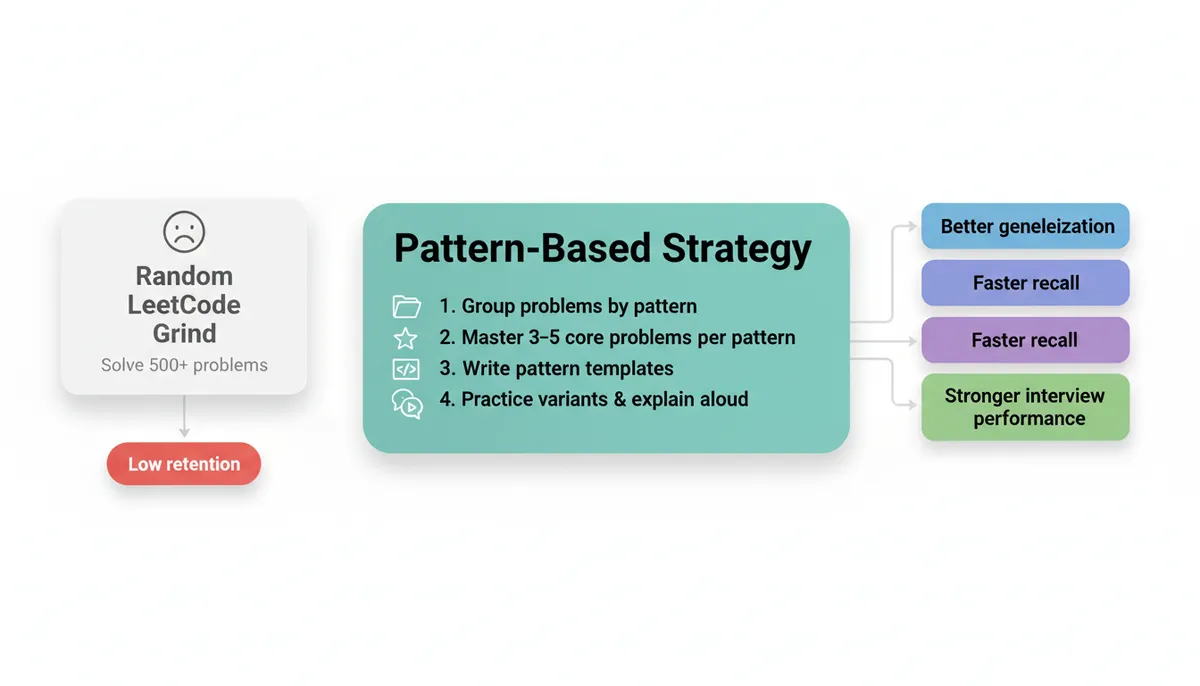
Instead of “solve 500+ random problems,” a better coding interview strategy is pattern-first.
Step 1: Organize by Patterns, Not Problem IDs
Group problems into patterns like:
- Arrays & Strings
- Two pointers
- Sliding window
- Prefix sums
- Linked Lists
- Fast/slow pointers
- Reversal patterns
- Trees & Graphs
- DFS/BFS
- Topological sort
- Shortest path
- Dynamic Programming
- 0/1 knapsack
- Unbounded knapsack
- Longest subsequence
- Interval DP
- Greedy & Heaps
- Binary Search & Divide-and-Conquer
This is the philosophy behind pattern-based resources (e.g., Thita’s DSA patterns sheet): master 90+ patterns instead of memorizing 900+ problems.
Step 2: Go Deep on a Few Representative Problems Per Pattern
For each pattern:
- Pick 3–5 canonical LeetCode problems.
- Solve them without help.
- Then:
- Re-solve from scratch a few days later.
- Implement variants (e.g., change constraints, ask “what if duplicates?”).
- Explain the solution aloud as if teaching someone.
Step 3: Build a Pattern Summary Sheet
For each pattern, write:
-
When to use it
e.g., “Sliding window: subarrays/substrings over contiguous elements with constraints like sum/length/count.” -
Template / pseudocode
PYTHON
- Common pitfalls
e.g., off-by-one in window bounds, forgetting to update best after shrinking.
This makes patterns retrievable under pressure, not just vaguely familiar.
Example: Pattern Thinking vs Problem Memorization
Consider a typical FAANG-style problem:
“Given an array of integers and a target sum
k, return the length of the longest subarray with sum at mostk.”
If you’ve only memorized individual LeetCode problems, you might panic if you haven’t seen this exact one.
If you think in patterns:
- “Subarray” → contiguous → likely sliding window or prefix sums
- “At most k” → monotonic constraint → sliding window with shrinking
You recall your sliding window template and adapt it:
PYTHON
Time complexity: O(n)
Space complexity: O(1)
You didn’t need the exact problem; you needed the pattern.
Visual: Pattern-Based LeetCode Strategy
Common Mistakes Candidates Make With LeetCode
Mistake 1: Chasing Problem Counts
“I solved 700+ problems; why did I still fail?”
Symptoms:
- Can’t explain why a solution works
- Freeze on unseen problem variants
- Forget solutions after a few weeks
Fix:
- Track patterns mastered, not problems solved.
- After solving, write a 2–3 sentence explanation in your own words.
- Revisit key problems after a spaced interval.
Mistake 2: Over-Reliance on Hints and Editorials
Reading solutions too early:
- Short-circuits your problem-solving muscle
- Creates a false sense of understanding
- Doesn’t train you to struggle productively
Fix:
- Set a hard rule: at least 20–30 minutes of solo effort before hints.
- When you read the editorial, re-implement from scratch without looking.
- Explain the solution out loud as if teaching.
Mistake 3: Ignoring Edge Cases and Testing
LeetCode’s test suite can hide bad habits:
- You rely on “Wrong Answer” feedback instead of reasoning.
- You don’t proactively test edge cases.
Fix:
Before running code, always ask:
- What about empty inputs?
- Min/max values?
- Duplicates?
- Sorted vs unsorted?
- Negative numbers?
Write a few manual test cases and walk through them.
Mistake 4: Zero Communication Practice
You might be strong at silent problem solving but weak at:
- Clarifying constraints
- Articulating tradeoffs
- Responding to hints
Fix:
- Practice speaking your thoughts while solving LeetCode.
- Record yourself and listen for clarity and structure.
- Pair up for mock interviews (human or AI-based) to simulate pressure. Tools like Thita’s AI interview practice can approximate real-time feedback.
Beyond LeetCode: The Other Pillars of FAANG Interview Prep
If LeetCode is one pillar, you still need at least three more.
1. System Design (Especially for Mid/Senior)
For candidates with 3+ years experience, FAANG interviews almost always include system design.
Topics include:
- Designing scalable APIs (e.g., URL shortener, news feed, chat)
- Databases: SQL vs NoSQL, indexing, sharding, replication
- Caching strategies, CDNs
- Messaging queues, event-driven architectures
- Consistency vs availability tradeoffs
Preparation strategy:
- Study a small set of canonical designs deeply.
- Practice drawing architectures on a whiteboard or tablet.
- Focus on tradeoff discussions, not memorized architectures. The System Design Trends 2026: What Modern FAANG-Level Interviews Are Expecting article is a great resource to understand current expectations.
2. Behavioral & Leadership
Even for junior roles, companies evaluate:
- Ownership and accountability
- Ability to learn from failure
- Team collaboration
- Handling ambiguity and conflict
Use a structured framework like STAR (Situation, Task, Action, Result):
- Prepare 8–10 stories:
- A time you led something
- A time you failed
- A time you disagreed
- A time you improved a process
- Practice concise, outcome-focused storytelling.
3. Realistic Mock Interviews
You need live practice under constraints:
- 45–60 minute sessions
- Unknown problems
- An interviewer asking “why?” and “what if?”
You can:
- Pair with peers
- Use AI mock interviewers
- Join interview prep communities
The key is feedback: identify patterns in your mistakes and intentionally fix them.
How to Integrate LeetCode Into a Complete FAANG Coding Interview Strategy
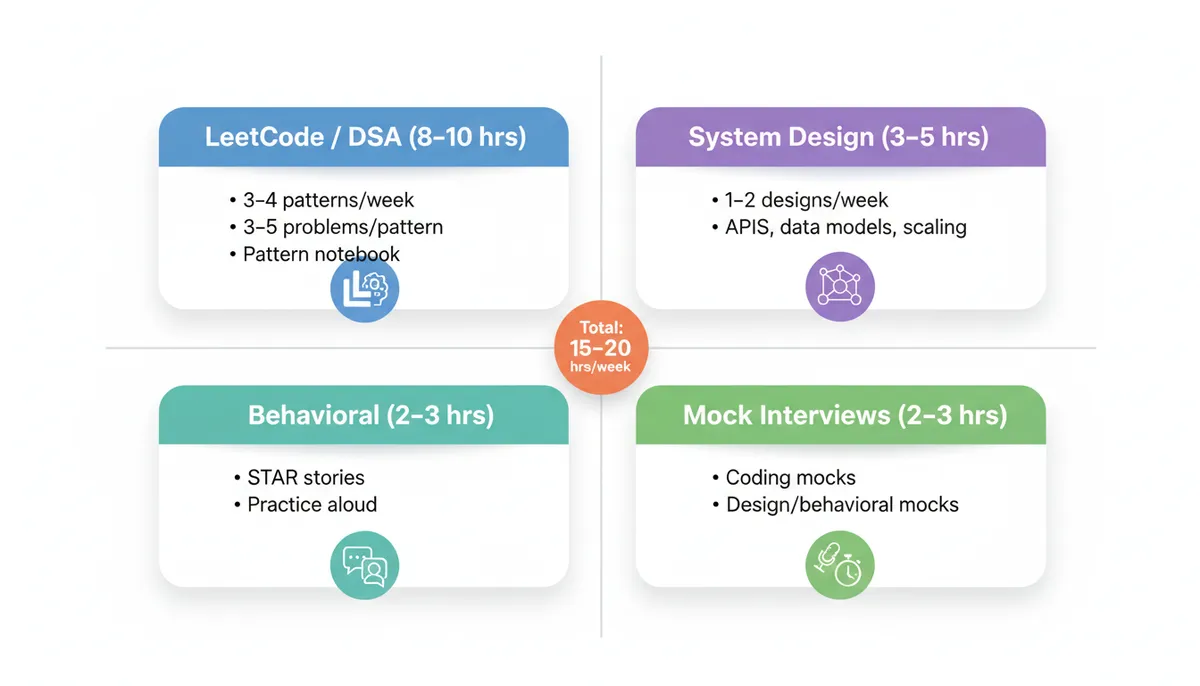
Here’s a concrete weekly plan for someone targeting FAANG interviews in 3–4 months.
Weekly Structure (Assuming ~15–20 hours/week)
1. LeetCode / DSA (8–10 hours)
- 3–4 patterns per week
- For each pattern:
- 3–5 representative problems
- Solve → review → re-solve
- Maintain a pattern notebook with:
- Pseudocode templates
- Common pitfalls
- Example problems
2. System Design (3–5 hours)
- 1–2 design problems per week
- Practice:
- Requirements clarification
- API design
- Data model
- High-level architecture
- Bottlenecks and scaling strategies
3. Behavioral Prep (2–3 hours)
- Craft and refine STAR stories
- Practice aloud answers to:
- “Tell me about yourself”
- “Biggest challenge you faced”
- “Conflict with a teammate”
- Get feedback from peers or mentors.
4. Mock Interviews (2–3 hours)
- 1–2 coding mocks
- 1 design or behavioral mock every 1–2 weeks
- Review recordings or notes:
- Where did you freeze?
- Where was your explanation unclear?
- Which patterns did you miss?
Advanced: Using AI Tools Without Undermining Your Prep
In 2026, candidates often use AI coding assistants while “practicing” LeetCode. This is a double-edged sword.
Good Uses of AI for LeetCode Practice
-
Post-solution review
After you solve a problem, ask an AI:- “Is there a more optimal approach?”
- “Can you explain my solution’s complexity?”
- “What edge cases might I have missed?”
-
Concept clarification
Use AI to explain:- Why a certain DP transition works
- How a particular graph algorithm behaves
-
Pattern reinforcement
Ask: “What pattern does this problem belong to? What are similar problems?”
Bad Uses That Hurt Your Readiness
- Letting AI write the core logic for you
- Copy-pasting solutions without deep understanding
- Using AI to “speed-run” problem sets
Remember: interviewers won’t let you use AI. If your preparation depends on it, you’re training the wrong skill.
For guidance on balancing AI tools with effective study habits, see How to Use AI Tools Like ChatGPT for Interview Preparation (Without Becoming Dependent).
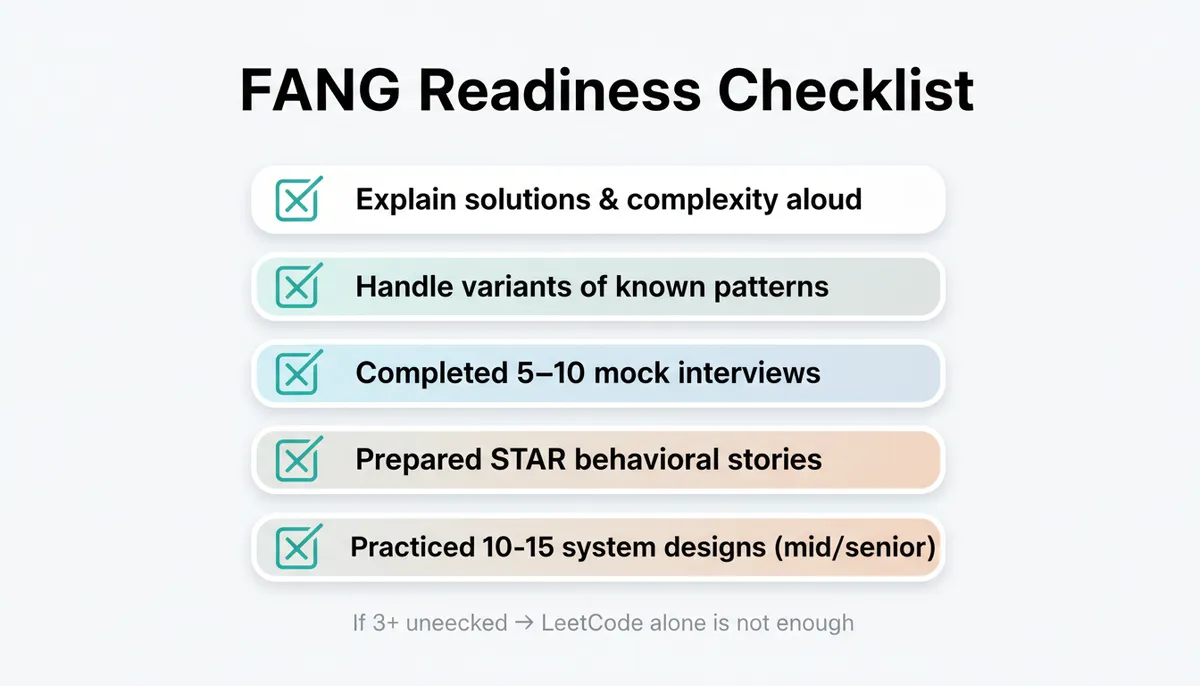
Quick Checklist: Are You Relying Too Much on LeetCode?
Ask yourself:
- Can I explain, out loud, why my solution works and its complexity?
- Can I handle a new problem that’s a twist on a known pattern?
- Have I done at least 5–10 live mock interviews?
- Do I have prepared behavioral stories with clear outcomes?
- For mid/senior: Have I practiced at least 10–15 system design problems?
If the answer to 3 or more of these is “no”, then LeetCode alone is not enough for you yet.
Key Takeaways
- LeetCode is necessary but not sufficient for FAANG interview preparation in 2026.
- The goal is not to memorize solutions, but to master patterns and be able to adapt them.
- A strong coding interview strategy includes:
- Pattern-based LeetCode practice
- System design preparation (for 3+ years experience)
- Behavioral and communication practice
- Regular, realistic mock interviews
- AI tools can accelerate learning, but over-reliance on them for solving problems will backfire in real interviews.
Used thoughtfully, LeetCode is one of the best foundations you can build. Just don’t mistake a high problem count for readiness. Interviewers don’t care how many problems you’ve solved; they care how you think when faced with one you haven’t.