
Interview
Is LeetCode's Mock Interview Actually a Mock Interview?
LeetCode mock mode has a timer and judge. Learn what it prepares you for, what it misses, and how live AI interview practice closes the gap for candidates.
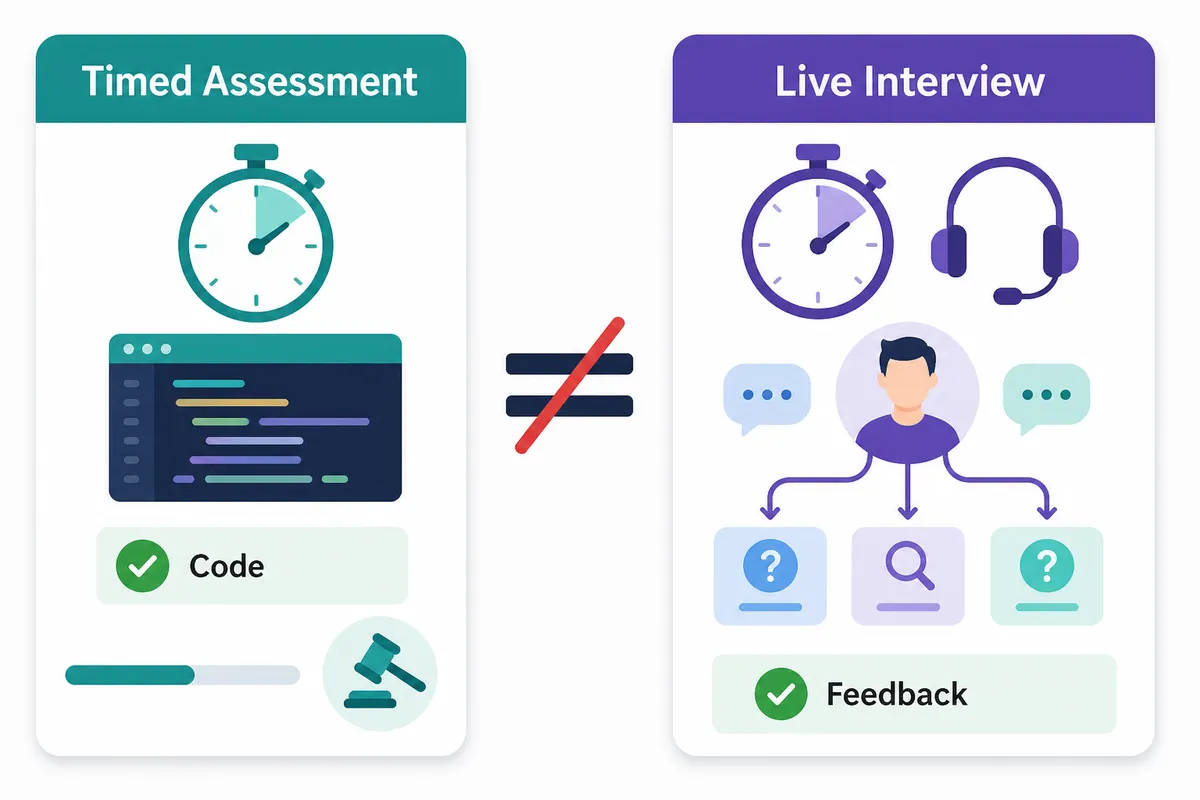
LeetCode's mock interview mode is useful. It gives you a selected problem, a timer and a judge, then asks you to solve under a little more pressure than a normal practice session. For candidates who have spent weeks solving untimed questions, that change matters.
But is it actually a mock interview?
Not quite. It is a timed coding assessment simulation. There is no interviewer listening while you reason, no voice conversation, no clarification question, no follow-up after your first solution, and no one asking why you chose a particular trade-off.
That distinction is not a criticism of LeetCode's core strength. Its problem corpus is unmatched, and solving its questions remains one of the best ways to build DSA fluency. The issue is simply that a timer is not an interviewer.
If you need to practise the parts of a live round that happen around the code, a live voice AI interview practice session adds the conversation, adaptive questioning and feedback that a judge alone cannot provide.
Does LeetCode have mock interviews?
Yes, LeetCode has a mock interview mode. It presents a coding problem in a timed environment and evaluates your submitted solution through its judge.
That is valuable preparation for a specific skill: solving an unfamiliar algorithmic problem independently within a fixed window. It can expose whether you recognise patterns quickly, write syntactically correct code under pressure and handle common edge cases before time expires.
Those are real interview skills. They just are not the whole interview.
In a typical live coding round, the problem does not arrive as a perfectly self-contained prompt that you silently solve. Instead, the process usually looks more like this:
- The interviewer introduces a problem, often with incomplete details.
- You ask questions to clarify input constraints, expected output and assumptions.
- You talk through an initial approach.
- The interviewer challenges an assumption or asks for a better complexity.
- You write code while explaining your decisions.
- Your code is tested, either by you or by the interviewer.
- A follow-up changes the constraints, asks for a variation or probes a weak spot.
LeetCode mock mode handles the timed-solving portion of that sequence. It does not attempt to recreate the interpersonal, adaptive portion.
This is why the answer to “does LeetCode have mock interviews?” needs a little context. It has a product labelled mock interview, and it is a useful mock of a timed coding exercise. But it is not a full simulation of a live interview.
That is not a semantic argument. It changes what you practise.
What LeetCode mock mode prepares you for well
Any fair assessment should start with what it does exceptionally well.
1. Working from a strong problem corpus
LeetCode's collection of problems is its greatest advantage. Candidates can find questions across core DSA topics, difficulty levels and common interview patterns. If you need more repetitions on binary search, graphs, dynamic programming, sliding window or trees, the corpus gives you substantial room to improve.
The more patterns you can recognise, the less likely you are to freeze when a new problem appears in an interview. Timed mode adds useful urgency to that recognition process.
2. Managing a countdown
Many candidates can solve a Medium problem eventually but struggle to solve it in 35 or 45 minutes. A timer reveals that gap quickly.
Time pressure exposes habits such as:
- Spending too long on an elegant but unnecessary optimisation
- Starting to code before checking constraints
- Losing five minutes to avoidable syntax errors
- Failing to reserve time for testing
- Continuing with a bad approach because restarting feels expensive
Timed practice can make these patterns visible. That alone makes the mode worth using.
3. Receiving an objective result
A code judge gives a clear signal: accepted, wrong answer, runtime error or time limit exceeded. That feedback is more reliable than your own feeling that a solution “should work”.
Candidates need this. Coding interviews reward correctness, and confidence without execution is not correctness.
For a more structured way to choose what to solve before you time yourself, see this guide to how to practise coding interview questions effectively. The key is not merely accumulating solved problems. It is reviewing why a pattern worked, where you hesitated and what you would do differently next time.
4. Building independent problem-solving stamina
There is value in being alone with a hard prompt and a ticking clock. A real interviewer will not rescue you every time. You need enough DSA grounding to create a plan, test it and implement it without depending on hints.
LeetCode's mock mode can train exactly that independence.
⚠️ Important: None of this means you should stop using LeetCode once you begin interview simulations. Strong live performance depends on strong problem-solving fundamentals. The goal is to add interview practice to your preparation, not replace your problem practice.
Where the simulation stops
The phrase “mock interview” can create an expectation that the experience resembles sitting opposite an interviewer. This is where the leetcode mock interview vs real interview gap becomes important.
There is no clarification stage
Real interview prompts can be deliberately broad. An interviewer may expect you to ask whether inputs are sorted, whether duplicates are allowed, what size constraints matter or whether modifying the input is permitted.
A written LeetCode problem generally supplies those details. That makes it efficient for practice, but it removes a skill that interviewers actively assess: identifying ambiguity before committing to an approach.
A candidate who immediately starts coding may look decisive. A candidate who asks two sharp clarifying questions often looks more senior and more reliable.
There is no spoken explanation
In a live coding interview, silence is risky. The interviewer cannot assess reasoning that remains in your head.
They are listening for whether you can:
- Break the problem into sensible parts
- Compare a brute-force solution with an optimised one
- State time and space complexity accurately
- Explain a bug without panicking
- Narrate implementation choices clearly
- Recognise when an assumption is no longer valid
Solving a problem and explaining a problem are related skills, but they are not identical. Someone can be very strong on LeetCode and still underperform when asked, “Why is this data structure necessary?”
For practical examples, read how to think out loud in coding interviews. Good narration is not constant talking. It is a clear account of the decisions an interviewer needs to evaluate.
There are no adaptive follow-ups
This is the biggest difference.
Suppose you solve a two-sum style problem with a hash map. In a real interview, you may then hear:
- “Can the input arrive as a stream?”
- “What if memory is limited?”
- “How would you return all valid pairs?”
- “What changes if the array is sorted?”
- “Can you make this work across distributed partitions?”
Those follow-ups are not random extras. They test whether you understand the underlying technique or have memorised one standard answer.
A code judge evaluates the solution you submit. An interviewer evaluates how you respond when the original solution is no longer enough.
There is no reaction to your mistakes
A wrong answer in a judge is useful information. But a real interview has another layer: someone watches what you do when the answer is wrong.
Do you blame the prompt? Do you silently edit until something passes? Do you identify a likely failure mode, form a test case and explain your debugging path?
That recovery is often as revealing as the final code.
💡 Pro Tip: When a test fails during practice, pause before editing. Say out loud what you think failed and why. Then make the smallest change that tests your hypothesis. This is a simple way to turn solo practice into interview-ready practice.
Timer pressure and interviewer pressure are different
Candidates sometimes assume that if they can solve problems under a timer, they are prepared for the pressure of an interview. The two pressures overlap, but they are not the same.
A timer creates urgency. An interviewer creates uncertainty.
Under a timer, you are mainly managing your own process. Under an interviewer, you are also managing communication, incomplete information, interruptions and changing expectations. You may be asked to justify a complexity estimate halfway through implementation. You may be given a hint you did not want. You may realise the interviewer interpreted the requirement differently from you.
This is why a candidate can complete many timed questions successfully and still feel unexpectedly unsettled in a live round.
| Timed problem practice | Live interview practice |
|---|---|
| Solve a written prompt | Clarify an evolving prompt |
| Manage a countdown | Manage time and conversation |
| Submit to a judge | Explain choices to an interviewer |
| Fix a failing result | Diagnose a mistake aloud |
| Finish one solution | Handle follow-ups and variations |
Neither column is more important in every context. They train different muscles.
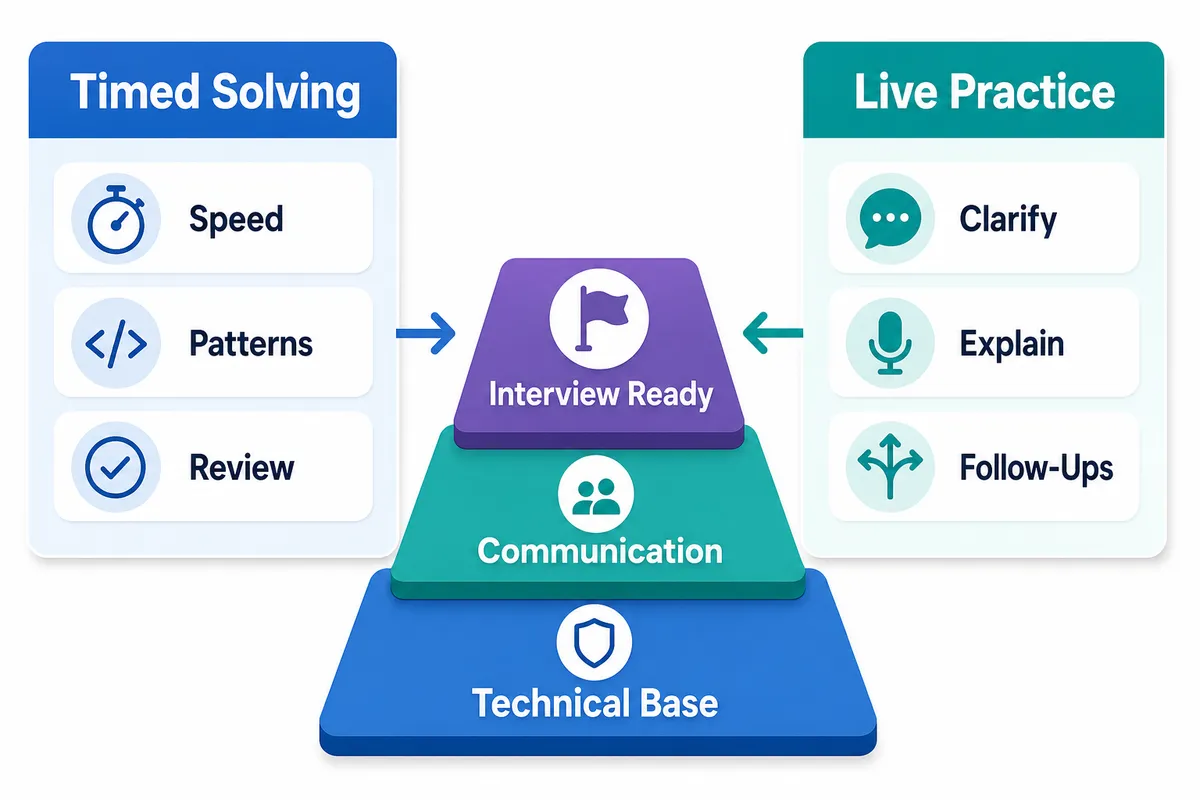
For candidates preparing for interviews soon, a useful routine is to keep timed problem-solving as the foundation, then schedule regular simulations where you must speak, explain and respond. This is especially important if you have noticed that your written solutions are stronger than your verbal explanations.
How to use LeetCode and live interview practice together
The most productive approach is not to treat one format as sufficient for everything. Use each for the job it does best.
Use LeetCode to build your technical base
Spend your focused DSA study time on patterns, implementation repetition and review. Work through weak topics systematically rather than selecting random problems every day.
If you are unsure how much volume you need, this breakdown of how many LeetCode problems are enough for interviews can help you think beyond a single target number. The quality of review, pattern coverage and ability to solve unseen questions matter more than a streak count.
Use timed mocks to check independent execution
Once a week, run a timed session without notes, solutions or hints. Treat it as a checkpoint. Note where you lost time:
- Understanding the problem
- Selecting the approach
- Writing the implementation
- Debugging
- Testing edge cases
Do not only record whether you passed. Record the bottleneck.
Use live simulations to practise being evaluated
Then add a LeetCode-style AI mock interview when you need to practise the live-round behaviours a judge does not evaluate.
Thita provides live voice AI interviews with adaptive follow-ups. For coding rounds, you work in a code editor that compiles and runs your code, so you can practise both execution and explanation. You can practise in six languages: Python, C++, Java, JavaScript, Go and C#.
The AI can ask you to clarify assumptions, challenge your complexity, probe your first design choice and react to the solution you actually produce. That makes a session useful not because it replaces a great problem library, but because it recreates the interaction around the problem.
Review the communication, not just the code
After a live practice session, review questions such as:
- Did I ask useful clarifying questions?
- Did I explain the brute-force option before optimising?
- Did I state complexity precisely?
- Did I test the cases most likely to fail?
- Did I recover clearly after an error?
- Did I answer the follow-up, or repeat my original solution?
These are the details that decide whether a technically correct candidate sounds ready to work with an engineering team.
✅ Do keep a short interview notebook containing repeated communication mistakes.
✅ Do practise saying your complexity analysis before you code.
✅ Do alternate familiar pattern practice with unfamiliar interview-style prompts.
❌ Don't interpret an accepted submission as proof that you can explain the solution.
❌ Don't wait until the week before an interview to speak your reasoning aloud for the first time.
When a timer-only mock may be enough
A timer and judge may be sufficient if your immediate goal is an online assessment. Many assessments are deliberately individual and do not include live questioning. In that case, timed execution, accuracy and speed deserve most of your attention.
It can also be enough early in preparation, when you are still learning fundamental patterns. There is little value in simulating sophisticated follow-ups if you cannot yet implement a basic BFS or sliding-window solution independently.
However, move beyond timer-only practice when:
- You have live technical rounds booked
- You consistently solve problems but struggle to explain them
- You have received feedback that your communication is unclear
- You are targeting senior roles with design-heavy interviews
- You have been out of interviewing practice for a while
- You tend to go quiet when stuck
The closer you are to a real conversation, the more your preparation should include real conversation.
Frequently asked questions
Is LeetCode mock interview free?
LeetCode's available features and access conditions can change, so check its current product pages for the latest details. The more important question is what the mode helps you practise: timed, independently judged coding rather than a full interactive interview.
Does LeetCode have mock interviews with an interviewer?
LeetCode's mock interview mode provides a timer and code judge. It does not provide a voice interviewer, adaptive AI questioning or follow-up questions based on your solution.
Is LeetCode mock interview useful for real interviews?
Yes. It is useful for building speed, solving under time pressure and checking whether your code passes a judge. It is less suited to practising clarification, verbal reasoning, interviewer interaction and follow-up questions.
What is the main leetcode mock interview vs real interview difference?
The main difference is adaptation. A real interviewer can ask why you chose an approach, change a requirement, ask you to optimise or test how you recover from a bug. A timed judge evaluates the submitted solution without conducting that conversation.
Should I stop using LeetCode if I use AI mock interviews?
No. LeetCode is excellent for building DSA knowledge and getting repetitions on high-quality problems. AI interview practice is most effective when it adds live explanation, feedback and follow-ups to that technical foundation.
Can an AI mock interview run my code?
Some can, while others only discuss code. On Thita, coding sessions use a real editor that compiles and runs code in Python, C++, Java, JavaScript, Go and C#.
Can I practise more than DSA interviews?
Yes. Thita offers system design interviews on a canvas where the submitted architecture is evaluated, plus low-level design, machine coding, behavioural, product management, data science, AI and ML, CS fundamentals and resume-based interviews.
Turn timed solving into interview readiness
LeetCode's mock mode is worth using. It creates useful constraints around an exceptionally strong problem corpus, and timed independent solving should remain part of serious technical interview preparation.
Just do not mistake the timer for the interviewer.
A live round tests whether you can solve, explain, clarify, adapt and recover while someone is evaluating your process. Those skills need their own repetitions.
Practise a live voice AI interview to add adaptive follow-ups, real code execution and interview-style feedback to the DSA work you already do. Start with a familiar problem, explain every decision aloud and let the next question test whether you truly understand the first answer.
If you are hiring rather than preparing for interviews, visit https://interviews.thita.ai/.
Topics
Related on Thita
Your next step
Try Thita before you decide
The Starter plan is free: pattern sheets, code execution in six languages and an AI mock interview. Pro adds more AI code feedback and mock interviews, company kits and the 90-day roadmaps.