
Interview
How Many LeetCode Problems Are There, and How Many Are Enough for Top Tech Interviews?
LeetCode has 4,086 problems (checked 20 Oct 2026). You need 150-250 for FAANG, chosen by pattern. Plus mastery data from 815 engineers.

Most candidates eventually hit the same wall: “I’ve solved 200 LeetCode problems and I still don’t feel ready. How many LeetCode problems are actually enough to crack a top tech interview?”
The honest answer has two parts. LeetCode has 4,086 problems (as of 20 October 2026), so “solve them all” is not a plan. And there is no magic number for the total you should solve, but there is a real, measured number for the piece that predicts readiness: how many problems it takes to go from “I’ve seen this pattern” to “I can solve this pattern unaided.” We pulled that number from our own product data instead of guessing at it.
How many LeetCode problems are there?
LeetCode has 4,086 problems as of 20 October 2026: 972 Easy, 2,130 Medium and 984 Hard. Medium is the biggest bucket at about 52% of the catalogue. Of those, 3,300 are free and 786 are premium-only. LeetCode keeps adding problems, so the total drifts upward over time.
| Difficulty | Problems (20 Oct 2026) | Share |
|---|---|---|
| Easy | 972 | 24% |
| Medium | 2,130 | 52% |
| Hard | 984 | 24% |
| Total | 4,086 | 100% |
Source: the problem counts LeetCode itself returns for its public problemset (leetcode.com/problemset), checked on 2026-10-20. Older articles that say 1,800, 2,000 or 3,000 problems are simply out of date.
How many LeetCode problems should you do?
Almost nobody needs more than a few percent of that catalogue. Short answers by goal:
| Your goal | Problems to solve | What to do |
|---|---|---|
| Quick refresh, strong fundamentals | 75 | A curated list such as the Blind 75 |
| FAANG / big tech, 1-2 months | 150-250 | The NeetCode 150, then selected extras, chosen by pattern |
| Weaker start, or very competitive roles | 250-300 | The NeetCode 250 grouped by pattern, plus mock interviews |
| More than 300 | Diminishing returns | Only to close specific weak patterns |
The reason is not the count; it is what the count hides. In our data, the median engineer needed 5 problems to master one pattern (details below), so coverage across roughly 25-30 high-yield patterns, not volume, decides readiness.
This post breaks down how to think about “how many LeetCode problems” in a way that senior engineers and hiring managers actually care about, grounds it in real usage data by pattern, and shows how to design a practice plan that gets you there without grinding 1,000 problems at random.
What Our Own Data Shows: Problems to Reach Mastery, Per Pattern
Instead of a survey or a guess, we looked at how engineers using Thita.ai actually get from first exposure to a DSA pattern to genuinely mastering it — no coach hints needed, correct on the first try, repeatedly. Across 815 engineers who reached mastery on at least one pattern, the median engineer needed 5 problems to master a pattern, and three-quarters had mastered it within 11 problems.
That number holds up (with enough users to publish it reliably, k≥50 per pattern) for four individual patterns:
| Pattern | Median problems to mastery | 75th percentile | Engineers measured |
|---|---|---|---|
| Two Pointers | 4 | 10.25 | 278 |
| Sliding Window | 5 | 10.0 | 75 |
| Array/Matrix Manipulation | 5 | 12.0 | 75 |
| Tree Traversal | 6 | 13.0 | 63 |
| Overall (across all patterns) | 5 | 11.0 | 815 |
Snapshot date 2026-09-07. Full method below — the short version is: “mastered” means at least 3 attempts on the pattern with at least 60% of them solved without a coach hint, which is the same bar Thita’s own in-product coach uses to decide when to stop teaching a pattern from scratch. Patterns with fewer than 50 engineers who reached mastery are suppressed rather than published with a shaky number — that’s most of our 15-pattern catalog today, which is exactly why this is a semi-annual study rather than a one-time post: the numbers get more patterns and tighter each time we re-run it.
This lines up almost exactly with the “3–5 problems to learn a pattern” rule of thumb the rest of this post has always recommended — except now it’s not a rule of thumb, it’s what actually happened for hundreds of engineers. It also explains why that rule of thumb works: mastery is closer to 4–6 problems for the patterns candidates hit earliest and most often (two pointers, sliding window, array manipulation), and creeps toward 6+ for patterns with more structural variety (tree traversal has more shapes of problem — top-down vs. bottom-up, BFS vs. DFS — than two pointers does).
The Wrong Question: Why “How Many LeetCode Problems?” Is Misleading
The raw count of problems solved is a poor predictor of interview performance. Interviewers evaluate:
- Pattern recognition and problem decomposition
- Code quality and correctness
- Communication and reasoning
- Ability to handle variants and follow-ups
You can solve 800 problems and still:
- Freeze when the problem is worded differently
- Struggle to explain your approach
- Break on edge cases and complexity constraints
On the other hand, someone who has solved 150–200 well-chosen problems, with deep understanding of patterns, can perform extremely well.
A better question than “how many LeetCode problems” is:
“How many representative problems per pattern do I need to master to reliably solve unseen questions in interviews?”
That’s what we’ll answer.
What Top Tech Interviews Actually Test
Before designing a practice plan, it’s worth aligning with what FAANG-style interviews care about.
1. Core DSA and Algorithms (Patterns, Not Trivia)
Interviews rarely test obscure algorithms. They focus on:
- Arrays, strings, linked lists
- Hashing, sets, maps
- Trees, graphs, recursion, DFS/BFS
- Sorting, searching, binary search
- Dynamic programming
- Heaps, priority queues, intervals, greedy
- Basic math & bit manipulation
Within each of these, there are recognizable patterns (sliding window, two pointers, topological sort, etc.). Interviewers are checking if you can:
- Map a new problem to a known pattern
- Adapt that pattern to constraints
- Reason about time/space complexity
2. Problem-Solving Process
Your thought process matters at least as much as the final code:
- Clarifying requirements and constraints
- Generating and comparing approaches
- Identifying bottlenecks and tradeoffs
- Iterating from brute force to optimal
3. Implementation Quality
Once you have an approach, can you:
- Write clean, bug-free code under time pressure
- Handle edge cases (empty inputs, single elements, large values)
- Use appropriate data structures and APIs
- Test and debug your own solution aloud
LeetCode can help with all of this—but only if you’re deliberate. For enhanced preparation, consider leveraging Best Ways to Use AI for DSA and Coding Interview Preparation, which explores how AI tools can complement your coding practice effectively.
A Pattern-Based Answer: How Many Problems Per Pattern?
Instead of asking “how many LeetCode problems total,” think in terms of coverage and depth across DSA patterns.
A practical rule of thumb that aligns with how Thita.ai structures its 99 DSA patterns:
- For each common pattern:
- 3–5 problems to learn the pattern
- 3–5 problems to reinforce and handle variants
- For each advanced or niche pattern:
- 2–4 problems for familiarity
If you focus on ~25–30 high-yield patterns that show up most in interviews, that’s roughly:
- 6–10 problems × 25 patterns ≈ 150–250 problems
This is the range where most serious candidates start to see a clear shift: new problems feel like variations of something they’ve seen before, not completely novel.
The key is which 150–250 problems and how you solve them.
A Structured Roadmap: Levels of LeetCode Practice
Here’s a roadmap you can use to structure your coding interview practice. The number of problems is indicative, not prescriptive.
Phase 1: Foundations (0–50 Problems)
Goal: Build comfort with basic data structures, syntax, and simple patterns.
Focus areas:
- Arrays & strings: traversals, counting, frequency maps
- Hash maps / sets: lookup, deduplication
- Basic two pointers: removing duplicates, reversing, partitioning
- Simple stacks & queues
Target: 30–50 problems, mostly Easy with some approachable Mediums.
Example problem categories:
- “Two Sum” style (hash map lookup)
- Valid parentheses (stack)
- Reverse linked list
- Merge two sorted lists
- Move zeros / remove element (two pointers)
At this stage, don’t chase speed. Focus on:
- Writing correct, readable solutions
- Understanding time and space complexity
- Explaining your approach out loud
Phase 2: Core Patterns (50–150 Problems)
Goal: Learn and internalize the most common interview patterns.
This is where a structured pattern sheet (like Thita’s 99-pattern catalog) is essential. You want to cover the patterns that appear again and again across FAANG interview preparation materials.
Key patterns (non-exhaustive):
- Sliding window (fixed and variable size)
- Two pointers (sorted arrays, linked lists)
- Fast & slow pointers (cycle detection, middle of list)
- Binary search (value space and index space)
- Prefix sums & difference arrays
- Monotonic stacks (next greater element, histogram)
- BFS & DFS on trees and graphs
- Topological sort (Kahn’s algorithm)
- Backtracking (subsets, permutations, combinations)
- Basic dynamic programming (1D and 2D tabulation)
Target: 60–100 problems, mostly Medium, chosen to cover each pattern with several examples.
You should aim for:
- At least 3–5 problems per core pattern
- Actively identifying the pattern before coding
- Comparing your solution to editorial and alternative approaches
For a deeper dive into mastering these patterns, check out The 90 DSA Patterns That Cover 99% of Coding Interviews, which provides a comprehensive guide to essential coding interview patterns.
Phase 3: Depth + Variants (150–250 Problems)
Goal: Build robustness: handle tricky variants and follow-up questions.
Focus on:
- Harder variants of familiar patterns
- Combining patterns (e.g., sliding window + hash map, BFS + bitmask)
- Edge-case-heavy problems
- Time/space tradeoffs
Target: 50–100 additional problems, majority Medium, some Hard.
This is where you should simulate interview conditions:
- 30–40 minutes per problem
- No immediate peeking at solutions
- Explaining your reasoning as if talking to an interviewer
If you use something like Thita’s AI mock interviews, this is the stage where mock interviews are extremely valuable to expose gaps that LeetCode alone may not reveal (communication, pacing, handling hints).
Phase 4: Maintenance + Weak-Spot Drilling (Ongoing)
After ~200 problems, the marginal benefit of random new problems decreases. You should:
- Revisit problems you struggled with
- Drill specific weak patterns (e.g., DP, graphs)
- Practice timed sets of 2–3 problems back-to-back
- Simulate full interview loops end-to-end
The number of new problems here is flexible. Some candidates might go to 300–400; others might stay around 200 but iterate deeply.
The important metric is not “how many LeetCode problems” but:
- Can you solve a representative problem in each core pattern category under time pressure, while explaining clearly?
Example: Pattern-Based Learning vs. Problem Count
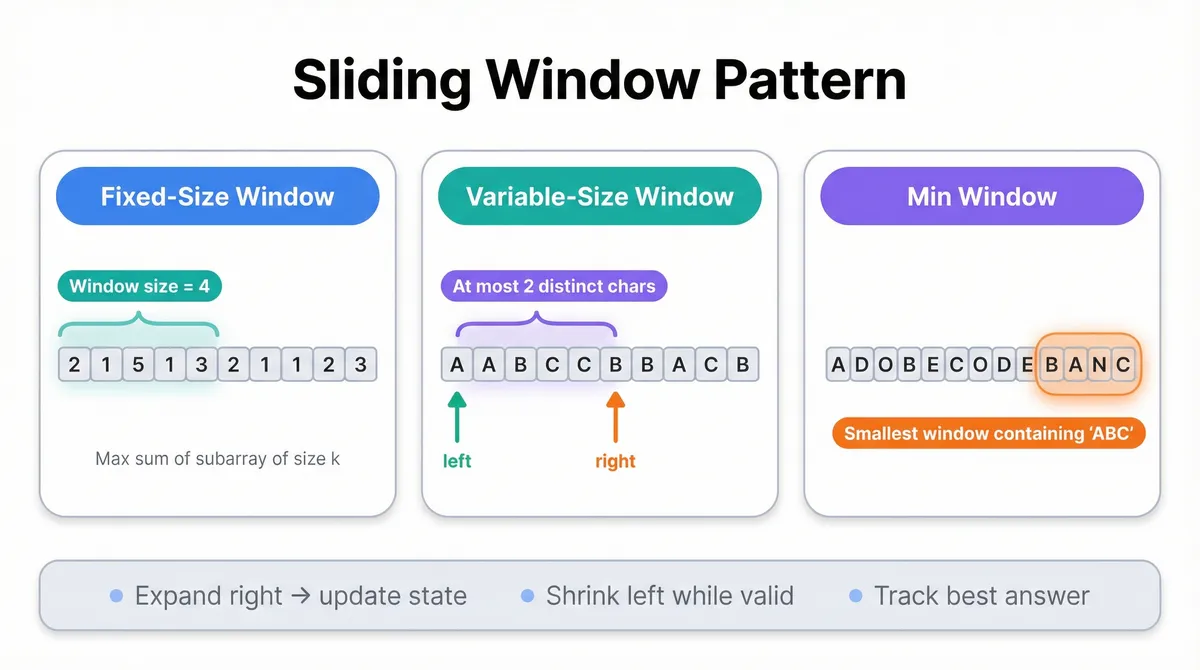
To make this concrete, consider the sliding window pattern.
Naïve Approach: Count Problems
You solve:
- 15 different “longest substring” / “subarray sum” / “minimum window” problems
- But treat each as an isolated challenge
- Don’t generalize the technique
You end up with:
- 15 problems solved
- Weak ability to recognize a new sliding window problem
Pattern Approach: Fewer Problems, Deeper Learning
You solve 6 problems, but deliberately:
- Start with a fixed-size window (e.g., maximum sum of subarray of size k)
- Move to variable-size window with count constraint (e.g., longest substring with at most k distinct chars)
- Handle problems where window validity is defined by a predicate (e.g., sum <= k)
- Handle more complex constraints (e.g., minimum window substring)
For each problem, you:
- Draw the window boundaries and track what changes when
leftorrightmoves - Write the generic template for sliding window
- Compare multiple problems to see the same structure
By the end, you can look at a new problem and say:
“This is a variable-size sliding window where we maintain a frequency map and shrink until the constraint is met.”
You’ve solved fewer problems, but built a reusable mental model.
How to Use LeetCode for Interviews Effectively
The way you solve each problem matters more than the number.
1. Always Start With a Brute Force
Even if you know the optimal pattern, practice articulating:
- A simple, possibly inefficient solution
- Why it’s too slow (e.g., O(n²) vs. required O(n log n) or O(n))
- How constraints force you toward a better approach
This mirrors real interview expectations: interviewers want to see your path from naive to optimal.
2. Identify the Underlying Pattern
Before coding, ask:
- Is the input sorted or can it be sorted? → two pointers, binary search
- Am I looking for a subarray/substring with constraints? → sliding window
- Am I exploring combinations or subsets? → backtracking
- Is there overlapping subproblems and optimal substructure? → dynamic programming
- Is it about shortest path / levels? → BFS
- Is it about visiting all possibilities with pruning? → DFS/backtracking
Write down the pattern in your notes. Over time, you’ll build a mental index.
3. Code with Interview Constraints in Mind
When you implement:
- Use clear variable names (
left,right,count,freq) - Talk through your logic as you type
- Handle edge cases explicitly
- Add quick sanity checks with sample inputs
Example (Python, sliding window):
PYTHON
Time complexity: O(n)
Space complexity: O(k) or O(1) bounded by character set size.
4. Review and Generalize After Each Problem
After solving (or reading the editorial if you got stuck):
- Summarize the pattern in 2–3 sentences
- Note the key invariants (what must always be true)
- Compare with similar problems you’ve seen
- Capture a general template if applicable
For dynamic programming, for example:
- Define
dp[i]ordp[i][j]clearly - Write the recurrence relation
- Identify base cases
- Consider space optimization
Over time, these meta-notes become more valuable than the problem count.
Common Mistakes in Coding Interview Practice
Mistake 1: Chasing Problem Count Without Depth
Solving 500 problems with shallow understanding is less useful than 200 with deep pattern recognition.
Symptoms:
- You rarely revisit problems
- You can’t explain why your solution is optimal
- You struggle to adapt to small variations
Fix:
- Limit new problems per day; allocate time for review
- Maintain a “weak problems” list and revisit weekly
- Practice explaining solutions without looking at code
Mistake 2: Ignoring Systematic Coverage
Randomly picking problems from the LeetCode feed leads to gaps, especially in:
- Graphs (BFS/DFS, topological sort)
- Dynamic programming (knapsack, subsequences, intervals)
- Trees & tries
Fix:
- Use a structured pattern sheet (e.g., Thita’s /dsa-patterns-sheet)
- Track which patterns you’ve covered and to what depth
- Aim for at least 3–5 solid problems per core pattern
Mistake 3: Over-Focusing on LeetCode Hards
Many FAANG interviews do not require solving LeetCode Hard problems under time pressure. Mediums are the backbone.
Symptoms:
- Spending days stuck on a single hard
- Feeling demotivated and slow
- Missing core Mediums that appear frequently
Fix:
- Treat Hards as bonus / stretch goals
- Prioritize breadth and mastery of Mediums
- Use Hards to deepen understanding of a pattern you already know
Mistake 4: Not Practicing Communication
LeetCode is a silent environment; interviews are not.
Symptoms:
- You can code alone but freeze when asked to explain
- You struggle to structure your thoughts
- You don’t verbalize tradeoffs or complexity
Fix:
- Practice “thinking aloud” while solving
- Do mock interviews with a friend or an AI interviewer (e.g., Thita’s /ai-interview)
- Use a consistent structure: restate problem → clarify → propose brute force → optimize → code → test
Mistake 5: Neglecting Time and Space Complexity
Many candidates write code that passes LeetCode’s tests but would be rejected in interviews for violating constraints.
Fix:
- Always estimate complexity before coding
- Re-evaluate complexity after coding
- Ask: “Can we do better?” even if solution passes
Designing Your Personal LeetCode Plan
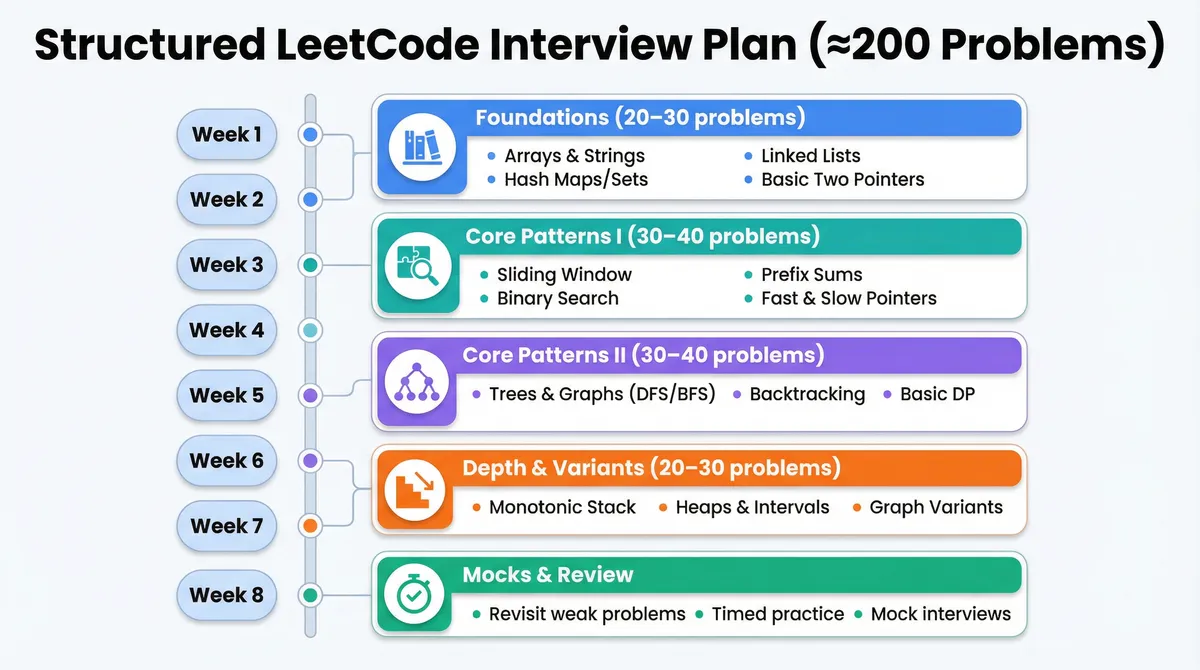
Here’s a sample 8–10 week plan targeting ~200 problems with good coverage.
Step 1: Assess Your Starting Point
Ask yourself:
- Can I comfortably code basic data structures from scratch?
- Do I know at least 5–10 common patterns by name?
- Have I done any timed practice?
If you’re early in the journey, spend more time in Phases 1 and 2. If you’re already at 100+ problems, focus on depth, mock interviews, and weak spots.
Step 2: Choose Patterns, Then Problems
Instead of opening LeetCode and scrolling:
- Pick 2–3 patterns to focus on for the week
- For each pattern, select 3–5 Easy/Medium problems to start
- Add 1–2 harder variants once you’re comfortable
Track this in a simple spreadsheet or note:
- Columns: Problem, Pattern, Date solved, Difficulty, Notes (struggles, insights)
- Mark problems to revisit
Step 3: Mix New Problems with Review
A balanced session might look like:
- 45–60 minutes: 1 new Medium problem
- 20–30 minutes: revisit 1–2 previously hard problems
- 10 minutes: notes and pattern review
This ensures retention and builds confidence.
Step 4: Integrate Mock Interviews
In the final 3–4 weeks before interviews:
- Do at least 1–2 mock interviews per week
- Use problems you haven’t seen before
- Get feedback on communication, pacing, and clarity
Tools like Thita’s AI mock interviews can simulate this environment with real-time feedback on your reasoning and code, complementing your LeetCode practice.
How Many LeetCode Problems Do Successful Candidates Actually Solve?
Our per-pattern data (above) isn’t a total problem count — it’s the number of problems it takes to master one pattern. Scaling it up to a full prep plan: if you need working mastery of the 10–15 patterns that show up most often in interviews, and each one takes a median of 5 problems (up to 11 at the 75th percentile) to master, that alone is 50–165 problems just for core-pattern mastery. Add breadth (patterns you only need familiarity with, not mastery), variants, and mock-interview practice, and you land in the same range this post has always recommended:
- <100 problems: Often insufficient unless you already have very strong fundamentals and prior interview experience — our data suggests this rarely covers mastery-level depth on more than 10-ish patterns.
- 100–200 problems: Reasonable for strong CS backgrounds or those using a very focused pattern-based approach — enough to master most core patterns at the median rate above, with room for variants.
- 200–300 problems: Common range for candidates who started weaker (needing closer to the 75th-percentile problem count per pattern) or who want broader coverage and confidence.
- >300 problems: Diminishing returns unless you’re deliberately targeting gaps or aiming for particularly algorithm-heavy roles — well past what our data shows mastery actually requires per pattern.
The number alone doesn’t guarantee anything. What matters is:
- Pattern coverage (did you hit all the major categories?)
- Depth (can you handle variants and follow-ups?)
- Interview skills (communication, pacing, handling hints)
Method
The pattern-mastery numbers in this post come from a semi-annual internal study of Thita.ai’s own product data (next scheduled re-run: roughly six months from the 2026-09-07 snapshot above, as more patterns cross the publication threshold).
- Mastery, defined precisely: an engineer has mastered a pattern once they’ve attempted at least 3 problems on it and solved at least 60% of them without opening a coach hint. This is not a definition invented for this post — it’s the exact threshold Thita’s in-product AI coach already uses (
services/tiro/mastery.py) to decide when to stop teaching a pattern from scratch and start giving direct answers, so the “mastery” in this post is the same mastery the product itself recognizes. - Problems-to-mastery: for every engineer who crossed that bar on a pattern, we looked at their problem-attempt history on that pattern in chronological order and counted how many were solved within the same window of attempts the mastery threshold itself counted. That’s the “problems to mastery” number.
- Privacy: every number in this post is an aggregate across a k≥50-engineer group. No individual engineer’s data, attempts, or identity is ever part of a published figure — patterns with fewer than 50 engineers who’ve reached mastery are held back until they have enough data, not published on a shaky sample. That’s why only 4 of Thita’s 15+ published DSA pattern families appear in the table today; the rest are measured internally and will publish once they clear the threshold.
- What this doesn’t measure: this is problems solved, not problems solved fully unaided in the strict sense the mastery threshold uses for classifying someone as “mastered” — the underlying attempt-history table doesn’t track hint usage per problem, only per pattern in aggregate. Treat these as a slightly generous same-scale estimate, not a hairline-precise count.
How many LeetCode problems for FAANG?
For FAANG and other big-tech loops, 150-250 well-chosen problems is the range where new questions start to feel like variations of ones you have seen. That means the NeetCode 150 as a base, then extra Mediums in your weakest patterns. Mediums are the backbone; Hards are stretch goals. If you are short on time, the Blind 75 is the compact version, and NeetCode 150 vs 250 vs Blind 75 helps you pick a scope by timeline. Is the 150 enough? See Is NeetCode 150 enough for FAANG?.
How many LeetCode problems per day?
One to two new problems a day, plus review, beats a daily grind of five. A session that works: one new Medium (45-60 minutes), a re-solve of one problem that went badly (20-30 minutes), and 10 minutes writing the pattern down. At that pace 150-250 problems takes roughly 8-12 weeks, which matches the plan above. Placement and campus-hiring candidates can usually aim at the lower end (100-150 problems, heavy on arrays, strings, hashing, two pointers, trees and basic DP) unless the target company is known for hard rounds.
How many Easy, Medium and Hard problems?
A reasonable split inside your 150-250 is roughly 20% Easy, 65-70% Medium and 10-15% Hard. See Easy vs Medium vs Hard LeetCode for how each level is used in real loops.
FAQ
How many LeetCode problems are there in total?
4,086 as of 20 October 2026 (972 Easy, 2,130 Medium, 984 Hard). Of those, 3,300 are free and 786 are premium-only. The number grows as new problems are added.
How many LeetCode problems should I do for FAANG?
Plan on 150-250, selected by pattern and weighted toward Mediums, plus mock interviews. More than about 300 gives diminishing returns unless you are closing specific gaps.
How many LeetCode problems should I do for placement?
Roughly 100-150 on core topics is a solid target for most campus placements; go toward 200 if you are aiming at product companies with harder online assessments.
How much LeetCode is enough?
Enough is when you can recognise the pattern in a new Medium within a few minutes and implement it in about 20-30 minutes while explaining your reasoning. That is a skill threshold, not a count.
How many LeetCode problems should I do per day?
One or two new problems plus a review of an older one. Consistency over eight to twelve weeks matters more than daily volume.
Does solving 500+ problems guarantee an offer?
No. Interviewers score pattern recognition, communication and handling follow-ups. Depth on 200 problems beats shallow coverage of 500.
Key Takeaways
- LeetCode has 4,086 problems (20 Oct 2026); you need roughly 150-250 of them, chosen by pattern.
- There is no universal magic number of LeetCode problems, but there is a real, measured one for the unit that actually matters: a median of 5 problems (up to 11 at the 75th percentile) to master one DSA pattern, based on 815 engineers who’ve done it on Thita.ai.
- Scale that up: mastering the 10–15 patterns that show up most in interviews puts most candidates in the 150–250 total problems range this post has always recommended — now with real usage data behind it instead of a rule of thumb.
- Think in terms of problems per pattern, not total problems. Our data shows 4–6 problems gets most engineers to mastery on the earliest, most common patterns (two pointers, sliding window); structurally richer patterns like tree traversal run a bit higher.
- Use a structured roadmap: foundations → core patterns → depth/variants → mocks & review.
- Avoid common pitfalls: chasing problem count, ignoring patterns, over-focusing on Hards, neglecting communication and complexity.
- LeetCode is a tool, not the goal. Your objective is to become the kind of engineer who can recognize patterns, reason clearly, and implement robust solutions under pressure.
If you structure your coding interview practice around patterns, deliberate review, and mock interviews, “how many LeetCode problems” stops being an anxiety-inducing metric—and becomes just one part of a much more reliable preparation strategy, backed by what actually happens for engineers who get there.
Read next
- One Week to Prepare for an Interview: A Day-by-Day Plan — turn your pattern targets into a concrete seven-day schedule.
Topics
Related on Thita
Your next step
Practise with AI mock interviews
A spoken interview that asks follow-up questions, runs your code and ends with a written report.