
Interview
Is Paying for an AI Mock Interview Worth It? An Honest Breakdown
Is paying for an AI mock interview worth it? Compare free sheets, peer practice and paid tools to decide what feedback and realism you actually need.
Is paying for an AI mock interview worth it? Sometimes. But not automatically, and not for every candidate.
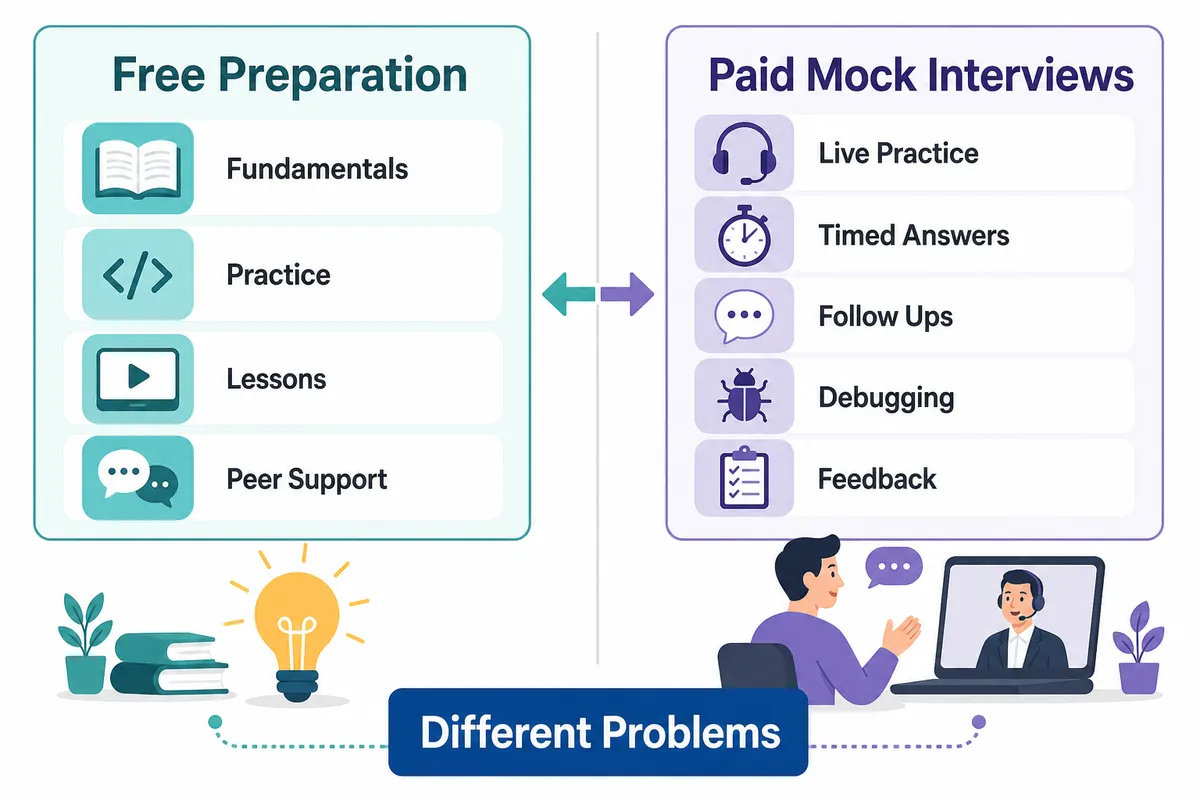
Free preparation has never been better. You can find quality problem lists, system design notes, interview questions, coding judges, videos, peer communities and study plans without spending anything. If you are still learning fundamentals, those resources may be exactly what you need. A paid subscription cannot replace the work of understanding arrays, recursion, SQL, distributed systems, or how to tell a convincing story about your experience.
Where a tool such as a live AI mock interview can earn its place is different: it helps you rehearse the performance of interviewing. That means explaining out loud, making decisions under a timer, responding to follow-up questions, debugging while someone waits, and recovering when your first answer is not strong enough.
The honest answer is this: paying is worth it when your gap is interview simulation and feedback, not when your gap is basic knowledge. This guide will help you tell the difference before you spend anything.
Start with the uncomfortable truth: free options do a lot well
The debate around free vs paid mock interview tools can get distorted because paid platforms often imply that free preparation is somehow incomplete. It is not.
For many candidates, free resources are the sensible starting point. They let you build knowledge cheaply, explore a role before committing to it, and practise at your own pace. A student with several months before placements, for example, may get more value from working through core concepts consistently than from doing repeated mock interviews too early.
Free sheets are a real alternative, not a teaser for the “real” product. If you need a structured list of what to study, browse the DSA patterns sheet, system design sheet, or low-level design sheet. They can help you identify gaps, choose questions deliberately and avoid spending three weeks solving random problems.
Free options are especially good for:
- Learning fundamentals. A mock interviewer cannot teach you every data structure or design concept from zero.
- Building repetition. Coding judges and problem sheets are excellent for solving many questions and recognising patterns.
- Creating a study plan. A practical 30-day technical interview preparation plan can be more useful than another subscription if you do not yet know what to study next.
- Practising with friends. A capable friend who challenges your assumptions can provide feedback no tool fully replicates.
If you have not yet solved enough questions to recognise common patterns, do not use paid mocks as a substitute for study. You may end up paying to repeatedly discover that you need to learn the basics first.
💡 Pro Tip: Before paying for anything, spend one focused week using free resources. Track where you get stuck: understanding concepts, finding questions, writing code, speaking aloud, managing time, or responding to follow-ups. Your pattern tells you what to buy, if anything.
What free preparation does not always reproduce
Free resources can teach the ingredients of an interview without recreating the pressure of combining them.
A coding question on a problem site asks, “Can you solve this?” A live interview asks several things at once:
- Can you clarify the requirements before coding?
- Can you explain a sensible first approach without over-talking?
- Can you choose a better approach when prompted?
- Can you write correct code while narrating your decisions?
- Can you debug a failing case without panicking?
- Can you answer, “What would change if the input were much larger?”
- Can you recover after making a mistake?
Those are not trivial additions. They are often the difference between a candidate who solves a problem alone and a candidate who performs well in a real interview.
This is why people can complete dozens or hundreds of coding questions and still freeze in a live round. They have trained solution recall, but not communication, time management or judgement under interruption. Our guide to why LeetCode and real interviews feel different explains that gap in more detail.
Peer mock interviews can solve some of it. Pramp and Exponent-style sessions offer the benefit of a real human, a shared editor and genuine unpredictability. That is valuable. The trade-off is scheduling: you need a partner to be available, turn up prepared, understand the format, and give useful feedback. The quality of the session can vary sharply.
A paid AI mock interview is not necessarily better than a strong human mock. Its advantage is usually consistency and availability: you can practise at 7am, after work, or the night before an interview without asking another person for a favour.
When paying for an AI mock interview is a waste
A paid platform is not a badge of seriousness. There are clear situations where it is poor value.
You are still at the fundamentals stage
If you cannot yet explain time complexity, write a basic hash map solution, or distinguish a load balancer from a database, more simulation is unlikely to fix the underlying issue. Use free learning resources first. You need knowledge before you need pressure testing.
You have plenty of time and a reliable practice group
If you can regularly practise with skilled friends, alumni, mentors or colleagues, you may not need an AI interviewer. A thoughtful human who asks hard questions, notices weak communication and pushes back on vague answers is excellent preparation.
You only want a question bank
If all you need is a list of common questions, paying for an interview simulation is probably unnecessary. Free sheets, public repositories and company-specific guides can take you a long way. For example, the top coding interview questions by pattern can help you choose worthwhile practice without adding another monthly commitment.
You will not use it repeatedly
The value of mock practice comes from feedback loops: attempt, review, adjust, repeat. One rushed session the evening before an interview may still calm your nerves, but it is not the best use of a paid plan if you will never return to it.
You are trying to buy confidence instead of practising
No platform can guarantee an offer, eliminate nerves or make an interviewer like you. Be wary of any product that sells certainty. Good preparation improves your odds because it exposes weaknesses early. It does not remove the uncertainty of hiring.
⚠️ Important: Do not pay for a tool merely because an interview is close. Pay only if the format will help with a problem you can name: live coding nerves, weak behavioural answers, unclear system design explanations, poor follow-up handling, or trouble discussing your own CV.
When a paid AI mock interview can be worth it
The best case for paying is simple: you know the material reasonably well, but you need realistic repetitions before the real interview.
That often applies to candidates who are already solving questions but not converting interviews, professionals returning after a break, career switchers who need to explain their experience clearly, or candidates facing several rounds across different formats.
A paid platform can be useful when you need:
A live interviewer, not just a prompt
Talking through a solution changes how you think. You have to organise your answer, say assumptions aloud and respond when challenged. An adaptive interviewer can ask about complexity, edge cases, trade-offs or an alternative design based on what you actually said.
Fast, repeatable practice without scheduling
Human mocks remain worthwhile, but they are hard to arrange frequently. AI sessions make it possible to practise more often, at the moment you have time and energy. That makes them useful for short, focused rehearsal blocks in the final weeks before an interview.
Feedback beyond “accepted” or “wrong answer”
A coding judge can tell you whether the output passed. It cannot always tell you whether your explanation was hard to follow, whether you skipped clarification, whether you committed to an inefficient approach too early, or whether your recovery sounded confident.
A way to rehearse your own background
For non-technical roles especially, generic interview questions can only go so far. A resume-based mock that asks about your own projects, decisions and achievements is more relevant than another generic “tell me about yourself” prompt.
At Thita, AI interview practice with adaptive follow-ups covers DSA, system design, low-level design, machine coding, behavioural, product management, data science, AI and ML, CS fundamentals, and interviews generated from your own CV. 24,000+ engineers have practised on the platform, but it also works for non-technical candidates using resume-based interviews.
For coding rounds, you can practise in six languages: Python, C++, Java, JavaScript, Go and C#. The editor compiles and runs code, so you can test, debug and discuss a real implementation rather than merely describing one.
The AI mock interview cost question: judge value per useful session
The right question is not, “Is the AI mock interview cost low?” It is, “Will I use this enough to improve a real weakness?”
A lower-priced product can be poor value if you use it once. A more substantial investment can be sensible if it gives you several focused rehearsals before high-stakes interviews. Avoid calculating value only against the number of questions included. Calculate it against the practice you would otherwise struggle to create.
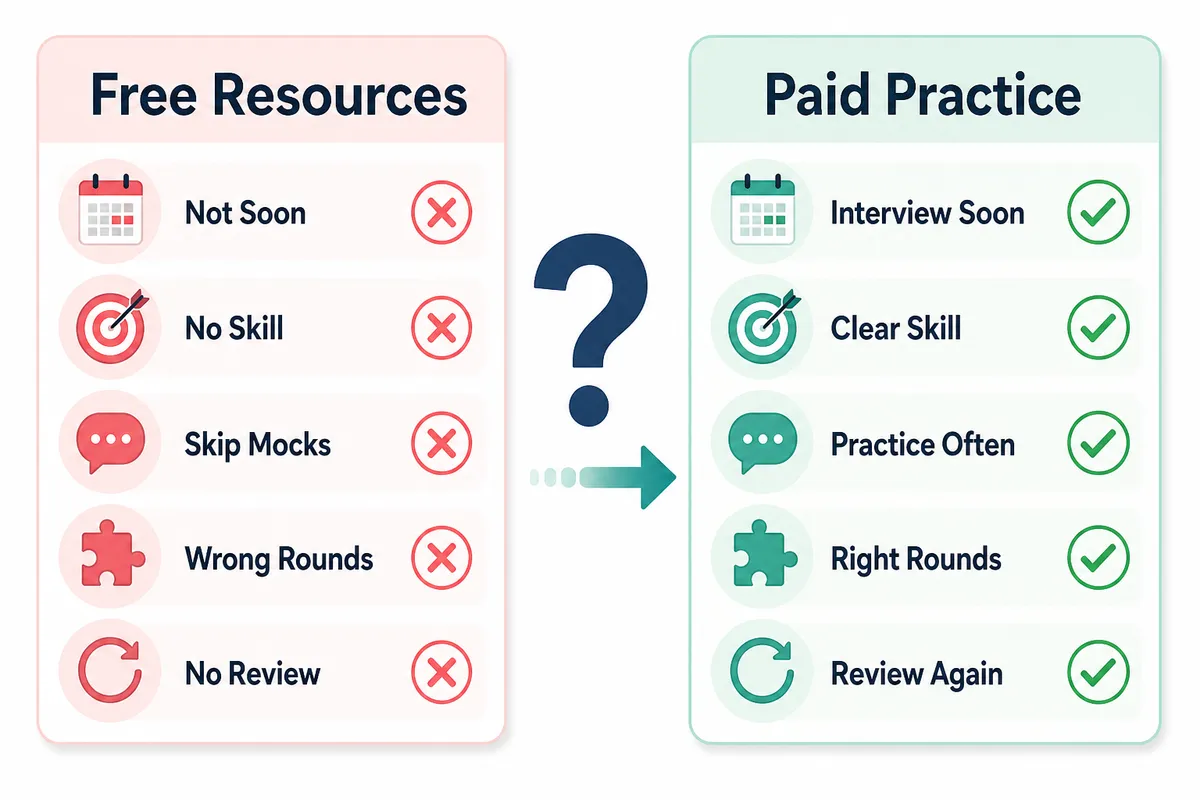
Ask yourself these five questions:
- Do I have interviews coming up soon enough to use this consistently?
- Can I name the skill I need to improve?
- Would I otherwise schedule human mocks, or skip them entirely?
- Does the platform support the rounds I actually expect?
- Will I review feedback and do another attempt, rather than just collecting scores?
If your answer is “no” to most of those, stay with free resources for now.
If your answer is “yes”, compare plans carefully. Look at the Thita pricing page for current options rather than relying on an old review or forum comment. Pricing, features and access limits can change, so current information matters.
How different tools fit different needs
There is no single best tool because candidates are solving different problems.
If your challenge is spoken delivery, Yoodli can be useful for analysing pacing, filler words and verbal habits. It is not designed to grade code or system architecture, but that is not its job.
If you want a coding judge and timed practice, LeetCode’s mock interview mode is a legitimate option. It gives you a timer and judge, but not voice conversation, AI follow-ups or an interviewer who responds to your decisions.
AlgoExpert can run code and provide structured coding practice. The difference is that it does not put an interviewer into the session to ask follow-up questions while you work.
Pramp and Exponent-style peer sessions offer human interaction and a shared editor, which can be excellent when your partner is engaged. Their limitation is logistical rather than conceptual: someone must be available and show up.
Google Interview Warmup used to be a free behavioural practice option, but Google retired it in April 2026. Google now points users towards Gemini, which is a general assistant rather than a purpose-built interview practice tool.
For broader technical interview simulation, compare what each product actually supports. HackerRank offers a long-standing code judge alongside AI voice interviewing and design whiteboards. CodeSignal’s AI Interviewer includes a named, toggleable code-execution setting. Hello Interview has a strong AI-evaluated system design canvas. These are credible options, particularly where enterprise access, specific round formats or team requirements matter.
The practical comparison is not “AI versus non-AI”. It is whether the tool gives you the kind of rehearsal you need: self-serve access, real code execution, adaptive follow-ups, a design canvas, company-specific preparation, or broad round coverage without scheduling.
A sensible free-first, paid-second approach
You do not need to choose one method forever. A balanced plan usually works best.
Weeks one to three: learn and revise with free sheets, notes and coding practice. Build a foundation, identify weak patterns and keep a record of recurring mistakes.
Weeks four to five: start explaining answers aloud. Use a friend, record yourself, or use free prompts. Focus on clarification, structure and concise reasoning.
Final two weeks: add realistic mock sessions if you have interviews scheduled. Rehearse the formats you expect, review feedback, and repeat the areas where you lose confidence.
✅ Do use free resources to build knowledge before paying for simulation.
✅ Do make each mock specific: one coding round, one behavioural round, one design round, or one resume-based session.
✅ Do revisit the feedback. The second attempt is often where the value appears.
❌ Don't spend every session on questions you already know how to solve.
❌ Don't confuse a polished AI score with real interview readiness.
❌ Don't abandon human practice entirely if you can access it. Real people remain useful preparation for real people.
Frequently asked questions
Are paid interview prep platforms worth it?
They are worth it when they solve a specific problem that free resources do not: live practice, adaptive follow-ups, detailed feedback, code execution, or convenient mock sessions without scheduling. They are less useful when you still need to learn fundamentals.
What is the best free vs paid mock interview strategy?
Use free resources first for concepts, question selection and repetition. Add paid mock interviews later if you need to practise explaining, handling pressure and responding to follow-up questions.
Is an AI mock interview as useful as a human mock interview?
They are useful in different ways. AI practice is easier to repeat and available whenever you need it. Human practice is better for unpredictable reactions and interpersonal nuance. Using both can be effective.
What should I check before paying for an AI mock interview?
Check whether it supports your interview format, gives feedback you can act on, runs code if you need coding practice, evaluates submitted designs if you need system design, and lets you practise often enough to justify the cost.
Can AI mock interviews help non-technical candidates?
Yes. Resume-based interviews, behavioural practice and role-specific sessions can help candidates prepare for product, operations, analyst, customer-facing and other non-technical roles.
Do I need to pay if I only have one interview coming up?
Not necessarily. Start with free sheets, company research and practice with a friend. Paying may make sense if the interview is high stakes and you specifically need live rehearsal that you cannot otherwise arrange.
Can I practise coding interviews in my preferred language?
On Thita, you can practise in six languages: Python, C++, Java, JavaScript, Go and C#. Use the language you expect to use in the real interview whenever possible.
The honest verdict
Paying for an AI mock interview is worth it when it creates practice you would not otherwise do: realistic, spoken, adaptive rehearsal with feedback you can use before the real interview.
It is not worth it if you are looking for a shortcut around learning, only need a question list, have no time to practise repeatedly, or already have strong human mocks available.
Start with the free material. Build the foundation. Then, if your weakness is performing under interview conditions rather than solving alone, practise with a live AI interviewer and see whether repeated feedback changes how you show up.
If you are hiring rather than interviewing, visit interviews.thita.ai.
Topics
Related on Thita
Your next step
Try Thita before you decide
The Starter plan is free: pattern sheets, code execution in six languages and an AI mock interview. Pro adds more AI code feedback and mock interviews, company kits and the 90-day roadmaps.