
Interview
Top 50 Most Asked Coding Interview Questions in 2026 (With Patterns)
Preparing for coding interviews in 2026 feels different from five years ago. Interviews are more pattern-driven, time-boxed, and often AI-assisted. The compa...
Preparing for coding interviews in 2026 feels different from five years ago. Interviews are more pattern-driven, time-boxed, and often AI-assisted. The companies that ask the most asked coding interview questions are not just checking if you can code—they’re checking if you recognize patterns, reason about trade-offs, and communicate clearly under pressure.
This guide walks through 50 top coding interview questions for 2026, grouped by core DSA patterns. For each pattern, you’ll see representative problems, how to think about them, and typical variations. If you can recognize these patterns quickly, most “new” questions you see will look familiar.
Why Patterns Matter More Than Memorizing Questions
You can’t memorize every LeetCode problem, but you can learn to recognize that:
- “Find two numbers that sum to target” → Two Pointers / Hashing
- “Maximum subarray / longest substring” → Sliding Window
- “Paths in a grid / graph shortest path” → Graph Traversal / BFS
- “Schedule tasks / select intervals” → Greedy & Sorting
Top companies reuse these patterns constantly, often with domain-specific wrappers (e.g., “recommendations,” “rate limits,” “log processing”).
A pattern-based approach—like the one underlying Thita’s DSA patterns sheet—lets you reduce hundreds of problems to a manageable set of reusable mental models. For a comprehensive learning path, consider following the Beginner to Advanced DSA Roadmap for Software Engineers in 2026 to master these essential patterns systematically.
1. Arrays & Strings: Foundation for Most Asked Coding Interview Questions
Arrays and strings dominate the most frequently asked programming questions because they are simple to state and hard to optimize under pressure.
1.1 Two Pointers Pattern
When you see:
- Sorted arrays
- Pairs/triples with some condition
- Need to move from both ends or compress in-place
Think Two Pointers.
Representative top coding interview questions:
-
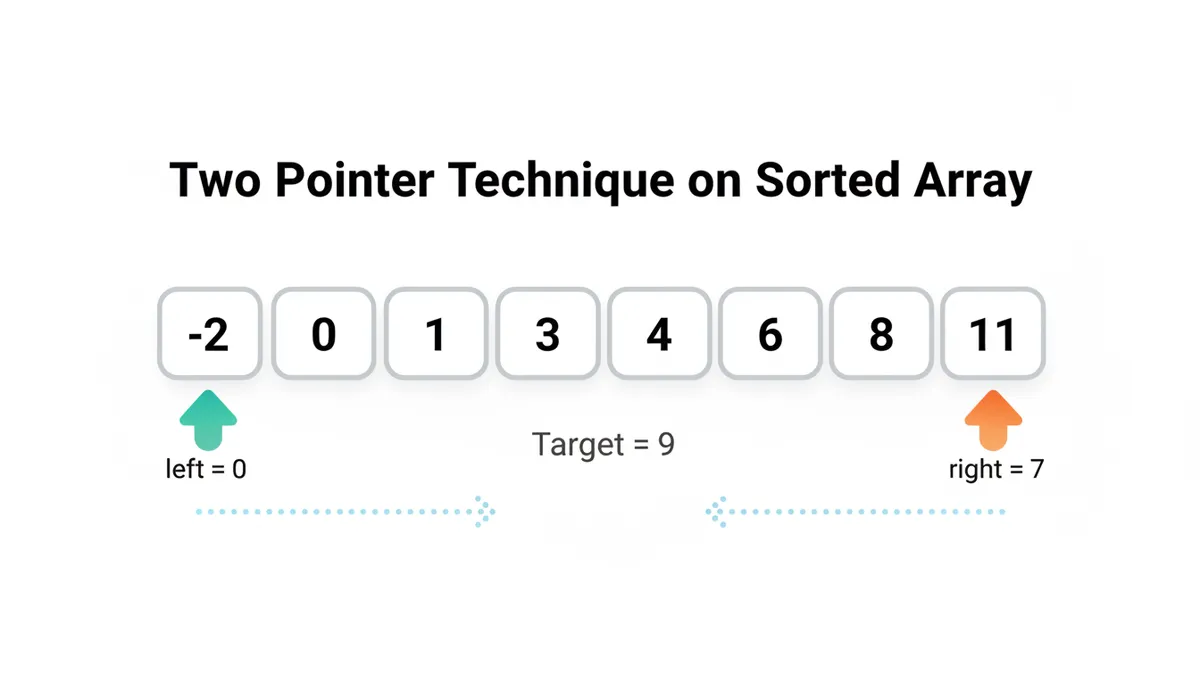
Two Sum II – Input array is sorted
- Problem: Given a sorted array
numsand a target, find indices of two numbers that sum to target. - Pattern: Two pointers (
left,right). - Idea:
- If
nums[left] + nums[right] > target, moveright-- - If
< target, moveleft++
- If
- Complexity: Time
O(n), SpaceO(1).
- Problem: Given a sorted array
-
3Sum
- Problem: Find all unique triplets that sum to zero.
- Pattern: Sort + fixed pointer + inner two pointers.
- Key Pitfall: Handling duplicates carefully.
-
Container With Most Water
- Problem: Maximize area between vertical lines.
- Pattern: Two pointers shrinking towards center.
- Insight: Move the pointer at the shorter line; moving the taller line can’t help.
-
Remove Duplicates from Sorted Array
- Problem: In-place removal of duplicates from sorted array.
- Pattern: Slow/fast pointers.
-
Move Zeroes
- Problem: Move all zeroes to end, preserve order of non-zero elements.
- Pattern: Partitioning with two pointers.
For a deeper dive into this technique, check out the detailed guide on the Master the Two Pointer Pattern: Complete Guide with Examples.
1.2 Sliding Window Pattern
When you see:
- “Longest substring/subarray” with some constraint
- “At most K distinct” or “sum <= K”
- Continuous segments
Think Sliding Window.
Representative questions:
-
Longest Substring Without Repeating Characters
- Pattern: Variable-size window + hash map of last indices.
- Core idea: Expand
right; when duplicate, moveleftpast previous occurrence.
-
Minimum Size Subarray Sum
- Pattern: Shrinking window while maintaining sum ≥ target.
- Complexity:
O(n).
-
Longest Substring with At Most K Distinct Characters
- Pattern: Map of char → count; shrink when distinct count > K.
-
Max Consecutive Ones III
- Problem: Longest subarray with at most K zero flips.
- Pattern: Sliding window with a count of zeroes.
-
Permutation in String
- Problem: Check if
s2contains a permutation ofs1. - Pattern: Fixed-size window + frequency arrays.
- Problem: Check if
1.3 Prefix Sums & Hashing on Arrays
- Subarray Sum Equals K
- Pattern: Prefix sum + hash map of counts.
- Idea: For sum up to index
i=prefix[i], need previous prefixprefix[i] - K.
- Continuous Subarray Sum (Multiple of K)
- Pattern: Prefix sums mod K + map of earliest index for each mod.
- Product of Array Except Self
- Pattern: Prefix product + suffix product (no division).
- Complexity:
O(n)time,O(1)extra space (output excluded).
- Find Pivot Index
- Pattern: Total sum + running left sum; check
left == total - left - nums[i].
- Maximum Subarray (Kadane’s Algorithm)
- Pattern: Dynamic window via DP.
- Idea:
cur = max(nums[i], cur + nums[i]),best = max(best, cur).
2. Linked Lists: Pointers, Cycles, and Reversal
Linked list problems test your pointer discipline and edge case handling.
2.1 Fast & Slow Pointers
- Linked List Cycle Detection
- Pattern: Floyd’s Tortoise and Hare.
- Idea:
- Move
slowby 1,fastby 2. - If they ever meet, there’s a cycle.
- Move
- Linked List Cycle II (Find Start of Cycle)
- After detection, reset one pointer to head and move both by 1; meeting point is cycle start.
- Middle of the Linked List
slowmoves 1,fastmoves 2; when fast ends, slow is middle.
- Palindrome Linked List
- Pattern: Find middle, reverse second half, compare halves.
- Remove N-th Node From End of List
- Pattern: Two pointers with gap of N+1; move both until fast hits end.
2.2 Reversal and Manipulation
- Reverse Linked List
- Iterative:
prev,curr,nextpointers. - Complexity:
O(n)time,O(1)space.
- Reverse Nodes in k-Group
- Reverse sublists of size k; careful with connections and leftover nodes.
- Merge Two Sorted Lists
- Merge like merge step in merge sort.
- Reorder List
- Find middle, reverse second half, then interleave nodes.
- Copy List with Random Pointer
- Patterns:
- Hash map from original → clone nodes, or
- Interweave clones inside original list, then split.
3. Trees & BSTs: Recursion, Traversals, and Structure
Tree questions remain some of the most asked coding interview questions because they reveal recursive thinking and abstraction.
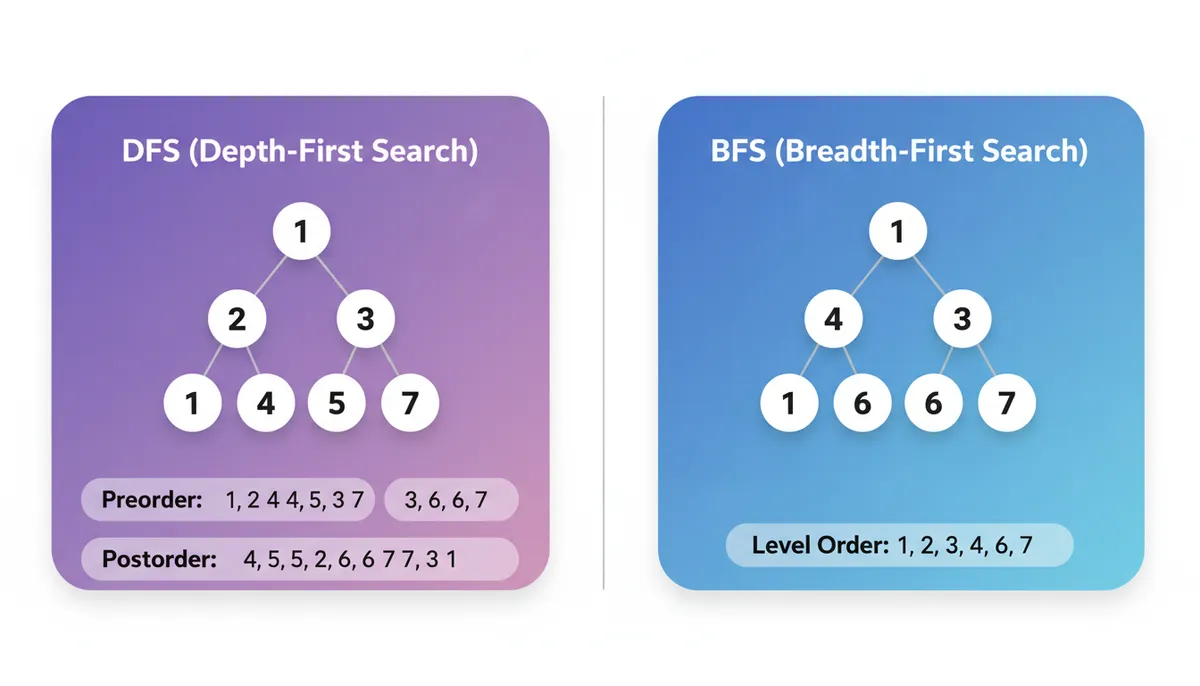
3.1 Binary Tree Traversals & DFS
- Binary Tree Inorder/Preorder/Postorder Traversal
- Implement recursively and iteratively (stack-based).
- Maximum Depth of Binary Tree
- Pattern: DFS; depth =
1 + max(leftDepth, rightDepth).
- Diameter of Binary Tree
- Track longest path through each node:
leftHeight + rightHeight.
- Path Sum / Path Sum II / Path Sum III
- Variants with root-to-leaf path, all paths, or any path using prefix sums.
- Lowest Common Ancestor (LCA) in Binary Tree
- Pattern: Postorder DFS returning candidate node up the recursion.
3.2 Binary Search Tree (BST) Specific
- Validate Binary Search Tree
- Pattern: DFS with
(min, max)constraints or inorder traversal must be strictly increasing.
- Kth Smallest Element in a BST
- Inorder traversal with counter.
- Insert into a Binary Search Tree
- Standard BST insert.
- Delete Node in a BST
- Cases: leaf, one child, two children (replace with inorder successor).
- Recover Binary Search Tree
- Two swapped nodes; detect via inorder traversal and swap back.
4. Graphs: Traversal, Connectivity, and Shortest Paths
In 2026, graph problems often appear wrapped in “systems” language: social networks, dependencies, maps.
4.1 BFS & DFS on Graphs
- Number of Islands
- Pattern: Grid as implicit graph; DFS/BFS to mark visited land.
- Clone Graph
- Graph copy using DFS/BFS + map from original → clone.
- Course Schedule / Course Schedule II
- Pattern: Directed graph + cycle detection / topological sort.
- Rotting Oranges
- Multi-source BFS from all rotten oranges.
- Word Ladder
- BFS on words as nodes, edges between words differing by 1 letter.
4.2 Shortest Path & Union-Find
- Shortest Path in Binary Matrix / Grid with Obstacles
- BFS for unweighted grid.
- Network Delay Time
- Dijkstra’s algorithm for weighted directed graph.
- Number of Connected Components in an Undirected Graph
- DFS/BFS or Union-Find.
- Redundant Connection
- Union-Find to detect extra edge forming a cycle.
- Accounts Merge
- Union-Find by email → account mapping.
For a comprehensive understanding of graph traversal and shortest path patterns, see the Master Graph Traversal Patterns (DFS & BFS): 11 templates for Coding Interviews.
5. Heaps, Priority Queues & Top-K Problems
Many frequently asked programming questions boil down to “keep track of the K best/worst.”
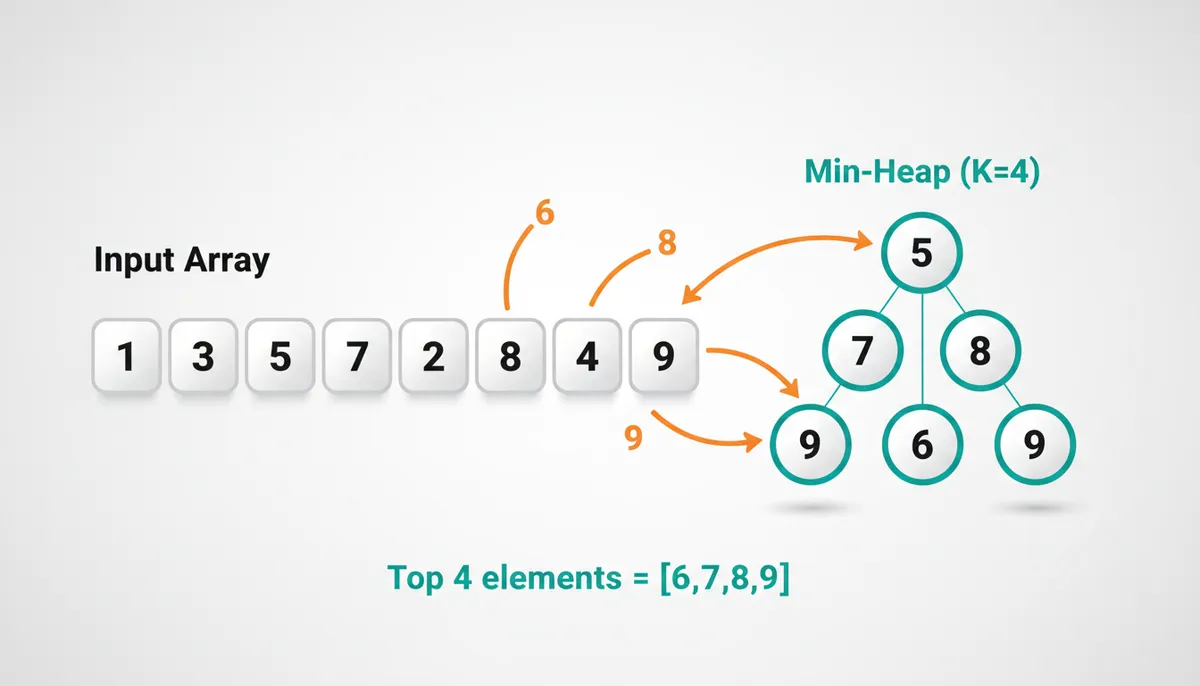
- Kth Largest Element in an Array
- Patterns:
- Min-heap of size K:
O(n log k) - Quickselect: average
O(n).
- Min-heap of size K:
- Top K Frequent Elements
- Frequency map + bucket sort or min-heap.
- Merge K Sorted Lists
- Min-heap of current heads of each list; pop min, push next.
- Find Median from Data Stream
- Two heaps: max-heap for lower half, min-heap for upper half.
- Task Scheduler
- Count tasks, use max-heap by frequency, or compute idle slots analytically.
Representative Code Example: Sliding Window
Here’s a canonical sliding window example you’ll see in many top coding interview questions.
Problem: Longest substring without repeating characters.
PYTHON
- Time:
O(n)— each index visited at most twice (left/right). - Space:
O(min(n, alphabet)).
For more strategies on practicing coding interview questions effectively, including how to avoid dependency on brute force, see How to Practice Coding Interview Questions Effectively (Not Just Solve More Problems).
Common Mistakes Across These Top Coding Interview Questions
Regardless of pattern, candidates frequently stumble on similar issues:
1. Not Identifying the Pattern Early
- Treating a sliding window problem as brute-force nested loops.
- Missing that a grid is just a graph with 4 or 8 neighbors.
Fix: Before coding, say out loud: “This looks like a [pattern] problem because [reason].”
2. Off-by-One and Boundary Errors
- Linked list deletions at head/tail.
- Sliding window
left/rightupdates. - Tree recursion base cases (
Nonehandling).
Fix: Draw a small example and walk the code mentally on edge cases: empty, single element, all same values, already sorted, etc.
3. Ignoring Time/Space Complexity Trade-offs
- Using
O(n²)brute force whenO(n log n)orO(n)exists. - Overusing extra arrays/maps when in-place is possible.
Fix: After writing a solution, always articulate complexity and ask if it meets constraints.
4. Weak Communication
- Coding silently.
- Not explaining why a pattern fits.
- Not stating invariants (e.g., “In this window, we always maintain at most K distinct characters”).
Fix: Practice with timed, spoken walkthroughs (mock interviews or tools like Thita’s AI mock interviews).
Best Practices for Coding Interview Preparation in 2026
1. Learn Patterns, Not Just Problems
Organize your practice around patterns:
- Two Pointers
- Sliding Window
- Fast/Slow Pointers
- Binary Search
- DFS/BFS (trees and graphs)
- Backtracking
- DP on sequences, grids, and trees
- Greedy + Sorting
- Union-Find
- Heaps / Top-K
For each pattern:
- Understand the core invariant.
- Implement 3–5 classic problems.
- Practice explaining why it applies.
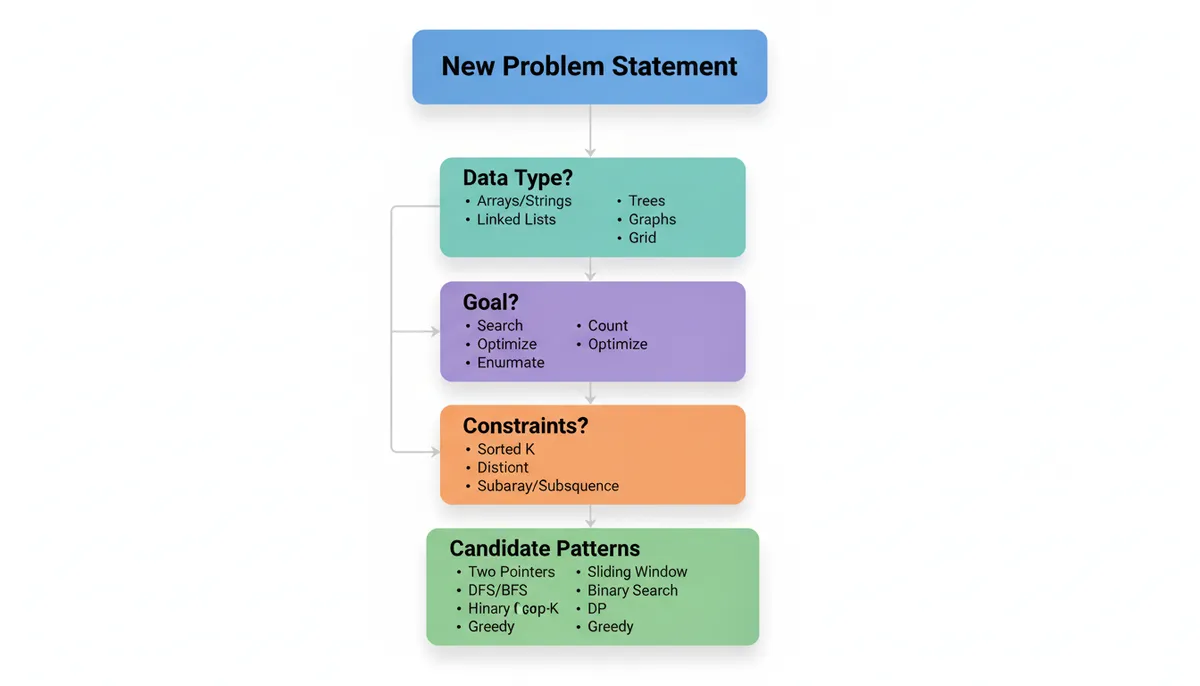
2. Build a Mental “Decision Tree”
When you see a new problem, quickly classify:
- Data structure: array, string, list, tree, graph, matrix?
- Operation: search, count, optimize (max/min), enumerate?
- Constraints: sorted? at most K? unique? subarray/substring?
Then map to candidate patterns. For example:
- Array + “kth smallest” → heap or quickselect.
- Matrix + “regions” → DFS/BFS (Number of Islands).
- DAG + “course prerequisites” → topological sort.
3. Practice Under Real Constraints
- Time: 30–45 minutes per medium problem.
- Environment: No autocomplete, no external docs.
- Process:
- Clarify problem and constraints.
- Brainstorm patterns and approaches.
- Pick an approach and outline verbally.
- Code with small test cases.
- Analyze complexity and possible improvements.
4. Implement Multiple Approaches
For common patterns, know at least:
- Brute force → optimized pattern-based solution.
- Space-rich vs space-optimized versions.
- Recursive vs iterative for trees/graphs.
Example: Two Sum
- Brute force:
O(n²)double loop. - Hash map:
O(n)time,O(n)space. - Two pointers (if sorted):
O(n)time,O(1)space.
Key Takeaways
- The most asked coding interview questions in 2026 are variations on a relatively small set of DSA patterns.
- Arrays/strings, linked lists, trees, graphs, and heaps form the backbone of top coding interview questions.
- Recognizing the underlying pattern quickly is often more important than memorizing the exact problem.
- Practicing pattern identification, edge cases, and clear communication will differentiate you more than raw speed.
- Treat each problem as an opportunity to reinforce a pattern you can reuse, not just another item on a checklist.
If you build fluency with these 50 representative questions and their patterns, you’ll find that most “new” interview problems feel like old friends in disguise.