
Interview
JPMorgan Interview Questions and Process: The Complete Guide (2026)
Understand JPMorgan interview questions, HackerRank screens and Superday: round-by-round preparation, difficulty, a 30-day plan and practical next steps.
JPMorgan interview questions commonly appear in a process that starts with a HackerRank test, moves through one or two live technical screens, and culminates in a Superday. Reported accounts describe the Superday as a concentrated series of back-to-back interviews, so preparation needs to cover both coding fluency and the ability to explain your technical decisions clearly under repeated evaluation. Start with JPMorgan's interview kit, which holds seven mapped DSA questions for focused pattern practice.
The exact sequence can vary by role, location and team. Still, the reported shape is useful: pass the initial coding filter, communicate well in live screens, then stay consistent through the Superday rather than treating it as a single final conversation.
The JPMorgan interview process at a glance
| Stage | Reported format | What to prepare for | What it can reveal |
|---|---|---|---|
| HackerRank | Two easy-to-medium coding problems | Core DSA patterns, clean implementation | Baseline coding fluency |
| Live technical screen | One or two engineer-led screens | Problem solving aloud, complexity, debugging | Technical reasoning and communication |
| Superday | Three to five back-to-back interviews of roughly 30 minutes | Consistent technical and project discussion | Depth, judgement and role fit |
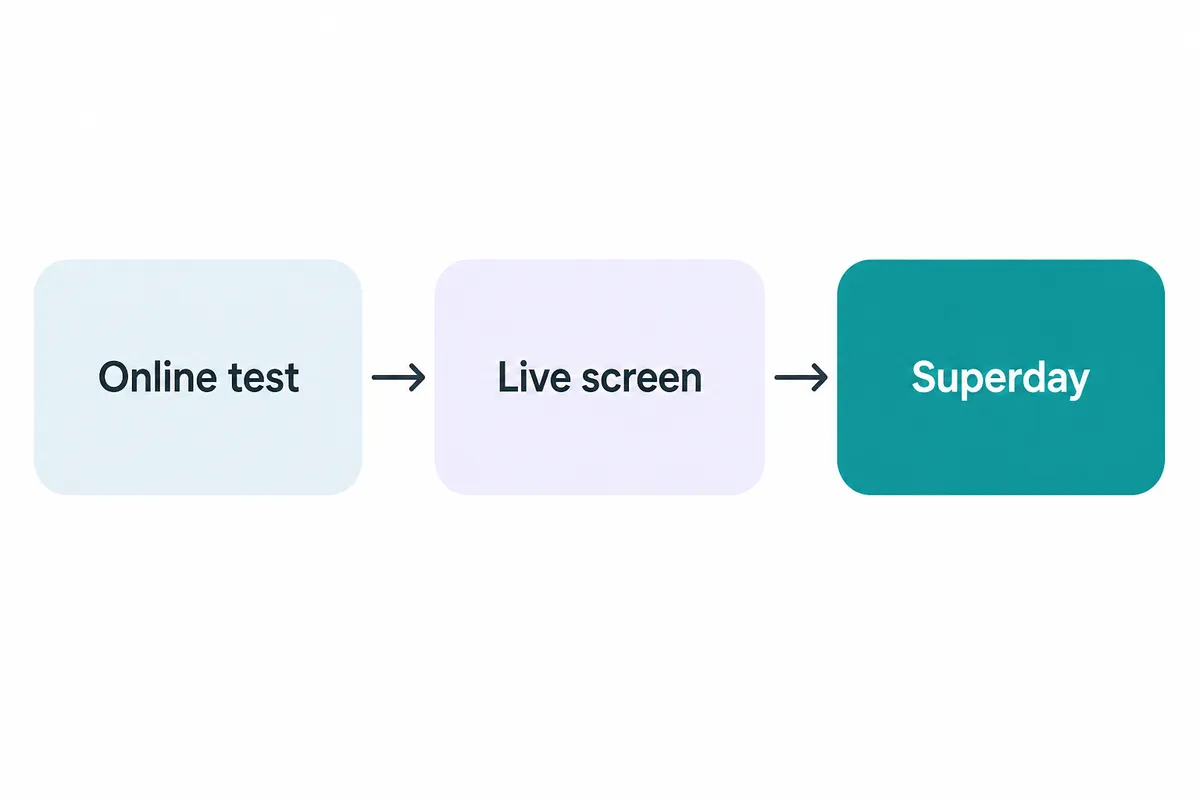
Reported accounts describe this as a staged process rather than a fixed universal script. Confirm the platform, interview order, role expectations and logistics with your recruiter. That is especially important for engineering roles attached to different business areas, where the technical context can change even when the broad process remains familiar.
Round 1 — HackerRank coding test
The reported opening stage is a HackerRank test with two easy-to-medium problems. Its purpose is straightforward: establish whether you can turn an approach into correct code within a constrained setting.
This is not the moment to chase the hardest possible problem set. The higher-return preparation is to make familiar patterns automatic: arrays and strings, hash maps, two pointers, sliding windows, sorting, stacks, queues, trees, graphs and binary search. For each problem, get used to identifying the constraint that changes the solution. A large input size may rule out nested loops; ordered data may suggest binary search; repeated lookups may point to a hash map.
Use the free-to-browse DSA Patterns Sheet to practise by reusable pattern rather than by an unstructured list. If choosing an approach quickly is your weak point, read how to identify the right DSA pattern in a coding interview.
A good test routine has four parts:
- Read the full prompt before writing code.
- Say or note the brute-force approach first.
- Choose the efficient approach and state its time and space complexity.
- Test edge cases before submitting.
The last point is easy to neglect. Empty inputs, duplicate values, a single item, boundaries and unusually large values are often where an otherwise sound solution fails.
💡 Pro tip: Avoid practising only with editorials open beside you. Attempt the problem unaided first, then compare your reasoning with the editorial after you have committed to an approach.
Round 2 — live technical screens
Candidate reports describe one or two live technical screens after the coding test. A live screen changes the task: correct code still matters, but your interviewer can now see the path you take to get there.
Prepare to make your reasoning legible. Before coding, restate the problem in your own words and ask about unclear assumptions. Then describe the data structures you intend to use, why they fit, and what trade-off they create. This gives the interviewer a way to follow your thinking and lets them correct a misunderstanding early.
A strong live-coding rhythm is simple:
- clarify inputs, outputs and constraints;
- work through a small example;
- state a baseline solution;
- improve it deliberately;
- code in readable blocks;
- test aloud;
- summarise complexity and possible extensions.
This structure is useful even if the discussion moves beyond a conventional coding question. It demonstrates that you can break down an unfamiliar problem, prioritise the central requirement and revise an approach when new information appears.
For a fuller walkthrough of the communication side, see what interviewers actually look for in live coding interviews. You can also use AI interview practice to rehearse explaining a solution out loud, rather than only solving silently in an editor.
✅ Do: narrate why you are choosing a data structure before you start implementing it.
❌ Don’t: write a solution in silence and wait until the end to explain it.
Round 3 — Superday
The defining feature of the reported JPMorgan process is the Superday. Candidate accounts describe three to five back-to-back interviews, each lasting roughly 30 minutes. That compressed format makes consistency part of the challenge.
A Superday is not best prepared for as one giant technical round. Think of it as several separate conversations that happen to be scheduled together. You need enough technical sharpness to reset after a difficult discussion, enough energy to stay engaged late in the day, and enough clarity to avoid giving a different version of your experience to each interviewer.
The exact content of individual sessions is not reliably uniform across teams, so avoid building a preparation plan around an assumed fixed panel. Instead, arrive ready for the broad areas that commonly matter in a software engineering loop:
- coding and complexity reasoning;
- technical decisions from your own projects;
- system or component trade-offs where relevant to the role;
- collaboration, ownership and difficult moments at work;
- motivation for the team and the type of work.
For project discussions, prepare evidence rather than summaries. “I worked on a migration” is vague. A stronger answer explains the problem, your personal responsibility, the alternatives considered, the decision made, the result, and what you would change now. Keep the stories truthful and specific.
Your energy management matters too. Eat beforehand, bring water where permitted, and treat a difficult earlier session as finished once it ends. Interviewers usually assess their own conversation; carrying frustration from one session into the next is a preventable loss.
The JPMorgan-specific feature: Superday at 270 Park Avenue
Many companies run an onsite loop. What makes JPMorgan’s reported process distinctive is the Superday format: several short interviews grouped together, rather than a sequence spread over separate days.
Reported accounts also describe Superday interviews returning in person at 270 Park Avenue since late 2025. That detail may not apply to every role, team or location, so treat it as a reported logistics pattern rather than a universal policy. Your recruiter is the source of truth for whether your own process is virtual, hybrid or in person.
Why does this format change how you should prepare?
First, short sessions reward a fast opening. Have a compact introduction ready: your current role, the type of systems or problems you work on, and the direction you want next. Do not deliver a memorised speech, but do avoid spending half the conversation reconstructing your résumé.
Second, transitions matter. You may need to move from a coding discussion to a project deep dive without much downtime. Rehearse switching gears: close one answer cleanly, pause, then address the next prompt as a fresh conversation.
Third, Superday performance compounds. Clear communication in every room is more valuable than one spectacular answer followed by vague or rushed discussions. Build stamina into your preparation by doing consecutive mock sessions, not just isolated problems.
Midway through your plan, return to JPMorgan's interview kit. The seven mapped DSA questions are useful not merely as problems to finish, but as prompts to practise your full live-round routine: clarify, choose, implement, test and explain.
Is the JPMorgan interview hard?
Yes, mainly because the process tests consistency across several formats rather than because every problem needs an exotic technique.
The HackerRank stage is reported as easy to medium, but time pressure can make familiar material feel harder than it is. The live screens add communication pressure. Then the Superday asks you to repeat that quality across three to five back-to-back interviews of roughly 30 minutes each.
How many rounds are there? Reported accounts describe a HackerRank test, one or two live technical screens, and a Superday containing three to five interviews. The final shape can vary by team and role.
How long does it take? There is no dependable sourced end-to-end timeline in the available reports. Scheduling, business area and location can all affect it, so ask your recruiter when to expect each step.
The practical takeaway is encouraging: you do not need to prepare for an imaginary, universal JPMorgan question bank. You need reliable fundamentals, a repeatable communication process and project stories that withstand follow-up questions.
A 30-day JPMorgan preparation plan
Days 1–7 — rebuild pattern recognition
Focus on the DSA patterns most likely to make coding feel routine. Solve a manageable number of problems daily, but spend more time reviewing than collecting completions. For every problem, write down the trigger that should have helped you recognise the pattern sooner.
Use JPMorgan's interview kit as a focused company-tagged set, then broaden with the free-to-browse DSA Patterns Sheet.
Days 8–14 — practise live explanation
Solve problems aloud. Set a timer, use a shared-editor style environment and explain every choice as if someone were listening. Record yourself if possible. You will quickly notice where your explanations become vague, where you skip constraints, or where you describe complexity inaccurately.
Read how to explain your thought process clearly in coding interviews, then do short mock sessions through AI interview practice.
Days 15–21 — prepare technical project stories
Choose three projects with different themes: one delivery story, one difficult technical trade-off, and one incident, failure or change of direction. For each, prepare a concise version and a deeper version.
Review relevant fundamentals too. Depending on the role, the free-to-browse operating systems sheet, DBMS sheet and computer networks sheet can help you refresh concepts that often arise naturally in technical conversation.
Days 22–30 — rehearse the Superday
Run practice blocks containing several sessions in a row. For example: one coding problem, one project discussion, a short break, then another coding or design discussion. The aim is not exhaustion; it is learning how to reset.
If your role is experienced or design-oriented, review how to distinguish component-level and architecture-level discussions in low-level design vs high-level design. The free-to-browse System Design Sheet is a useful way to rehearse trade-offs and structured explanations.
Frequently asked questions
What is the JPMorgan interview process for software engineers?
Reported accounts describe a HackerRank test with two easy-to-medium problems, followed by one or two live technical screens and a Superday. Exact steps vary by role, team and location.
What is JPMorgan Superday?
Superday is a concentrated interview stage. Candidate reports describe three to five back-to-back interviews of roughly 30 minutes each.
Is JPMorgan Superday in person?
Reported accounts describe Superday returning in person at 270 Park Avenue since late 2025. This will not necessarily apply to every role or location, so confirm the format with your recruiter.
Are JPMorgan interview questions difficult?
The reported HackerRank problems are easy to medium, but the wider process can be demanding because it combines timed coding, live technical discussion and repeated interviews in Superday.
How should I prepare for the HackerRank round?
Practise core DSA patterns under time pressure. Focus on reading constraints, choosing an appropriate data structure, writing correct code and testing edge cases before submission.
How many technical screens does JPMorgan have?
Candidate reports describe one or two live technical screens after the HackerRank stage. The exact number can vary.
Should I prepare system design for JPMorgan?
It depends on the role and level. It is sensible to be ready to discuss technical trade-offs and systems from your own experience, particularly for experienced engineering roles. Confirm role-specific expectations with your recruiter.
What matters most in a live coding interview?
Clear reasoning matters alongside correct code. Clarify the task, explain your approach, state complexity, test edge cases and respond calmly to follow-up questions.
How do I prepare for several interviews in one day?
Practise in blocks. Combine coding, project discussion and mock interview sessions so you learn to reset between conversations and maintain clear communication.
Where to start
The most efficient starting point is a focused DSA routine paired with live communication practice. Build speed for the HackerRank stage, then rehearse explaining your reasoning and project decisions for the screens and Superday.
Open JPMorgan's interview kit to practise the seven mapped DSA questions, review the free sheets for supporting fundamentals, and use AI interview practice to rehearse the conversations that a problem list alone cannot simulate.
Interview processes change, and candidate reports are not a company specification. Confirm your own format, timing and interview logistics with your recruiter.
Topics
Related on Thita
Your next step
Practise with AI mock interviews
A spoken interview that asks follow-up questions, runs your code and ends with a written report.