
Interview
Lyft Interview Questions and Process: The Complete Guide (2026)
Lyft interview questions, process and preparation: reported rounds, the paired-programming exercise, difficulty, timing and a focused 30-day plan.
Reported accounts describe Lyft’s software engineering process as a recruiter screen, a technical phone screen, and an onsite loop that combines conventional technical conversations with a laptop-based paired-programming exercise. The paired exercise is the differentiator: you need to write, explain, test and adapt code while working with another engineer, not merely reach a correct answer alone. Prepare core coding patterns, practise narrating decisions, and rehearse working in an unfamiliar codebase. For targeted technical practice, Lyft’s interview kit contains eight mapped DSA questions and one system design problem evidenced at Lyft.
This guide explains the reported round shape, what each stage is likely to screen for, why the paired exercise changes how you should prepare, and how to use the next month well. Exact formats vary by team, level and hiring need, so confirm the current process with your recruiter.
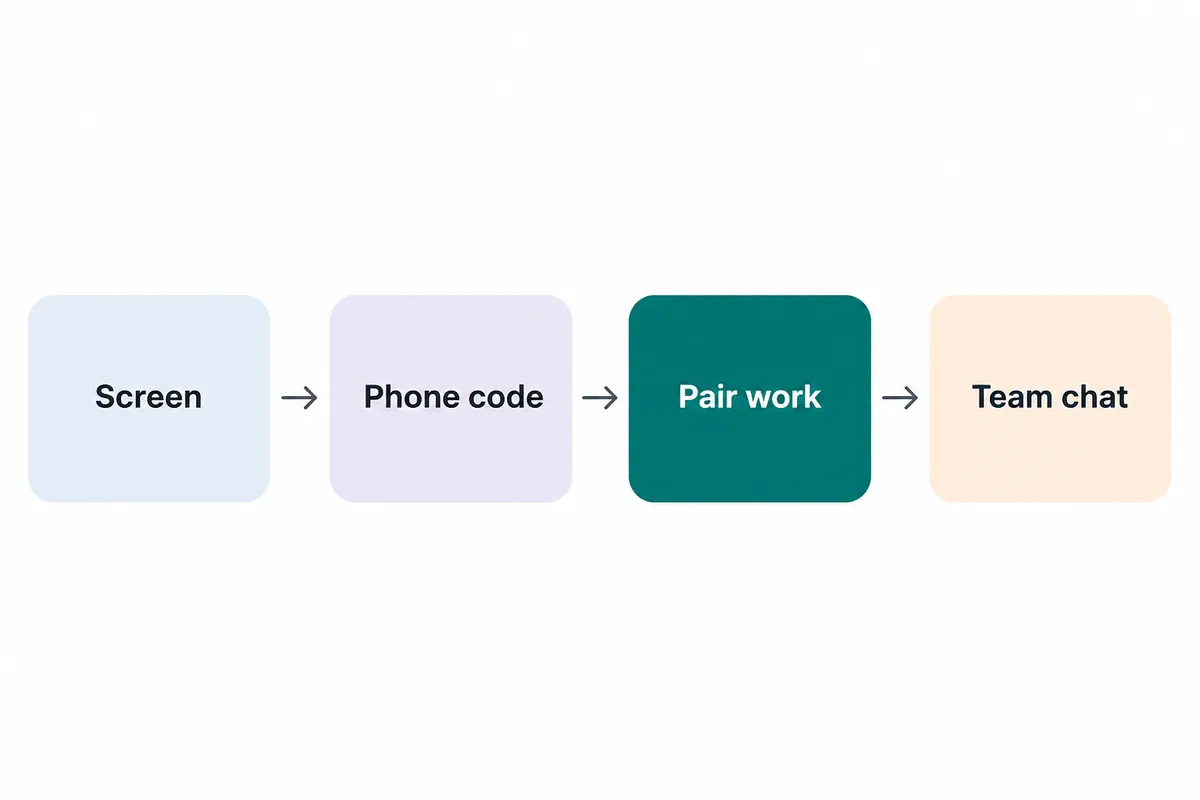
The process at a glance
| Stage | Reported format | What it screens for | How to prepare |
|---|---|---|---|
| Recruiter screen | Initial conversation | Role fit, motivation and experience | Tell a clear story about your work |
| Technical phone | Technical discussion | Coding foundations and communication | Practise patterns aloud |
| Onsite technical rounds | Engineering conversations | Depth, judgement and engineering habits | Prepare projects and trade-offs |
| Paired-programming exercise | Laptop-based collaborative coding | Working code, testing and adaptability | Build with a partner |
| Design discussion | May appear for relevant roles and levels | System boundaries and scaling judgement | Structure design answers first |
The sequence is a reported shape, not a fixed company policy. Teams may combine discussions, change emphasis, or add role-specific depth. The durable preparation method is to solve clearly, communicate continuously, and make your code easy for another engineer to understand.
Recruiter screen: establish the narrative
The recruiter conversation is often treated as administrative, but it sets the context for everything that follows. It is where you establish why Lyft, why this role, and why your experience fits the work the team needs done.
Prepare concise answers to predictable questions:
- What kind of engineering work have you owned?
- Which recent project best shows your strengths?
- Why are you considering a move now?
- What do you want from your next team?
- What interests you about Lyft’s product and engineering challenges?
The best answers are specific. “I enjoy solving hard problems” is vague; “I enjoy building systems where latency, reliability and user experience pull in different directions” gives the recruiter something concrete to work with.
Prepare a short version and a longer version of your background. The short version should take about a minute and connect your recent work to the role. The longer version should let you discuss one or two projects in enough depth to demonstrate ownership.
💡 Pro Tip: Do not memorise a script. Memorised answers become brittle as soon as the conversation takes an unexpected turn. Instead, memorise the milestones in your story: problem, responsibility, decision, outcome and lesson.
Technical phone screen: make your reasoning visible
Reported accounts place a technical phone screen between the recruiter conversation and onsite. The exact format can vary, but this stage commonly tests whether you can reason through a problem in a structured, collaborative way.
That means a correct final solution is not the only signal. An interviewer can observe whether you:
- Clarify inputs, constraints and edge cases.
- Identify a sensible baseline before reaching for a better approach.
- Explain why your chosen data structure fits.
- State time and space complexity.
- Test the code with examples rather than assuming it works.
- Respond productively when the interviewer changes a condition.
These habits matter especially before an onsite paired exercise. Candidates who stay silent while thinking may be capable engineers, yet give the interviewer little evidence of how they collaborate.
Use the free-to-browse DSA Patterns Sheet to practise recognition rather than random repetition. The goal is to see a problem shape quickly: a sliding window, graph traversal, binary search boundary, heap-based selection or dynamic programming state.
If identifying the pattern is your weak point, read how to identify the right DSA pattern in a coding interview. It provides a practical decision process for moving from prompt to approach without guessing.
✅ Do: Say what you are checking before you write code.
❌ Don’t: Produce a solution in silence and explain it only after the interviewer asks.
Onsite technical conversations: show engineering judgement
The onsite is where reported accounts describe a broader assessment than a single coding task. Conventional technical rounds can probe how you build software, reason about constraints, work with other people, and reflect on past decisions.
Prepare for discussions that move beyond “can you solve this?” into questions such as:
- How did you decide between two implementation options?
- What failure mode did you discover late?
- How did you measure whether a change worked?
- Which part of a project did you personally own?
- What trade-off would you revisit now?
- How did you influence a decision?
A strong answer has a clear personal role. Avoid hiding behind “we” for every decision. Collaboration matters, but interviewers need to understand what you noticed, proposed, built, changed or learned.
Technical depth also matters. If you mention improving performance, be ready to explain the bottleneck, measurement, alternatives and outcome. If you mention a reliability incident, explain detection, mitigation and prevention. If you mention a design choice, explain what constraint made it reasonable at the time.
For rehearsal, an AI mock interview can help you practise answering project-depth and behavioural questions aloud. The useful feedback is whether another engineer can follow your context, contribution and judgement.
The Lyft-specific round: paired programming on a laptop
The most distinctive element in reported Lyft accounts is an onsite laptop or paired-programming exercise. This deserves separate preparation because it tests a different skill from solving a standalone puzzle in an editor.
In paired programming, the interviewer can watch your full working process. They may see how you break down a task, how you choose names, whether you write small testable pieces, how you react to feedback, and whether you keep moving when the first idea proves imperfect.
Start by agreeing on the problem. Restate the goal, ask about assumptions, and identify the smallest useful version. Then build that version before extending it. A small working implementation gives you something to test, improve and discuss. An ambitious design that never runs gives neither you nor your partner much to evaluate.
Keep your thinking audible. Explain the assumptions you are making, identify why a data structure or interface is useful, and say when you are deliberately choosing a simple first version over a more elaborate one. After each meaningful step, run an example and describe what you are checking.
This is not unnecessary commentary. It is evidence of collaboration.
Practise this format with a friend when possible. Take turns as driver and reviewer. The driver writes; the reviewer asks clarifying questions, introduces a changed requirement, and requests a test case. Afterwards, assess whether the code was understandable without an extended explanation.
Our guide to what interviewers actually look for in live coding rounds is particularly useful here. It explains why communication, recovery and testing often matter as much as arriving at an elegant solution.
⚠️ Important: Do not over-engineer the first version. In a collaborative exercise, clean incremental progress is usually more persuasive than a complex abstraction built before the core behaviour works.
Design discussion: organise the trade-offs
The reported process includes an onsite, and design may appear depending on the role and level. Lyft’s interview kit includes one system design problem evidenced at Lyft. Treat it as a way to practise the shape of a design discussion, not as a promise that a particular team will use a particular prompt.
A good system design answer is structured rather than exhaustive:
- Clarify the product goal and scope.
- Estimate the important load or latency constraints.
- Define the main entities, APIs and data flow.
- Draw a simple baseline architecture.
- Identify the bottleneck or failure mode most likely to matter.
- Discuss trade-offs and a sensible next iteration.
Do not begin with every possible component. Start with the critical path: what happens when a user takes the core action, where state lives, and how the system returns a result. Then add complexity only when a stated constraint requires it.
The free-to-browse System Design Sheet can help you practise common architecture patterns. If you are unsure how deeply to prepare for your level, how much system design is enough for SDE-1 versus SDE-2 interviews offers a useful framework.
Is the Lyft interview hard?
Yes, but the difficulty is less about a reported fixed number of rounds than about switching between different modes of engineering communication.
You need the focused problem solving of a technical screen, the technical judgement of an onsite conversation, and the collaborative habits required by a paired-programming exercise. Candidates who prepare only by solving coding problems may find the transition difficult: they can reach a solution, but struggle to explain choices, accept input, test incrementally or adapt when requirements shift.
How many rounds are there? Reported accounts describe a recruiter screen, technical phone screen and onsite, with the onsite containing both conventional rounds and paired programming. The detailed composition can vary by team and level.
How long does it take? Reported accounts put the median time to hire at roughly 19 days, which is relatively fast. Treat that as an estimate rather than a guarantee; scheduling and team hiring needs can extend any process.
The practical implication is simple: do not wait until an onsite invitation to practise collaboration. Build that skill alongside coding preparation from the start.
A 30-day Lyft interview preparation plan
Days 1–7: rebuild coding fluency
Work through core data-structure patterns and focus on explaining each one aloud. Do not measure progress only by problems completed. Measure whether you can describe the brute-force approach, improve it, justify complexity and test edge cases.
Use in-browser code practice for short, frequent sessions. Finish each session by saying your solution explanation out loud as if an interviewer had just joined the call.
Days 8–14: practise collaborative coding
Choose manageable problems and solve them with another person where possible. One person drives while the other asks questions, challenges assumptions and requests tests.
Practise these habits:
- Clarifying before implementation.
- Naming functions and variables for readability.
- Writing a small working path first.
- Testing after each meaningful step.
- Explaining trade-offs without becoming defensive.
- Revising code calmly after feedback.
If you practise alone, simulate the same structure. Pause after the problem statement and write down assumptions. Pause after the first implementation and list tests. Then introduce one changed requirement and adapt the code.
Days 15–21: add system and project depth
Use Lyft’s interview kit for company-relevant DSA and design practice. Alternate coding sessions with design discussions. For each design prompt, speak for several minutes before drawing anything: clarify requirements, identify scale, then explain your baseline.
Also prepare two project stories. One should show technical ownership; the other should show a difficult trade-off, failure or disagreement. Keep the structure simple: situation, responsibility, action, result and reflection.
Days 22–30: rehearse the full loop
Run mock sessions that combine formats. Start with a short coding problem, then move into a project discussion or paired exercise. This matters because real interviews require context switching.
Use the free-to-browse Operating Systems Sheet if you need to refresh practical systems foundations, especially when your experience stories involve performance, processes, memory or reliability.
In the final days, reduce novelty. Revisit patterns you have already learned, repeat one paired session, and refine project stories. Calm execution is more valuable than cramming unfamiliar material at the last minute.
What strong candidates do differently in the paired exercise
The paired-programming format rewards habits that are easy to overlook in solo practice.
They make the work inspectable. Their code is readable, their assumptions are stated, and their tests show intent. Another engineer can understand where the solution is going.
They keep a steady pace. They do not freeze after an unexpected question or spend too long defending an early choice. They make a decision, test it and adjust if needed.
They invite collaboration. They ask whether the interviewer wants a particular constraint considered. They treat input as useful information rather than interruption.
They separate correctness from polish. First, make the central flow work. Then improve names, handling and structure. This prevents the common failure mode of discussing an ideal design without demonstrating a functioning one.
They connect past work to present judgement. In conventional onsite conversations, they can explain not just what a team built, but why a choice was made and what they would alter now.
These are practised behaviours, and every one can improve noticeably in a month.
Frequently asked questions
What is the Lyft interview process for software engineers?
Reported accounts describe a recruiter screen, technical phone screen and onsite. The onsite includes conventional technical discussions and a distinctive laptop-based paired-programming exercise.
Does Lyft have a paired-programming interview?
Reported accounts describe a paired-programming exercise during the onsite. Prepare to write and discuss code collaboratively rather than treating it as a silent individual assessment.
What should I practise for Lyft coding interviews?
Practise core DSA patterns, complexity analysis, edge-case testing and explaining your approach aloud. Use Lyft’s interview kit for the mapped company set.
How should I prepare for the paired-programming round?
Practise with another engineer when possible. Build a small working version first, explain decisions as you go, test frequently and adapt when a requirement changes.
Is the Lyft interview difficult?
It can be demanding because it tests both technical ability and collaboration. The paired exercise especially rewards candidates who can communicate clearly while coding.
How long does the Lyft hiring process take?
Reported accounts suggest a median of roughly 19 days, though timing varies with scheduling, team needs and the role.
Will system design be part of the interview?
Design discussion may be relevant for particular roles and levels. Prepare a clear framework for requirements, data flow, trade-offs and scaling rather than memorising a diagram.
What should I say in the recruiter screen?
Give a concise account of your recent work, what you owned, what you want next and why Lyft’s engineering work interests you. Specific examples are stronger than generic enthusiasm.
How can I improve my interview communication?
Practise narrating your reasoning during every coding session. Explain assumptions, alternatives, complexity, tests and changes rather than saving the explanation for the end.
Where to start
The highest-leverage Lyft preparation is to combine coding practice with collaboration practice. A technically correct solution is necessary; showing how you arrive at it with another engineer is what makes the paired exercise different.
Start with Lyft’s interview kit, which includes eight mapped DSA questions and one system design problem evidenced at Lyft. Then use an AI mock interview to rehearse technical explanations and project stories, and make at least one practice session a genuine paired-coding session.
Interview formats change, and team-level variation is normal. Confirm the current structure with your recruiter, but prepare for the durable skills: clear reasoning, working code, thoughtful trade-offs and collaborative engineering.
Topics
Related on Thita
Your next step
Practise with AI mock interviews
A spoken interview that asks follow-up questions, runs your code and ends with a written report.