
Interview
Meta Coding Interview Questions: Patterns and Prep (2026)
Meta coding interview questions, pattern families, and a focused plan for the online assessment, live coding, AI-enabled round, design, and behavioural prep.
Meta coding interview questions reward a particular kind of speed: not typing speed, but the ability to recognise the underlying pattern before a problem’s surface details pull you in the wrong direction. The technical loop is coding-heavy, and the useful preparation unit is a pattern family rather than an isolated prompt.
Meta's interview kit holds 185 mapped DSA questions, one low-level design problem, and 10 system design problems. That depth matters because Meta preparation is not about memorising a handful of famous problems. It is about repeatedly seeing how a small set of problem shapes reappears with different wording, constraints and traps.
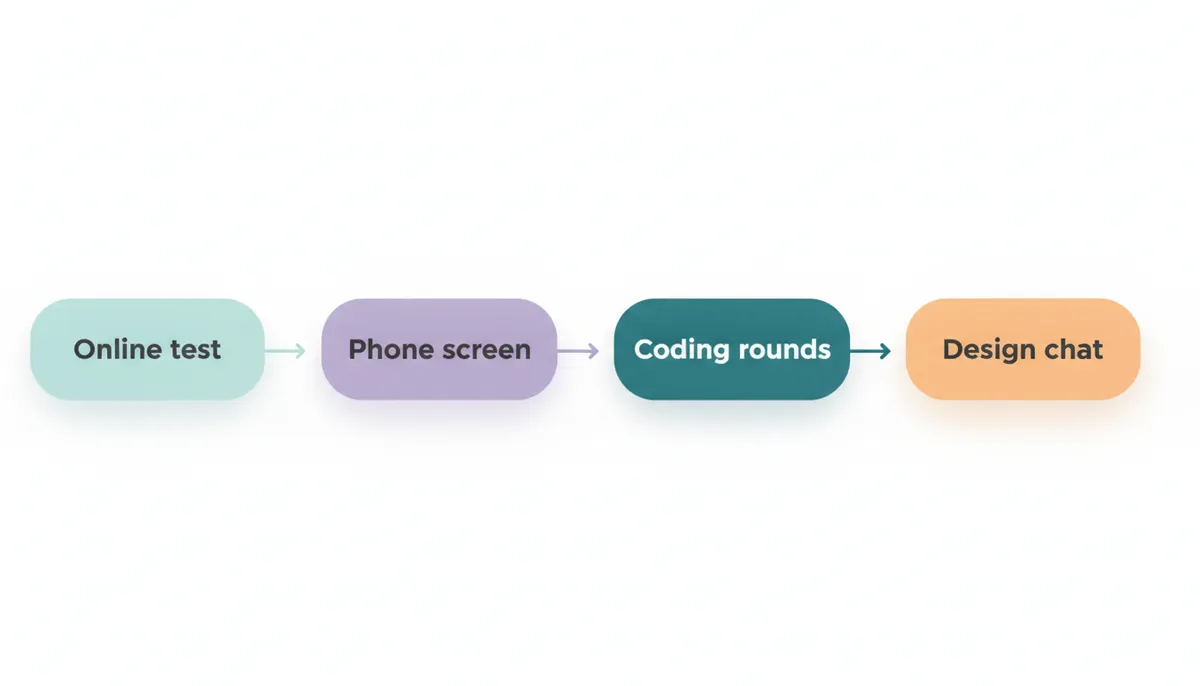
Reported accounts describe an online assessment, a phone screen, then an onsite loop with a traditional coding round, an AI-enabled coding round, a system design or product architecture round, and a behavioural round. Exact sequencing can vary by role and level, so treat that as the commonly reported shape rather than a fixed company policy.
The Meta pattern mix: what to recognise quickly
The strongest Meta preparation plan starts with pattern families that compress many apparently different coding tasks into a familiar decision. You should be able to hear a problem statement, identify the likely family, name the data structure that supports it, and explain why it fits before writing the full solution.
The core families to prioritise are these:
- Hashing and frequency tracking for membership, duplicate detection, grouping, and fast lookup.
- Two pointers and sliding windows for contiguous ranges, pair relationships, and constrained subarrays or substrings.
- Trees and recursive traversal for hierarchy, path state, ancestor relationships, and divide-and-conquer reasoning.
- Graphs and traversal for reachability, dependencies, shortest-path thinking, connected groups, and state exploration.
- Binary search when an ordered space, monotonic condition, or answer range lets you reduce the search efficiently.
- Backtracking and recursion when the task asks you to construct, explore, filter, or enumerate valid choices.
- Dynamic programming when a recursive choice repeats the same subproblem and needs remembered results.
This is not a question list. It is a recognition map. Meta-style coding rounds can change the story, input format and edge conditions while still testing one of these same decisions.
The difficulty mix is best understood as a progression from clean fundamentals to compound reasoning. You need straightforward command of common data structures first. Then you need to handle a follow-up that changes the constraints: improve time complexity, reduce space, support an additional condition, or adapt the approach when the initial idea no longer works. The candidate who recognises the base pattern quickly has more time for that second layer.
The free-to-browse DSA Patterns Sheet is useful for organising this work by reusable structure rather than by a random feed of problems. For a deeper explanation of the mental process, read how to identify the right DSA pattern in a coding interview.
What recognition speed actually means
Recognition speed is often misunderstood as arriving at an answer instantly. It is not. It means reducing uncertainty early enough to spend the rest of the round on the work that interviewers can actually evaluate: clarification, trade-offs, correct implementation, tests, and follow-ups.
A candidate with strong recognition speed does a few things consistently.
First, they translate the prompt into a structural signal. “Contiguous range” suggests a window. “Find a relationship across values” suggests hashing or pointers. “Fewest steps” suggests graph distance. “Can this condition hold at a given threshold?” suggests a binary-searchable answer space.
Second, they state a candidate approach before coding. That gives the interviewer a chance to redirect a mistaken interpretation before it becomes a page of code. It also makes your complexity reasoning visible.
Third, they actively reject alternatives. Saying, “A nested scan would work, but it repeats lookup work, so I’ll keep seen values in a map,” demonstrates judgement. A clean answer without that explanation can look accidental.
Finally, they preserve time for verification. A correct pattern can still fail in implementation through empty inputs, repeated values, boundary movement, mutation, recursion depth, or a missed base case. Recognition buys checking time.
The goal is not to sound rehearsed. The goal is to make your reasoning easy to follow. Our guide to explaining your thought process clearly in coding interviews offers a practical structure for doing that without narrating every keystroke.
A useful rule: name the shape, propose the approach, give the complexity, then code. If the shape changes after clarification, say so plainly and reset.
The online assessment and phone screen
Reported accounts commonly include an online assessment before the live technical stages. This is where pattern fluency has the clearest payoff. Time pressure makes broad topic revision less useful than fast classification: you want familiar first moves for arrays, strings, maps, traversal, searching and recursion.
Do not prepare for an assessment by doing every problem in one category consecutively. That creates false confidence because the category is already revealed. Instead, mix families together. Your real task is to decide which tool applies when nobody has labelled the topic for you.
The phone screen shifts the emphasis. A live interviewer can observe how you clarify requirements, respond to hints, and recover from a route that does not work. Treat it as a communication round as well as a coding round.
A reliable live-round sequence looks like this:
- Restate the goal and ask about constraints or ambiguous cases.
- Describe a direct baseline, even if you will improve it.
- Explain the better pattern and its complexity.
- Code in small coherent sections while continuing to communicate.
- Walk through an example, then test edge cases aloud.
That final step is a differentiator. Many candidates stop once the main example works. Strong candidates deliberately look for the case most likely to break their own solution.
For timed implementation practice, code practice can help turn pattern recognition into a repeatable coding routine. It is more productive to practise explaining an approach under a timer than to passively read another solution.
The AI-enabled coding round
Reported across 2026 accounts for a large share of Meta E4–E7 loops, one onsite coding round uses a CoderPad environment with an integrated AI assistant. This is not reported as a universal format for every Meta candidate, and its coverage is still estimated rather than company-published policy.
The reported format is a longer multi-file task in three broad phases: bug fixing, core implementation, and optimisation. The round is reported to last 60 minutes. The important distinction is that the assessment is not simply whether you invoke the assistant. Candidate reports describe evaluation of how you direct it, inspect its output, identify errors, and decide what to trust.
That changes the preparation target.
You still need the same underlying coding judgement: understand unfamiliar code, isolate the actual failure, decide what belongs in the implementation, and verify that a suggested change has not introduced a regression. An assistant can generate plausible code quickly. It cannot take responsibility for whether the code meets the requirement.
Practise a deliberate verification loop:
- Read the existing code before proposing a broad rewrite.
- State the suspected fault and the evidence for it.
- Ask for narrowly scoped help rather than accepting a large opaque patch.
- Check complexity, edge cases and API assumptions in generated code.
- Run or mentally trace tests that could falsify the change.
This is a useful professional habit beyond interview preparation. It also protects you in a live environment where the obvious answer may be subtly wrong.
The reported Meta E4–E7 AI-enabled round should not replace conventional DSA practice in your schedule. It sits alongside a traditional coding round, so you need both independent problem solving and disciplined AI-assisted debugging.
The system design round
Reported accounts describe one system design or product architecture round in the Meta onsite. Your preparation should focus less on reciting a fixed architecture and more on driving a structured design conversation.
Start by clarifying the product goal, expected users, main operations, and important non-functional constraints. Then define a simple version of the system before adding scale, reliability, storage, caching, asynchronous work, observability, and trade-offs. Interviewers can follow a design that evolves logically; they cannot easily credit a diagram filled with components that have no stated purpose.
Meta's interview kit includes the kind of system design problems evidenced at Meta, giving you a company-focused place to practise the transition from requirements to architecture.
The free-to-browse System Design Sheet is also a useful companion when you need broader repetition across common architecture shapes. If you are unsure where low-level design ends and high-level design begins, low-level design vs high-level design: what interviews actually expect explains how the conversations differ.
For an experienced candidate, depth matters. Be ready to defend why a data store fits the access pattern, what failure mode a queue addresses, how you would manage stale cache data, and which metric would reveal that the design is degrading. The best answers are not maximal systems. They are systems whose decisions connect to the stated requirements.
Do not underprepare the behavioural round
Meta’s technical reputation can encourage candidates to treat behavioural preparation as an afterthought. Reported accounts describe the behavioural round as decisive, so it deserves deliberate rehearsal.
Prepare a small set of stories that reveal ownership, conflict management, impact, difficult trade-offs, a project that changed direction, and a mistake you learned from. For each story, be precise about your own actions. “We” is appropriate for context, but the interviewer needs to understand what you decided, built, influenced, or repaired.
Use a simple narrative structure:
- Set the situation and your responsibility.
- Describe the complication or decision point.
- Explain the actions you took and why.
- Share the outcome, including what you would improve now.
The free-to-browse sheets help with technical knowledge, but spoken behavioural answers need rehearsal. An AI mock interview is a practical way to practise delivery, follow-up questions and concise project stories before the real conversation.
A focused preparation plan
Start with diagnosis
Before beginning a large volume of practice, test your baseline across mixed pattern families. Can you identify the likely approach within a short period? Can you implement it without relying on a remembered template? Can you explain its complexity? Your weakest point determines the first block of work.
If recognition is slow, focus on pattern cues. If recognition is quick but code is fragile, focus on implementation and testing. If you solve correctly but communicate poorly, use mock rounds and practise speaking through the same material.
Build pattern fluency
Use short, frequent sessions with mixed topics. After each attempt, write down three things: the clue you missed or recognised, the key invariant, and the edge case that mattered. This small review turns a solved problem into a reusable mental model.
For graphs in particular, graph traversal patterns with DFS and BFS is useful when you need to choose between depth-first exploration, breadth-first distance reasoning, and state tracking.
Add live-round discipline
Once the underlying patterns feel familiar, introduce constraints. Set a timer, talk aloud, write the approach before coding, and reserve time for tests. Record yourself occasionally if possible. You may notice habits that are invisible when practising silently: long pauses, unexplained code changes, or failure to state complexity.
Rehearse the AI-enabled format carefully
For the reported Meta E4–E7 AI-enabled coding format, practise reading unfamiliar code and validating AI suggestions. Work with small codebases or old projects, introduce a defect, then diagnose it methodically. Ask an assistant for help only after you can describe the problem you are trying to solve.
The skill is not producing more code. It is retaining technical ownership while using a tool.
Finish with integration
In the final stretch, rotate through a conventional coding simulation, a design conversation, an AI-assisted debugging exercise, and a behavioural mock. This exposes context switching, which is closer to the commonly reported Meta loop than spending every session on one narrow topic.
Frequently asked questions
What patterns are most useful for Meta coding interview questions?
Prioritise hashing, two pointers, sliding windows, trees, graphs, binary search, recursion, backtracking and dynamic programming. The advantage comes from recognising the structure quickly, not memorising one solution per prompt.
Are Meta coding rounds mainly about hard problems?
Reported accounts describe a coding-heavy loop where strong fundamentals and follow-up reasoning matter. Prepare for clean core solutions, complexity discussion, and constraint changes rather than assuming difficulty alone determines the outcome.
Does Meta have an online assessment?
Reported accounts commonly describe an online assessment before the phone screen and onsite stages. Confirm the exact format for your role with your recruiter.
What is Meta’s AI-enabled coding round?
Reported across 2026 accounts for a large share of Meta E4–E7 loops, it is a 60-minute CoderPad round with an integrated AI assistant. Candidate reports describe a multi-file task involving bug fixing, implementation and optimisation, with emphasis on directing and verifying the assistant.
Is the AI-enabled round used for every Meta candidate?
No universal policy is established in the available reports. It is reported for a large share of E4–E7 loops, while coverage remains estimated and may vary by interview process.
How should I practise for the AI-enabled coding round?
Practise diagnosing unfamiliar code, writing targeted prompts, reviewing generated changes, and testing assumptions. Keep conventional coding practice in your schedule because reported Meta E4–E7 loops also include a traditional coding round.
Is system design part of the Meta interview?
Reported accounts describe a system design or product architecture round in the onsite loop. Prepare to clarify requirements, propose a simple baseline, discuss trade-offs, and evolve the design for scale and reliability.
How important is the behavioural round?
Reported accounts describe it as decisive. Prepare specific stories about ownership, collaboration, conflict, impact and learning, then practise answering follow-up questions without losing clarity.
Where can I practise Meta-focused material?
Meta's interview kit groups the mapped company material in one place. The DSA, low-level design and system design sheets are free to browse for wider pattern practice.
Where to start
Start with a mixed set of core DSA patterns, not a random list of disconnected prompts. Build recognition speed first, then add live communication, code verification, system design structure and behavioural rehearsal.
Open Meta's interview kit to work through 185 mapped DSA questions, one low-level design problem, and 10 system design problems. Use the free-to-browse Low Level Design Sheet and System Design Sheet to broaden your design practice, then use an AI mock interview to rehearse the coding and behavioural conversations.
Interview processes evolve. Treat reported round shapes as preparation guidance and confirm the current format, level expectations and interview tools with your recruiter.
Topics
Related on Thita
Your next step
Practise with AI mock interviews
A spoken interview that asks follow-up questions, runs your code and ends with a written report.