
Interview
Meta Interview Questions and Process: The Complete Guide (2026)
Meta interview questions, rounds, AI-enabled coding, system design and behavioural preparation, plus a practical 30-day plan for software engineers.
Meta interview questions are coding-heavy, but a strong outcome depends on more than solving familiar data structures problems. Reported accounts describe an online assessment, phone screen, and a four-round onsite loop covering traditional coding, AI-enabled coding, system design or product architecture, and behavioural judgement. The most effective preparation combines pattern recognition, clear communication, design trade-offs, and deliberate practice using AI without outsourcing your judgement.
For technical preparation, Meta's interview kit holds 185 mapped DSA questions, one low-level design problem and 10 system design problems evidenced at Meta. Use it to practise the technical shapes that recur, then rehearse explaining your decisions under interview conditions.
The Meta interview process at a glance
| Stage | Round | Common format | What it screens for |
|---|---|---|---|
| 1 | Online assessment | Timed coding problems | Core problem solving and implementation |
| 2 | Phone screen | Live coding discussion | Communication, fundamentals and code quality |
| 3 | Traditional coding | Live technical interview | Pattern recognition and complexity reasoning |
| 4 | AI-enabled coding | Multi-file coding in CoderPad | AI direction, verification and engineering judgement |
| 5 | System design | Architecture discussion | Product thinking, scale and trade-offs |
| 6 | Behavioural | Experience-based conversation | Ownership, collaboration and impact |
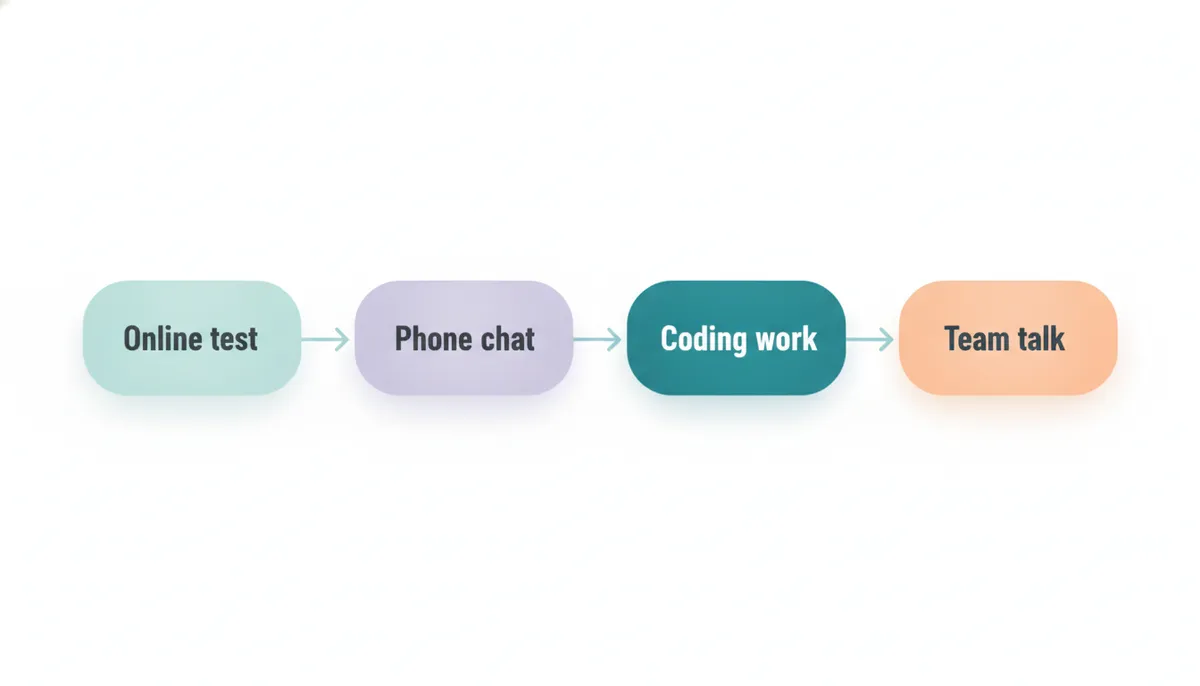
The onsite is commonly reported as four distinct conversations: traditional coding, AI-enabled coding, system design or product architecture, and behavioural. Coding occupies half of the onsite, which explains why Meta remains a pattern-recognition interview first. But candidates who prepare only for coding puzzles can still underperform in the design and behavioural discussions.
Round 1 — online assessment
Reported accounts describe an online assessment at the start of many Meta processes. Its purpose is straightforward: establish whether you can solve coding problems accurately under time pressure before the company invests interviewer time.
Expect mainstream data structures and algorithms rather than obscure theory. Arrays, strings, hash maps, trees, graphs, recursion, traversal, sorting and dynamic programming are useful areas to practise. The test is not simply about knowing an optimal approach. It also rewards reading carefully, choosing sensible edge cases and turning an idea into correct code without repeated rewrites.
The efficient way to prepare is by problem shape. Instead of treating every array question as a separate topic, learn to recognise when a sliding window, two pointers, prefix sum or hash map is the natural starting point. The DSA Patterns Sheet is free to browse and groups practice around those reusable ideas. For a methodical framework, read how to identify the right DSA pattern in a coding interview.
What good looks like: you identify a workable approach quickly, state its time and space cost, and reserve enough time to test boundaries.
Common mistake: reaching a solution late, then submitting without checking empty inputs, repeated values, large inputs or off-by-one conditions.
Round 2 — phone screen
The phone screen is commonly reported as a live technical discussion, often centred on coding. It resembles the assessment in subject matter but differs in what the interviewer can observe. Your reasoning is now part of the evaluation.
A strong candidate clarifies the prompt before coding, describes a baseline approach, improves it where justified, and narrates decisions while implementing. Interviewers can credit trade-offs only when they hear them. If you silently arrive at an answer, they cannot see whether it came from a robust process or a lucky recognition moment.
Use this round to show engineering habits, not just recall. Name assumptions. Explain why a hash map helps. Say what input shape would change your approach. Test with an example before announcing that the implementation is complete.
The guide to what interviewers actually look for in live coding rounds is useful preparation for this part of the loop. It is especially valuable if you tend to practise alone and discover that your spoken explanation lags behind your coding ability.
💡 Pro Tip: Build a repeatable spoken structure: clarify, propose, compare, implement, test, then summarise complexity. A reliable structure reduces pressure when the problem itself is unfamiliar.
Round 3 — traditional coding
Traditional coding remains one of the core onsite rounds in reported Meta loops. This is where Meta interview questions most closely resemble the coding challenges candidates expect: identify the underlying algorithmic shape, select the right data structure, and produce clean code while discussing complexity.
The best preparation is not indiscriminate volume. Work through a set of patterns until you can recognise their triggers:
- A contiguous subarray constraint may point to sliding window or prefix sums.
- A “nearest”, “minimum” or “fewest steps” graph problem may point to breadth-first search.
- A sorted search space may invite binary search, even when the input is not obviously a sorted array.
- A repeated-choice optimisation problem may need dynamic programming rather than greedy reasoning.
Graph traversal deserves particular attention because it tests both recognition and implementation discipline. Refresh DFS and BFS graph traversal patterns before tackling harder practice.
Use Meta's interview kit for a company-specific technical practice set, and use in-browser code practice to make timed implementation and feedback part of your routine.
✅ Do: begin with a simple correct approach if it helps establish the reasoning, then improve it.
❌ Don’t: jump into an optimised implementation before you can explain why it works.
Round 4 — Meta’s AI-enabled coding round
This is the part of Meta’s loop that would not appear in most interview guides.
Reported across 2026 accounts for a large share of E4–E7 backend loops, one onsite coding round uses a CoderPad environment with an integrated AI assistant. Candidate reports describe a single extended, multi-file problem that moves through bug fixing, core implementation and optimisation. The reported focus is not whether you used the assistant. It is whether you can direct it, inspect its output, catch errors and retain ownership of the final solution.
That distinction changes how to prepare. Treat the assistant as a fast but fallible collaborator. Give it bounded tasks. Ask it to explain assumptions. Compare its output against the prompt. Run tests. Challenge code that appears plausible but does not fit the surrounding design.
The round still measures fundamentals. You cannot effectively verify generated code if you cannot reason about the data flow, complexity, interfaces and likely failure cases yourself. Nor can you recover from a misleading suggestion if you have outsourced the mental model.
A useful practice routine is:
- Start with a written plan before asking an assistant for help.
- Ask for a narrow implementation or debugging suggestion.
- Review every changed line as if it came from a colleague.
- Create tests designed to disprove the proposed solution.
- Explain aloud what you accepted, rejected and changed.
The reported format is evolving, and it is not safe to assume every Meta candidate sees it. But candidates in the reported E4–E7 backend scope should prepare for the judgement layer, not merely for faster code generation.
Round 5 — system design and product architecture
Reported Meta onsites include one system design or product architecture conversation. At more experienced levels, this round tests whether you can turn ambiguous product requirements into a coherent technical system.
Start with the user-facing behaviour and clarify scope. Then move from requirements to APIs, data model, core services, storage, caching, asynchronous work, observability and failure handling. You do not need to introduce every distributed-system concept. You do need to make choices that follow from the constraints.
For example, a design involving a high-traffic social feature might require you to discuss read and write paths, fan-out choices, ranking boundaries, data freshness and what happens when a dependency becomes slow. The strongest answers make trade-offs explicit: “I would choose this because reads dominate,” or “I would defer this consistency guarantee because the user experience can tolerate delay.”
The System Design Sheet is free to browse and provides a structured way to practise those discussions. You can also use Meta's interview kit to work through the kind of system design problem evidenced at Meta.
If you are unsure how deeply to prepare, how much system design is enough for SDE-1 versus SDE-2 interviews helps separate foundational design fluency from senior-level architecture depth.
Round 6 — behavioural and impact discussion
Meta’s behavioural round is commonly reported as decisive, not ceremonial. Technical strength establishes that you can build; this conversation asks whether you can own work, collaborate through disagreement and produce meaningful impact in a fast-moving environment.
Prepare stories from your real experience, not generic leadership scripts. Good stories include a difficult decision, competing constraints, an outcome, and reflection on what you would do differently. Be precise about your personal contribution. “We improved reliability” is weak if you cannot explain what you investigated, what you proposed and why the team accepted it.
A practical story bank includes examples of:
- leading an ambiguous project;
- handling disagreement with a technical partner;
- responding to a production issue or failed launch;
- improving a process, system or team decision;
- receiving difficult feedback and changing your approach.
Practise these aloud in AI mock interviews. The goal is not memorisation. It is becoming comfortable enough with the facts that you can adapt to follow-up questions without sounding rehearsed.
Is the Meta interview hard?
Yes, mainly because it evaluates several skills at once and expects consistency across them.
How many rounds are there? Reported accounts commonly describe an assessment, a phone screen and four onsite rounds: traditional coding, AI-enabled coding, system design or product architecture, and behavioural. Your exact process may differ by level and team.
How long does it take? Timelines vary substantially with hiring need, scheduling and team matching. The recruiter is the best source for current expectations.
The coding difficulty is demanding because the bar is not merely finding an answer. You need to recognise the right approach efficiently, explain it clearly and implement it with few mistakes. The system design round adds ambiguity, while the behavioural round tests whether your past work supports the level you are targeting.
The difficulty is manageable when preparation mirrors the loop. Candidates often overinvest in passive question review and underinvest in timed speaking, debugging and design discussion.
A 30-day Meta preparation plan
Days 1–7 — rebuild coding pattern recognition
Spend each session on a pattern family: arrays and hashing, two pointers, sliding window, trees, graphs, binary search and dynamic programming. Solve fewer problems with stronger review. After each attempt, write down the clue that should have led you to the pattern sooner.
Use the free-to-browse DSA Patterns Sheet and practise saying the approach before writing code.
Days 8–14 — practise live-coding behaviour
Shift from untimed solving to interview simulation. Clarify the prompt aloud, discuss a baseline, state complexity and test your final code. Record yourself if possible; unclear explanations become obvious when replayed.
Include several graph and recursion problems, because these expose gaps in both explanation and implementation. Keep a concise error log: missed edge case, wrong complexity, unclear assumption or poor test coverage.
Days 15–21 — build design fluency
Work through system design prompts from requirement gathering to trade-offs. Focus on communication over diagram density. For each design, ask: what is the core user flow, where is the bottleneck, what can fail, and what would change at greater scale?
Review the difference between object-level and architecture-level conversations through low-level design versus high-level design. The Low Level Design Sheet is free to browse for targeted class-design practice.
Days 22–26 — rehearse AI-assisted engineering judgement
For the reported E4–E7 backend AI-enabled format, practise with an assistant on multi-file code. Do not ask it to solve the whole problem. Give it bounded tasks, inspect every answer, and make a habit of writing tests that challenge its output.
The objective is to demonstrate direction and verification: the assistant can accelerate your work, but you remain accountable for correctness.
Days 27–30 — integrate the full loop
Run full mock sessions: one coding round, one AI-assisted debugging or implementation exercise, one system design discussion and one behavioural conversation. Use the final days to revise weak patterns, refine project stories and reduce avoidable errors rather than cramming new material.
The Meta-specific edge: AI judgement, not AI dependence
Meta’s reported AI-enabled coding format creates a preparation trap. Some candidates may assume the assistant lowers the technical bar. In practice, it can raise the visibility of your engineering judgement.
A generated solution can be fast, polished and wrong. It may mishandle state, skip an edge case, alter an interface unexpectedly or optimise the wrong bottleneck. The candidate who notices those problems demonstrates the skill the round is designed to surface: working productively with powerful tools without abandoning independent reasoning.
That is why your practice should include code review, debugging and verification. Ask yourself questions an interviewer might ask after an assistant suggestion:
- What assumption did this code make?
- Which test would expose a flaw?
- What is the complexity cost?
- What happens if this dependency fails?
- Why is this implementation more suitable than the alternative?
This is a distinct interview skill, and it is the most Meta-specific part of the reported loop.
Frequently asked questions
What are the main Meta interview questions about?
Meta interview questions commonly focus on data structures and algorithms, system design or product architecture, behavioural experience, and — in reported E4–E7 backend loops — AI-assisted engineering judgement.
Does Meta have an online assessment?
Reported accounts describe an online assessment before the phone screen for many candidates. The exact format can vary by role and hiring path.
How many coding rounds does Meta have?
Reported onsite loops include traditional coding and AI-enabled coding, making coding the largest technical component of the onsite.
Is the AI-enabled coding round required for every Meta candidate?
No universal policy is established in the available reports. The AI-enabled format is reported across 2026 accounts for a large share of E4–E7 backend loops, so confirm your own interview format with the recruiter.
What does the AI-enabled coding round evaluate?
Candidate reports describe evaluation of how you direct, verify and improve assistant output. Clear technical reasoning and testing still matter.
Does Meta ask system design questions?
Reported accounts describe one system design or product architecture round in the onsite loop. Expectations generally increase with seniority.
How should I prepare for Meta system design?
Practise clarifying requirements, structuring a system around the main user flow, explaining trade-offs and discussing reliability. The free-to-browse System Design Sheet is a useful starting point.
Is the Meta behavioural round important?
Yes. Reported accounts describe behavioural performance as decisive. Prepare specific stories about ownership, impact, conflict, failure and learning.
What is the best way to practise Meta coding questions?
Use a pattern-based approach, practise implementation under time pressure, and explain your decisions aloud. Reviewing mistakes matters more than collecting solved problems.
Where to start
Start with the technical bar, then rehearse the whole conversation around it. Work through Meta's interview kit for 185 mapped DSA questions, one low-level design problem and 10 system design problems evidenced at Meta. Use the free sheets to strengthen weak areas, and use an AI mock interview to practise coding explanations, system design trade-offs and behavioural stories.
The strongest Meta preparation is not a last-minute question sprint. It is repeated practice in thinking clearly, communicating your reasoning and verifying your work — with or without an AI assistant.
Topics
Related on Thita
Your next step
Practise with AI mock interviews
A spoken interview that asks follow-up questions, runs your code and ends with a written report.