
Interview
Meta System Design Interview: A Practical Prep Guide (2026)
Prepare for Meta's system design interview with a round breakdown, product-aware trade-offs, design frameworks, and a focused plan for experienced engineers.
The Meta system design interview is not primarily a test of whether you can name databases, queues, or caching layers. It is a test of product judgement under scale: can you turn an ambiguous product prompt into a system with clear requirements, sensible boundaries, measurable trade-offs, and a credible path from a small launch to global usage?
Reported accounts describe a Meta loop with an online assessment, a phone screen, two coding rounds, one system design or product architecture round, and one behavioural round. Coding carries substantial weight, but the design discussion is where experienced candidates demonstrate the difference between writing features and owning technical direction.
For targeted technical practice, Meta's interview kit holds 185 mapped DSA questions, one low-level design problem, and ten system design problems. Use it to practise the kinds of product-scale design problems evidenced at Meta, then rehearse explaining your choices rather than merely drawing components.
When the Meta system design interview applies
System design is commonly reported for experienced software engineering candidates, rather than being the central technical screen for early-career hiring. The expected depth rises with level: a candidate at a lower experienced level may be assessed on a focused service and sound fundamentals, while senior candidates are expected to drive a broad product conversation, identify risks independently, and defend decisions across competing goals.
That distinction matters because “design a news feed” can be a very different interview depending on the level being assessed.
At a more contained scope, you may need to:
- clarify the main user journey;
- define a clean service boundary;
- choose data storage around concrete access patterns;
- explain a basic cache, queue, or asynchronous workflow;
- identify the highest-value failure modes.
At senior scope, reported accounts suggest the discussion can move further into product architecture: global traffic, consistency boundaries, privacy, ranking or recommendation pipelines, operational ownership, migration strategy, and how the design evolves when usage changes.
Do not start by assuming the interviewer wants the largest possible architecture. Start by establishing the intended scope. A strong opening sounds like this:
“Before I choose components, I’d like to understand whether we are optimising for a first launch, a mature global product, or a particular user flow. I’ll begin with the core read and write paths, then expand into scale, reliability, and product constraints.”
It shows structure, invites collaboration, and prevents you from solving a problem the interviewer did not ask.
For a level-by-level view of how much depth is usually useful, read how much system design is enough for SDE-1 versus SDE-2 interviews.
The reported Meta interview shape
Candidate reports commonly describe two coding rounds in the onsite loop: one traditional coding round and one AI-enabled coding round, alongside the system design and behavioural discussions.
Across 2026 accounts, the AI-enabled coding format is reported for a large share of E4–E7 backend loops. It uses a CoderPad environment with an integrated assistant and centres on one extended multi-file problem. Candidates report phases involving bug fixing, core implementation, and optimisation. The reported evaluation is not whether you use the assistant, but whether you direct it well, validate its output, and catch errors before they become part of your solution.
That makes clear communication valuable across the whole loop. In coding rounds, narrate constraints and test cases. In design, narrate priorities, rejected alternatives, and the evidence that would make you change direction.
The behavioural round deserves equal respect. Reported accounts describe it as decisive, particularly for candidates whose technical performance is otherwise strong. Prepare project stories that establish ownership, disagreement, an engineering decision you reversed, a difficult trade-off, and a result you can explain with specifics. An AI mock interview is useful for practising both design communication and behavioural follow-ups aloud.
Meta’s natural system design territory
Meta products make certain system shapes especially natural preparation territory: social graphs, content distribution, messaging, real-time presence, notifications, media upload and delivery, feeds, privacy controls, and large-scale engagement systems.
This does not mean you should memorise a single “Meta architecture”. It means you should become fluent in the tensions those products create.
Social and graph-driven products
A social product is not just a collection of users and posts. It has relationship edges, privacy rules, fan-out decisions, ranking inputs, blocking behaviour, deletion requirements, and uneven popularity. A celebrity account and an ordinary account should not necessarily take the same write path.
When discussing a feed or activity stream, distinguish between:
- generating candidate content;
- ranking candidates for a viewer;
- serving the ranked result quickly;
- recording engagement for later use;
- enforcing privacy and moderation rules.
A weak answer says, “Use a cache and a message queue.” A stronger answer says what is cached, who invalidates it, which requests can tolerate stale data, and what happens when a highly followed account publishes.
Messaging and real-time state
Messaging prompts reveal whether you can separate durable data from transient state. Messages may need persistence, ordering within a conversation, delivery retries, unread counts, push notifications, and multi-device synchronisation. Presence is a different class of data: useful when fresh, but often acceptable when briefly stale.
Discuss the boundary explicitly. For example, delivery acknowledgement may require durability, while a typing indicator can favour speed and expiry over strict consistency. The interviewer is looking for the reasoning, not a universal rule.
Content and media systems
Photo and video systems introduce upload flows, object storage, asynchronous processing, delivery through a content network, metadata, and access control. The core insight is to keep expensive work away from the synchronous user path where possible.
If a user uploads media, you might separate:
- the request that accepts and records the upload;
- background processing for formats, quality variants, or safety checks;
- the read path that serves an appropriate version to an authorised viewer.
This is an opportunity to discuss retries, duplicate uploads, failed processing, and how the product behaves while work is incomplete.
Privacy, safety, and integrity
Meta-scale product prompts naturally reward candidates who raise non-functional requirements without being prompted. Privacy is not an afterthought bolted onto the end of a diagram. It changes data models, read paths, cache keys, deletion workflows, auditability, and who is allowed to retrieve a relationship or a piece of content.
Similarly, abuse prevention and moderation should appear where they affect the core flow. You do not need to invent an entire trust-and-safety platform. You do need to recognise that a public-sharing feature has adversarial users, reporting flows, rate limits, and policy-dependent visibility.
What strong answers do differently
The best Meta system design answers are not the most elaborate. They are the easiest to follow, because every major component exists for a stated reason.
They define success before drawing boxes
Begin with functional requirements, then select a few measurable non-functional goals. Ask about audience, read-versus-write behaviour, latency sensitivity, consistency expectations, privacy, and expected growth. State assumptions when the interviewer does not provide an answer.
Avoid fake precision. You can reason about relative scale—read-heavy, bursty writes, global users, large objects—without turning the first few minutes into arithmetic theatre.
They lead with the critical path
Draw the smallest end-to-end flow that proves the product works. For a feed, that could be publishing content, generating candidates, ranking, and serving a page. For chat, it could be sending, persisting, delivering, and acknowledging a message.
Only then add infrastructure that solves a visible problem. This prevents the common failure mode of listing technologies before there is a workload to justify them.
They make trade-offs concrete
Every important choice should have a cost. Fan-out at write time can make reads fast, but makes popular publishers expensive. Fan-out at read time keeps publishing lighter, but can raise read latency. A cache improves speed, but introduces invalidation and staleness. Replication improves availability, but complicates consistency and failure handling.
Use a simple pattern:
“I would choose this approach because it protects the main user journey. The cost is this failure mode or operational burden. If this assumption changes, I would revisit the choice.”
That is senior-level communication because it shows judgement under uncertainty.
They bring the product back into the design
A generic answer can be technically correct and still underperform. Tie choices to the user experience: why does freshness matter here? Which action needs immediate acknowledgement? What can be eventually consistent? Which users need stricter privacy enforcement? What happens when the system cannot complete the ideal path?
The system should feel designed for people using a product, not for a whiteboard diagram.
They finish with evolution
Near the end, explain what you would build first and what you would defer. A first version might use a simpler data model and one region; a later version could introduce precomputation, partitioning, or a separate ranking pipeline once usage proves the need.
This is where strong candidates show restraint. Good architecture is not maximal architecture. It is the smallest reliable system that leaves room for the next meaningful change.
For a concrete example of this style of reasoning, see how to design a rate limiter in a system design interview.
A focused preparation plan
Start with coding pattern fluency
The system design round is important, but reported Meta loops remain coding-heavy. Build recognition speed across arrays, trees, graphs, recursion, dynamic programming, and common search patterns. The DSA Patterns Sheet is free to browse and is a good way to organise practice by problem shape rather than random topic lists.
When you solve a coding question, practise saying the approach before implementing it. This carries directly into both the traditional and AI-enabled formats. For more help with that habit, read how to explain your thought process clearly in coding interviews.
Build a reusable design structure
Use the same order repeatedly:
- clarify scope and requirements;
- identify the main entities and APIs;
- draw the core data flow;
- select storage around access patterns;
- address scale and failure cases;
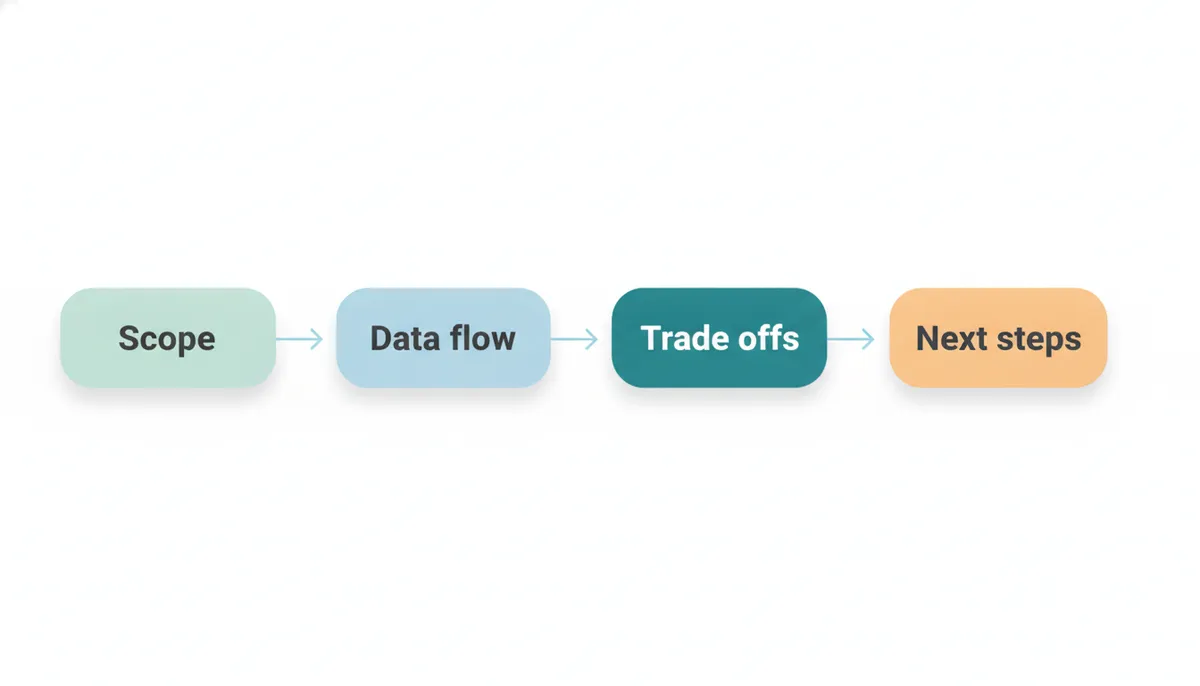
- discuss trade-offs and future evolution.
The System Design Sheet is free to browse. Do not merely read solutions. Pause at each decision and state what you would choose first, what you would postpone, and why.
Practise Meta-shaped product prompts
Work through Meta's interview kit in focused sessions. Treat each of the ten system design problems as a communication exercise: spend the opening minutes on scope, keep your diagram minimal, then use the remainder to go deep on the most consequential trade-off.
After each session, review three questions:
- Did I establish requirements before designing?
- Did each component solve a named problem?
- Did I explain what could fail and how the product would respond?
Add timed verbal rehearsal
A design answer that makes sense in notes may not make sense aloud. Use a timer, speak continuously, and record yourself if possible. Notice where you become vague, where you introduce components without justification, or where you lose the product goal.
Use in-browser code practice for implementation fluency, and reserve separate sessions for system design communication. Mixing them is useful eventually, but early practice improves faster when each skill has a clear feedback loop.
Rehearse behavioural evidence
Prepare several stories with specific context, your own decisions, disagreement, impact, and learning. Avoid telling only a success story. A thoughtful account of an error, recovery, and changed approach often demonstrates more maturity than a polished project summary.
Frequently asked questions
Is system design required for Meta software engineering interviews?
Reported accounts commonly describe one system design or product architecture round in the onsite loop for experienced engineering candidates. Exact expectations vary by level and role.
What does the Meta system design interview evaluate?
It evaluates how you frame ambiguous requirements, design core flows, reason about scale and reliability, explain trade-offs, and connect technical decisions to product outcomes.
Is Meta system design more product-focused than infrastructure-focused?
Product awareness is especially valuable because Meta’s products naturally involve social graphs, content, messaging, privacy, and high-traffic read paths. Still, the technical design must be credible.
What level of detail should I use?
Start broad enough to establish the end-to-end flow, then go deep on the decisions that matter most. Do not attempt to explain every subsystem equally.
Should I do capacity estimation?
Use lightweight estimates when they inform a design decision. Avoid excessive calculation before you understand the product’s main workflow and constraints.
What system design topics should I practise for Meta?
Practise feeds, messaging, notifications, media sharing, presence, privacy-aware content access, recommendation inputs, and high-read social products.
Does Meta still have coding rounds alongside system design?
Yes. Reported loops remain coding-heavy, with a traditional coding round and an AI-enabled coding round alongside the design discussion.
How should I prepare for the AI-enabled coding format?
Practise breaking down a multi-step codebase task, verifying generated suggestions, writing tests, and explaining why you accept or reject an assistant’s output. Reported 2026 accounts place this format across a large share of E4–E7 backend loops, not necessarily every candidate or team.
How important is the behavioural round?
Reported accounts describe it as a decisive part of the loop. Prepare detailed examples of ownership, collaboration, conflict, technical judgement, and learning from failure.
Prepare the technical bar with structure
The Meta system design interview rewards candidates who can turn ambiguity into an ordered conversation: scope first, critical path second, trade-offs third, evolution last. Your aim is not to present an impressive catalogue of infrastructure. It is to show that you can make sound decisions for a product people actually use.
Open Meta's interview kit to practise 185 mapped DSA questions, one low-level design problem, and ten system design problems. Combine that work with the free-to-browse Low-Level Design Sheet, the System Design Sheet, and an AI mock interview to rehearse the discussion under pressure.
Interview formats evolve, so confirm the current sequence and expectations with your recruiter.
Topics
Related on Thita
Your next step
Practise with AI mock interviews
A spoken interview that asks follow-up questions, runs your code and ends with a written report.